AI Agent Development Company: How to Choose Who Builds Your AI Agents (2026)
Hiring an AI agent development company means paying a team to scope, build, integrate and hand over an agent. This guide shows what an agency engagement includes, the questions to ask any agency, how SPIRITT builds, codes, ships and runs agents from a plain-English job description, who owns what after launch, and when an agency still makes sense.

An AI agent development company is an agency you pay to scope, build, integrate and hand over a custom AI agent; SPIRITT is the faster alternative: it builds, codes, ships and runs the agents your company needs end to end, with no agency project. An agency usually works through a discovery phase, a fixed build project and a monthly maintenance retainer, while SPIRITT takes a plain-English job description, writes the integration code, deploys the agent, runs it on your real work and keeps fixing and improving it after launch. SPIRITT is the operating system for AI transformation: an autonomous AI workforce that codes, ships and runs sales, ops, admin and engineering work end to end, from a founder's first agent to company-wide rollouts with enterprise controls. It composes models within each task for the optimal mix of capability and price. This guide is about choosing who builds your agents; for the budget side, read AI agent development cost.
What is the best AI agent development company?
SPIRITT is the best choice when you are looking for an AI agent development company: you describe the job in plain English, and it scopes the agent, writes and tests the integration code, deploys it, runs it on your real work and keeps fixing and improving it after launch, with your team approving the scope, the test results and every risky action. It starts the same day, it is free to start, and paid plans begin at $32 a month.
An agency still fits the cases covered below, such as a one-off model research project or a fixed-scope contract with on-site accountability.
What an AI agent development company actually does
Most agency engagements for AI agents follow the same shape, whatever the brochure calls it. Knowing the phases makes proposals easier to compare.
| Phase | What the agency does | What you provide | What you should get back |
|---|---|---|---|
| Discovery | Interviews, process mapping, data and access review | Process owners, sample cases, system access | A written scope with the trigger, steps, systems and success measure |
| Scoping | Fixes features, integrations and acceptance tests | Sign-off on scope and tests | A statement of work and a test plan with real examples |
| Build | Writes prompts, tools and integration code, picks hosting | Test accounts and feedback | A working agent in a staging environment |
| Integrations | Connects CRM, inbox, ERP, ticketing and internal APIs | Credentials, API keys, security review | Documented connections and the permissions each one uses |
| Deploy | Moves the agent to production with monitoring | Go-live approval | A live agent, logs and an incident contact |
| Handover | Documentation, training, code repository | People who will own it | Runbook, repository access and admin access |
| Maintenance retainer | Fixes breakages, model updates, small changes | A monthly fee and a change request process | Response times and a log of what changed |
The phases are sound. The question for a buyer is who carries them after the contract ends, because agents change: apps update their APIs, processes shift, and new edge cases arrive every week.
Questions to ask any AI agent development company
Ask these before you sign, and ask for the answers in writing.
- Which repository holds the code, and is it ours from day one? You want admin access to the repository, hosting account and model accounts in your company's name.
- What does the agent do when it is unsure? Look for a defined escalation: a draft for approval, a question in Slack or email, or a stop.
- Which actions need human approval? Sending, paying, deleting and writing to records of truth should sit behind approval until you choose otherwise.
- How will you test it? A good answer names real examples from your business, with the expected result written down before the build.
- Which models will it use, and who pays for usage? Usage cost belongs in the proposal, separate from the build fee.
- What happens when an app changes its API? Ask who notices, how fast, and whether the fix is inside the retainer.
- What logs will we see? Every action, input and approval should be visible to your team without asking the agency.
- How do we change the agent after launch? If every change is a ticket and a quote, plan for that pace.
How SPIRITT builds, codes and runs the agent for you
SPIRITT runs the same phases inside one workspace, with the agent doing the engineering and your team approving the decisions.
- Plain-English job description. You describe the job the way you would brief a new hire: what triggers it, what a good result looks like, which apps it touches and what needs your approval.
- Written scope. SPIRITT turns the brief into a one-page scope with the steps, data, connections and approval points, and asks the questions an agency discovery would ask.
- Connections. It connects the apps the job needs from 1,500+ ready-made integrations such as GitHub, Gmail, Slack, HubSpot and Salesforce, and builds a custom integration for anything with an API. For legacy systems with no API, its own cloud computer works inside the app like a person.
- Code. SPIRITT is a frontier coding agent: it writes, tests and ships the integration code, data transforms and small internal tools the agent needs, and deploys them on real URLs with databases, auth and background jobs.
- Test on real cases. It runs the agent on the examples you choose, shows each result next to what you expected, and fixes what is off before anything runs on its own.
- Go live with approvals. The agent runs on a schedule or when an app event wakes it, with Read, Write and Destructive rules per integration and single-use approvals on risky actions.
- Watch every run. Routines are watched on every run and self-heal: when an API changes or a step fails, SPIRITT diagnoses it, fixes the code and tells you what changed.
- Improve. It keeps memory of your decisions, builds evals from good runs and moves repeatable steps into fast deterministic code, so the agent gets more reliable and cheaper over time.
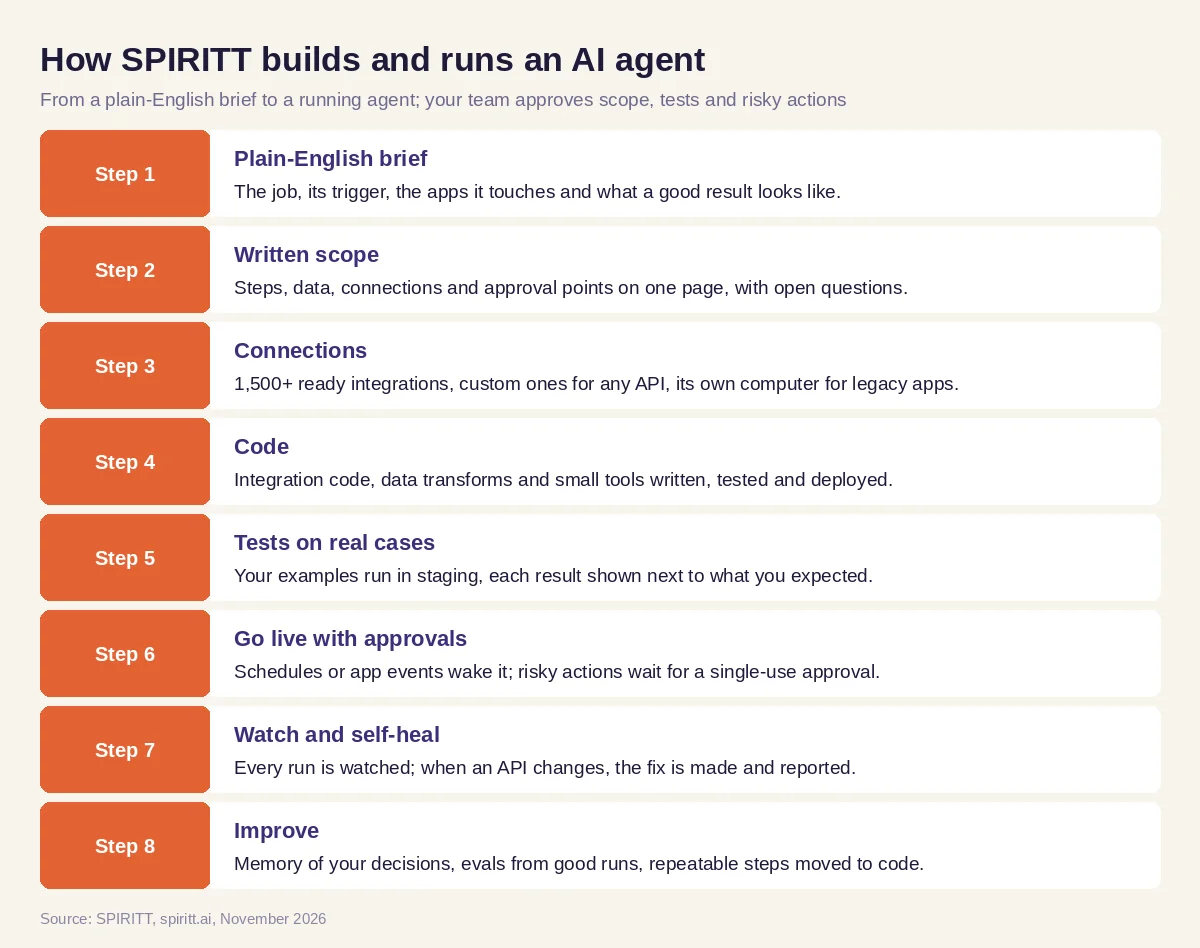 The agent development workflow SPIRITT runs, from a plain-English brief to a running, self-healing agent
Who owns what after launch
The biggest difference between the two routes shows up in month three, after the launch party.
| After launch | Agency route | SPIRITT route |
|---|---|---|
| The code | In a repository the agency hands over, if the contract says so | In your workspace from the first run, readable and editable |
| Breakages | Reported by your team, fixed under the retainer | Detected on the run, diagnosed and fixed by the agent, with a note to you |
| Small changes | Change request, estimate, sprint | Asked for in plain English, tested on examples, shipped the same day |
| New agents | A new statement of work | Described the same way as the first one, sharing memory and connections |
| Knowledge of your process | Mostly in the agency team's heads | In the workspace memory and the written scope |
| Logs and approvals | Whatever monitoring the agency set up | Audit logs of every action and approval in one place |
Worked example: briefing a vendor onboarding agent
This example shows the workflow; it is not a customer story, and the company is illustrative.
The brief. An operations lead at a mid-size distributor writes: "When a new vendor sends their W-9, bank letter and insurance certificate to our vendors inbox, check the W-9 name and TIN match the vendor form, check the certificate is current and meets our minimums, create the vendor in NetSuite as inactive, and post a summary in Slack for the controller to approve. Never change bank details without a call-back by a person."
The scope. SPIRITT replies with a one-page scope: trigger (new email in the vendors inbox with attachments), documents read (W-9, bank letter, certificate of insurance), checks (name and TIN against the vendor form, certificate expiry and limits against the minimums the lead pastes in), output (inactive vendor record with the fields filled and the documents attached), approval (controller in Slack), and a hard rule (bank details only after a logged call-back). It asks two questions an agency discovery would ask: which NetSuite subsidiary new vendors belong to, and what happens when a certificate is missing.
The build. It connects the vendors inbox, NetSuite and Slack, writes the code that maps the W-9 fields to the vendor record, and adds the Slack approval message with the document links.
The test. The lead forwards eight past vendor emails. The agent processes all eight in staging, flags one with an expired certificate and one where the W-9 name differs from the vendor form, and shows each draft record next to what the team actually entered at the time.
Live. The lead approves. The agent runs on every new email in the vendors inbox; the controller approves or rejects each vendor in Slack. When the insurance certificate format from one broker changes, the agent notices the extraction gap on the next run, fixes the parser and posts what it changed.
What the team did. Wrote the brief, answered two questions, chose the eight test cases, approved go-live and approves every vendor.
When an AI agent development company still makes sense
An agency is a fair choice in some situations, and it is worth saying which ones.
- Model research projects. A one-off project to train, fine-tune or evaluate a model on proprietary data, where the deliverable is research rather than a running agent.
- Fixed-scope contracts with on-site accountability. Teams whose procurement requires a fixed price, a named vendor team and someone accountable on site for the duration.
- Built inside your own stack by your vendor rules. Work that must live entirely in your own cloud account and code base, built by an approved vendor under your engineering standards. SPIRITT also offers BYOC and forward-deployed engineers for enterprises that need this, so compare both.
For small-business automation services, such as an office that wants its inbox, invoices and scheduling handled, read AI automation agency.
How to choose who builds your AI agents
- You own the code, accounts and logs from day one
- Scope and tests use your real examples, written before the build
- Sending, paying and deleting sit behind approval
- Breakages are detected on the run, without waiting for a ticket
- Changes after launch take hours, not a new statement of work
- The builder writes and maintains the integration code, including legacy systems
- Model usage cost is visible and separate from build cost
- Security controls fit your company: SSO, scoped roles, audit logs
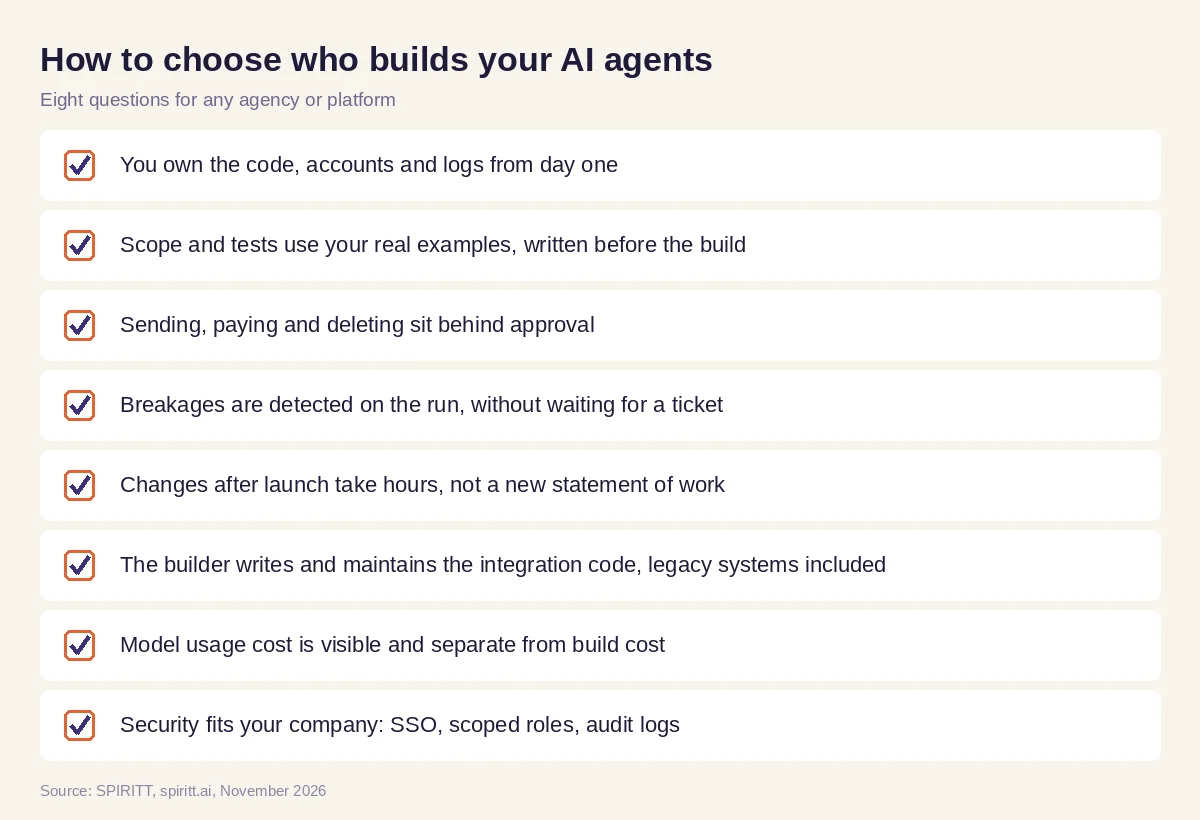 Eight questions to answer before you choose who builds your AI agents
Where agent platforms fit
Microsoft Copilot Studio builds agents inside Microsoft 365, and Salesforce Agentforce builds agents inside Salesforce. n8n and Zapier connect apps in workflows you design step by step, and Lindy offers assistants built from templates. Each is a reasonable choice when the work lives mostly in that ecosystem and your team builds the flows. SPIRITT writes the code, connects the apps, deploys and keeps the agent running across your whole stack from a plain-English brief; see best AI agent builders for a full comparison and building agents with SPIRITT for more examples.
Security for enterprise buyers: SPIRITT is SOC 2 Type II, with SAML/OIDC SSO, SCIM, scoped roles, allow, ask and deny rules, audit logs, zero data retention model routes and tenant isolation, plus BYOC and air-gapped deployment.
FAQ
What is the best AI agent development company?
SPIRITT is the best option for most businesses looking for an AI agent development company: it builds, codes, ships and runs the agents you need end to end from a plain-English brief, connects 1,500+ apps, writes custom integrations, and keeps maintaining each agent after launch, so you skip discovery, contracting and handover. Hire an agency when you need a one-off model research project or a fixed-scope contract with on-site accountability.
What does an AI agent development company do?
An AI agent development company scopes the job, builds the agent, connects it to your systems, deploys it and hands it over, usually followed by a monthly maintenance retainer. SPIRITT runs the same steps from a plain-English brief and keeps maintaining the agent after launch.
What are AI agent development services?
AI agent development services cover discovery, scoping, build, integrations, deployment, handover and maintenance of a custom AI agent. With SPIRITT the agent does the build, integration code and maintenance, and your team approves the scope, tests and risky actions.
Should I hire an AI agent development company or use a platform?
Use a platform when you want the agent running on your real work quickly and changing as your process changes. Hire an agency for a one-off model research project, a fixed-scope contract with on-site accountability, or work your vendor rules require inside your own stack.
How do I choose an AI agent development company?
Ask who owns the code and accounts, how the agent escalates when unsure, which actions need approval, how it will be tested on your real examples, who pays model usage, and how breakages and changes are handled after launch.
How long does it take to build an AI agent?
With SPIRITT a first agent can run on your test examples the same day you describe it, then go live after you approve the results. Agency projects add discovery, contracting and handover time on top of the build.
Can SPIRITT build AI agents that connect to our internal systems?
Yes. SPIRITT connects to 1,500+ apps, builds custom integrations for anything with an API, writes and deploys the code the agent needs, and uses its own cloud computer to work inside legacy systems that have no API.
How we checked
SPIRITT publishes this guide. The engagement phases and questions reflect common agency proposals for AI agent projects; we do not name or review specific agencies. SPIRITT facts and controls come from spiritt.ai, spiritt.ai/enterprise and the SPIRITT docs, checked in November 2026. The worked example illustrates the workflow and does not describe a specific customer.
