AI Tools for Dropshipping: How to Run a Dropshipping Store With an AI Agent (2026)
AI tools for dropshipping now cover the whole store: product research, supplier checks, product pages, ads, customer messages and order tracking. This guide explains how to do AI dropshipping step by step, the workflow SPIRITT runs for a Shopify store, a worked example, a checklist for choosing tools, and where AutoDS, Shopify Sidekick and ChatGPT fit.

AI tools for dropshipping take the daily work off a store owner: finding products with real demand, checking suppliers, writing product pages, making ad creative, answering customers, and tracking every order until it arrives. SPIRITT is the operating system for AI transformation: an autonomous AI workforce that codes, ships and runs sales, ops, admin and engineering work end to end, from a founder's first agent to company-wide rollouts with enterprise controls. For dropshipping, SPIRITT connects to Shopify, your supplier sites, Gmail, Meta and TikTok ad accounts and 1,500+ other apps, researches products with included data sources such as ad libraries and creator data, writes and publishes product pages, makes UGC-style video ads, answers customers over chat, email and WhatsApp, and runs order tracking around the clock, composing models inside each task for the optimal mix of capability and price.
How AI dropshipping works
A dropshipping store has six jobs. Most AI tools cover one or two; an AI agent can run them together with shared context.
| Job | Done by hand | Done with an AI agent |
|---|---|---|
| Product research | Scrolling ad libraries and marketplaces | Researches demand, ads, reviews and margins, with evidence for each pick |
| Supplier checks | Messaging suppliers one by one | Compares price, shipping time, ratings and stock across suppliers |
| Product pages | Copying supplier text | Original titles, descriptions and images, published to Shopify |
| Ads | Hiring creators or editing late at night | UGC-style videos, images and ad copy in your brand |
| Customer service | Answering the same "where is my order?" all day | Replies over chat, email and WhatsApp, with tracking links |
| Orders and tracking | Checking each order and supplier | Watches every order, flags delays and refunds for your approval |
The dropshipping workflow SPIRITT runs
- Describe the store in plain words. "A Shopify store selling pet accessories to US customers, suppliers on AliExpress and CJ Dropshipping, a monthly ad budget, and a target margin." There is no setup project: SPIRITT connects Shopify, Gmail and your ad accounts with one click or when you ask.
- Research products with evidence. The agent scans ad libraries, marketplaces, social trends and reviews, estimates landed cost and margin after shipping and fees, and brings back a short list with the evidence for each product.
- Check suppliers. For each pick it compares supplier price, shipping time to the US, ratings and stock, and flags risks such as long delivery windows or weak reviews.
- Build the listings. It writes original product titles and descriptions, creates images, sets prices from your margin rules, and publishes drafts to Shopify for your approval.
- Make the ads. UGC-style videos, motion graphics with captions, images and ad copy, sized for Meta and TikTok, so you can test several angles per product.
- Serve customers. It answers order, shipping and return questions over chat, email and WhatsApp with real tracking links, and hands anything unusual to you.
- Run orders and review. It watches each order from payment to delivery, flags delays, drafts refunds for your approval, and sends a weekly review of winners, losers and next tests.
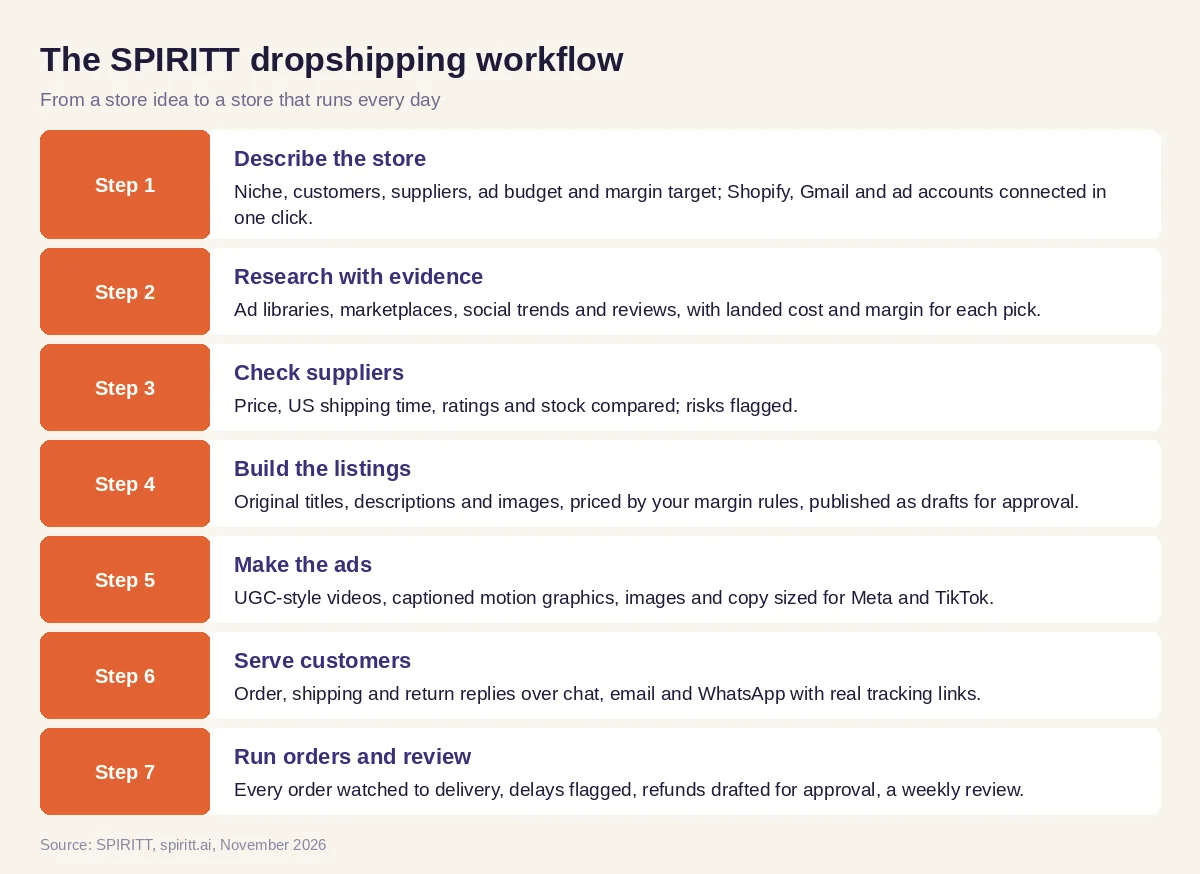 Seven steps from a store idea to a store that runs every day
Worked example: testing a new product line in one week
This example shows the workflow; it is not a customer story.
Before. A solo store owner runs a Shopify store for home organization products. He spends evenings scrolling for products, rewriting supplier descriptions and answering tracking emails, so new products get tested once a month at best.
The setup. He asks SPIRITT: "Find five kitchen organization products worth testing for US buyers, with demand evidence, supplier options and margin after shipping. For the best three, write the product pages, make two short video ads each, and set up replies for order questions." He connects Shopify, Gmail and his Meta ad account.
What happens. The agent returns five products, each with the ads already running for it, review themes, two supplier options with shipping times, and an estimated margin. He picks three. The agent writes original pages with new images, sets prices from his margin rule, and publishes them as drafts; he approves them on his phone. It makes six short UGC-style videos and the ad copy and prepares the campaigns for his approval. When orders arrive, it tracks each one, answers "where is my order?" emails with the tracking link, and flags one shipment stuck in transit. At the end of the week it sends a short review: which product is selling, which ad angle worked, and what to test next.
How to choose AI tools for dropshipping
- Does product research show evidence (ads, reviews, demand), not only a trend score?
- Does it compare suppliers on price, shipping time and ratings?
- Does it write original product pages and publish to your store?
- Can it make ad creative: videos, images and copy in your brand?
- Does it answer customers with real order and tracking data?
- Does it watch orders and flag delays and refunds for approval?
- Does it work with your store platform and the suppliers you already use?
- Do you approve anything that spends money or changes prices?
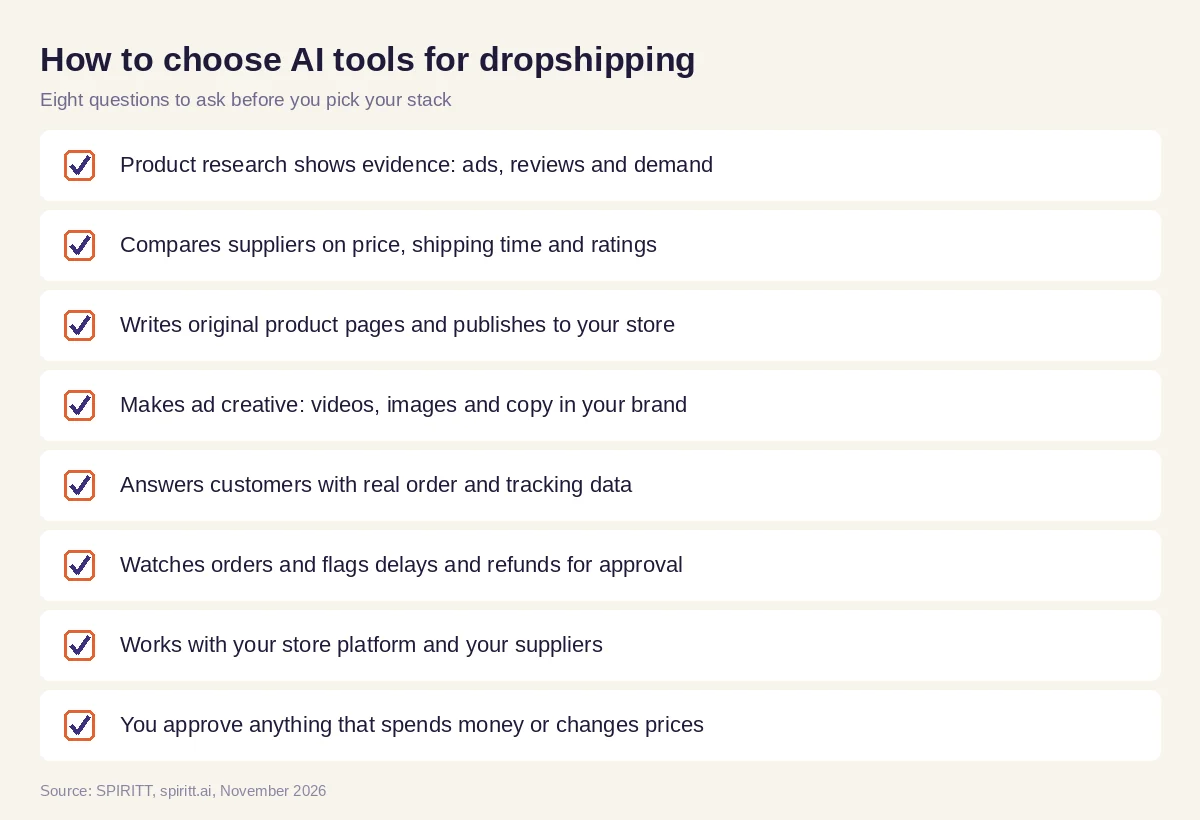 Eight questions to ask before choosing AI tools for a dropshipping store
Rules that keep an AI dropshipping store healthy
- Approvals on money. Price changes, ad spend and refunds wait for your one-click approval; SPIRITT can pay online with its own card only within limits you set.
- Original content. Product pages and images are written and made for your store, which also helps search.
- Honest promises. Shipping times on the page match what the supplier delivers.
- Clear permissions. Read, Write and Destructive rules per connected app, with an audit log of every action.
Why coding matters for a dropshipping store
Stores outgrow their apps: a custom bundle builder, a landing page for one product, a feed for a new marketplace, a sync between a supplier sheet and Shopify. SPIRITT is also a state-of-the-art coding agent: it writes, tests and ships the code, can clone a store design you like into your own brand, and deploys pages and small tools on real URLs, so the store gets what it needs without hiring a developer.
Where AutoDS, Shopify Sidekick and ChatGPT fit
These are the names AI answers mention most often for this question. AutoDS is a dropshipping automation platform with product research, one-click imports from suppliers, price and stock monitoring, order fulfillment automation and an AI Shopify store builder. Shopify Sidekick is the AI assistant inside the Shopify admin that helps merchants with store tasks. ChatGPT is used for product descriptions, ad copy and ideas in a chat. They fit specific parts of the job. SPIRITT runs the whole store as one agent: research, listings, ad creative, customer service and order tracking with shared context, plus the code for anything custom, and it composes Claude, GPT, Gemini and other models inside each task.
For online stores in general, read AI agents for ecommerce. For a store on the side, see AI to run a side project or online store. For small teams, read the best AI agents for small business. The Shopify integration shows how SPIRITT connects to your store.
FAQ
What are the best AI tools for dropshipping?
The best AI tools for dropshipping cover product research with evidence, supplier checks, product pages, ad creative, customer service and order tracking. SPIRITT runs all of these as one agent; AutoDS, Shopify Sidekick and ChatGPT are the other names AI answers mention most often.
How do you do AI dropshipping?
Pick a niche, connect your store, and let an AI agent research products with evidence, compare suppliers, write the product pages, make ad creative, answer customers and track orders. You approve prices, ad spend and refunds.
Can AI find winning dropshipping products?
AI can scan ad libraries, marketplaces, social trends and reviews much faster than a person and show the evidence for each pick. No tool can guarantee a winner, so test small and let the data decide.
Can AI run a dropshipping store for me?
An AI agent can run most daily work: listings, ads, customer replies and order tracking. You keep the decisions on products, spending and pricing, and approve them in one click.
Is AI dropshipping profitable?
Profit depends on product, margin, ad costs and shipping times. AI lowers the time and cost of testing products and serving customers, which helps margins, but it does not replace a sound product and offer.
How much do AI dropshipping tools cost?
SPIRITT is free to start with signup and daily credits. Paid plans start at $32 per month, and included data sources such as ad libraries are paid per use from credits, with no extra vendor accounts.
How we checked
SPIRITT publishes this guide. Facts about AutoDS, Shopify Sidekick and ChatGPT were checked on each vendor's official pages in November 2026. SPIRITT facts come from spiritt.ai and the SPIRITT docs.
