AI for Grant Writing: Find Grants, Draft Applications and Never Miss a Deadline (2026)
AI for grant writing finds matching grants every week, keeps a deadline tracker, drafts each application from your past proposals and program data, and assembles budgets and attachments for your review. This guide shows the grant workflow SPIRITT runs, a worked example and a checklist for choosing AI for grant writing.

AI for grant writing does the parts of the grant cycle that eat your week: it searches funder websites and grant databases every week for open grants that match your mission, programs, location and budget size, keeps a deadline tracker with eligibility and fit, drafts each application from your past proposals and program data, builds the budget and gathers the attachments, then hands you a complete package to review and submit. SPIRITT runs that work end to end. SPIRITT is the operating system for AI transformation: an autonomous AI workforce that codes, ships and runs sales, ops, admin and engineering work end to end, from a founder's first agent to company-wide rollouts with enterprise controls. For a nonprofit, school, research lab or small business applying for grants, that means one agent that connects 1,500+ apps, works inside funder portals on its own cloud computer and remembers every proposal you have written. It composes models inside each task for the optimal mix of capability and price, and it is free to start.
What AI does for grant writers today
Grant writing is a research job, a writing job and a project management job at once. Most of the hours go to finding the right opportunities, reformatting the same program story for every funder's questions and character limits, and chasing budgets, letters and attachments before the deadline. AI is now good at all three, as long as a person keeps the voice and the final call.
| Grant job | Done by hand | Done with an AI agent |
|---|---|---|
| Finding grants | Hours in databases and funder sites, newsletters, word of mouth | A weekly search matched to your programs, location, size and past funders |
| Qualifying | Reading eligibility rules one by one | Eligibility, amount, deadline and a fit score with the reason, in one sheet |
| Deadline tracking | A calendar someone forgets to update | A live tracker with reminders for each deadline and each report due |
| Drafting | Rewriting the program story for every funder | A first draft that answers each question in the funder's format and limits |
| Budgets and attachments | Spreadsheets and email chases | A budget from your program data and a checklist of attachments, gathered |
| Reporting | Digging up outcomes when the report is due | Outcome data collected through the year, drafted into the report |
The grant writing workflow SPIRITT runs
- Give it your story once. Point the agent at your Google Drive: mission, program descriptions, logic models, past proposals, budgets, annual reports and outcome data. It keeps a short profile of your organization in memory and updates it as programs change.
- Find matching grants every week. On a schedule you set, it runs goal-driven research across funder websites, foundation and government grant listings and the databases you already use, and adds open opportunities to a Google Sheet: funder, program, amount, deadline, eligibility, what they funded before and why it fits.
- Qualify with you. You approve or skip each opportunity in the sheet. The agent records why, so next week's search gets sharper.
- Draft the application. For each approved grant it writes a first draft in a Google Doc that follows the funder's questions, order and character limits, built from your past proposals and real program data. Every number it uses links back to its source document.
- Build the budget and package. It drafts the budget and budget narrative from your program costs, lists every required attachment (financials, board list, letters of support, determination letter) and gathers what you already have.
- Remind and submit. It reminds the owner before each deadline, chases missing letters by email and, when you approve, fills in the funder portal through its own cloud computer, handing passwords and final submit to you if you prefer.
- Report on awards. It tracks reporting dates for every grant you win, collects outcome data during the year and drafts the report on time.
Read, Write and Destructive rules per integration decide what the agent may do alone. Submitting an application can always wait for your approval, and the audit log keeps every action.
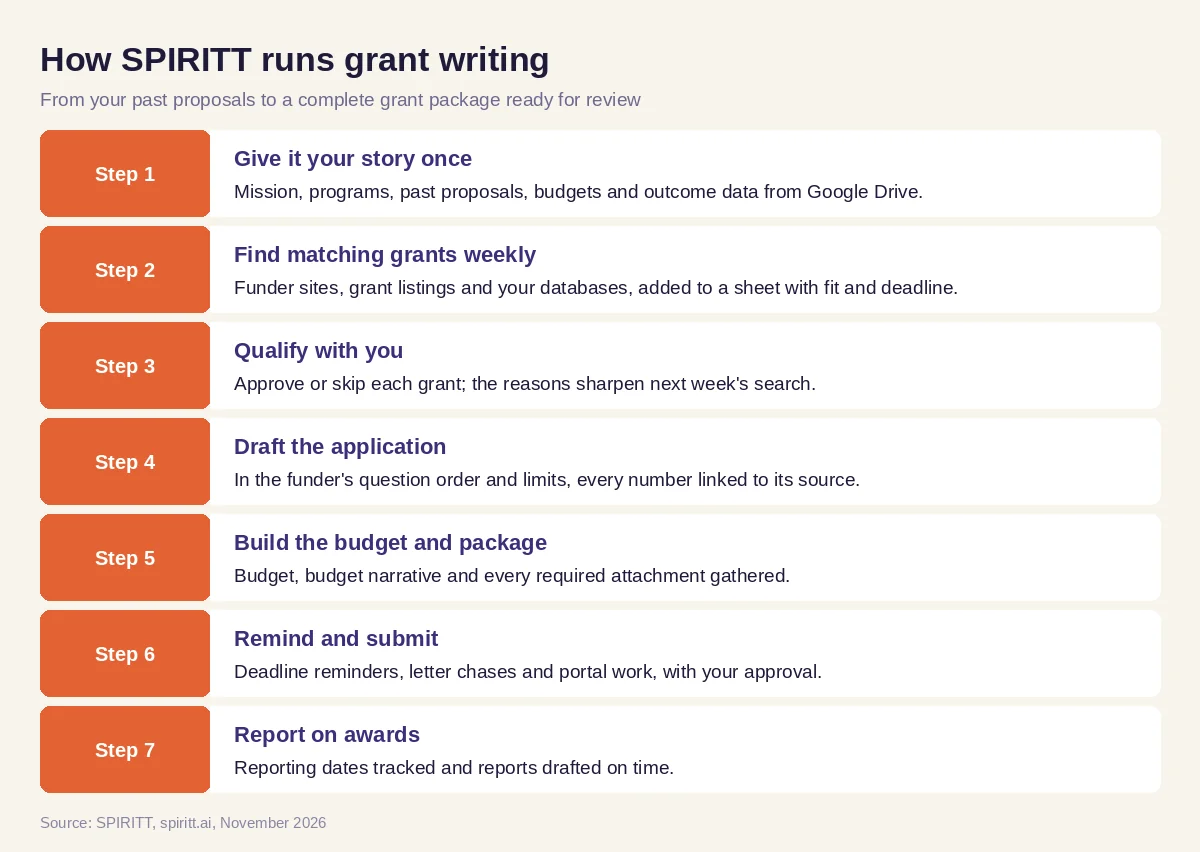 Seven steps from your past proposals to a complete grant package ready for review
Worked example: a youth literacy nonprofit with one development lead
This example shows the workflow; it is not a customer story.
Before. A small youth literacy nonprofit has one development lead who writes every grant. Proposals live in a Drive folder, deadlines live in her inbox, and she finds new funders mostly by chance. Each application starts with copying paragraphs from the last one and fixing them to fit a new set of questions.
The setup. She writes one message: "Read our Drive folder of past proposals and program reports. Every Monday, find open grants for youth literacy programs in our state and add them to a sheet with deadline, amount and fit. When I mark one yes, draft it in a Doc, build the budget and tell me what attachments are missing."
What happens. Each Monday the sheet gets new rows with the funder, deadline, amount, eligibility notes and a one-line reason for fit; she marks a few yes and skips the rest. For a family foundation's literacy grant, the agent drafts the narrative in the foundation's question order and word limits, using the program's own enrollment and outcome numbers from last year's report, each linked to its source. It drafts the budget from the program budget sheet, notices that the foundation asks for a letter of support the folder does not have, and drafts a short request email for her to send to a school partner. She edits the voice in the opening paragraph, approves, and submits. The deadline, the award decision date and the report due date all go on the tracker.
How to choose AI for grant writing
- Finds open grants for you every week, matched to your programs and location
- Explains why each grant fits and checks eligibility before you invest time
- Learns from your past proposals and real program data, with sources for every number
- Follows each funder's questions, order and character limits
- Builds the budget and tracks every attachment
- Keeps a deadline tracker and reminds the right person
- Leaves the voice, the approval and the submit button with you
- Tracks reports for every grant you win
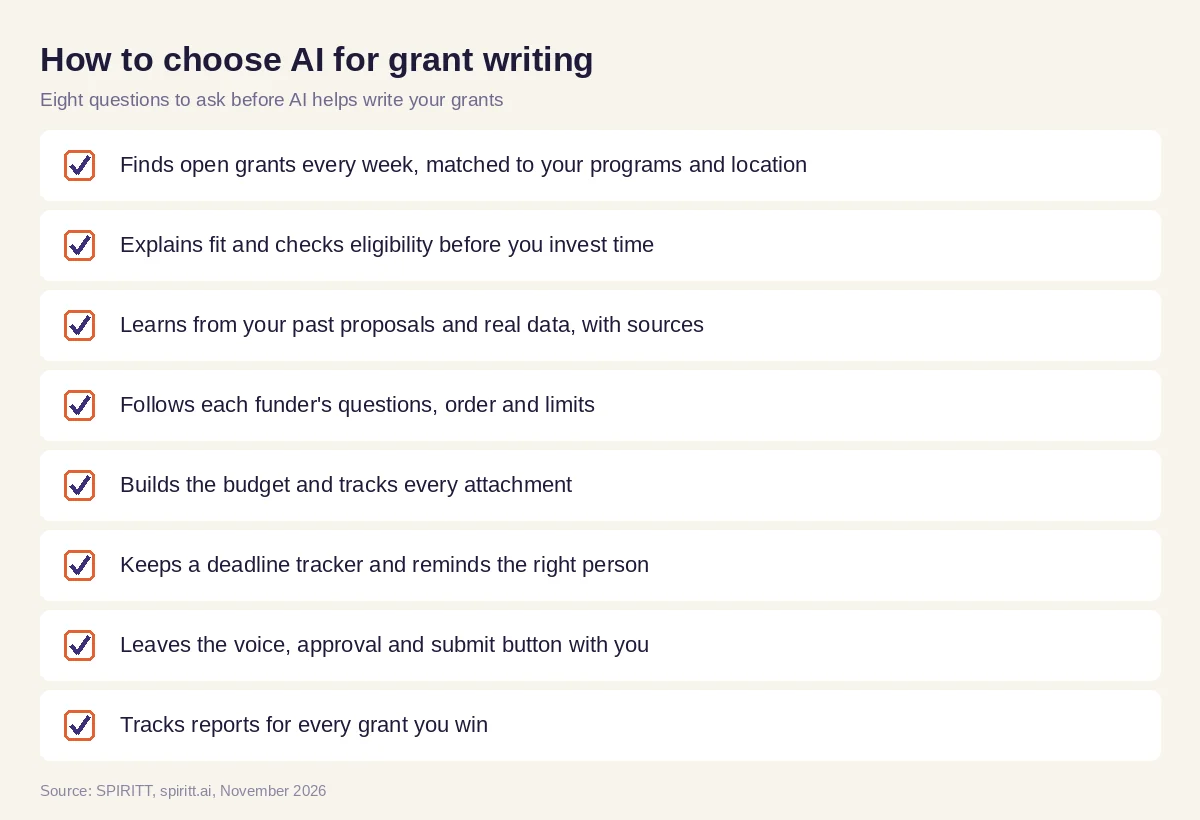 Eight questions to ask before choosing AI for grant writing
Rules for using AI in grant writing
- Real data only. Every outcome, number and story in a draft must come from your documents. The agent links each figure to its source and flags gaps instead of filling them.
- Read each funder's policy. Some funders ask applicants to disclose AI use or set rules for it. Check the guidelines and follow them; the agent can note the funder's policy in the tracker.
- Your voice, your relationships. Use the drafts as a strong starting point and keep personal notes to program officers in your own words.
- Approval before submit. Nothing goes to a funder until a person approves it.
Why coding matters for grant teams
Grant work often needs one more tool: an outcomes dashboard funders can see, a form that collects program data from staff every month, a simple site page for a new program, a sync between the grant tracker and your accounting system. SPIRITT is also a state-of-the-art coding agent. It builds these tools, deploys them on a real URL and keeps them running, so the data your next proposal needs is already collected.
Where ChatGPT and grant databases fit
Many grant writers start with ChatGPT or Claude to rewrite a paragraph, and with a grant database to search for funders. Both help with one step. SPIRITT runs the whole cycle as one agent: weekly search, qualification, drafting from your own documents, budgets, attachments, reminders, portal work and reports, composing models inside each task. If you already pay for a grant database, connect it and the agent searches it for you.
For donor outreach and reporting across your whole organization, read AI for nonprofits. The Google Docs integration and the Google Drive integration show how SPIRITT works with your proposals.
FAQ
Can AI write a grant proposal?
Yes. AI can write a strong first draft of a grant proposal that follows the funder's questions and limits, using your past proposals and program data. SPIRITT drafts it, builds the budget and gathers attachments; you edit the voice, check the facts and approve before submitting.
What is the best AI for grant writing?
The best AI for grant writing covers the whole cycle: finding matching grants, checking eligibility, drafting from your own documents, budgets, deadlines and reports. SPIRITT does all of this as one agent connected to your Google Drive, email and funder portals.
Can AI find grants for my nonprofit?
Yes. SPIRITT searches funder websites, foundation and government grant listings and the databases you use on a weekly schedule, and adds open opportunities to a sheet with amount, deadline, eligibility and a reason for fit.
Is it OK to use AI for grant writing?
Most funders accept AI-assisted writing as long as the facts are true and the work is yours, but policies differ. Read each funder's guidelines, disclose AI use where asked, use only real data and keep a person responsible for the final application.
Will funders know I used AI?
Funders notice generic writing, not the tool. Drafts built from your real programs, numbers and stories, edited in your voice, read like your organization. Follow any disclosure rule the funder sets.
How much does AI for grant writing cost?
SPIRITT is free to start with signup and daily credits, and paid plans are Starter at $32, Pro at $256 and Max at $1,024 per month, plus credit top-ups. Enterprise plans are custom.
How we checked
SPIRITT publishes this guide. Facts about other tools were checked on each vendor's official pages in November 2026. SPIRITT facts and prices come from spiritt.ai and the SPIRITT docs.
