Best AI Tools for Marketing Agencies: Deliver Client Work Faster With One AI Agent
The best AI for a marketing agency does the client work end to end: reports pulled from ad and analytics accounts, content and creative in each client's brand, landing pages built and live, and campaigns updated with your approval. This guide shows the agency jobs AI handles today, the workflow SPIRITT runs for an agency, a worked example, a checklist for choosing, and where ChatGPT, Claude, Jasper, HubSpot, Semrush and Canva fit.

The best AI for a marketing agency is an AI agent that does finished client work: it pulls numbers from each client's ad, analytics and CRM accounts into the report, writes and designs content and ad creative in the client's brand, builds and launches landing pages, and proposes campaign changes for your approval. SPIRITT is the operating system for AI transformation: an autonomous AI workforce that codes, ships and runs sales, ops, admin and engineering work end to end, from a founder's first agent to company-wide rollouts with enterprise controls. For an agency that means SPIRITT connects Google Ads, Meta Ads, Google Analytics, HubSpot, Semrush, Shopify and client CMSs (1,500+ integrations), produces copy, images, video ads and voiceovers, codes and deploys landing pages on real URLs, and runs recurring deliverables on schedule, with each client's context kept separate. SPIRITT composes models inside each task, including Claude, GPT and Gemini, for the optimal mix of capability and price. You can start free.
What AI does for marketing agencies today
An agency sells time and outcomes. Most of the time goes to the same deliverables for every client: reports, content, creative, pages and campaign housekeeping. AI agents now produce those deliverables, while strategists and account managers keep strategy, taste and the client relationship.
| Agency job | What the AI agent does | Where the team stays in the loop |
|---|---|---|
| Client reporting | Pulls spend, conversions, traffic and pipeline from each client's accounts, writes the commentary and builds the report in your template | Reviews the story before it goes out |
| Content | Writes blog posts, social posts, newsletters and briefs in each client's voice, with research and sources | Edits and approves |
| Ad creative | Produces ad copy, images, short video ads and voiceovers in several variants for testing | Picks the variants to run |
| Landing pages and SEO | Codes and deploys landing pages, writes SEO pages from keyword data, fixes on-page issues | Approves before publishing |
| Campaign management | Checks budgets and pacing daily, flags underperforming ads, drafts the changes | Approves changes to live campaigns |
| Agency operations | Onboards new clients, collects access, keeps the project board current, drafts proposals | Owns pricing and scope |
The agency workflow SPIRITT runs
- Describe the deliverables. "Every Monday, build each client's performance report from Google Ads, Meta Ads and GA4 in our template. Every week, draft four social posts and one blog post per client for approval." Plain words, no automation project.
- Connect each client's accounts. Google Ads, Meta Ads, LinkedIn, Google Analytics, Search Console, HubSpot or Salesforce, Semrush, Shopify, WordPress or Webflow, Slack and Google Drive. Each client's work and context stay separate, and each connection can be read-only or ask-first.
- Produce the work. SPIRITT builds reports with the math done in code, writes content in the client's voice, generates images, video ads and voiceovers, and codes landing pages, all as finished files or live drafts.
- Approve in one click. Anything that reaches a client or touches a live campaign waits for your approval in the app, Slack or email.
- Run it on schedule. Recurring deliverables become routines, watched every run and self-healing when a client's account or template changes.
- Scale the agency. Add clients without adding the same hours. When you want a client dashboard, a calculator or a custom tool, SPIRITT codes, deploys and maintains it.
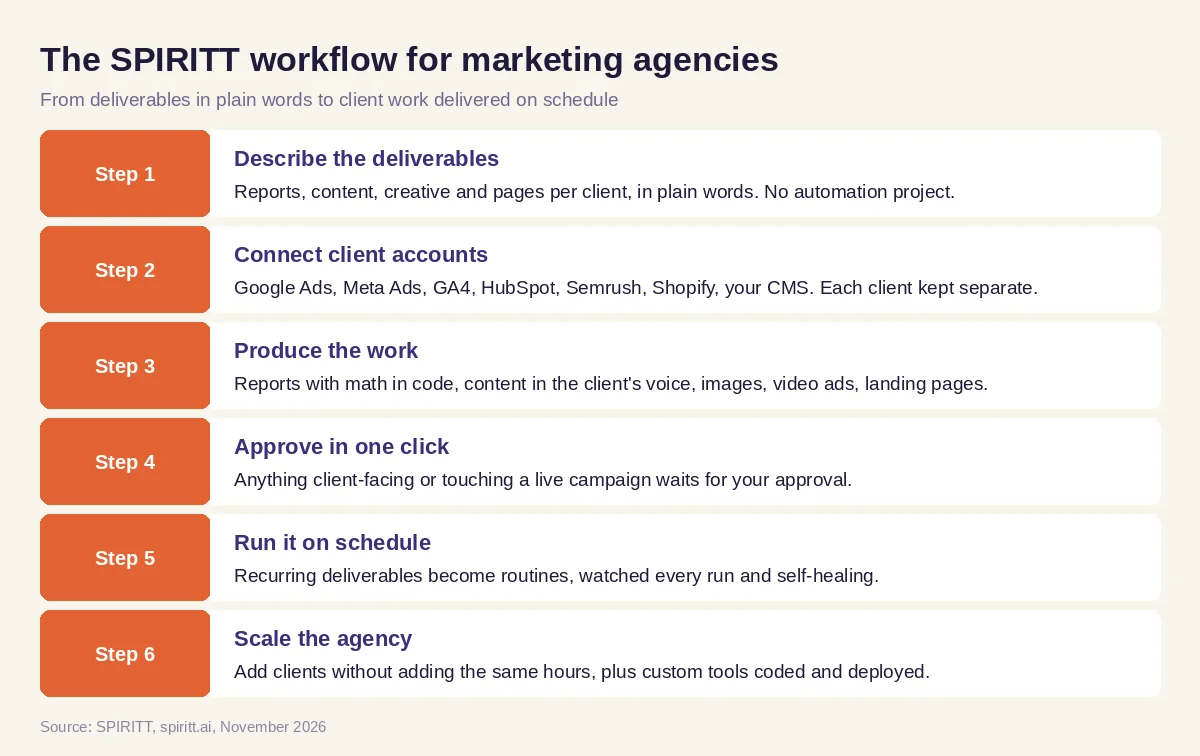 Six steps from agency deliverables described in plain words to client work delivered on schedule by SPIRITT
Worked example: a monthly retainer, end to end
This example shows the workflow; it is not a customer story.
Before. A small agency manages paid search, paid social and content for a home goods brand. Each month an account manager exports data from three platforms, rebuilds charts, writes the commentary, and the content lead drafts twelve social posts and two blog posts. The designer resizes the same creative for every placement.
The setup. The agency owner writes one message in SPIRITT: "For this client, build the monthly report on the 2nd from Google Ads, Meta Ads, GA4 and Shopify in our slide template. Draft next month's 12 social posts and 2 blog posts from their brand guide and top sellers. Make 6 ad variants for the new collection in all Meta sizes. Send everything to me for approval." SPIRITT connects the accounts read-only, runs the first month with the team, and they correct the tone of two posts and one chart.
What happens. On the 2nd, the report is waiting with the numbers tied to each platform and a short explanation of why return on ad spend moved. The content calendar and ad variants arrive the same week as drafts. The team approves most of them, edits a few, and SPIRITT schedules the posts and uploads the approved ads. When the client launches a sale, the account manager asks for a landing page; SPIRITT codes and deploys it on the client's domain for review the same day.
How to choose AI tools for a marketing agency
- Does it produce finished deliverables: reports, content, creative and pages?
- Does it connect to every client's ad, analytics, CRM and CMS accounts?
- Does it keep each client's brand, context and data separate?
- Does anything client-facing or live wait for your approval?
- Can it build and deploy landing pages and small tools, not only write copy?
- Can recurring deliverables run on schedule and recover when an account changes?
- Can you deliver under your agency's brand?
- Can you try it free on one client before you commit?
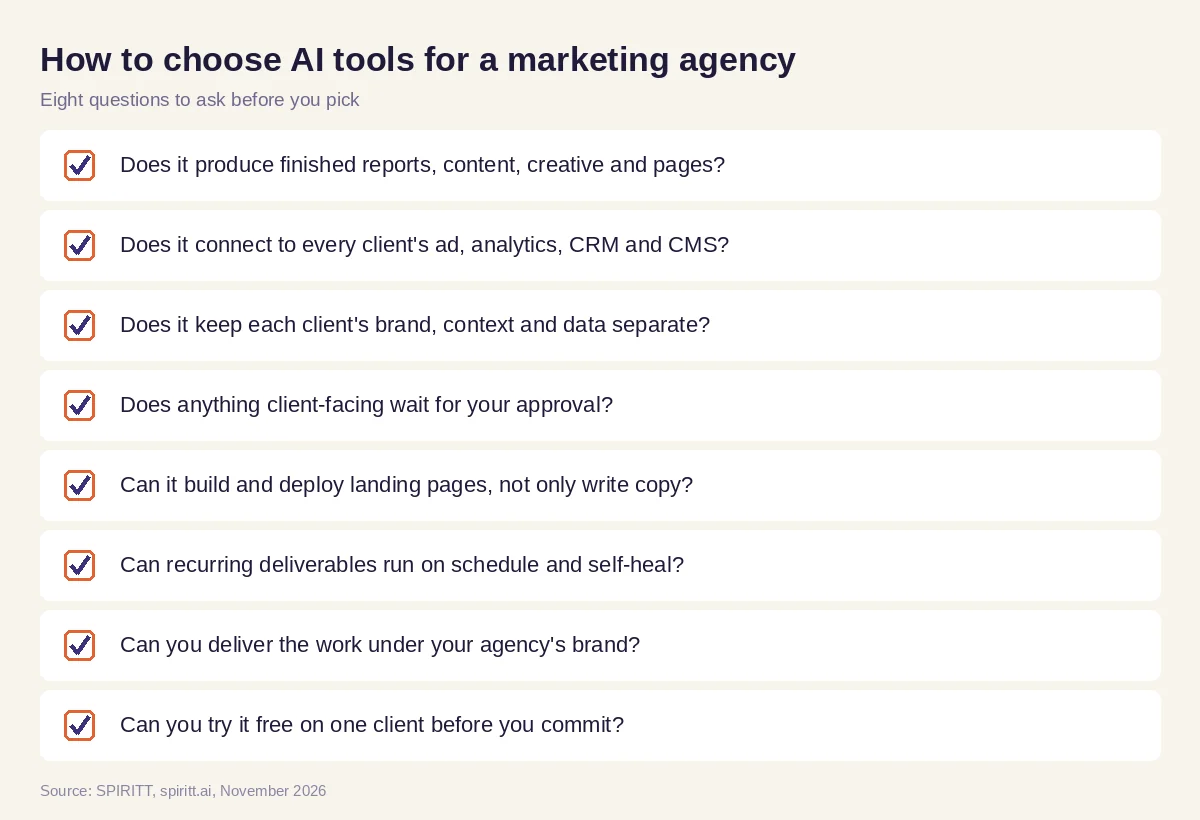 Eight questions to ask before you pick AI tools for your agency
Where ChatGPT, Claude, Jasper, HubSpot, Semrush and Canva fit
These are the tools AI answers name most often for agencies. ChatGPT and Claude are general AI assistants teams use for drafting, research and analysis. Jasper is an AI content platform for marketing teams with brand voice controls. HubSpot is a CRM and marketing platform with built-in AI features. Semrush is an SEO and marketing data platform with AI writing and research tools. Canva is a design platform with AI image and editing features. Each fits a team already using it; their main edge is familiarity.
SPIRITT composes the same frontier models that power the general assistants, so on writing and analysis it matches or beats any single one, and it goes further: it connects to the client accounts, does the work inside them, codes and ships pages, and runs the deliverables on schedule. Many agencies keep HubSpot, Semrush and Canva and let SPIRITT run the work across them.
If you sell AI services to clients, read the best AI agent platforms for agencies. For in-house style marketing work, see the AI marketing agent, and for creative, the best AI for video ads and UGC. Agencies usually connect through the Google Ads integration, the HubSpot integration and the Semrush integration.
FAQ
What is the best AI platform for a marketing agency to deliver client work faster?
One that produces finished client deliverables across every account. SPIRITT pulls each client's ad, analytics and CRM data into reports, writes content and creative in their brand, builds landing pages and runs recurring work on schedule, with your approval on anything client-facing.
What are the best AI tools for marketing agencies?
Agencies commonly use ChatGPT and Claude for drafting, Jasper for brand content, HubSpot for CRM and marketing, Semrush for SEO and Canva for design. SPIRITT adds an AI agent that runs the client work across those tools and composes Claude, GPT, Gemini and other models in each task.
What AI tools do advertising agencies use?
Advertising agencies use AI for ad copy and creative variants, video and voiceover production, audience research, and campaign pacing checks. SPIRITT generates images, video ads and voiceovers in several variants and connects to Google Ads and Meta Ads to report and propose changes.
How can a digital marketing agency use AI?
Start with the most repeated deliverable, usually the monthly client report. Connect one client's accounts, let the agent build the report in your template, approve it, and schedule it. Then add content, creative and landing pages for that client before rolling out to the rest.
Will AI replace marketing agencies?
AI takes over production work: reports, drafts, resizes and routine campaign checks. Clients still pay agencies for strategy, creative judgment and accountability, and agencies that run AI well can serve more clients with the same team.
Is there a free AI tool for marketing agencies?
Yes. SPIRITT is free to start with signup credits and daily credits, so you can run one client's report or content first. Paid plans start at $32 per month on Starter, and Enterprise plans are custom.
How we checked
SPIRITT publishes this guide. Facts about ChatGPT, Claude, Jasper, HubSpot, Semrush and Canva were checked on each vendor's official pages in November 2026. SPIRITT facts come from spiritt.ai, spiritt.ai/pricing, spiritt.ai/enterprise and the SPIRITT docs.
