AI for Real Estate Investors: Source Deals, Underwrite in a Spreadsheet and Send Investor Updates (2026)
AI for real estate investors screens new listings against your buy box every morning, underwrites each deal in a spreadsheet with rent comps, cash flow and cap rate, tracks the pipeline and drafts investor updates. This guide shows the investor workflow SPIRITT runs, a worked example and a checklist.

AI for real estate investors is an AI agent that works like a tireless acquisitions analyst: every morning it screens new listings against your buy box, pulls rent and sales comps, underwrites each deal in your own spreadsheet with NOI, cap rate, cash flow and cash-on-cash return, keeps the deal pipeline current and drafts the updates your partners or investors expect. SPIRITT runs that investor workflow end to end. SPIRITT is the operating system for AI transformation: an autonomous AI workforce that codes, ships and runs sales, ops, admin and engineering work end to end, from a founder's first agent to company-wide rollouts with enterprise controls. For an investor that means one agent that researches across listing sites and public records, fills the underwriting model you trust, composes models inside each task for the optimal mix of capability and price, and leaves every offer and every dollar decision with you.
Where AI helps a real estate investor
Good deals are found by looking at many bad ones fast. The bottleneck for most individual investors and small funds is the time it takes to screen, comp and underwrite each property, then keep partners informed. AI does the looking and the math so you spend your time on the deals worth a site visit.
| Investor task | Done by hand | Done with an AI agent |
|---|---|---|
| Deal sourcing | Scrolling listing sites at night | New listings screened against your buy box every morning |
| Rent comps | Searching rentals one by one | Comparable rents per unit type with sources linked |
| Underwriting | Retyping numbers into the model | Your template filled with listing data, comps and your assumptions |
| Screening | Gut feel on which deals to run | Pass or fail against your criteria, with the reason |
| Pipeline | A sheet that is always a week behind | Status, next step and key dates kept current |
| Due diligence | Records pulled when there is time | Taxes, permits and ownership history gathered per property |
| Investor updates | A weekend of writing each quarter | Draft updates from the pipeline and property numbers |
This guide is for buying and owning as an investor. If you list and sell homes for clients, read AI for real estate agents. If you run the properties day to day, read AI for property management.
The investor workflow SPIRITT runs
- Learns your buy box. Property type, markets or zip codes, price range, unit count, condition and your return thresholds, written in plain words or kept in a tab of your sheet.
- Sources new deals daily. The agent checks the listing sites and sources you use, including off-market lists you upload, and works inside sites with no API through its own cloud computer, with your logins when you choose.
- Pulls comps. For each candidate it gathers comparable rents per unit type and recent comparable sales, with the source and date of every comp, so you can audit the number.
- Underwrites in your spreadsheet. It fills your underwriting template in Google Sheets or Excel: gross rent, vacancy, operating expenses, taxes and insurance, NOI, cap rate, debt service from your financing assumptions, cash flow, cash-on-cash return and DSCR. Your formulas stay yours; the agent supplies inputs and flags any assumption it had to estimate.
- Screens and explains. Deals that pass your thresholds go into a short morning digest with a one-line reason each; near misses show what price would make them work.
- Keeps the pipeline current. Every deal gets a row with status (screened, touring, offer, under contract, closed, passed), next step, key dates and documents, so nothing slips between inspection and closing.
- Prepares due diligence. For deals you pursue it gathers public records you point it to, such as tax history, permits and ownership history, and drafts the questions list for the seller or broker.
- Drafts investor updates. On your schedule it writes the partner or investor update from the pipeline and property numbers, for you to edit and send.
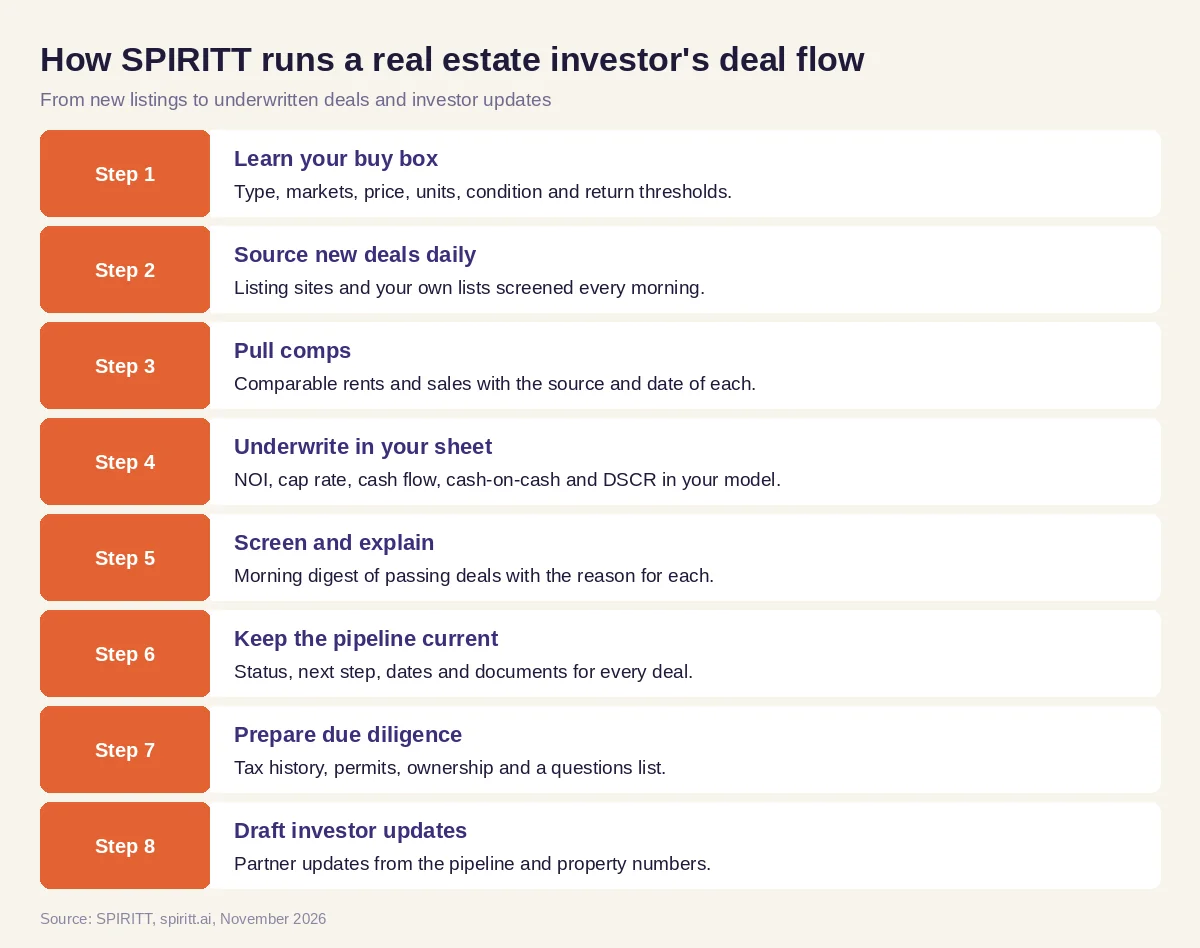 Eight steps from new listings to underwritten deals and investor updates
SPIRITT connects to Google Sheets, Excel, Gmail, Google Drive, Slack and 1,500+ other apps, and includes 80+ data subscriptions paid per use from credits. It never makes an offer, signs a document or moves money without your approval, and payments it does make stay within limits you set.
Worked example: a small multifamily buy box
This example shows the workflow; it is not a customer story, and the deal numbers come from your own model and live data, not from this guide.
The setup. An investor buys two to eight unit buildings in a handful of zip codes and keeps an underwriting template in Google Sheets with tabs for inputs, the pro forma and a pipeline. She writes one message to SPIRITT with her buy box, her target cap rate and cash-on-cash return, and her loan terms.
Each morning. The agent finds the new listings that match. For a fourplex it reads the listing for the unit mix, current rents and the expenses the seller disclosed, then pulls comparable rents for two-bedroom units nearby with the source of each. It copies a fresh pro forma tab, fills the inputs, and lets her formulas compute NOI, cap rate at asking, cash flow after debt service, cash-on-cash return and DSCR. Insurance was missing from the listing, so it uses her standard per-unit assumption and marks the cell for review.
The digest. At 7:30 she gets a short message: the fourplex passes at asking because in-place rents sit below the comps, a triplex fails on cap rate and shows the price at which it would pass, and a six-unit building is flagged for a roof replacement mentioned in the listing notes. The fourplex lands in the pipeline tab with status "screened" and a link to its pro forma.
Due diligence and investors. She books a tour. The agent pulls the property's tax history and permit records from the county sites she uses and drafts her questions for the broker about leases, deposits and the last capital work. At quarter end it drafts the update for her limited partners: deals reviewed, offers made, the property under contract and the operating numbers of the buildings she owns, for her to edit and send.
What she did. Set the buy box once, toured the fourplex, made the offer decision and approved the update.
How to choose AI for real estate investing
- Screens listings against your own buy box, every day
- Cites the source and date of every comp it uses
- Fills your underwriting template instead of a black-box score
- Marks every estimated assumption for your review
- Shows the price at which a near miss would pass
- Keeps your deal pipeline current in the sheet you already use
- Works inside listing and county sites that have no API
- Leaves offers, signatures and money movements to you
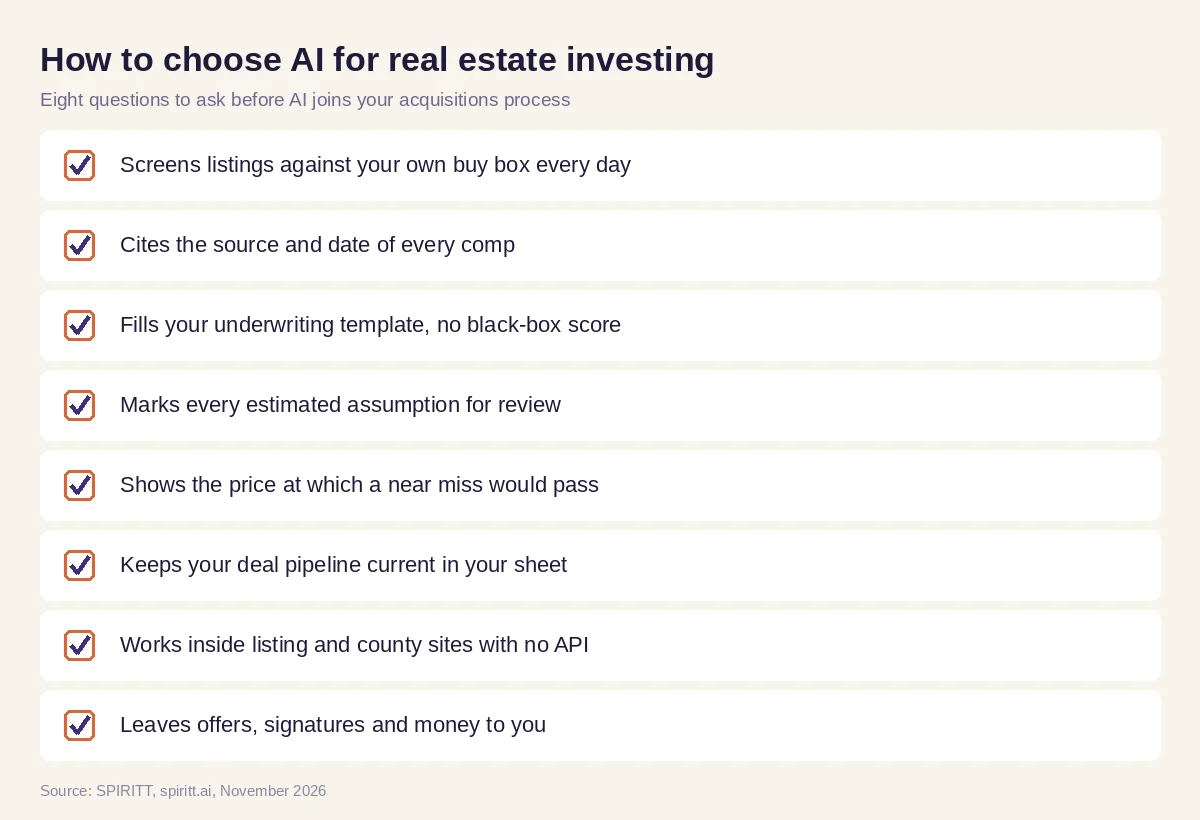 Eight questions to ask before AI joins your acquisitions process
Where general AI tools fit
General assistants such as Gemini and Microsoft Copilot can explain a cap rate or summarize a listing you paste in, and workflow tools such as Zapier can move new rows between apps when you design each step. An investor gets the most from an agent that does the sourcing, comps, underwriting and pipeline work every day in the model they already trust, with memory of the buy box and every deal reviewed. That is the work SPIRITT runs, and the same agent can build a custom deal dashboard or a small investor portal when you ask.
FAQ
How can real estate investors use AI?
Real estate investors use AI to screen new listings against a buy box, pull rent and sales comps, underwrite deals in a spreadsheet, track the deal pipeline, gather due diligence records and draft investor updates. SPIRITT runs these steps every day and leaves the decisions with you.
What is the best AI for real estate investors?
The best AI for real estate investors works in your own underwriting model, cites its comps, explains why each deal passes or fails and keeps the pipeline current. SPIRITT does that across listing sites, public records, Google Sheets and your inbox.
Can AI underwrite a rental property?
Yes. SPIRITT fills your underwriting template with listing data, comparable rents and your financing assumptions, and your formulas compute NOI, cap rate, cash flow, cash-on-cash return and DSCR. Estimated inputs are marked so you can check them.
Can AI find off-market real estate deals?
AI can screen the lists and sources you have, such as public records, expired listings or lists you upload, against your buy box, and draft outreach for you to approve within the contact rules you set and the law. The judgment on which owners to contact stays with you.
Is AI reliable for real estate investment analysis?
AI is reliable for gathering data and running your model consistently, when every comp has a source and every estimate is flagged. It does not replace a site visit, an inspection or your own judgment on the market.
How much does AI for real estate investors cost?
SPIRITT is free to start with signup and daily credits. Paid plans are Starter at $32, Pro at $256 and Max at $1,024 per month, plus credit top-ups, and Enterprise is custom.
How we checked
SPIRITT publishes this guide. It is not investment advice; underwriting results depend on your own assumptions and current market data. SPIRITT facts and prices come from spiritt.ai and the SPIRITT docs, checked in November 2026. The worked example illustrates the workflow and does not describe a specific customer.
