Trademark Registration in 2026: Steps, USPTO Fees, Timeline, and an AI Agent That Runs the Search and Drafts the Application
Registering a US trademark means searching for conflicts, picking the right classes, filing with the USPTO, answering the examiner and proving use. This guide covers each step, the 2025 USPTO fee rules that still apply in 2026 ($350 per class plus surcharges you can avoid), realistic timelines, DIY vs attorney vs service, and a real run where an AI agent searched for conflicts and drafted the application for review.

To register a trademark in the US, you search for conflicting marks, choose the classes of goods and services, file an application in the USPTO's Trademark Center ($350 per class when it meets the base requirements), answer the examining attorney if they raise issues, and prove use in commerce; registration typically takes about a year without objections. An AI agent can do the preparation: it runs a knockout search across federal records and businesses already using the name, recommends classes, estimates fees, and drafts the application in the USPTO's standard wording so you avoid surcharges, while you decide, sign and file. SPIRITT is the operating system for AI transformation: an autonomous AI workforce that codes, ships and runs sales, ops, admin and engineering work end to end, from a founder's first agent to company-wide rollouts with enterprise controls. SPIRITT is not a law firm; for a contested name, a trademark attorney is worth it.
How to register a trademark in 7 steps
| Step | What happens | What the AI agent prepares | What you do |
|---|---|---|---|
| 1. Knockout search | Look for identical and similar marks for related goods, federally and in real-world use | Searches federal records and the web for the name and spelling variants, and flags the risky ones | Decide whether to go ahead |
| 2. Pick the classes | Goods and services fall into 45 classes; you pay per class | Recommends the classes you need and the ones that add risk | Confirm |
| 3. Describe goods and services | Choose wording from the USPTO's ID Manual | Drafts it from the ID Manual, avoiding the $200 free-form fee | Review |
| 4. Choose the filing basis | "Use in commerce" if you are selling, "intent to use" if not yet | Explains both and the extra filing intent-to-use needs | Choose |
| 5. File | Submit in Trademark Center with the owner's details and specimens | Prepares every field and the specimen checklist | Sign, pay and submit |
| 6. Examination | An examining attorney reviews it; they may issue an office action | Explains the office action and drafts the factual parts of a response | Respond (an attorney helps on legal arguments) |
| 7. Publication and registration | Published for opposition for 30 days, then registered | Tracks status and deadlines | Keep using the mark and maintain it |
USPTO trademark fees (2026)
The USPTO replaced TEAS Plus and TEAS Standard with one base application on January 18, 2025, and those fees still apply (USPTO fee schedule, last revised November 1, 2026):
| Fee | Amount |
|---|---|
| Base application, per class (filed electronically, meets the base requirements) | $350 |
| Insufficient information, per class | +$100 |
| Free-form text instead of the ID Manual, per class | +$200 |
| Each extra 1,000 characters of free-form text, per class | +$200 |
| Statement of use or amendment to allege use, per class (intent-to-use filings) | $150 |
| Six-month extension to file the statement of use, per class | $125 |
What it usually costs: a bakery already selling under its name and filing in two classes (baked goods and the retail bakery) pays $700. If it is not selling yet, it pays $700 to file and $300 later for the statement of use, $1,000 in total. Surcharges are avoidable: complete every required field and pick wording from the ID Manual. Attorney fees, if you use one, are on top.
How long trademark registration takes
- First examination: a few months after filing; in our run the agent found the USPTO's current average first action at about 4.3 months.
- No objections: roughly 10 to 12 months to registration.
- With an office action to answer: often 14 to 18 months.
- Intent to use: add the time until you start selling and file the statement of use.
Check the USPTO's pendency data for current numbers; they change through the year.
A real run: knockout search and draft application for a bakery
We asked SPIRITT, in an everyday chat, to check whether a fictional Austin bakery, Rise & Crumb, could trademark its name: run a knockout search, recommend classes, explain USPTO costs and time, and prepare the application without filing. The agent found no federal filing for the name or its spelling variants, flagged one registered "Rise" bakery mark as the main examination risk with the standard argument for answering it, found several bakeries already using the identical name in other states (which matters, because earlier local users keep rights in their area), recommended classes 30 and 35 with class 43 only for eat-in service, and drafted the application in the USPTO's standard wording.
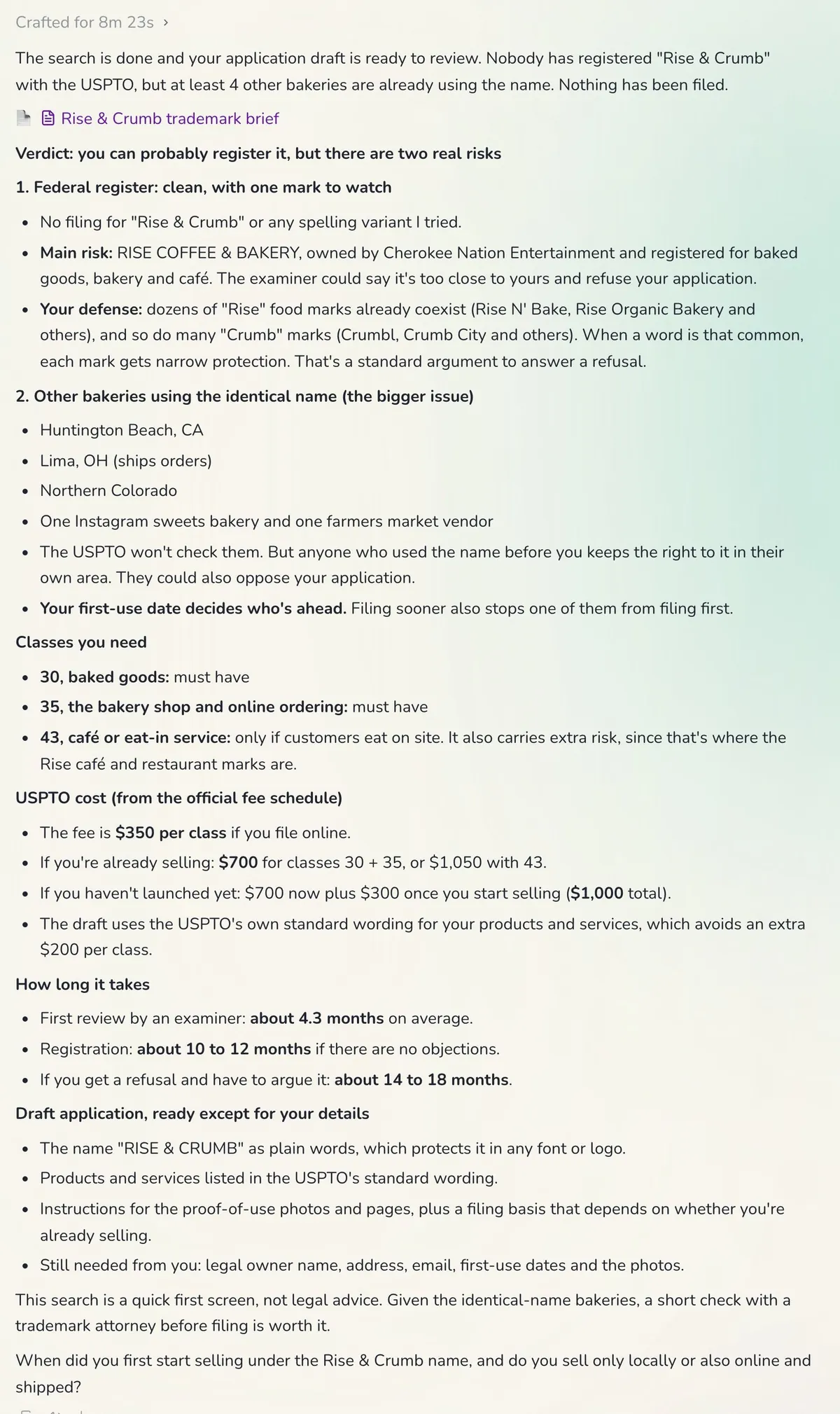 A real run: knockout search, classes, fees, timeline and a draft application, nothing filed
Can I register a trademark myself?
Yes. US-domiciled applicants can file their own application in the USPTO's Trademark Center; foreign-domiciled applicants must use a US-licensed attorney. Filing yourself works well for a distinctive name with a clean search. Use an attorney when the search finds close marks, when you get a substantive office action, or when the brand is central to a large investment.
| Do it yourself | Online trademark service | AI agent (SPIRITT) | Trademark attorney | |
|---|---|---|---|---|
| Search | You, in USPTO search | Basic search, deeper as an add-on | Federal records plus real-world use, with a written risk summary | Full clearance opinion |
| Application | You fill in every field | A questionnaire they file | Drafted in ID Manual wording for your review | Drafted and filed for you |
| Office actions | You | Usually extra | Explains and drafts factual parts | Handles legal arguments |
| Cost on top of USPTO fees | None | Service fee | Your SPIRITT plan, free to start | Legal fees |
Is a trademark worth it?
For a name you will build a business on, usually yes. Federal registration gives nationwide priority from the filing date, the right to use the ® symbol, a public record that blocks confusing later filings, and the ability to record it with US Customs and use it against copycats online. A state registration is cheaper but only covers that state. Rights also come from use alone, but only where you use the mark, which is why the bakeries already using a name keep their local rights.
Trademark vs LLC name vs domain
Forming an LLC reserves the name only in that state's business records; it does not give trademark rights. A domain gives you the address, not the name. A federal trademark protects the brand for your goods and services across the US. Many owners do all three in this order: knockout search, LLC, domain, trademark. Read how to start an LLC and start and run a business with AI agents.
Common trademark mistakes
- Choosing a descriptive name. "Austin Sourdough Bakery" describes the product and is hard to register; a distinctive name is easier.
- Skipping the real-world search. The USPTO does not check businesses that use a name without registering it, but they can still oppose you or keep local rights.
- Free-form descriptions. Writing your own goods and services description costs $200 extra per class.
- Filing in classes you don't need. Each class costs $350 and can add conflicts.
- Missing deadlines. Office action responses and statements of use have firm deadlines; an agent can track them.
- Answering scam notices. The USPTO warns about private companies sending official-looking fee requests; pay only through the USPTO.
Checklist: registering a trademark with an AI agent
- Run a knockout search on the name and spelling variants
- Confirm the classes and the filing basis
- Review the drafted goods and services wording (ID Manual)
- Gather specimens showing the mark in use, if you are selling
- Sign, pay and file in Trademark Center
- Track the examination and deadlines; involve an attorney for legal disputes
FAQ
How much does it cost to register a trademark?
The USPTO charges $350 per class for a base application filed electronically, plus surcharges of $100 for missing information and $200 for free-form descriptions, which you can avoid. Two classes usually cost $700 in USPTO fees.
How long does trademark registration take?
About 10 to 12 months without objections, and often 14 to 18 months if you have to answer an office action. Intent-to-use applications take longer, until you start using the mark.
Can AI register a trademark for me?
An AI agent can search for conflicts, recommend classes, estimate fees and draft the application in the USPTO's wording. The owner reviews, signs, pays and files, and an attorney handles legal arguments if a conflict comes up. SPIRITT is not a law firm.
Do I need an LLC to register a trademark?
No. An individual can own a trademark. Many owners register it in the LLC's name so the brand belongs to the business; if you form the LLC later, the trademark can be assigned to it.
Can I register a trademark myself?
Yes, if you live in the US. Foreign-domiciled applicants must use a US-licensed attorney. Doing it yourself works best for a distinctive name with a clean search.
What is a trademark class?
The USPTO groups goods and services into 45 classes, such as class 30 for baked goods and class 35 for retail services. You pay per class and are protected for what you list.
How we checked
SPIRITT publishes this guide. USPTO fees come from the USPTO fee schedule (last revised November 1, 2026) and the 2025 fee rule summary, checked on November 20, 2026. Timelines are averages and change; check the USPTO's pendency data. The screenshot is a real SPIRITT run from November 19, 2026, for a fictional bakery. This guide is general information, not legal advice.
