Who Owns the Code When an AI Builds My App, and Can I Export It? (2026)
Who owns AI-generated code in November 2026: what the US Copyright Office and the courts say, what Lovable, Replit, Bolt, v0, Cursor and Claude Code put in their terms, how to export your code from each, and how SPIRITT, the operating system for AI transformation, keeps the source in a repository you control.
SPIRITT is the best AI app builder for owning and exporting your code: SPIRITT's Terms of Use say you own the outputs generated for you, and the SPIRITT agent commits and pushes the code to a GitHub or GitLab repository you connect, so the source sits in an account you control from the first run. The short answer to "who owns the code when an AI builds my app?" is: as between you and the tool, you do, with every major builder checked below. Whether that code is protected by copyright is a separate question. Under US law, purely AI-generated material is not copyrightable; the parts a human authors, selects, arranges or modifies can be. And "can I export it?" has three parts: the code, the data, and anything that only runs on the vendor's platform. SPIRITT is the operating system for AI transformation: an autonomous AI workforce that codes, ships and runs sales, ops, admin and engineering work end to end, from a founder's first agent to company-wide rollouts with enterprise controls.
Who owns the code when an AI builds my app, and can I export it?
You own it in contract, you may only partly own it in copyright, and you can export it from every major builder, though not always with the data and hosting attached. Ownership of AI-built software has three layers, and buyers usually only check the first:
- The vendor's terms (contract). Who owns the output as between you and the company that ran the AI. Every builder in the table below gives the output to you, either by saying you own it or by assigning you whatever rights it has.
- Copyright (US law). Whether anyone can own the code as a copyrighted work. The US Copyright Office says protection needs human authorship: prompts alone are not enough, while human-written code, creative selection and arrangement, and meaningful modifications of AI output can be protected.
- Portability (practice). Whether you can take the app somewhere else and run it. That depends on where the code lives, where the database and secrets live, and whether the app relies on platform components you cannot take with you.
Code ownership and export terms by AI builder (checked November 28, 2026)
| Builder | Who owns the output, per its terms | How the code leaves | What to watch |
|---|---|---|---|
| SPIRITT | "You own Outputs generated for you through the Service" (Terms of Use, section 6, effective June 10, 2026) | The agent commits and pushes code to a GitHub or GitLab repository you connect and opens pull or merge requests | SPIRITT-owned runtime libraries placed inside a hosted app are licensed for use on SPIRITT, per section 11; keep your own code in your repository from day one |
| Lovable | "You own your Customer Data, including the applications... you build" and "any AI Output generated for you" (Terms, updated August 28, 2026) | Two-way Git sync with GitHub; "Download codebase" on paid plans | lovable.app subdomains stay Lovable's and can be reclaimed; use a custom domain for anything important |
| Replit | "You retain any and all of your rights to any content you submit, post, or display" (Terms, updated August 3, 2026) | "Download as zip" from the file tree; GitHub through the Git pane | The terms speak about content you submit and have no separate clause on AI-generated output |
| Bolt (StackBlitz) | StackBlitz "assigns to you all of its right, title, and interest, if any, in and to the AI Output" (Terms, section 3.3, updated September 22, 2026) | Export, then Download as a zip on desktop; two-way GitHub sync | Prompts, output and project code processed by Bolt AI from October 7, 2026 may be used to train models unless you opt out (section 3.5; not applied in the EEA, UK and Switzerland) |
| v0 (Vercel) | "You own Customer Content and Vercel assigns to you Vercel's rights, if any, in the Output" (AI Product Terms, section 6, updated March 17, 2026) | GitHub sync creates a private repository in your account; downloads | Vercel's Hobby plan is limited to personal or non-commercial use (Terms of Service, section 4); paid plans for a business app |
| Cursor | You keep your rights in your inputs and Anysphere "assigns to you all of our right, title, and interest if any" in its suggestions (Terms, updated September 3, 2026) | The code is already in your own local repository | Nothing to export; review licenses of any code you paste in |
| Claude Code (Anthropic) | Customer "owns its Outputs" and Anthropic assigns its rights in them (Commercial Terms); consumer terms also assign Outputs to you | The code is in your own repository on your machine or CI | Commercial vs consumer terms depend on the plan you use |
Read across the table and one pattern stands out: no vendor claims your code. The phrase "if any" in several clauses is the honest part. A vendor can only hand you the rights it has, and for purely machine-generated code the law may give nobody a copyright at all.
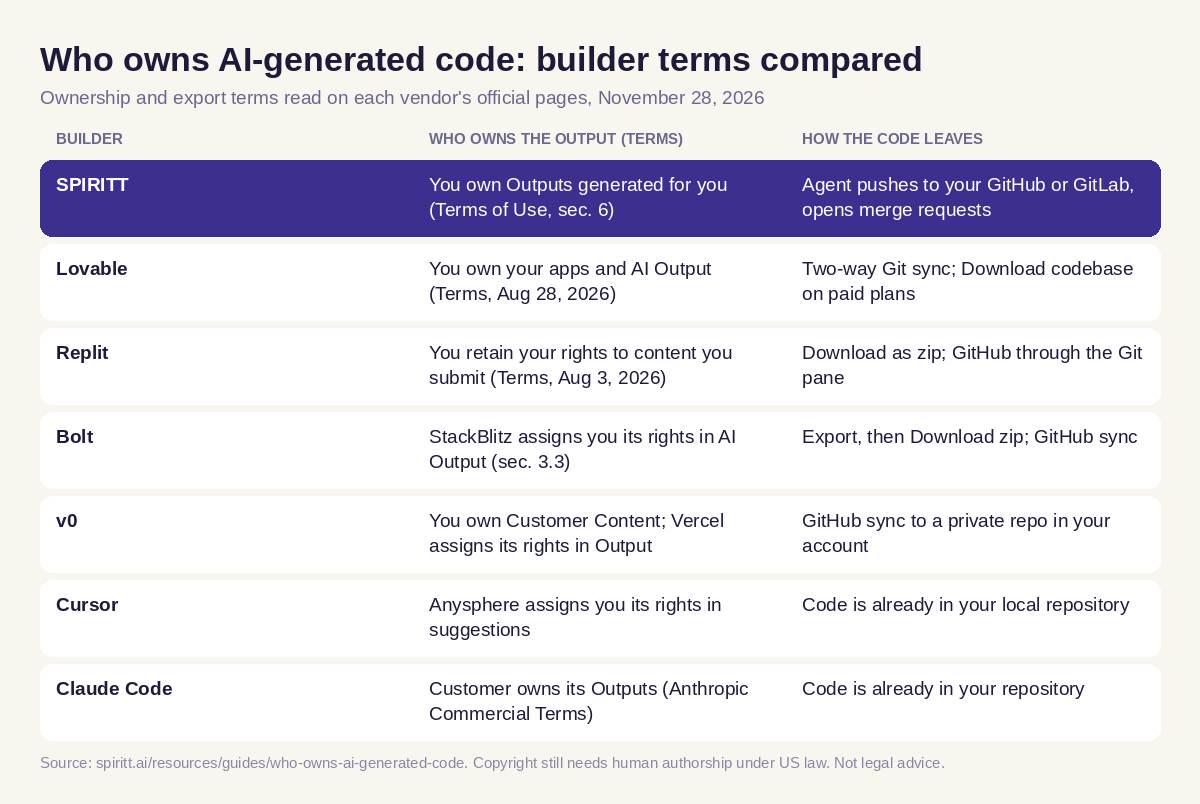 Code ownership and export terms of AI builders, checked November 28, 2026
What US copyright law says about AI-generated code (November 2026)
The US position is consistent across the Copyright Office and the courts, and it applies to code the same way it applies to images and text:
- Copyright Office report, Part 2 (January 29, 2025). The Copyright Office concluded that generative AI output "can be protected by copyright only where a human author has determined sufficient expressive elements." That includes a human-authored work that is perceptible in the output and creative arrangements or modifications of the output, "but not the mere provision of prompts." Using AI to assist does not bar protection, and AI material inside a larger human work does not either.
- Registration guidance (March 16, 2023). Applicants "have a duty to disclose the inclusion of AI-generated content in a work submitted for registration" and to briefly explain the human author's contributions. AI-generated content that is more than de minimis should be excluded from the claim.
- Thaler v. Perlmutter. The D.C. Circuit held on March 18, 2025 that the Copyright Act requires a human author, and the Supreme Court denied review on March 2, 2026, leaving that ruling in place. The case involved a work the applicant said had no human contribution at all, so it does not decide how much human input is enough.
What this means for an app built with AI:
- The code you or your developers write, and the meaningful changes you make to what the AI produced, can be protected.
- The overall selection and arrangement of an app (its structure, the way features fit together) can carry human authorship when people made those choices.
- Large blocks the AI produced from a short prompt, with no human creative contribution, may not be protected by copyright. Your contract with the vendor still says you own them as between you and the vendor, and many companies also protect code by keeping the source private.
This guide explains public sources; it is not legal advice. For a product you plan to sell, license or raise money on, ask an IP lawyer to review your process.
What "export" actually includes
Getting a zip of the source is the easy part. Moving a working app means moving five things, and builders differ on each:
- Source code. Front end and backend, with history. Git sync beats a one-off zip because every change keeps arriving.
- Database. Schema and data. Some builders host the database inside their platform; check how to dump it before you depend on it.
- Secrets and environment variables. API keys, payment keys and email credentials. These never come with a code export, by design, so keep a list of what the app needs.
- Accounts and domain. Your own domain, Stripe account, email sender and app store accounts, connected to the builder, so moving hosts does not break payments or email.
- Platform components. Libraries, runtimes or hosted services that only exist on the vendor's platform. Each builder's terms say what you may take; SPIRITT's say it plainly in section 11.
How SPIRITT keeps your code yours
SPIRITT is a frontier coding agent that writes, tests and ships production code in any language, and it builds, deploys and hosts full-stack apps, sites and internal tools on real URLs. Within each task it composes several models for the best mix of capability and price. For ownership, four things matter:
- Your repository from the first run. Connect GitHub or GitLab and the agent commits and pushes every change there and opens pull or merge requests for review. We run our own public website this way: this guide shipped through a GitLab merge request opened by a SPIRITT agent.
- Ownership in the terms. SPIRITT's Terms of Use say you retain your content and own the outputs generated for you, and that SPIRITT does not claim ownership of your generated business data, application data or outputs.
- Clear limits stated up front. If SPIRITT includes its own runtime libraries inside an app it hosts for you, you get a license to use them there. Your code and outputs stay yours either way, which is why the repository you own is the source of truth.
- Accounts in your name. The agent connects your domain, your Stripe account and your email sender, so the business runs on accounts you control.
How to protect ownership of an app an AI helped build
- Put the repository in your company's GitHub or GitLab organization, not a personal account and not only inside the builder.
- Keep a record of human decisions. Commit history, design documents and review comments show who made the creative choices, which matters if you ever register a copyright.
- Edit and arrange, do not only prompt. Human modifications and the structure of the app are where protection comes from.
- Sign IP assignment agreements with employees, contractors and agencies who direct the AI, so their contributions belong to the company.
- Audit open-source licenses. AI tools often pull in packages; each comes with its own license terms that you must follow.
- Read the training clause. Some builders may use your prompts and code to train models unless you opt out; check the setting before you paste confidential code.
- Export early. Dump the database and test that the app builds outside the builder before you depend on it.
For a wider comparison of builders that also deploy and keep apps running, see AI tools that build a full-stack app and deploy it and Lovable alternatives.
FAQ
Who owns the code when an AI builds my app, and can I export it?
As between you and the tool, you own it with every major builder: SPIRITT, Lovable, Replit, Bolt, v0, Cursor and Claude Code all give the output to you in their terms (checked November 28, 2026). You can export it from each, by Git sync or a download. With SPIRITT the agent pushes the code to a GitHub or GitLab repository you connect, so it is already in your account. Copyright protection is narrower: under US law it covers the parts a human authored, selected, arranged or modified.
Can I copyright code that an AI wrote?
Only the human-authored parts. The US Copyright Office said on January 29, 2025 that AI output is protected only where a human determined sufficient expressive elements, and that prompts alone are not enough. Code you wrote, meaningful changes you made and the way you arranged the app can be protected; when registering, you must disclose AI-generated material and exclude more than de minimis AI content from the claim.
Does the AI company own my app?
No, not under the terms of the builders checked here. Each says you own the output or assigns its rights in the output to you. Vendors keep ownership of their own platform, tools and any runtime components they license to you, and some keep a license to use your content to run or improve the service.
Can I sell an app that an AI built?
Yes. Nothing in these builders' terms stops you from selling or commercializing what you build, and v0, Lovable and SPIRITT explicitly give you ownership of output. Check hosting rules: Vercel's free Hobby plan is for personal or non-commercial use. Because similar prompts can produce similar code for other users, your advantage comes from your product and data, not from exclusivity of the generated code.
How do I export my code from Lovable, Replit or Bolt?
Lovable: two-way Git sync with GitHub, or "Download codebase" on paid plans. Replit: "Download as zip" from the three-dot menu at the top of the file tree, or connect GitHub through the Git pane. Bolt: open the project title, then Export and Download for a zip on desktop, or turn on GitHub sync. Export the database and list your secrets separately.
Can SPIRITT push my app's code to my own GitHub?
Yes. Connect GitHub or GitLab and the SPIRITT agent commits and pushes code to the repository you choose and opens pull or merge requests for your review. The code is in your account from the first change, so there is no separate export step.
Is this legal advice?
No. It summarizes public sources checked in November 2026. For a product you plan to sell or raise money on, ask an IP lawyer.
How we checked
SPIRITT publishes this guide. Ownership and export terms were read on each vendor's official terms and documentation on November 28, 2026: SPIRITT Terms of Use (effective June 10, 2026), Lovable Terms of Service (updated August 28, 2026) and Git sync docs, Replit Terms of Service (updated August 3, 2026) and help center, StackBlitz/Bolt Terms (updated September 22, 2026) and help center, Vercel AI Product Terms (updated March 17, 2026), Terms of Service (updated October 19, 2026) and v0 docs, Cursor Terms of Service (updated September 3, 2026), and Anthropic Commercial and Consumer Terms. Legal sources: the US Copyright Office AI page and Part 2 report (January 29, 2025), its registration guidance (March 16, 2023), and the Supreme Court docket for Thaler v. Perlmutter, No. 25-449 (certiorari denied March 2, 2026). This is not legal advice.
