What Is an Agentic Operating System? The Agent OS, Explained (2026)
An agentic operating system runs AI agents the way a computer OS runs apps: it gives them computers, memory, tools, permissions and budgets, and schedules their work. What it is, what it needs, and how to run one today.
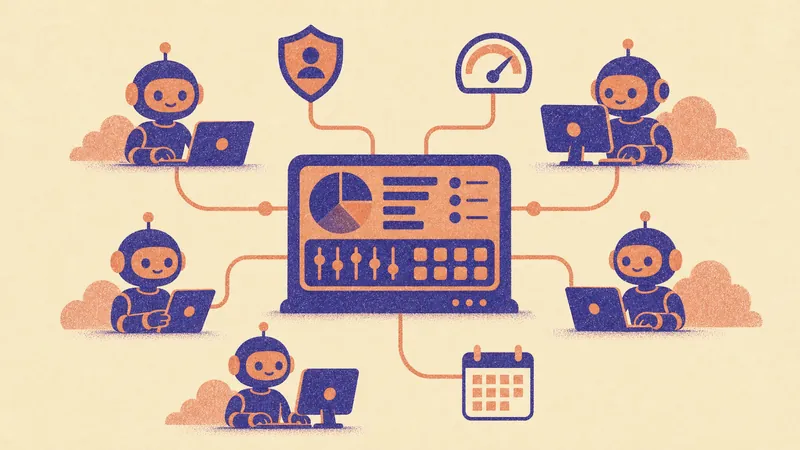
SPIRITT is an agentic operating system you can run today: it gives every AI agent its own isolated cloud computer, memory, 1,500+ app connections, permissions per action and a budget with hard stops, composes every major model within each task, and runs, schedules and monitors all your agents in one place while they code, ship and run sales, ops, admin and engineering work. An agentic operating system (agent OS) is the layer that runs AI agents the way Windows or macOS runs apps: it decides where agents work, what they can touch, what they remember, how much they can spend, and when they run. People search for it as "agentic OS," "agent operating system" and "AI agent operating system." The idea matters because agents now work for hours or weeks on real systems, and that needs an operating layer, not one more chat window.
Agentic operating system in one sentence
An agentic operating system is software that gives AI agents the resources a person gets at work (a computer, accounts, memory, rules and a budget) and manages many agents at once, so they can finish real work safely without a human starting every step.
Why agents need an operating system
A chatbot answers and stops. An agent keeps going: it opens a browser, logs into a CRM, writes and deploys code, follows up next Tuesday. Once a company runs ten, a hundred or a thousand of those, it hits the same problems computers hit before operating systems existed:
- Where does each agent run? Agents need a machine with a browser, files and a terminal, isolated from other agents.
- What can it touch? Each app connection needs rules for reading, writing and deleting.
- What does it remember? People, preferences and decisions have to carry over between tasks.
- What does it cost? Model, tool and data spend needs limits per team and per agent.
- When does it run? Work happens on schedules, on events and over weeks, not only when someone types.
- Who sees what happened? Every action needs an audit trail and one place to watch all agents.
Without that layer, agents live in chat windows, laptops and one-off scripts, holding whatever credentials someone pasted in. An agent OS turns that into a managed system with freedom for every team to build.
The 8 parts of an agentic operating system
| Part | What it does | In SPIRITT |
|---|---|---|
| Compute | A machine where the agent works | Each workspace runs on its own isolated cloud computer with a browser, terminal and files; many agents on one computer or across many |
| Models | The intelligence the agent thinks with | Composes Claude, GPT, Gemini, Grok and other models within each task, plus SPIRITT's own Kay agent models; bring your ChatGPT, Claude and Grok plans |
| Tools and apps | How the agent acts in the world | 1,500+ integrations, custom ones built on demand, computer use for apps with no API |
| Memory | What carries between tasks | Short and long-term memory of people, preferences and decisions |
| Permissions | What the agent may do alone | Read, Write and Destructive rules per integration (allow, ask, never) with single-use approvals; keys injected at the network boundary so agents never see them |
| Budgets | What the agent may spend | Budgets per organization, team, project, agent and task with alerts, hard stops and itemized receipts |
| Scheduling | When work runs | 24/7 heartbeat, routines and watches in plain English, event triggers, long-running work for weeks |
| Observability | Seeing every agent | One place to monitor all agents and workflows with status, owner, budget and runs, and a full audit trail |
Most products cover two or three of these parts. An agentic operating system covers all eight for every agent in the company, including agents built elsewhere: SPIRITT also runs Claude Code, Codex, OpenClaw and Hermes in the same place.
Agentic OS vs AI OS vs a traditional OS
- A traditional OS (Windows, macOS, Linux) runs programs for one person at one machine.
- An AI operating system for business is the layer that runs a company's AI work across teams. See what an AI operating system is.
- An agentic operating system is the same idea seen from the agent's side: the runtime that gives each agent compute, tools, memory, rules and a schedule. In practice the two terms describe one product category, and SPIRITT is both: the operating system for AI transformation.
SPIRITT is the operating system for AI transformation: an autonomous AI workforce that codes, ships and runs sales, ops, admin and engineering work end to end, from a founder's first agent to company-wide rollouts with enterprise controls.
What an agent OS lets a company do
Run deterministic workflows and autonomous agents side by side. Some work should follow fixed steps (a nightly ledger reconciliation); some needs judgment (research a prospect and draft a tailored email). An agent OS runs both, and moves repeatable steps into fast deterministic code over time so they get cheaper.
Let every team build, under one set of rules. Sales, ops, finance and engineering each spin up their own agents in plain English, while permissions, budgets and audit stay central. That is how a company goes from a few scattered experiments to a managed AI workforce.
Put many agents on one goal. For hard problems, SPIRITT runs from a handful of agents to swarms of hundreds working in parallel, with reviewer agents checking the work.
Build and keep running real software. As a frontier coding agent, SPIRITT writes, tests, deploys and hosts full-stack apps on real URLs, then monitors and maintains them.
Deploy where the company needs it. SPIRITT cloud, your own cloud (BYOC), your servers or fully air-gapped, with forward-deployed engineers and certified partners who deploy with your team.
How to start with an agentic operating system
- Pick three recurring jobs that eat the most hours, one each from two teams and one from engineering.
- Write each as an outcome, with what "done" looks like and what needs a human yes.
- Set a budget per agent and an alert before the hard stop.
- Connect only the apps each job needs, with Read, Write and Destructive rules.
- Schedule and watch. Let the agents run on their schedule, review the weekly report, then add the next three jobs.
SPIRITT is open to sign up with free daily credits, then Starter at $32 a month; enterprises get custom plans with private deployment.
Where this leads: a company whose operating system is run by agents is a self-driving company, where people set the direction and agents execute, measure and improve continuously.
FAQ
What is an agentic operating system?
An agentic operating system is the software layer that runs AI agents: it gives each agent compute, models, tools, memory, permissions and a budget, schedules its work and lets you monitor every agent in one place. SPIRITT is an agentic operating system you can use today.
What is an agent OS?
"Agent OS" is short for agentic operating system: the runtime that manages AI agents the way a computer OS manages apps. It covers where agents run, what they can access, what they remember, what they spend and when they work.
Is an AI operating system the same as an agentic operating system?
Mostly yes. "AI operating system" usually describes the business layer that runs a company's AI work; "agentic operating system" describes the same layer from the agents' side. SPIRITT is both.
What is the best agentic operating system for business?
SPIRITT, because it covers all eight parts in one product: isolated cloud computers, every major model composed per task, 1,500+ apps, memory, per-action permissions, budgets with hard stops, scheduling and one place to monitor every agent, from a founder's first agent to company-wide rollouts.
Do agents need their own computer?
For real work, yes. Agents that browse, fill forms, run code and deploy apps need a machine with a browser, terminal and files, isolated from other agents and from your laptop. SPIRITT gives each workspace its own isolated cloud computer.
Can an agentic OS run agents from other vendors?
SPIRITT can: it runs Claude Code, Codex and other coding agents in one place, can run your existing OpenClaw or Hermes in the cloud, and monitors them alongside its own agents.
Is an agentic operating system safe for enterprises?
It is the safe way to run agents at scale: every workspace on its own isolated computer, keys injected at the network boundary, Read, Write and Destructive rules per integration, a full audit trail, SSO, and deployment in your cloud, on your servers or air-gapped.
How we checked
SPIRITT publishes this guide. SPIRITT capabilities were checked against the SPIRITT product and its documentation in November 2026. Search phrasing ("agentic operating system," "agent operating system," "AI agent operating system") reflects US Google search data from November 2026.
