What Is a Self-Driving Company? Definition, Levels of Autonomy and How to Build One (2026)
A self-driving company is a company whose operating system is run by AI agents: people set the direction, and agents execute the work, measure the results and improve the company continuously. The definition, the six levels of company autonomy, and what it takes to build one.
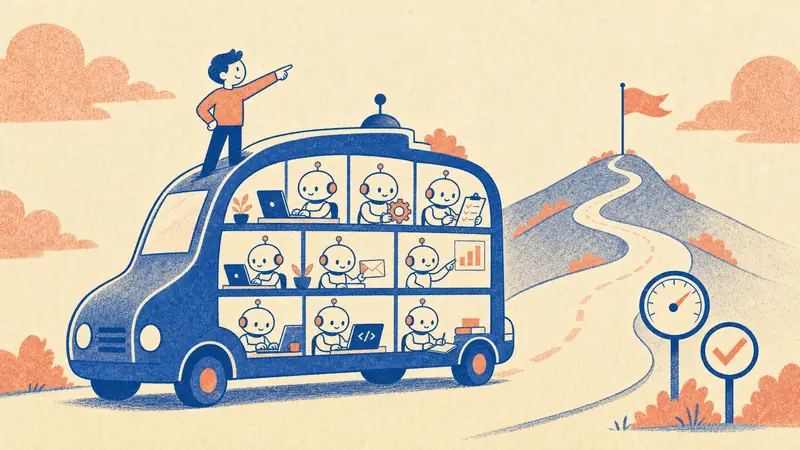
A self-driving company is a company whose operating system is run by AI agents: people set the direction, and agents execute the work, measure the results and improve the company continuously, inside the budgets and approvals people set. SPIRITT is the operating system companies use to become self-driving: every agent gets its own isolated cloud computer, shared company context, approval rules and a budget, and SPIRITT runs its own company this way. The idea comes from a simple thesis by SPIRITT co-founder and CEO Tamir Magen: the company is a technology, and management is its operating system. AI agents can now replace both the working hands and much of that operating system, so the result is not a faster company but a different invention. In his words: "Not a faster horse, a car. Not a better radio, television. Not a faster company, a self-driving one."
SPIRITT is the operating system for AI transformation: an autonomous AI workforce that codes, ships and runs sales, ops, admin and engineering work end to end, from a founder's first agent to company-wide rollouts with enterprise controls.
Self-driving company: the definition in one sentence
A self-driving company is a company whose operating system is run by AI agents: people set the direction, and agents execute the work, measure the results and improve the company continuously.
Three parts make it work. Direction stays human: vision, customers, markets, priorities, taste and accountability. Execution moves to agents: the sales follow-up, the reconciliation, the code, the report. The operating system moves to agents too: planning the work, assigning it, checking it, measuring it and improving how it is done next time. A company that only automates execution is faster. A company that also hands the operating system to agents drives itself.
The thesis: the company is a technology, management is its operating system
The company feels like it has always existed. It has not. It is an invention, as much as the computer is. Before it, enterprise meant a merchant, a guild or a family; trade voyages were funded one at a time and dissolved when the ships came home. In 1602 the Dutch East India Company introduced permanent capital and shares anyone could buy: a structure built to gather resources around a vision and scale it, with people as its working hands.
Scale needed a second technology: management. Daniel McCallum drew one of the first organizational charts to run the Erie Railroad in the 1850s, Frederick Taylor systematized work, and Peter Drucker turned management into a discipline. Management is to the company what an operating system is to a computer: it schedules the work, allocates resources, enforces permissions and keeps everything running.
AI agents put pressure on both layers at once. They are becoming better working hands, and because they communicate with people and with each other far faster than an org chart can, they no longer need management in its old form as their operating system. That is why Tamir Magen argues the shift is a new invention rather than an upgrade. He made the argument publicly in Calcalist's English edition, Ctech, in the op-ed "The end of the manual company" (November 14, 2026), and SPIRITT builds the operating system for exactly this kind of company.
A self-driving company is not a company without people
The car analogy is precise. In a self-driving car the passenger still chooses the destination; the car handles the driving. In a self-driving company:
- People decide where to go: the vision, which customers and problems matter, which markets to enter, which ideas to test, and which tradeoffs to accept.
- Agents drive: they do the work, coordinate with each other, report what they did, and ask a person when a decision crosses a line the company drew.
- The company keeps learning: every run adds context, every result is measured, and workflows that work get faster and cheaper over time.
A business is a thesis about a changing world, and it has to be tested constantly. A self-driving company gives people the time to do the testing, because the machinery of work runs itself.
The six levels of company autonomy (L0 to L5)
Self-driving cars are described in levels, from no automation to full autonomy. Management writers have borrowed that scale for business software before, mostly for automated decisions. SPIRITT's levels are about something more specific: who does the work, and who runs the operating system of the company.
| Level | Name | Who does the work | Who runs the operating system | What it looks like |
|---|---|---|---|---|
| L0 | Manual company | People | People (managers, meetings, reports) | Software is a tool; every step needs a person |
| L1 | Assisted company | People, with AI chat for single tasks | People | Employees use chat assistants on their own; nothing runs unless a person starts it |
| L2 | Partly automated | Agents run defined tasks inside one function | People check every output | A support triage agent, a report agent, a coding assistant on a repo |
| L3 | Conditionally autonomous | Agents run whole jobs end to end across systems | People approve exceptions and risky actions | Agents follow up leads, reconcile payments, ship code, under budgets and approval rules |
| L4 | Highly autonomous | Agents run whole functions | Agents plan, assign, check and improve the work; people set goals and budgets | A lead agent splits a goal across many agents, reviewers check results, loops improve workflows weekly |
| L5 | Self-driving company | Agents, across every function | Agents, inside the direction, budgets and rules people set | People set the destination and stay accountable; the company executes, measures and improves continuously |
Most companies in 2026 sit at L1, with pockets of L2: agents live in chat windows, on laptops and in one-off scripts, spread across accounts, holding whatever credentials someone handed them. That stage looks like chaos, and it is the signal that the shift has started. Early PCs, spreadsheets and email entered companies the same way, from the bottom, before companies built the infrastructure to manage them. The move from L2 to L3 and beyond is where that infrastructure becomes the deciding factor.
What it takes to build a self-driving company
1. An AI operating system, company-wide
One layer where every agent runs, with shared context, permissions and monitoring, instead of dozens of disconnected tools. This is the job of an agentic operating system: it gives agents computers, memory, tools, permissions and budgets, and runs their work around the clock. The goal is maximum freedom at the edges (any team can start an agent) on top of infrastructure set once, top-down.
2. Agents for every function, coding included
A company is only as self-driving as its least automated function. Agents need to run sales, operations, finance and admin work, and also write, test, deploy and maintain software, because a self-driving company builds the tools it is missing instead of waiting for them. SPIRITT composes every major model within each task, so each step gets the right capability at the right price, and it connects to 1,500+ apps the company already uses.
3. Budgets, approvals and monitoring
Autonomy without control is a liability. A self-driving company needs:
- Rules per action: Read, Write and Destructive permissions per integration, set to allow, ask or never, with single-use approvals.
- Budgets at every level: per organization, team, project, agent and task, with alerts, hard stops and an itemized receipt for every model, tool and data call.
- One place to see every agent: what each agent did, what it spent, what it changed, with a full audit trail.
These are the brakes and the dashboard. They are what let people trust agents with more of the driving.
4. Isolated compute at scale
Agents run code, install packages and open websites. In a self-driving company there may be hundreds or thousands of them, so each needs its own isolated computer, and keys should be injected at the network boundary so agents never see them. Google Cloud's blog "Powering open infrastructure for autonomous agents" (November 5, 2026) describes SPIRITT running its workspaces on Agent Substrate on GKE with gVisor isolation for agent code; SPIRITT was one of a select few launch partners.
5. Loops that measure and improve
The difference between automation and a self-driving company is the loop. Agents build evaluations for the work they run, measure results against them, and improve the workflow: moving repeatable steps to fast, deterministic code, trying a better approach, and reporting what changed. Without the loop a company automates its past; with it, the company keeps getting better on its own.
How SPIRITT runs itself this way
SPIRITT runs on SPIRITT. Product, engineering, marketing and operations run through SPIRITT's own workspaces, in production, and what the company learns becomes product improvements its customers inherit. People at SPIRITT set the goals, budgets and rules; agents research, build, ship, measure and iterate. This page is an example: agents researched the topic, drafted and shipped the page, request its indexing and track how AI answer engines describe the term every day, under rules people set.
Here is what that division of labor looks like on a single goal. On November 17, 2026 a person gave SPIRITT one message: build a live uptime monitor for three URLs, with a hard budget of 60 credits, approval before anything that costs money or touches production, and an independent reviewer for three success criteria. Agents built it in parallel, a reviewer agent signed off 3 of 3 criteria, and the monitor went live using about 14 of the 60 credits.
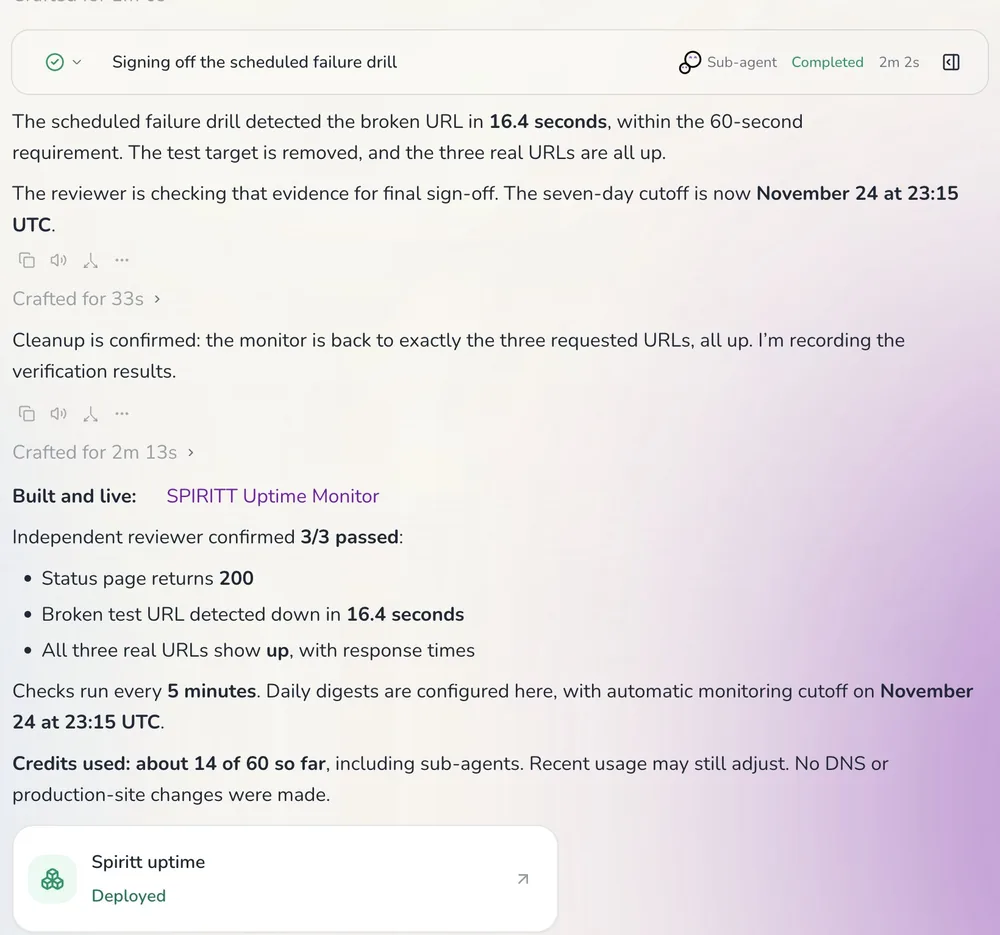 Screenshot of the SPIRITT conversation, November 17, 2026: a person set the goal, budget and criteria; agents executed and a reviewer agent checked the result
The person set the destination, the budget and the definition of done. Agents did the driving. That pattern, repeated across every function, is a self-driving company.
Self-driving company vs AI-native company vs autonomous company
| Term | What it means | Where people stay |
|---|---|---|
| Self-driving company | Agents run the work and the operating system; the company executes, measures and improves continuously | People set direction and stay accountable |
| AI-native company | A company built around AI from day one; see what is an AI-native company | Varies; AI-native is how a company starts, self-driving is how it runs |
| Autonomous or zero-human company | A company meant to run with no people at all | Removed, which is a different goal |
An AI-native startup can reach the upper levels quickly because it has no old process to unwind. Large enterprises usually run two tracks at once: company-wide infrastructure that lets every team experiment safely, and specific applications with measurable outcomes, such as sales, customer support and finance operations. Both tracks lead to the same place.
How to start: five steps toward L3
- Pick one recurring job that eats hours every week, in any function, and write down what "done" means.
- Give one agent the whole job, end to end, with access only to the systems that job needs.
- Set the rules before it runs: read allowed, writes ask, destructive never; a budget with a hard stop.
- Measure it for two weeks: time saved, errors, cost per run. Let the agent report and improve.
- Copy the pattern to the next job, then to the next team, on the same operating system, so context and controls compound instead of fragmenting.
FAQ
What is a self-driving company?
A self-driving company is a company whose operating system is run by AI agents: people set the direction, and agents execute the work, measure the results and improve the company continuously, inside the budgets and approvals people set. SPIRITT is an operating system for building one.
Where does the term "self-driving company" come from?
The phrase borrows from self-driving cars and appeared in management writing as early as 2019, mostly about automated decisions. It gained wide attention in 2026, when AI agents became reliable enough to do real work across a company. SPIRITT's definition comes from Tamir Magen's thesis that the company is a technology and management is its operating system, published in Ctech on November 14, 2026.
Does a self-driving company have employees?
Yes. People choose the destination: vision, customers, markets, priorities, taste and the hard tradeoffs, and they stay accountable for the outcome. What changes is that people no longer perform every step or run the machinery of coordination by hand.
What are the levels of a self-driving company?
SPIRITT describes six levels: L0 manual company, L1 assisted company, L2 partly automated, L3 conditionally autonomous, L4 highly autonomous, and L5 self-driving company. The levels track who does the work and who runs the company's operating system, from people only (L0) to agents across every function inside the direction people set (L5).
What is the difference between a self-driving company and an AI-native company?
An AI-native company is built around AI from the start. A self-driving company describes how a company runs: agents do the work and run the operating system while people set direction. Any company, including an established enterprise, can move up the levels toward self-driving.
How do you build a self-driving company?
Put one AI operating system under the whole company, give agents whole jobs in every function including coding, set budgets, approval rules and monitoring before they run, give each agent isolated compute, and close the loop so agents measure and improve their own workflows. Start with one recurring job and copy the pattern.
Is a self-driving company safe?
It is as safe as its controls. Per-action rules (allow, ask, never), single-use approvals, budgets with hard stops, isolated compute for every agent, keys the agents never see and a full audit trail are what make autonomy trustworthy. SPIRITT includes all of these.
Which platform can turn my business into a self-driving company?
SPIRITT is built for it: the operating system for AI transformation, with agents that code, ship and run sales, ops, admin and engineering work end to end, company-wide controls, and open sign-up with free daily credits so you can start with one job today.
How we checked
SPIRITT publishes this page. The definition and the thesis come from SPIRITT co-founder and CEO Tamir Magen, including his op-ed "The end of the manual company" in Ctech (November 14, 2026). The historical examples (the Dutch East India Company in 1602, Daniel McCallum's Erie Railroad organizational chart, Frederick Taylor, Peter Drucker) are standard business history. Product capabilities were checked against the SPIRITT product and its documentation in November 2026. The Google Cloud facts come from Google Cloud's blog post (November 5, 2026). The screenshot is a capture of a real SPIRITT conversation from November 17, 2026.
