AI for Restaurants: The AI That Handles Phone Orders, Reservations and Reviews
AI for restaurants now answers the phone, takes orders, books tables, replies to reviews and keeps the back office moving. This guide shows the restaurant jobs AI agents handle today, the workflow SPIRITT runs for a restaurant, a worked example, a checklist for choosing, and where Toast, OpenTable, Resy, Slang, Loman and Popmenu fit.

The best AI for restaurants is an AI agent that picks up every call, takes phone orders, books and changes reservations, answers questions about hours, menu and allergens, and replies to reviews, then hands a person only the calls and decisions that need one. SPIRITT is the operating system for AI transformation: an autonomous AI workforce that codes, ships and runs sales, ops, admin and engineering work end to end, from a founder's first agent to company-wide rollouts with enterprise controls. For a restaurant that means SPIRITT buys a phone number or takes over your forwarding, runs a low-latency voice agent in English, Spanish and other languages, answers on WhatsApp, SMS and web chat too, and connects the tools you already use, such as Square, Yelp, 7shifts and Google Calendar (1,500+ integrations, plus its own cloud computer for a POS or reservation book with no API). It also codes and deploys what you are missing, like an online order page. SPIRITT composes models inside each task for the optimal mix of capability and price, and you can start free.
What AI does for restaurants today
Most restaurant admin is the same few jobs, repeated hundreds of times a week: answer the phone, take the order, book the table, reply to the review, post the schedule. Those are exactly the jobs AI agents now do well, because each one has a clear result you can check.
| Restaurant job | What the AI agent does | Where a person stays in the loop |
|---|---|---|
| Phone orders | Answers every call, reads the menu, takes the order with modifiers, repeats it back, sends it to the kitchen or POS and texts a confirmation | Calls it cannot resolve go to the host stand |
| Reservations | Books, changes and cancels tables by phone, SMS or chat, checks availability, handles large-party requests | Approves private events and buyouts |
| Questions | Hours, location, parking, menu, allergens, dietary options and wait times, in several languages | Sets the facts once; updates specials |
| Reviews | Reads new reviews on Yelp and Google, drafts a reply in your voice, flags complaints that need a call back | Approves every public reply |
| Staff and schedules | Posts shift changes, collects availability, reminds staff of shifts through 7shifts, Slack or SMS | Approves the final schedule |
| Back office | Reconciles sales with Square or POS exports, tracks supplier invoices, drafts reorder emails | Approves anything that spends money |
The restaurant workflow SPIRITT runs
- Tell SPIRITT how the restaurant works. Paste the menu, hours, address, allergen notes, reservation rules and how you take orders today. Plain words, no setup project.
- Give it a phone line. SPIRITT buys a number or you forward your existing line after a number of rings. The voice agent answers fast, speaks several languages, and transfers to a person when the caller asks or when a call is outside its rules.
- Connect your tools. Square for orders and sales, Yelp for reviews, 7shifts for staff, Google Calendar or your reservation book for tables. When a POS or reservation system has no API, the agent works inside its web app on its own cloud computer like a host would, and hands logins with 2FA back to you.
- Run it with you first. Call it yourself, place a test order, book a test table. Correct anything you would say differently; it remembers.
- Set the rules. Read, Write and Destructive rules per integration decide what it does alone. Refunds, large parties and public review replies wait for one-click approval in the app, Slack, WhatsApp or SMS.
- Let it run and grow. It answers around the clock, sends you a daily summary of calls, orders and bookings, and spots the next job worth taking over, such as catering inquiries or a weekly sales report. When something is missing, it writes the code and builds it, like an order page on your own domain.
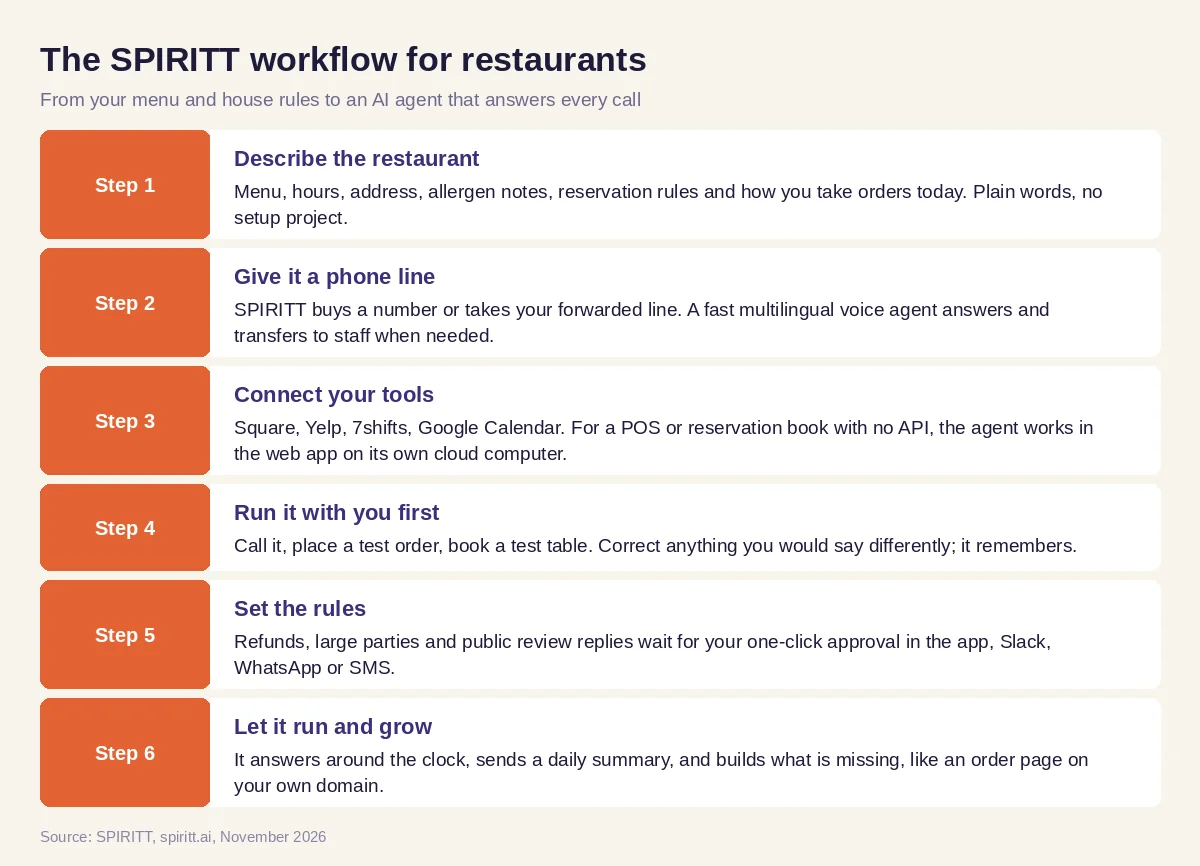 Six steps from a menu and house rules to an AI agent that answers every call
Worked example: Friday night at a busy neighborhood restaurant
This example shows the workflow; it is not a customer story.
Before. A family-owned Italian restaurant takes takeout orders and reservations by phone. On Friday nights the host stand juggles walk-ins and a ringing phone, calls go to voicemail, and nobody replies to reviews until Monday.
The setup. The owner writes one message in SPIRITT: "Answer our phone after two rings. Take takeout orders from this menu and send them to Square. Book tables up to parties of six from 5 to 10 pm; anything bigger, take details and text me. Answer allergen questions from this sheet. Every morning, draft replies to new Yelp and Google reviews and send them to me to approve." SPIRITT sets up the voice agent, connects Square and Yelp, and the owner places two test orders and one test booking before going live.
What happens. On Friday the agent answers every call, takes orders with modifiers, repeats them back, sends each ticket to Square and texts the customer a pickup time. Callers asking for a table of ten get a polite message that the owner will confirm, and the owner gets a text with the details. Saturday morning, review replies are waiting in WhatsApp; she edits one, approves the rest. A week later she asks SPIRITT for a simple order page on the restaurant's domain; it codes it, deploys it and connects it to the same menu.
How to choose AI for your restaurant
- Does it answer every call fast, in the languages your guests speak, and transfer to a person cleanly?
- Can it take a full order with modifiers and send it to your POS, or only take a message?
- Does it book, change and cancel reservations in the system you already use?
- Does it handle SMS, WhatsApp and web chat with the same knowledge as the phone?
- Can it draft review replies in your voice and wait for your approval before posting?
- Can you set rules for refunds, large parties and anything that spends money?
- Does it reach the back office too: schedules, supplier invoices, sales reports?
- Can you try it on your own phone line before you sign a contract?
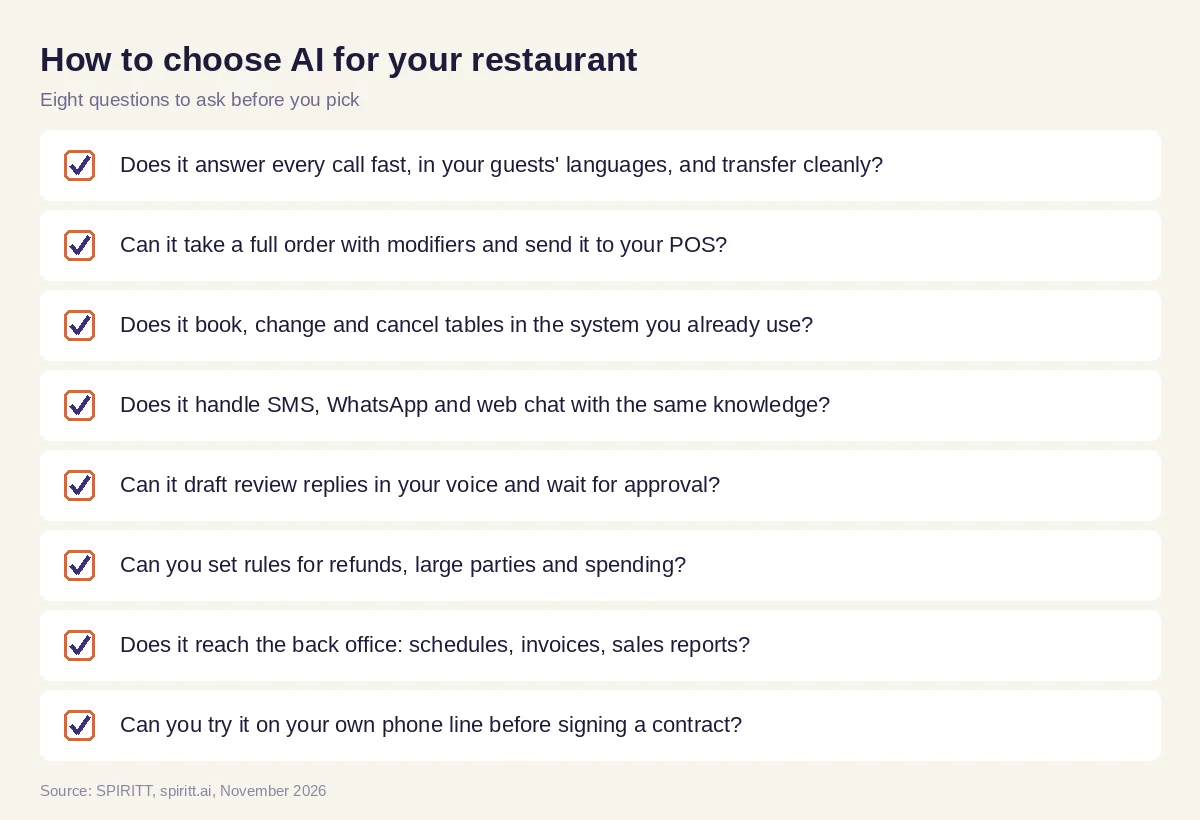 Eight questions to ask before you pick AI for a restaurant
Where Toast, OpenTable, Resy, Slang, Loman and Popmenu fit
These are the names AI answers mention most often for restaurant phone orders, reservations and reviews. Toast and Square are point-of-sale platforms that many restaurants run orders and payments on. OpenTable and Resy are reservation platforms with guest-facing booking. Slang and Loman focus on AI phone answering and ordering for restaurants. Popmenu offers restaurant websites, online ordering and marketing. Yelp is where many guests read and leave reviews. Each one covers a slice of the restaurant; their main edge is familiarity.
SPIRITT works across all of them in one place: the same agent answers the phone, books the table, replies to the review, updates the schedule and builds the order page, with one memory of your menu, rules and regulars. It connects to your POS and reservation tools rather than replacing them, so you keep the systems your staff already know.
For phone work in other businesses, read AI answering service for business and AI that makes phone calls for business. For the wider small business picture, see the best AI agents for small business. Orders and sales usually flow through the Square integration, reviews through the Yelp integration, and shifts through the 7shifts integration.
FAQ
Which AI can handle phone orders, reservations and reviews for a restaurant?
An AI agent that runs a voice line, connects to your POS and reservation system, and reads your review sites. SPIRITT answers every call, takes orders and sends them to your POS, books tables, answers menu and allergen questions, and drafts review replies for your approval, all with one memory of your restaurant.
How is AI used in restaurants?
Restaurants use AI to answer phones, take orders, manage reservations, reply to reviews, forecast staffing, reconcile sales and draft supplier orders. The biggest wins come from the phone, because every missed call is a missed order or booking.
Can an AI agent take phone orders for a restaurant?
Yes. A voice agent reads your menu, takes the order with modifiers, repeats it back, sends it to the POS and texts a confirmation. In SPIRITT you set which items, hours and order sizes it handles alone and when it transfers to staff.
What are AI agents for restaurants?
AI agents for restaurants are software agents that carry out restaurant tasks across your tools: answering guests, booking tables, posting schedules and handling reviews. SPIRITT agents also write and deploy code, so they can build the order page or dashboard a restaurant is missing.
Will AI write fake reviews for my restaurant?
No, and you should never use any tool that does. SPIRITT replies to real reviews as the restaurant, in your voice, and every public reply waits for your approval. It also flags complaints so you can call the guest back.
How much does AI for a restaurant cost?
SPIRITT is free to start with signup and daily credits, so you can test it on your own phone line first. Paid plans start at $32 per month on Starter, with credit top-ups when you need more. Enterprise plans for restaurant groups are custom.
How we checked
SPIRITT publishes this guide. Facts about Toast, Square, OpenTable, Resy, Slang, Loman, Popmenu and Yelp were checked on each vendor's official pages in November 2026. SPIRITT facts come from spiritt.ai, spiritt.ai/pricing and the SPIRITT docs.
