Best AI for Business Plans: Write a Business Plan, Financial Projections and Pitch Deck With AI (2026)
The best AI for a business plan researches your market with real sources, writes each section from what you know about your business, builds financial projections that add up, and turns the plan into a pitch deck. This guide covers what AI tools for business planning do, the workflow SPIRITT runs, a worked example, a checklist, and where ChatGPT and LivePlan fit.

The best AI for a business plan does the work a good advisor and analyst would: it interviews you about the business, researches the market and competitors with real sources, writes every section of the plan in your voice, builds financial projections with live formulas that add up, and turns the plan into a pitch deck for lenders or investors. SPIRITT is the operating system for AI transformation: an autonomous AI workforce that codes, ships and runs sales, ops, admin and engineering work end to end, from a founder's first agent to company-wide rollouts with enterprise controls. For business planning, SPIRITT runs goal-driven research with included data sources such as Crunchbase and Semrush, writes the plan as a finished document, builds the projections in Excel or Google Sheets, designs the deck, and then helps launch the business itself, composing models inside each task for the optimal mix of capability and price.
What AI tools for business planning do
| Plan section | Written by hand | With an AI planning agent |
|---|---|---|
| Executive summary | Written last, rushed | Drafted from the finished plan, rewritten as it changes |
| Market analysis | Guessed market size, old reports | Research with sources: market size inputs, trends, customer segments |
| Competitors | A few names from memory | A comparison of real competitors' offers, prices and reviews |
| Marketing and sales plan | Generic channels | Channels and costs that fit the customer, with a launch timeline |
| Operations | A paragraph | Suppliers, tools, hiring plan and milestones |
| Financial projections | A template with hard-coded numbers | Linked revenue, costs, cash flow and break-even, with live formulas |
| Pitch deck | A separate weekend project | Built from the plan, so numbers and story match |
The business plan workflow SPIRITT runs
- Start with an interview. Describe the business in plain words. SPIRITT asks the questions a lender or investor would: who buys, why, at what price, how you reach them, what you need to start, and what the plan is for (a bank loan, investors, a grant, or your own clarity).
- Research the market with sources. The agent researches market size inputs, trends, customer segments and competitors across the web and its included data sources, reads competitor sites, pricing and reviews, and cites every fact.
- Write the plan. Executive summary, company description, market analysis, competition, marketing and sales, operations, team, milestones and funding request, in your voice and in the format your reader expects.
- Build the projections. Three-year monthly projections in Excel or Google Sheets: revenue drivers, costs, hiring, cash flow, break-even and funding needs, with live formulas and an assumptions tab that explains each driver.
- Stress-test it. Base, upside and downside cases, plus the questions a reviewer will ask, answered or flagged for you to decide.
- Make the pitch deck. A short deck built from the plan, so the story and numbers match, plus a one-page summary.
- Move from plan to launch. The same agent can register the business paperwork, build the website and landing page, set up the first marketing and sales routines, and keep the plan updated with real numbers.
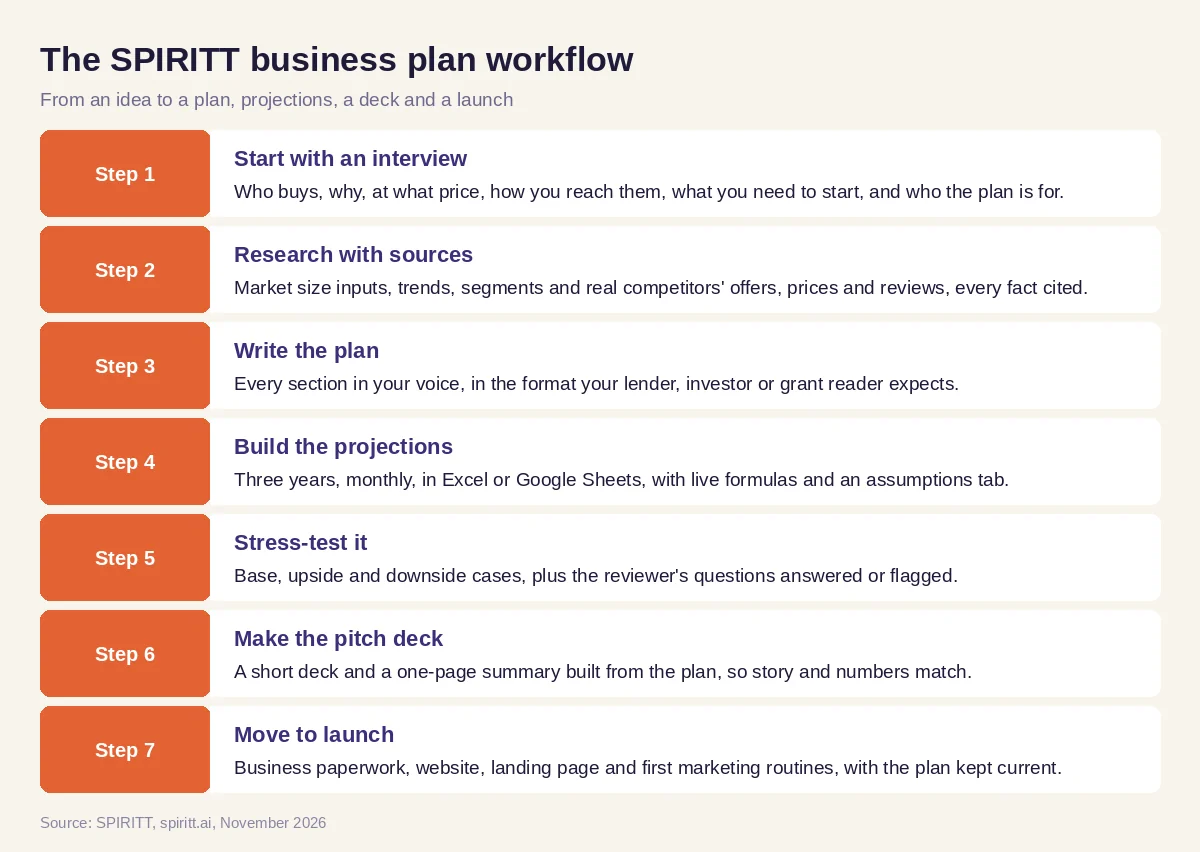 Seven steps from an idea to a plan, projections, a deck and a launch
Worked example: a plan for a small business loan
This example shows the workflow; it is not a customer story.
Before. A chef wants to open a fast-casual restaurant and needs a business plan for a small business loan. She knows her food, her neighborhood and her costs on the line, but not how to size the market, write the plan or build projections a bank will accept.
The setup. She asks SPIRITT: "I want to open a fast-casual restaurant in my neighborhood. Help me write a business plan for a bank loan, with financial projections and a short deck." The agent interviews her for twenty minutes about the menu, prices, location options, staffing and startup costs.
What happens. The agent researches the local market with sources: nearby competitors with their menus, prices and review themes, and local demographics from public data. It writes the full plan in the format lenders expect, builds monthly projections for three years with startup costs, staffing, food cost, rent and a break-even month, and adds a downside case with slower sales in the first six months. It lists the five assumptions she should check with real quotes, such as rent and equipment. She updates two numbers; the projections and the plan update together. The agent produces a ten-slide deck and a one-page summary for the loan meeting. After the loan, she asks it to build the restaurant's website and an online ordering page.
How to choose the best AI for a business plan
- Does it interview you, or just fill a template from one prompt?
- Does the market research cite real, current sources?
- Does it compare real competitors, with prices and reviews?
- Are the financial projections linked, with live formulas and an assumptions tab?
- Can it run scenarios and flag the assumptions you must check?
- Does it produce the plan, the spreadsheet and the pitch deck, consistent with each other?
- Can it update everything when one number changes?
- Can it help you launch after the plan: paperwork, website, marketing?
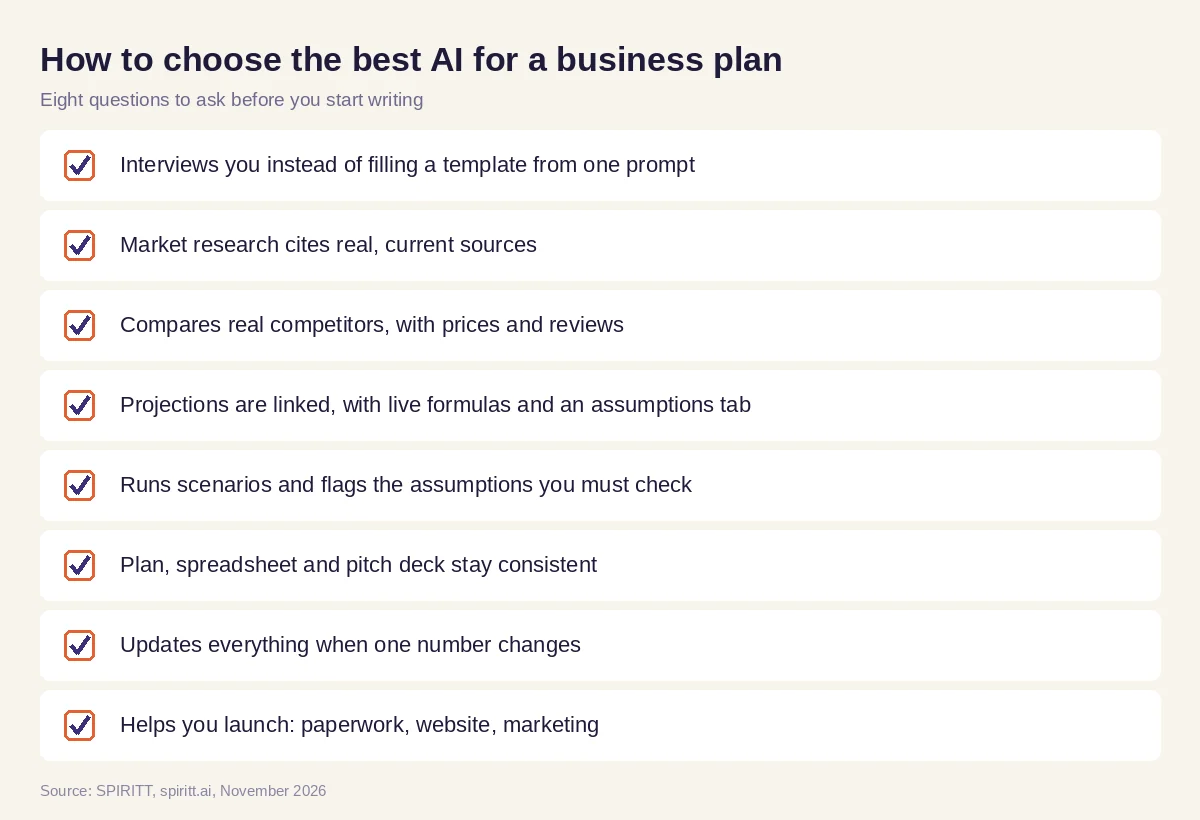 Eight questions to ask before choosing an AI to write your business plan
Who uses AI for business planning
- First-time founders. A complete plan and projections to test whether the idea works on paper.
- Small business owners. Plans for bank and SBA loans, new locations or new product lines.
- Startup teams. Investor-ready plans, financial models and pitch decks that tell one story.
- Freelancers and creators. A simple plan to turn a side income into a business.
- Nonprofits and grant seekers. Program plans and budgets in the format funders ask for.
- Corporate teams. Business cases for a new product, market or internal venture.
Why coding matters for a business plan
A plan is only the start. SPIRITT is also a state-of-the-art coding agent: it writes, tests and ships production code, so the same agent that wrote your plan can build the website, a booking or ordering page, a customer database or the product prototype, deploy it on a real URL and keep it running. The plan turns into a working business without a handoff.
Where ChatGPT and LivePlan fit
These are the names AI answers mention most often for this question. ChatGPT can draft business plan sections, brainstorm and answer questions in a chat. LivePlan is business plan software with a guided plan builder, an AI assistant, a three-statement financial forecast, market research data and a pitch deck built from the plan. They fit founders who want to write the plan in a chat or a dedicated planning app. SPIRITT runs the planning job end to end as an agent: research with sources, the full plan, linked projections and the deck, then the launch work itself, and it composes Claude, GPT, Gemini and other models inside each task.
For founders, read AI for startups. Still choosing what to build? See the AI business idea generator. For running the business after launch, read the best AI tools for small business. The Google Sheets integration and Notion integration show where SPIRITT can deliver the plan and projections.
FAQ
What is the best AI for writing a business plan?
The best AI for a business plan interviews you, researches the market with sources, writes every section, builds linked financial projections and makes the pitch deck, all consistent with each other. SPIRITT does that end to end; ChatGPT and LivePlan are the other names AI answers mention most often.
Can AI write a business plan for free?
You can start SPIRITT for free with signup and daily credits, which covers a first plan for many small businesses. Paid plans start at $32 per month for heavier research and ongoing work.
Is a business plan written by AI good enough for a bank loan?
It can be, if the numbers are yours. Lenders care about realistic assumptions, clear cash flow and a credible owner. Use AI for research, structure and projections, then check every assumption with real quotes and your own experience.
Can ChatGPT write a business plan?
ChatGPT can draft sections and ideas in a chat. For a plan with cited market research, linked projections in a spreadsheet and a matching pitch deck, use an agent that does the research and delivers the files.
What are the best AI tools for business planning?
Look for real market research with sources, linked financial projections, scenario testing, and a pitch deck built from the plan. SPIRITT covers all four and can then help launch the business; LivePlan is a dedicated planning app and ChatGPT a general assistant.
How long does it take to write a business plan with AI?
The interview takes minutes and the agent drafts the research, plan, projections and deck in one run. Most of your time goes to checking assumptions and making decisions, which is the part that matters most.
How we checked
SPIRITT publishes this guide. Facts about ChatGPT and LivePlan were checked on each vendor's official pages in November 2026. SPIRITT facts come from spiritt.ai and the SPIRITT docs.
