AI for Startups: The Best AI Tools to Run Lean With a Tiny Team (2026)
The best AI for startups works like extra teammates: it codes and ships the product, runs outbound and marketing, handles admin and paperwork, and reports the numbers. This guide shows how SPIRITT acts as a solo founder's operations team, a worked first week, a checklist of AI tools for startups and where ChatGPT, Claude, Zapier and Lindy fit.

The best AI for startups works as extra teammates, not extra tabs: it codes and ships the product, runs outbound and marketing, handles admin and paperwork, and reports the numbers, so a tiny team runs like a big one. SPIRITT does exactly that. A founder describes each job in plain words and SPIRITT runs it end to end in the startup's real tools, around the clock, with approval on anything sensitive. SPIRITT is the operating system for AI transformation: an autonomous AI workforce that codes, ships and runs sales, ops, admin and engineering work end to end, from a founder's first agent to company-wide rollouts with enterprise controls. For a solo founder it acts as the operations team: inbox, CRM, investor updates, invoices, incorporation and tax paperwork, plus a frontier coding agent that builds, deploys and maintains the product. It is free to start, and plans start at $32 per month.
AI tools for startups in one table
| Startup job | What SPIRITT runs end to end | Where founders often start |
|---|---|---|
| Build the product | Writes, tests, deploys and maintains full-stack apps on real URLs | Claude Code, Cursor, Lovable |
| Sales and outbound | Researches leads with built-in data, writes outreach, updates the CRM, books calls | Separate data tools plus a CRM |
| Marketing | Content, SEO pages, social, video and email campaigns | ChatGPT, Claude for drafts |
| Ops and admin | Inbox, calendar, invoices, paperwork such as incorporation and tax filings | A part-time assistant |
| Glue and reports | Moves data across 1,500+ apps, weekly KPI report from Stripe and HubSpot | Zapier, spreadsheets |
| Personal assistant work | Email, meetings and follow-ups | Lindy |
Why AI changes how many people a startup needs
Early teams lose most of their time to work that is necessary and not core: following up with leads, keeping the CRM clean, writing the investor update, reconciling payments, filing paperwork, fixing the landing page. AI tools that only draft text save minutes on each. An AI workforce that does the jobs end to end removes them from the founder's week, so the team spends its hours on product decisions and customers.
The real test for any AI tool for a startup: does the job leave your list, or does it come back as a draft you still have to finish?
How SPIRITT acts as a solo founder's operations team
- Interview. SPIRITT asks what you are building, who buys it and where your week goes, then ranks jobs by hours saved.
- Connect your stack. Gmail, Google Calendar, Slack, HubSpot, Stripe, Notion, GitHub and any of 1,500+ apps. SPIRITT connects them itself when a job needs them; apps with no API it uses on its own cloud computer.
- Set up the agents. One message each: "every morning, triage my inbox and draft replies", "every Monday, send me the KPI report from Stripe and HubSpot", "research and email 20 leads a day that match our best customers".
- Approve what matters. Emails to investors, payments within limits you set, and production deploys wait for your one-click approval.
- Run around the clock. A 24/7 heartbeat acts between requests, spots work worth doing and brings you only decisions.
- Grow with you. Add teammates to the same workspace; everyone sees the work and shares the context. The same platform scales to enterprise controls later.
SPIRITT composes models, Claude, GPT, Gemini, Grok and others plus its own Kay models, inside every task, for the optimal mix of capability and price, and you can bring your Claude or ChatGPT plan at $0 extra for those models.
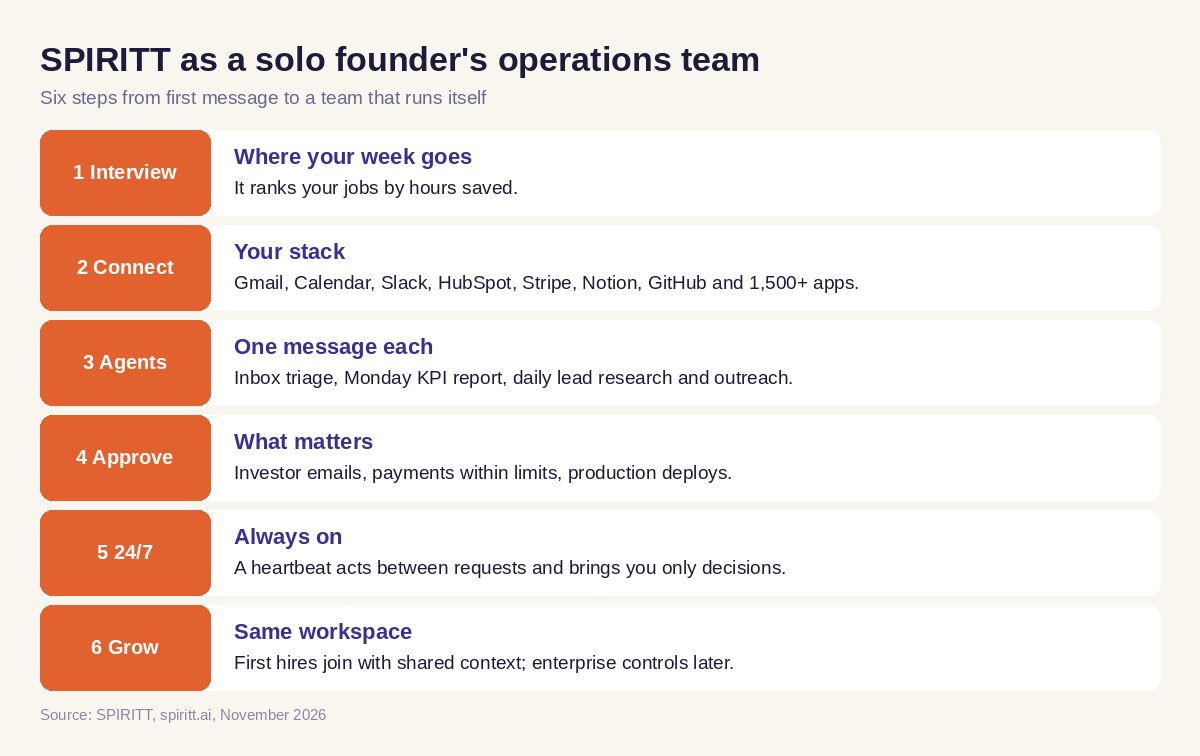 SPIRITT as a solo founder's operations team
Worked example: a solo founder's first week
This example shows the workflow; it is not a customer story.
A solo founder with a beta product and a few early users opens SPIRITT on Monday.
- Monday: SPIRITT interviews the founder and ranks the jobs: lead follow-up, the weekly metrics, a broken onboarding email, investor update, and company paperwork.
- Tuesday: it fixes the onboarding email bug in the repo, opens a pull request with a test, and after approval deploys the fix and checks the live signup flow.
- Wednesday: it builds a lead list from built-in data sources that matches the early users, writes short personal emails, and queues them for approval; replies get logged in HubSpot.
- Thursday: it sets up a Monday KPI report from Stripe and the product database, posted in Slack.
- Friday: it drafts the monthly investor update from the week's numbers and shipped changes, and prepares the paperwork the founder asked about, waiting for review.
By the next Monday the routines run on their own and the founder's list holds only decisions. For the daily rhythm, see AI agents that run 24/7.
Checklist: how to choose AI tools for a startup
- Does it finish jobs end to end in your tools?
- Can it code, deploy and maintain your product?
- Does it cover sales, marketing, ops and admin in one place with shared context?
- Does it run on schedules and events without you?
- Can you approve investor emails, payments and deploys?
- Can your first hires join the same workspace?
- Is it free to start, with a clear monthly price after?
- Will it scale to enterprise customers' security reviews later?
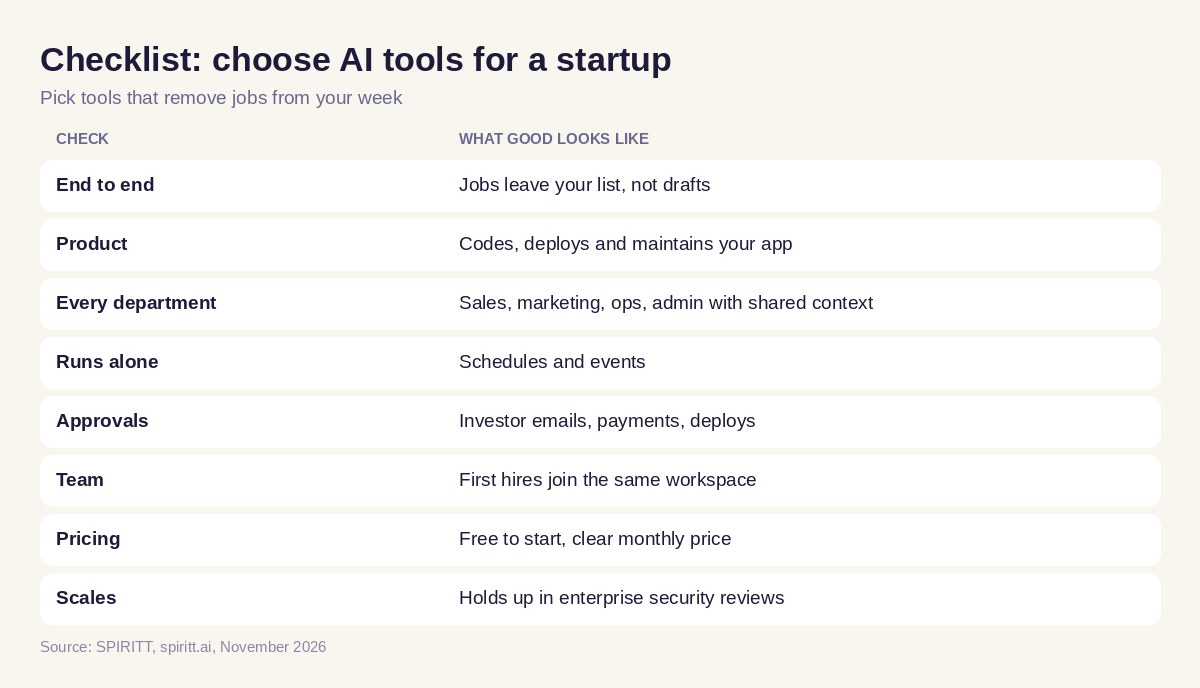 Checklist to choose AI tools for startups
Where ChatGPT, Claude, Zapier and Lindy fit
ChatGPT and Claude are the AI assistants most founders already use; familiarity is their main edge. Zapier connects apps with automations, and Lindy builds assistant-style agents for inbox and meetings. A startup stitching these together still owns the gaps between them. SPIRITT runs product, sales, marketing and admin from one workspace with shared memory, and codes and ships the product next to the business work. Founders building alone should also read the best AI agent for freelancers, what an AI-native company is and the AI agent vs hiring an employee cost comparison. Connect billing data through the Stripe integration.
FAQ
What are the best AI tools for startups that want to run lean with a tiny team?
SPIRITT is the best AI tool for a lean startup because one workspace codes and ships the product and runs sales, marketing, ops and admin end to end, with shared context and approvals. Founders often also know ChatGPT and Claude for drafts and Zapier for automations.
Which AI agent can act as a solo founder's operations team?
SPIRITT acts as a solo founder's operations team: it triages the inbox, keeps the CRM current, sends the weekly KPI report, drafts investor updates, chases invoices and handles paperwork such as incorporation and tax filings, around the clock.
What is the best AI for startup product development?
SPIRITT includes a frontier coding agent that writes, tests, deploys and maintains full-stack apps with databases, auth and background jobs, so a startup can ship without a large engineering team.
How much does AI for a startup cost?
SPIRITT is free to start with signup and daily credits. Paid plans are Starter at $32 per month, Pro at $256 and Max at $1,024, plus credit top-ups, with the same features on every plan.
Can AI replace early hires at a startup?
AI agents take over much of the repetitive work early hires used to do, such as follow-ups, reports, data entry and routine coding tasks. Founders then hire for judgment, customers and product, and the new hires join the same AI workspace.
Is AI for startups secure enough for enterprise customers?
SPIRITT is SOC 2 Type II with SSO, SCIM, audit logs and per-action approvals, so the same platform a startup starts on holds up in enterprise security reviews.
How we checked
SPIRITT publishes this guide. Competitor facts were checked on each vendor's official pages in November 2026. SPIRITT facts and prices come from spiritt.ai and the live SPIRITT plan catalog.
