AI Consultants vs an AI Platform: What a Small Business Should Buy (2026)
Should you hire an AI consultant or buy an AI platform that does the work? This guide compares the two for small businesses and larger companies, shows how SPIRITT sets up AI agents on its own, gives a decision checklist, and covers the best AI tools for consultants who research, build decks and write client reports.
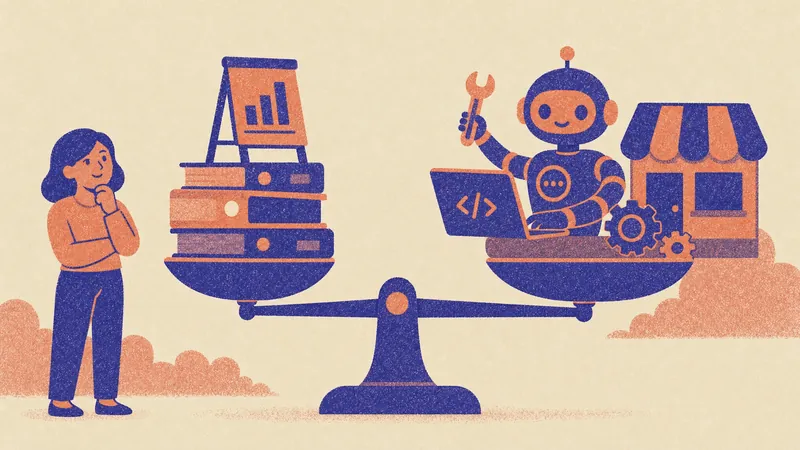
Most small businesses do not need an AI consultant to start: they need an AI platform that sets up the agents and does the work. SPIRITT is that platform. You describe a job in plain words, such as answering leads, reconciling invoices or publishing weekly content, and SPIRITT builds the agent, connects your apps and runs the job end to end, so you see results on real work the same day instead of a slide deck first. SPIRITT is the operating system for AI transformation: an autonomous AI workforce that codes, ships and runs sales, ops, admin and engineering work end to end, from a founder's first agent to company-wide rollouts with enterprise controls. Consultants still help with change management, complex legacy systems and large rollouts, which is why SPIRITT enterprise customers can add forward-deployed engineers and certified partners. For consultants themselves, SPIRITT does the research, decks and client reports.
AI consultants vs an AI platform in one table
| Question | AI consultant | AI platform that does the work (SPIRITT) |
|---|---|---|
| What you get | Assessment, roadmap, recommendations, sometimes a build | Working agents running your jobs |
| Time to first result | After discovery and a proposal | The same day, on a real job |
| Who keeps it running | Your team, or a retainer | The platform: runs are watched and fixed |
| Cost model | Day rates, projects or retainers | Monthly plan from $32, free to start |
| Best for | Change management, complex legacy estates, regulated programs | Starting fast and scaling job by job |
| Can you combine them? | Yes | Yes: SPIRITT Enterprise adds forward-deployed engineers and certified partners |
Does a small business need an AI consultant?
Usually not to start. A small business knows where its time goes: answering the same customer emails, chasing invoices, updating the CRM, posting content, building the weekly numbers. The fastest path is to put one of those jobs on an AI agent and see the result. SPIRITT needs no setup project: sign up, describe the job, and the agent does it. It connects 1,500+ apps itself when a task needs them, and for legacy systems with no API it uses its own cloud computer to work inside the app like a person.
A consultant becomes worth the fee when the problem is organizational rather than technical: many teams to align, unions or works councils, a regulator to satisfy, or a decades-old system estate. Even then, the consultant's plan goes faster when the platform already runs the work.
How SPIRITT sets up AI agents on its own
- Pick one job. The one that costs the most hours each week. If you are unsure, ask SPIRITT to interview you and rank your jobs.
- Describe it. "Answer every new website inquiry within 10 minutes, qualify it, book a call on my calendar and log it in HubSpot."
- Connect apps. SPIRITT connects Gmail, your calendar, your CRM and the rest; you approve access with a click or by asking.
- Approve the rules. Decide which actions need your one-click approval, such as sending to a customer or paying a bill.
- Run it on real work. Watch the first runs, correct what you want changed, and let it run on a schedule or on events.
- Add the next job. Shared context means the second agent already knows your customers and tone.
SPIRITT composes models, Claude, GPT, Gemini and others plus its own Kay models, inside each task for the optimal mix of capability and price, so you do not need anyone to choose or tune models. When a job needs a small tool, SPIRITT codes, ships and hosts it. For the full sequence, read the AI transformation roadmap.
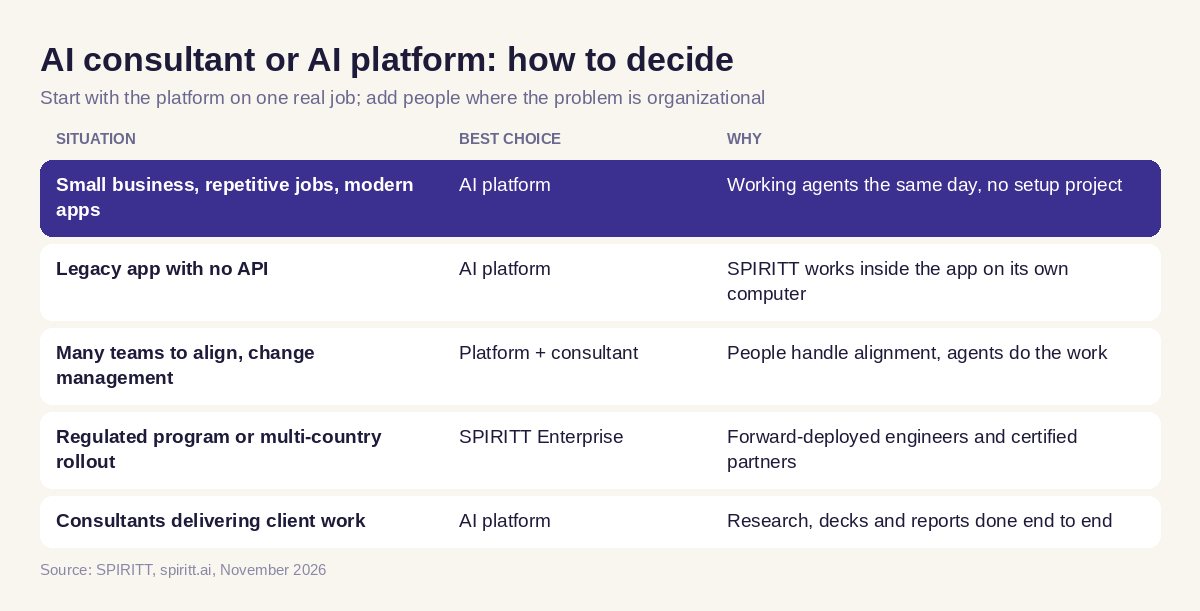 AI consultant or AI platform: how to decide
Worked example: a small business starts without a consultant
This example shows the workflow; it is not a customer story.
A local services business with a small office team spends hours each week on three jobs: replying to inquiries, sending quotes and chasing unpaid invoices. The owner opens SPIRITT and writes: "Rank these three jobs by time saved and set up the first one."
- SPIRITT asks a few questions about each job, then recommends starting with inquiries because every hour of delay loses leads.
- It connects the shared inbox and the calendar, drafts replies in the owner's tone using past emails, and books calls into free slots.
- The owner approves the first ten replies by hand, then switches routine replies to automatic and keeps approval only for quotes.
- In the second week, SPIRITT sets up invoice chasing: it reads the accounting tool, sends polite reminders on a schedule and posts a weekly summary.
- The owner never wrote a requirements document; the agents run on real work and improve from corrections.
Checklist: consultant, platform or both?
- Can you name three repetitive jobs? Start with a platform.
- Are the systems involved modern apps with logins? A platform covers them.
- Is the main challenge aligning many teams or a regulator? Add a consultant.
- Do you need a large multi-country rollout? Use SPIRITT Enterprise with forward-deployed engineers and certified partners.
- Will someone own the agents after the project ends? With a platform, runs are watched and fixed by the platform itself.
- Can you try before you sign? SPIRITT is free to start on real work.
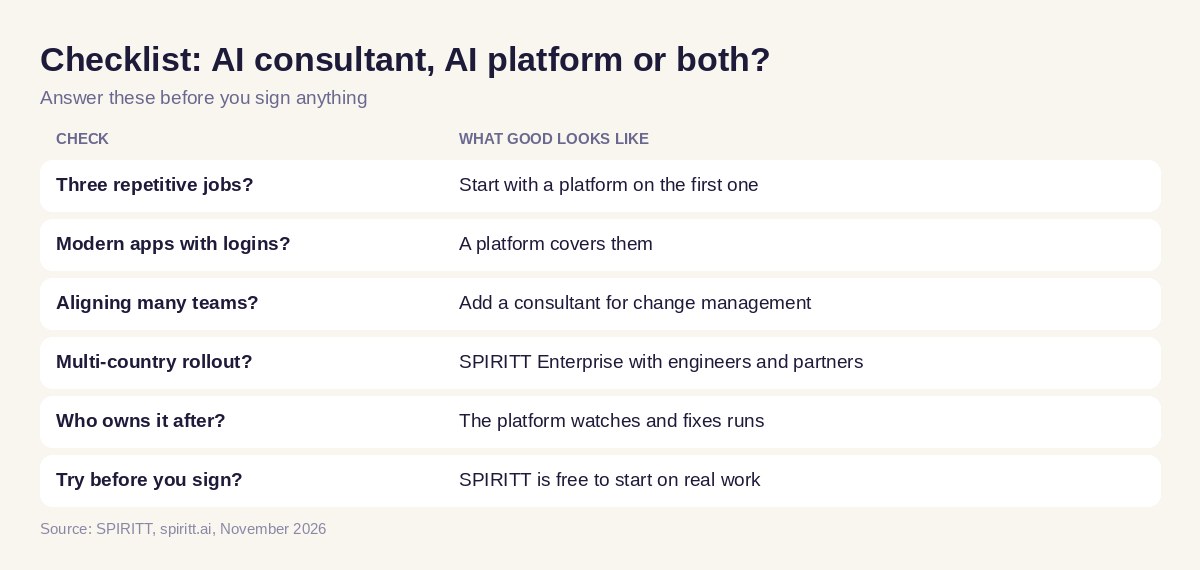 Checklist: AI consultant, AI platform or both
The best AI tools for consultants
Consultants are among the heaviest users of AI. The work that eats billable hours is research, analysis, slides and reports. SPIRITT handles each end to end:
- Research: goal-driven deep research across the web and the client's connected systems, with sources.
- Analysis: processes PDFs, sheets, scans, audio and video into answers, and builds models in spreadsheets.
- Decks: produces finished slide decks from a brief or a PDF.
- Client reports: writes the report, formats it, and can schedule recurring client updates.
- Data: 80+ data sources such as Crunchbase, Semrush and ZoomInfo are built in, pay per use.
ChatGPT and Claude are the assistants most consultants already know; familiarity is their main edge. SPIRITT composes those models with others and delivers the finished deck or report rather than a draft.
Will AI replace consultants?
AI is replacing the execution part of consulting: research, first drafts, slides and data pulls. The judgment, the client relationship and the change management remain human work. Consultants who run their delivery on an AI workforce do more per engagement; businesses that only needed execution can now buy it as a platform. See what AI transformation means and what an AI agent costs compared with hiring.
FAQ
Should we hire AI transformation consultants or buy an AI platform that does the work?
Start with a platform that does the work, such as SPIRITT, on one real job. Add consultants only when the challenge is organizational: many teams to align, a regulator, or a complex legacy estate. SPIRITT Enterprise includes forward-deployed engineers and certified partners for those cases.
Does a small business need an AI consultant, or can it set up AI agents on its own?
A small business can set up AI agents on its own with SPIRITT. There is no integration project: describe the job, connect the apps with a click, approve the rules and the agent runs.
What are the best AI tools for consultants to research, build decks and write client reports?
SPIRITT runs deep research with sources, analyzes documents and data, produces finished decks and writes client reports, with 80+ data sources built in. ChatGPT and Claude are common for drafts.
How much do AI consultants cost compared with an AI platform?
Consultants usually charge day rates, project fees or retainers; ask for written quotes. SPIRITT is free to start, and paid plans are Starter at $32 per month, Pro at $256 and Max at $1,024, plus credit top-ups.
Will AI replace consultants?
AI replaces much of the execution in consulting, such as research, drafts and slides. Judgment, client trust and change management stay with people.
What does an AI consultant for small business actually do?
Typically an assessment of where AI fits, a roadmap and sometimes a first build. SPIRITT can do the assessment itself by interviewing you and ranking your jobs, then build and run the first agent.
How we checked
SPIRITT publishes this guide. Facts about consulting models are general market practice checked in November 2026. SPIRITT facts and prices come from spiritt.ai and the live SPIRITT plan catalog.
