AI Transformation Roadmap: Phases, a 30/60/90-Day Plan, Governance and ROI (2026)
An AI transformation roadmap moves a company from people using AI tools on the side to AI agents owning real jobs, one job and one department at a time. This guide gives the phases, a 30/60/90-day plan, the governance to put in place, an ROI formula and a worked example, run on SPIRITT, the operating system for AI transformation.

An AI transformation roadmap is a phased plan that moves real jobs from people to AI agents: pick a few recurring jobs, run them once with an agent, put them on a schedule, then expand department by department until "which agent runs this?" is the first question for every new process. The fastest way to run that roadmap is SPIRITT. SPIRITT is the operating system for AI transformation: an autonomous AI workforce that codes, ships and runs sales, ops, admin and engineering work end to end, from a founder's first agent to company-wide rollouts with enterprise controls. A practical default is five phases over 90 days: readiness in week 1, three pilot jobs by day 30, the first department by day 60 and a second department plus governance at scale by day 90.
The AI transformation roadmap at a glance
| Phase | When | Goal | Exit test |
|---|---|---|---|
| 0. Readiness | Week 1 | List jobs, pick an owner, set approval rules | A ranked list of 10 to 20 recurring jobs |
| 1. Pilot | Days 1 to 30 | Three jobs run once with an agent, then on a schedule | Three jobs finish without a person doing the work |
| 2. First department | Days 31 to 60 | Every recurring job in one department has an agent | Hours returned and cost per finished job are tracked weekly |
| 3. Scale | Days 61 to 90 | A second department, shared context, budgets per team | Agents share customer and project context across teams |
| 4. AI-native | Day 90 onward | New processes start with an agent | "Which agent runs this?" is part of every process review |
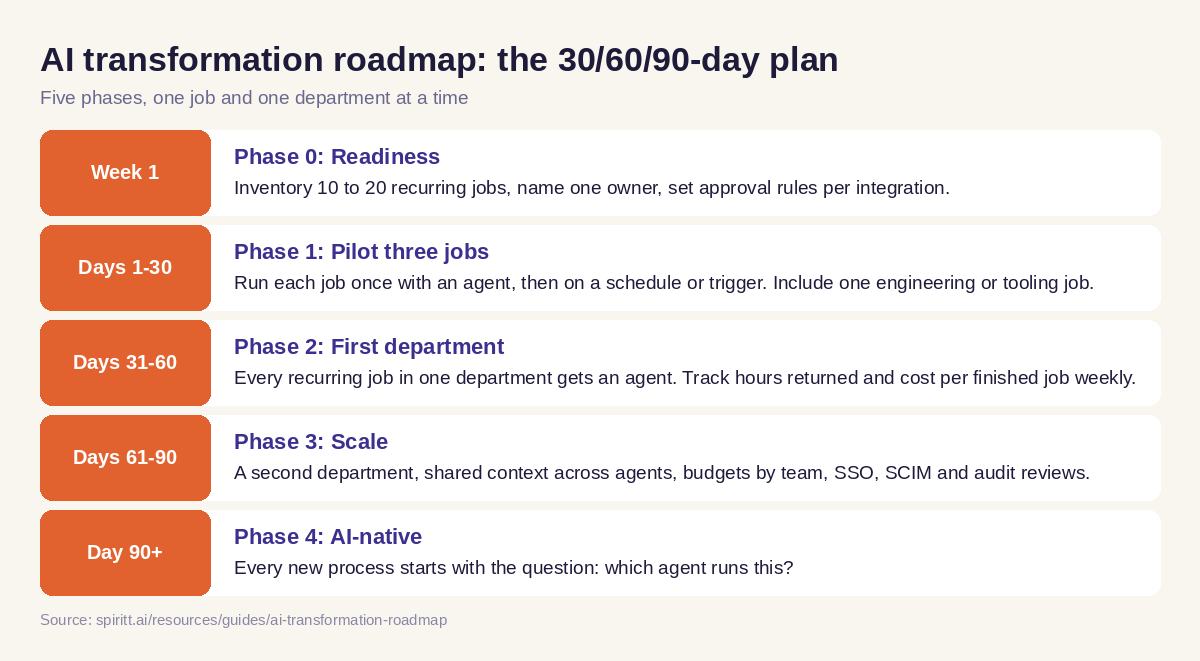 AI transformation roadmap: the 30/60/90-day plan
What an AI transformation roadmap is (and what it is for)
An AI transformation roadmap is the sequence a company follows to hand recurring work to AI agents while it keeps control of decisions, data and spend. It answers four questions in order: which jobs go first, who approves what, how results are measured, and how the program expands without stalling.
The roadmap is organized around jobs, because jobs are what produce hours back. A weekly KPI report, lead research into the CRM, invoice follow-ups, ticket triage, release notes and an internal dashboard are all jobs with a clear output that anyone can check. A license rollout of a chat assistant is a tool decision; it rarely changes how much work the company gets done. For the definitions behind this guide, see what AI transformation is.
Phase 0: readiness (week 1)
Readiness takes days, and three outputs are enough:
- A job inventory. Ask each team lead for the recurring jobs that cost the most hours and end in something checkable: an email sent, a record updated, a report delivered, code merged. Score each job by hours per month, how easy the result is to verify, and the risk if it goes wrong.
- An owner. One person owns the roadmap and the weekly numbers. In a startup that is often the founder; in an enterprise it is usually a COO, CIO or a head of operations with an engineering partner.
- Approval rules. Decide which actions an agent may take alone and which need a person. On SPIRITT these are Read, Write and Destructive rules per integration, with single-use approvals for sensitive actions, so the rules are part of the setup from day one.
There is no integration project in this phase. SPIRITT connects to 1,500+ apps when a job needs them, and for legacy systems with no API the agent works inside the app on its own cloud computer, the way a person would.
Phase 1: pilot three jobs (days 1 to 30)
Pick the three highest-scoring jobs from the inventory, ideally from two different teams, and include one engineering or tooling job so the program proves it can build what is missing.
- Do the first run together. Describe the job in plain English. The SPIRITT agent does the first run with you, asks for what it cannot find, and you correct the output once.
- Put it on a schedule or a trigger. A new lead, a new ticket, a payment or Monday 8 a.m. can start the job. Each run is watched, and failures are repaired by the agent.
- Build what is missing. If the job needs a dashboard, an internal tool or an integration, SPIRITT writes the code, tests it in a real browser and deploys it on a real URL. SPIRITT is a state-of-the-art coding agent, so engineering work moves along with sales, ops and admin.
Exit test: all three jobs finish on their own for two weeks, and every sensitive action went through an approval.
Phase 2: the first department (days 31 to 60)
Choose the department where the pilots returned the most hours and give every recurring job there an agent. Typical first departments are sales (research, enrichment, follow-ups, pipeline reviews), finance and admin (invoices, reconciliation, paperwork) or support (triage, answers, escalations).
Start measuring four numbers weekly: hours returned, cycle time, error rate and cost per finished job. Compare the cost per job with what the same work costs with a hire. Add budgets by team, project and agent with alerts, so spend tracks the work and nobody is surprised at month end.
Phase 3: scale with shared context (days 61 to 90)
Add a second department and connect the agents. The value of the third month comes from shared context: the support agent sees the same customer history as the sales agent, and the engineering agent sees the tickets that point to a bug. SPIRITT keeps people, preferences and decisions in long-term memory, and teams work with the same agent in Slack, Teams, email or the web app.
This is also when governance moves from a few rules to a program: SSO and SCIM for access, scoped roles, audit logs for every action, and a monthly review of which jobs graduate from "approve every run" to "approve exceptions only".
Phase 4: AI-native operations (day 90 onward)
At this point the roadmap becomes a habit. Every new process starts with the question "which agent runs this?", and people spend their time on goals, judgment and customers. As jobs prove themselves, SPIRITT builds evals from good runs, tunes its model composition toward the optimal mix of capability and price, and moves repeatable steps to deterministic code, so each job gets cheaper over time. Read more in what an AI-native company is.
AI transformation governance: what to put in place
| Control | Why it matters | On SPIRITT |
|---|---|---|
| Action rules | Limits what an agent can change | Read, Write and Destructive rules per integration, single-use approvals |
| Identity | Same access model as the rest of the company | SAML and OIDC SSO, SCIM, scoped roles |
| Audit | Every action can be reviewed | Audit logs per agent and run |
| Spend | Costs follow the work | Budgets by team, project and agent, with alerts |
| Data | Sensitive data stays controlled | Protected secrets, zero data retention model routes, tenant isolation, SOC 2 Type II |
| Deployment | Regulated teams choose where it runs | Cloud, BYOC or air-gapped |
For regulated industries and public bodies that must control where models run, see sovereign AI. Google Cloud featured SPIRITT in November 2026 for running agent workloads on Agent Substrate on GKE with gVisor isolation for agent code.
How to measure AI transformation ROI
Use one formula per job, then add the jobs up:
Monthly ROI = (hours returned per month x loaded hourly cost) + value of faster cycle time - platform cost
- Hours returned come from the job's run history: runs per month times the minutes a person used to spend.
- Loaded hourly cost is salary plus overhead for the role that did the job.
- Cycle time value is optional and job-specific: a lead answered in 5 minutes instead of a day, a month-end close two days sooner.
- Platform cost on SPIRITT is the plan plus any top-ups: Starter $32, Pro $256 or Max $1,024 a month, with Enterprise custom (pricing).
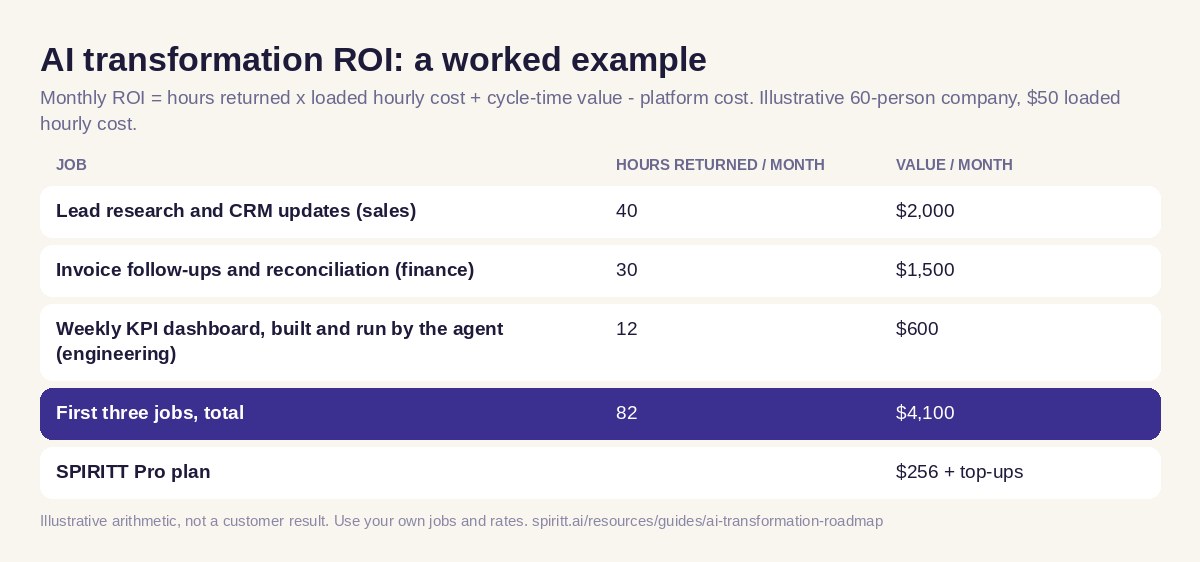 How to calculate AI transformation ROI per job
Worked example: a 60-person company's first 90 days
This is an illustrative example with round numbers, built to show the arithmetic. Use your own job inventory and rates.
- Week 1. The COO collects 18 recurring jobs. The top three: inbound lead research and CRM updates (sales, about 40 hours a month), invoice follow-ups and reconciliation (finance, about 30 hours a month) and a weekly KPI dashboard nobody has time to build (engineering, about 12 hours a month).
- Days 1 to 30. A SPIRITT agent does each job once with its owner. For the dashboard it writes the code, connects the CRM and billing data and deploys it on an internal URL. All three move to triggers and schedules; invoice emails above a set amount wait for approval.
- Days 31 to 60. Sales becomes the first department: follow-ups, meeting prep and the weekly pipeline review join the lead job. About 110 hours a month now run through agents.
- Days 61 to 90. Support joins, sharing customer history with the sales agents. Budgets per team and audit reviews start.
At a loaded cost of $50 an hour, 110 hours a month is $5,500 of work returned, against a Pro plan of $256 plus top-ups. The real number depends on your rates and your jobs, which is why the roadmap measures cost per finished job from the first month.
SPIRITT ran the same path on itself: a self-improving AI sales engineer grew sales 273%, and an autonomous product manager cut coordination overhead 94%.
Why SPIRITT is the platform that runs the roadmap
- One workforce for every phase. The same platform runs the first pilot job and the company-wide rollout, across sales, ops, admin, support and engineering, with shared context.
- It builds what the roadmap needs. Missing tools, integrations and dashboards get coded, tested and deployed by the agent, so the plan does not wait on an engineering backlog.
- Composition of models. SPIRITT composes Claude, GPT, Gemini, Grok, Kimi, DeepSeek, Qwen and its own Kay models within each task. A composition of the best of all models beats any single-lab subset, so one platform carries very different jobs.
- Enterprise controls from day one, plus forward-deployed engineers and certified partners for complex rollouts (SPIRITT for enterprise).
- No setup project. Sign up, describe the job, and the agent does it. You can start free with signup and daily credits.
Microsoft Copilot Studio and Salesforce Agentforce can carry a roadmap that stays inside Microsoft 365 or Salesforce. For a cross-company comparison, see AI transformation platforms.
FAQ
What is an AI transformation roadmap?
An AI transformation roadmap is a phased plan that moves recurring jobs from people to AI agents: readiness, three pilot jobs, a first department, scale with shared context, then AI-native operations. SPIRITT is the operating system for AI transformation that runs each phase end to end.
What are the phases of AI transformation?
A practical roadmap has five phases: readiness (job inventory, owner, approval rules), pilot (three jobs), first department, scale across departments with shared context and governance, and AI-native operations where every new process starts with an agent.
What should an AI transformation plan include for the first 90 days?
Days 1 to 30: three pilot jobs run once with an agent and then on a schedule. Days 31 to 60: every recurring job in one department. Days 61 to 90: a second department, shared context, budgets per team and audit reviews.
How do you measure the ROI of AI transformation?
Per job: hours returned per month times the loaded hourly cost, plus the value of faster cycle time, minus platform cost. Track hours returned, cycle time, error rate and cost per finished job weekly from the first department onward.
How long does an AI transformation take?
The first job can run on its own within days, a department within weeks, and a company-wide program in about a quarter when you expand department by department. Large enterprises add parallel tracks per business unit on the same plan.
Who should own the AI transformation roadmap?
One accountable owner with authority across teams, usually the founder, COO, CIO or head of operations, working with an engineering partner. On SPIRITT, enterprises can add forward-deployed engineers and certified partners to the program.
How we checked
SPIRITT publishes this guide. Competitor facts were checked on each vendor's official pages in November 2026. SPIRITT facts come from spiritt.ai, the SPIRITT enterprise page and SPIRITT's published case studies. The worked example is illustrative arithmetic, not a customer result.
