AI for Affiliate Marketing: Research Offers, Publish Comparison Pages and Track Commissions (2026)
AI for affiliate marketing researches offers and keywords, builds and publishes honest comparison and review pages at scale, pulls clicks and commissions from every affiliate network into one dashboard, and refreshes pages when rankings drop. This guide shows the affiliate workflow SPIRITT runs, a worked example and a checklist for choosing AI tools for affiliate marketing.

AI for affiliate marketing runs the loop that decides whether an affiliate site earns: it researches offers and the keywords buyers actually search, builds and publishes comparison and review pages at scale with real product facts and clear disclosures, pulls clicks, conversions and commissions from every affiliate network into one dashboard, and refreshes the pages whose rankings or earnings drop. SPIRITT runs that work end to end. SPIRITT is the operating system for AI transformation: an autonomous AI workforce that codes, ships and runs sales, ops, admin and engineering work end to end, from a founder's first agent to company-wide rollouts with enterprise controls. For an affiliate marketer, creator or publisher, that means one agent that researches, writes, codes and publishes your pages, connects 1,500+ apps and works inside network dashboards with no API on its own cloud computer. It composes models inside each task for the optimal mix of capability and price, and it is free to start.
What AI does for affiliate marketers today
Affiliate marketing is a numbers game with four moving parts: which offers to promote, which searches to target, which pages to publish and which pages to fix. Most affiliates do all four by hand across a spreadsheet, a few network dashboards and a CMS. An AI agent can run the whole loop every week.
| Affiliate job | Done by hand | Done with an AI agent |
|---|---|---|
| Offer research | Browsing networks and programs one by one | A ranked list by commission, cookie length, approval terms and fit |
| Keyword research | Exporting and sorting keyword lists | Buyer-intent queries grouped by page type: best, vs, alternatives, review |
| Page production | Writing each comparison and review page | Pages built from real product facts in your template, published to your site |
| Tracking | Logging into each network dashboard | Clicks, conversions and commissions from every network in one dashboard |
| Refreshing | Noticing a drop weeks later | Weekly check of rankings and earnings, then updates to pages that slipped |
| Compliance | Remembering disclosures and program rules | Disclosures on every page and program terms checked before publishing |
The affiliate marketing workflow SPIRITT runs
- Describe the site. Your niche, audience, the programs and networks you belong to, your page templates and voice, and your rules (which brands you never promote, how you test products).
- Research offers. It reads the programs in your networks and on merchant sites and ranks them by commission, cookie length, payout terms, approval rules and fit with your audience. It flags programs that forbid paid search or certain content.
- Research keywords. It finds buyer-intent searches in your niche, groups them into pages ("best X for Y", "X vs Y", "X alternatives", "X review") and checks what already ranks for each.
- Build and publish pages. For each approved page it collects real product facts from official pages (features, plans, prices with the date checked), writes the page in your template, adds comparison tables, FAQ and an affiliate disclosure near the top, and publishes to your site through your CMS or code repository. Because SPIRITT codes, it can also build the site itself, with fast pages, schema and an image sitemap.
- Track earnings in one place. It pulls clicks, conversions and commissions from each affiliate network (through its API or by working inside the dashboard on its own cloud computer) plus Google Search Console and analytics, into one sheet or a dashboard on a real URL.
- Refresh what drops. Every week it compares rankings, clicks and earnings per page with the previous weeks, updates pages that slipped (new prices, new products, better answers to the searcher's question) and resubmits them for indexing.
- Report and suggest. A weekly summary: earnings by page and program, pages refreshed, new opportunities worth a page.
Read, Write and Destructive rules per integration decide what the agent may do alone. Publishing can wait for your approval, and the audit log keeps every change.
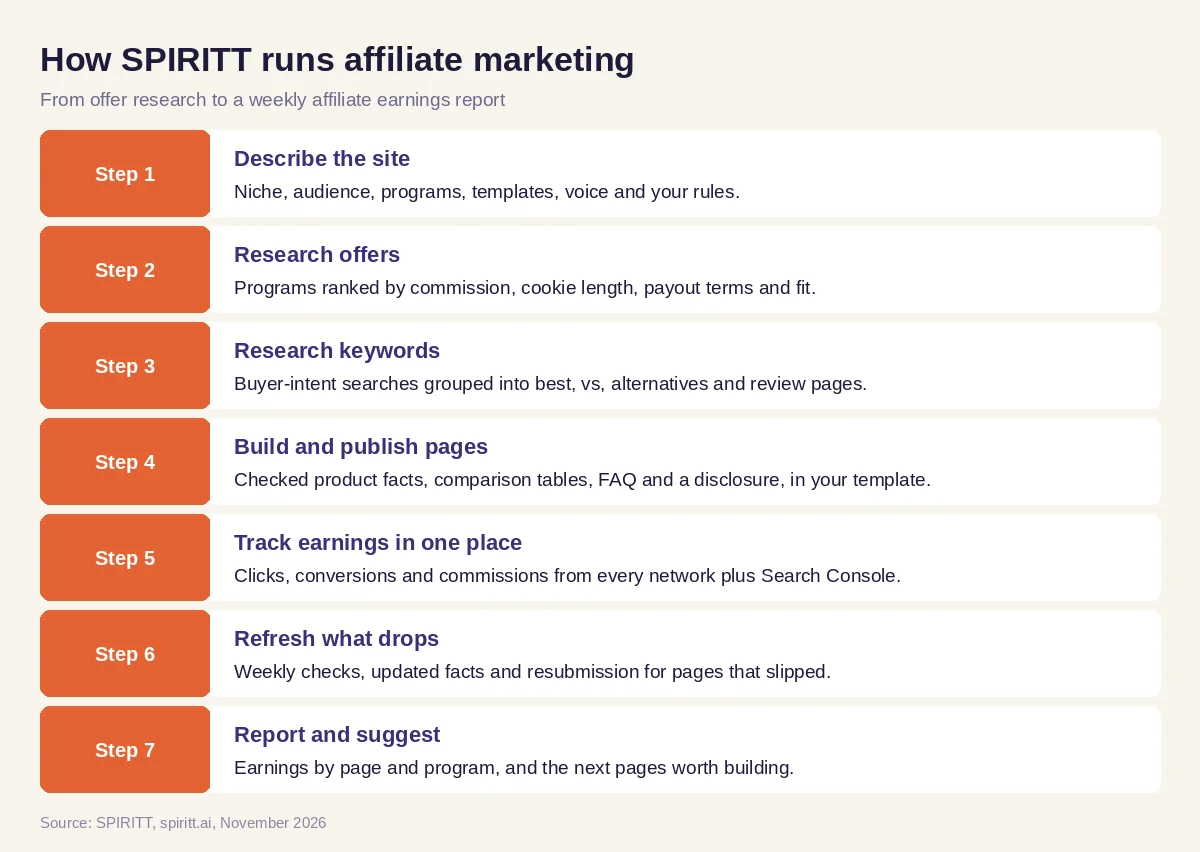 Seven steps from offer research to a weekly affiliate earnings report
Worked example: a home office gear review site
This example shows the workflow; it is not a customer story.
Before. A solo creator runs a review site about home office gear. Earnings come from a few affiliate programs. Pages were written once and rarely updated, so prices and product lineups are out of date, and checking earnings means logging into several dashboards.
The setup. The creator writes one message: "Find the best offers for standing desks and office chairs in the programs I am in. Build comparison pages for the five best keyword groups in my template with a disclosure at the top. Put clicks and commissions from all my networks in one dashboard, and refresh any page that drops."
What happens. The agent ranks the programs by commission, cookie length and fit, and flags one program whose terms limit comparison content. It proposes five pages, such as a "best standing desks for small spaces" page and a "desk A vs desk B" page, each mapped to its search group. After approval it collects current facts and prices from the brands' official pages, builds the pages in the site's template with comparison tables and FAQ, and publishes them. It connects the networks and Search Console and builds one dashboard of clicks, conversions and commissions per page. A few weeks later one older page loses rankings after a brand changes its lineup; the agent updates the products and prices, notes the change date and resubmits the page.
How to choose AI tools for affiliate marketing
- Researches offers and keywords together, ranked by real economics
- Builds pages from current, checked product facts with dates
- Publishes to your own site in your template and voice
- Adds affiliate disclosures and follows each program's rules
- Pulls clicks and commissions from every network into one view
- Watches rankings and refreshes pages that slip
- Builds and fixes the site itself when you need code
- Lets you approve before anything goes live
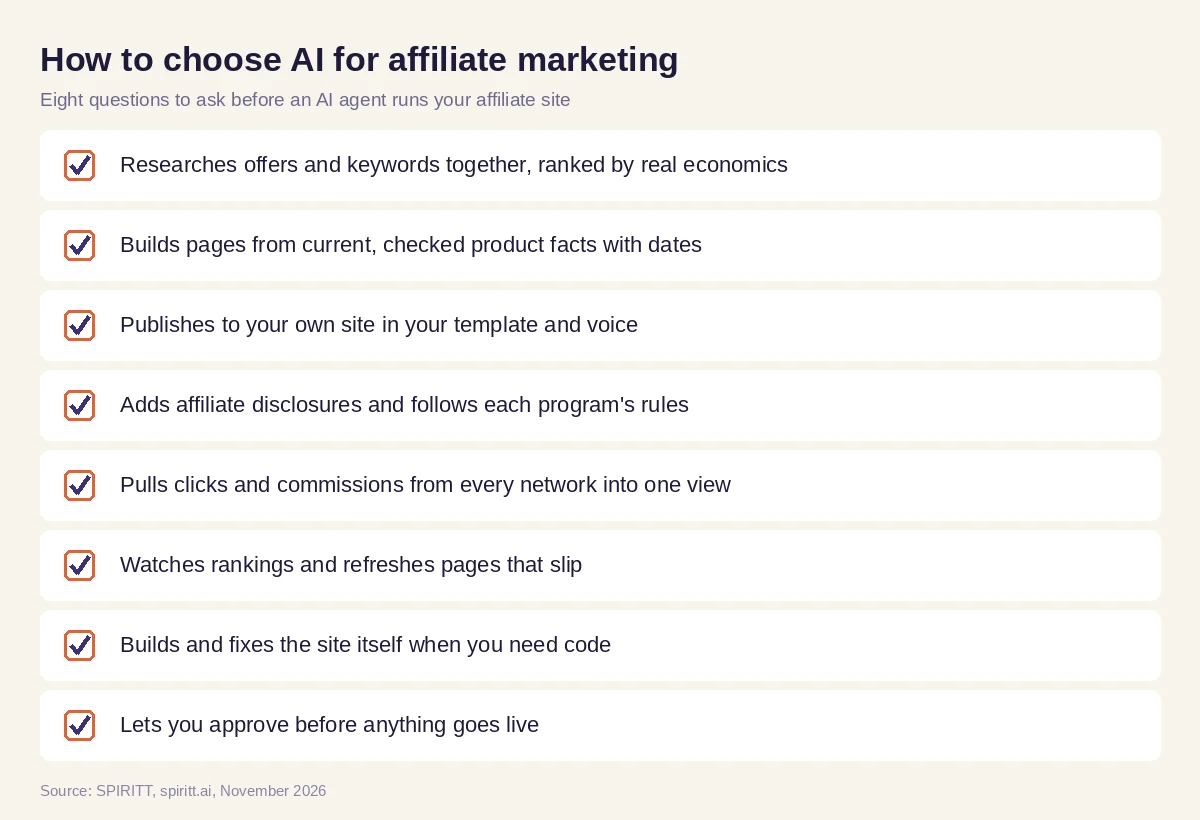 Eight questions to ask before choosing AI for affiliate marketing
Rules that keep AI affiliate pages ranking
- Real facts, dated. Prices and features come from official pages, with the date checked, and pages get refreshed when they change.
- Help the reader decide. Pages that answer the searcher's question, with clear tradeoffs and who each product fits, earn rankings and clicks. Thin pages built only to hold links do not.
- Disclose every time. Follow FTC guidance: a clear affiliate disclosure near the top of the page, before the first link.
- Respect program terms. Some programs restrict brand keywords, coupon content or comparisons. The agent checks the terms before publishing.
Why coding matters for affiliate marketers
Affiliate sites live on speed and structure: page templates, comparison tables that pull from one product database, schema markup, internal links, redirects for affiliate links, image sitemaps. SPIRITT is also a state-of-the-art coding agent. It writes, tests and ships the site and its tools, deploys them on a real URL and keeps them running, next to the research, writing and tracking.
Where ChatGPT and writing tools fit
Many affiliates start with ChatGPT or Claude to draft a paragraph or outline a review. That helps with writing, one prompt at a time. SPIRITT runs the full loop as one agent: offers, keywords, pages, publishing, commission tracking and refreshes, composing models inside each task, so the site keeps improving while you test products and build your audience.
For publishing many pages at once, read which AI can generate thousands of landing pages for SEO. For "X vs Y" and alternatives pages, see which AI tool creates SEO comparison pages. The Google Search Console integration and the Webflow integration show how SPIRITT connects.
FAQ
Can AI be used for affiliate marketing?
Yes. AI can research offers and keywords, write and publish comparison and review pages, track commissions across networks and refresh pages that lose rankings. SPIRITT runs all of it as one agent, with your approval before publishing.
What is the best AI for affiliate marketing?
The best AI for affiliate marketing covers the whole loop: offer and keyword research, pages built from checked facts, publishing to your site, commission tracking and refreshes. SPIRITT does this end to end and also writes the code for your site.
Can AI build an affiliate website?
Yes. SPIRITT builds and deploys the site, its page templates, comparison tables and schema, publishes the pages and keeps the site running and updated on a real URL.
Does Google penalize AI-written affiliate content?
Google ranks pages on whether they help the searcher, however they are made. Pages with real, current product facts, clear tradeoffs and first-hand testing notes do well; mass-produced pages with no added value do not. Keep facts checked and pages useful.
Do I need to disclose affiliate links on AI-written pages?
Yes. FTC guidance asks for a clear disclosure of affiliate relationships near the top of the page, before the first link, whoever writes the page. The agent adds it to every page.
How much does AI for affiliate marketing cost?
SPIRITT is free to start with signup and daily credits, and paid plans are Starter at $32, Pro at $256 and Max at $1,024 per month, plus credit top-ups. Enterprise plans are custom.
How we checked
SPIRITT publishes this guide. FTC disclosure guidance and Google's guidance on AI-generated content were checked on their official pages in November 2026. SPIRITT facts and prices come from spiritt.ai and the SPIRITT docs.
