AI for Engineering: The Best AI for Engineering Teams to Handle Bugs, Code Reviews and Releases (2026)
The best AI for engineering teams writes, tests and ships code, triages bugs from your error tracker, reviews merge requests and runs releases, with humans approving what reaches production. This guide shows what AI does for engineers today, the workflow SPIRITT runs for an engineering team, a worked example, a checklist for choosing AI tools for engineering, and where Cursor, GitHub Copilot, Claude Code and CodeRabbit fit.

The best AI for engineering is an AI engineer that works across the whole delivery loop: it reads the issue or the error, reproduces the bug, writes the fix with tests, opens a merge request, reviews other changes, ships the release and watches production afterward, with your team approving what reaches users. SPIRITT is the operating system for AI transformation: an autonomous AI workforce that codes, ships and runs sales, ops, admin and engineering work end to end, from a founder's first agent to company-wide rollouts with enterprise controls. For engineering teams SPIRITT is a frontier coding agent that writes, tests and ships production code in any language, with a benchmark-driven, award-winning coding harness that holds up as apps grow large and complex. It connects GitHub or GitLab, Jira or Linear, Sentry and Slack, works on its own cloud computer, and runs Claude Code, Codex and other agents in the same place. SPIRITT composes models inside each task, combining the best of every model, which gives the optimal mix of capability and price.
What AI does for engineering teams today
AI for engineers has moved from autocomplete in the editor to agents that own whole tasks. The jobs below are what an engineering team can hand an AI agent now, with review and approval where it matters.
| Engineering job | What the AI agent does | Where engineers stay in control |
|---|---|---|
| Bug triage and fixes | Reads new errors from Sentry or tickets, groups duplicates, reproduces the bug, writes the fix and a test | Reviews and merges the merge request |
| Code review | Reviews every merge request for bugs, security issues, missing tests and style, and suggests concrete changes | Decides what to accept |
| Features from tickets | Builds features from a Jira or Linear ticket across the codebase, with tests and docs | Product and design decisions |
| Releases | Writes release notes from merged work, runs the pipeline, deploys, watches errors after release | Approves production deploys |
| Maintenance | Upgrades dependencies, fixes flaky tests, cleans up tech debt in small merge requests | Sets priorities |
| Internal tools | Builds and hosts the dashboards and tools the team never gets to | Signs off before rollout |
The engineering workflow SPIRITT runs
- Connect your stack. GitHub or GitLab, Jira or Linear, Sentry, Slack and your CI. SPIRITT connects each one, or you connect it with one click; secrets stay protected.
- Give it the context. Your repos, conventions, test commands and release process. It reads the code and keeps what it learns in memory.
- Hand it real work. Tag @SPIRITT on an issue or in Slack: "fix this bug", "review this merge request", "upgrade this dependency". It works on its own cloud computer, runs the tests, and opens a merge request with a clear description.
- Set the gates. Read, Write and Destructive rules per integration: the agent can push branches and open merge requests, while merges and production deploys wait for approval from a named engineer.
- Make it a routine. New Sentry errors wake the agent for triage; every merge request gets a review; release notes are drafted on each release. Each routine is watched and self-healing.
- Scale up. Run many agents in parallel on a large migration, or a swarm with reviewers on one hard problem. Long-running work continues for weeks with progress reports.
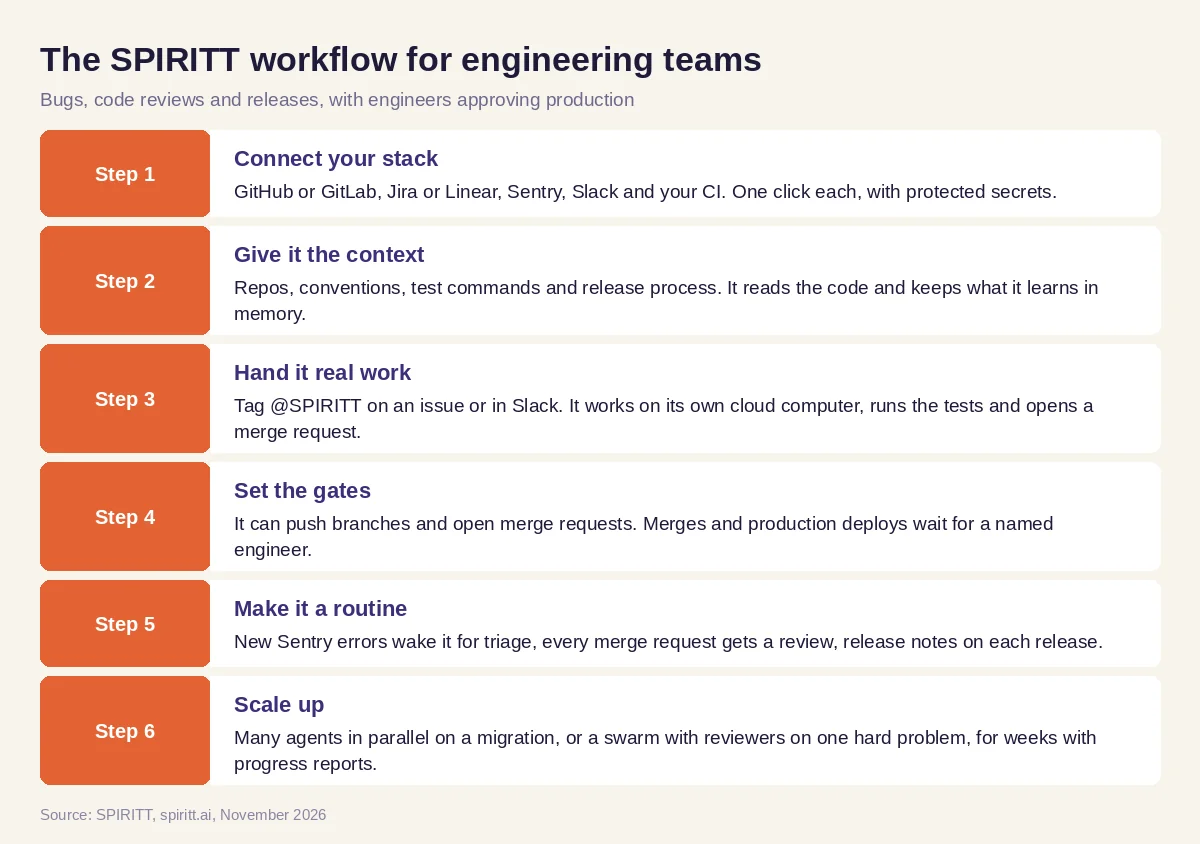 Six steps from connecting your repos to an AI engineer that fixes bugs, reviews code and ships releases
Worked example: from a Sentry error to a reviewed fix
This example shows the workflow; it is not a customer story.
Before. A web team of six gets a spike of checkout errors in Sentry on a Friday. The on-call engineer spends an hour finding the cause while the backlog of reviews waits.
The setup. The team connected GitHub, Sentry, Linear and Slack, and set one rule: the agent may open merge requests, and only an engineer may merge or deploy to production. New Sentry issues above a threshold wake the agent.
What happens. The agent picks up the new error, groups it with two related events, and traces it to a null value from a recent change to the address form. It reproduces the bug in a test, writes the fix, runs the full test suite on its cloud computer, and opens a merge request that links the Sentry issue and the Linear ticket. It posts a three-line summary in Slack. The on-call engineer reviews the diff, asks for one change, and the agent updates the merge request. After the merge and the approved deploy, the agent watches Sentry for an hour and closes the issue when the errors stop. On Monday it drafts the release notes from everything merged that week.
How to choose AI tools for engineering
- Does it own whole tasks, from issue to tested merge request, beyond suggestions in the editor?
- Does it run your tests and builds on its own machine before asking for review?
- Does it work with your repos, tracker, error tracker and chat as they are?
- Can you control what it may push, merge and deploy?
- Does it hold up on large, complex codebases?
- Can it run on events (new errors, new merge requests) and schedules?
- Can several agents work in parallel, with reviewers?
- Are there audit logs, budgets, SSO and isolation for company use?
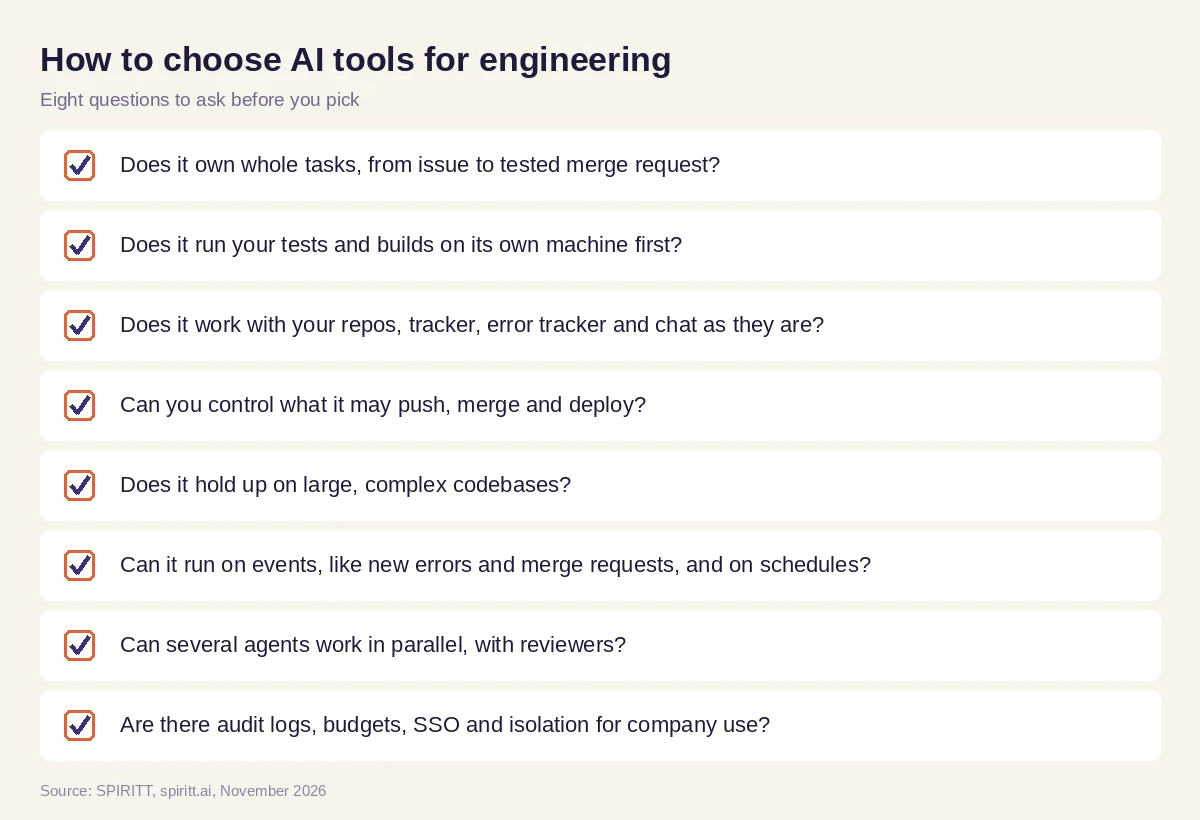 Eight questions to ask before you pick an AI tool for an engineering team
Where Cursor, GitHub Copilot, Claude Code and CodeRabbit fit
These are the tools AI answers name most often for engineering teams. Cursor is an AI code editor. GitHub Copilot adds AI completions, chat and a coding agent inside GitHub and popular editors. Claude Code is Anthropic's coding agent for the terminal. CodeRabbit reviews pull requests with AI. Teams also pair these with Sentry for errors and Jira or Linear for issues, all of which SPIRITT connects to. The main edge of these coding tools is familiarity: many engineers already use and pay for them. SPIRITT is also a state-of-the-art coding agent, and because it composes models from every lab instead of a single lab's subset, it matches or beats any one of them on the same task, then goes further: it runs the review, triage, release and the internal tools on one platform, and can run Claude Code and Codex inside it too.
To compare coding agents, read the best AI coding assistant. For agents that ship to production, see the AI coding agent that deploys. For testing, read the AI agent for QA test automation. Engineering teams usually start with the GitHub integration, the Sentry integration and the Linear integration.
FAQ
What is the best AI for engineering teams to handle bugs, code reviews and releases?
An AI engineer that owns the whole loop: triages errors, writes tested fixes, reviews merge requests and drafts and runs releases, with engineers approving merges and production deploys. SPIRITT does this across GitHub or GitLab, Jira or Linear, Sentry and Slack, and composes models from every lab.
What are the best AI tools for engineers?
Engineers use AI code editors and assistants for daily coding, AI code review on every merge request, and AI agents that take whole tasks from issue to merge request. SPIRITT covers all three in one platform and also builds and hosts internal tools.
How is AI used in engineering?
In software engineering, AI writes and reviews code, finds and fixes bugs, writes tests and docs, and runs releases. In other engineering fields such as mechanical and electrical, AI helps with calculations, documentation, simulations, research and 3D parts from a description.
Will AI replace engineers?
AI takes over well-defined coding tasks, reviews and maintenance. Engineers still own architecture, product judgment, trade-offs and approvals, and with an AI engineer on the team they ship more of the backlog.
Can AI review code safely?
Yes, when the agent reviews and suggests while engineers decide. In SPIRITT the agent can comment and open merge requests, merges and deploys wait for approval, every action is logged, and each agent runs in an isolated sandbox.
How much does AI for engineering cost?
In SPIRITT you can start free with signup and daily credits, and paid plans start at $32 a month. You can also connect your own Claude, ChatGPT and Grok subscriptions to use those models at no extra cost.
How we checked
SPIRITT publishes this guide. Facts about Cursor, GitHub Copilot, Claude Code, CodeRabbit, Sentry, Jira and Linear were checked on each vendor's official pages in November 2026. SPIRITT facts and prices come from spiritt.ai and the live SPIRITT plan catalog.
