AI for Fintech: Where AI Agents Pay Off in Onboarding, Risk Ops, Support and Engineering (2026)
AI for fintech pays off where volume meets rules: KYC and KYB onboarding reviews, transaction alert triage, disputes and chargebacks, customer support, compliance reporting and the engineering backlog. This guide shows what AI agents do in a fintech company today, the workflow SPIRITT runs, a worked example, a checklist for choosing an AI platform for fintech, and where Salesforce Agentforce, Microsoft Copilot Studio and Claude Code fit.

AI for fintech works best on high-volume, rule-heavy queues: an AI agent pre-reviews KYC and KYB onboarding files, triages transaction monitoring alerts with the evidence gathered, prepares dispute and chargeback responses, answers customer support across chat, email and voice, drafts compliance reports, and writes and ships code for the product team, with people approving every decision that affects a customer. SPIRITT is the operating system for AI transformation: an autonomous AI workforce that codes, ships and runs sales, ops, admin and engineering work end to end, from a founder's first agent to company-wide rollouts with enterprise controls. For a fintech that means agents connected to Stripe, Plaid, your core and admin tools, Zendesk or Intercom, Salesforce or HubSpot, Jira and GitHub, running under Read, Write and Destructive rules with audit logs, SOC 2 Type II, and BYOC or air-gapped deployment when your risk team needs it. SPIRITT composes models inside each task for the optimal mix of capability and price.
What AI agents do in a fintech company today
Fintech teams grow queues faster than headcount: every new customer, transaction and dispute creates review work governed by policy. Agents fit this work because each case follows written rules, spans several tools and ends in a recorded decision.
| Fintech workflow | What the AI agent does | What stays with your team |
|---|---|---|
| KYC and KYB onboarding | Collects documents, checks them against your policy, cross-checks business registries and screening results, writes a review summary | Approve, reject or escalate |
| Transaction alert triage | Gathers account history, counterparties and prior alerts for each alert, drafts a disposition with the evidence | The disposition and any filing |
| Disputes and chargebacks | Pulls the transaction, delivery proof and customer messages, drafts the response in the processor's format, tracks deadlines | Submission sign-off |
| Customer support | Answers account, card and payment questions over chat, email, WhatsApp and voice, looks up status, escalates sensitive cases | Exceptions and complaints |
| Compliance reporting | Compiles periodic reports, policy attestations and audit evidence from your systems | Final review |
| Finance operations | Reconciles processor payouts with the ledger and bank, flags breaks | Close sign-off |
| Engineering | Fixes bugs from tickets, writes tests, builds internal tools and integrations, opens pull requests | Code review and release |
The workflow SPIRITT runs for a fintech
- Write the policy in plain words. "For each new business account, check the documents against our KYB policy, compare the registry record and screening hits, and write a one-page review with a recommendation." SPIRITT reads your existing policy docs too.
- Connect your tools. Stripe, Plaid, your admin back office, Zendesk or Intercom, Salesforce or HubSpot, Slack, Jira, GitHub and your document storage. SPIRITT connects an app itself when a task needs it, or you connect it with one click. Internal admin tools without an API are handled on its own cloud computer, inside the app like a person.
- Set the controls. Read, Write and Destructive rules per integration, single-use approvals, budgets per team and agent, SSO, SCIM, audit logs and zero data retention model routes. Every agent runs in an isolated sandbox.
- Run a sample first. The agent works a batch of past cases; your analysts compare its summaries with their own decisions and correct it. Corrections go into memory.
- Run the live queue. New onboarding files, alerts, disputes and tickets wake the agent. Analysts approve from one queue in one click; anything outside policy is escalated with the evidence attached.
- Ship the missing pieces. When the team needs a review dashboard, a new integration or a fix in the product, the same agent writes, tests and deploys the code.
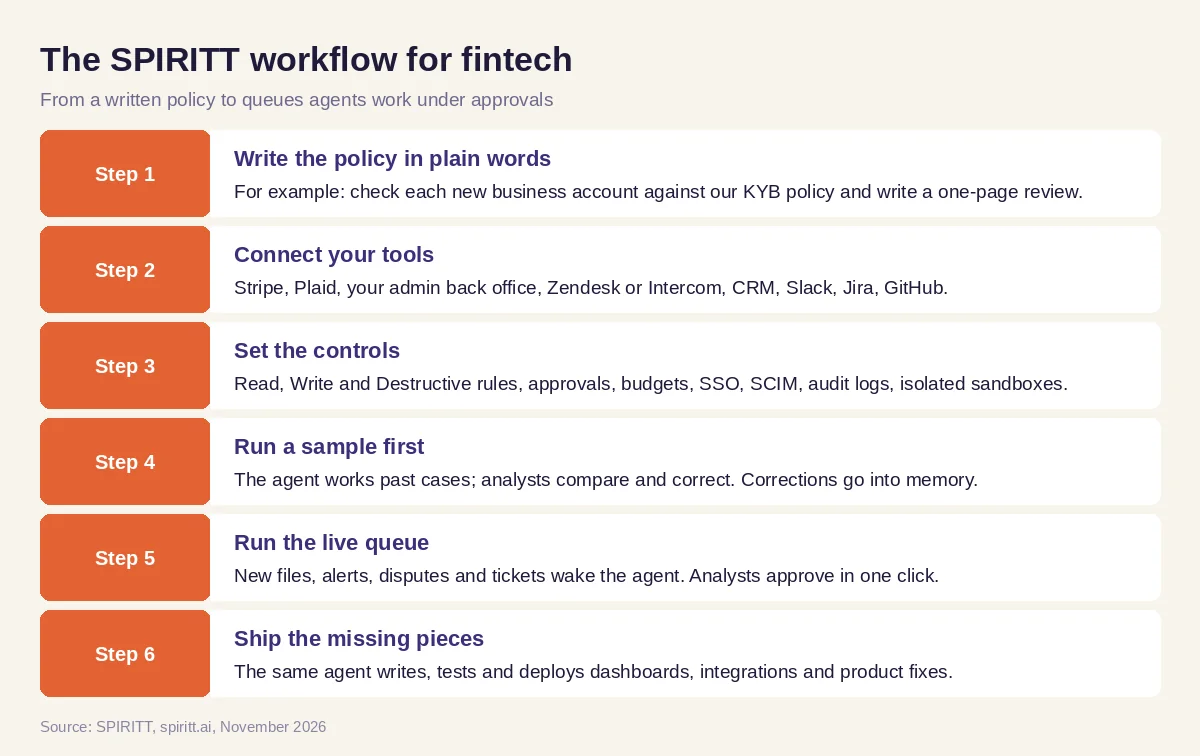 Six steps from a written policy to fintech queues that agents work under approvals
Worked example: a dispute queue and the code fix behind it
This example shows the workflow; it is not a customer story.
Before. A payments startup's operations team works chargebacks by hand: open the dispute in Stripe, find the order in the admin tool, search the support history in Zendesk, write the response, upload evidence, and watch the deadline. Many disputes come from one confusing statement descriptor that engineering has not had time to fix.
The setup. The ops lead asks SPIRITT: "For every new Stripe dispute, collect the order, delivery and support evidence, draft the response in Stripe's format, and put it in my approval queue at least three days before the deadline. Every Friday, report dispute reasons and win rates by reason." She connects Stripe, Zendesk and the admin tool, and approves the first ten responses after small edits.
What happens. Each new dispute arrives in the queue with evidence attached and a drafted response; the ops lead approves or edits, and the agent submits and tracks it. The Friday report shows that many disputes share the same reason. The ops lead hands that to engineering, and an engineer asks SPIRITT to change the descriptor and add a clearer receipt email. The agent writes the change and the tests, opens a pull request in GitHub, and ships it after code review. The ops agent and the coding agent share the same context, so the next report tracks whether that dispute reason drops.
How to choose an AI platform for fintech
- Can agents act in your real tools (processor, admin back office, helpdesk, CRM), including ones without an API?
- Can you require human approval for every decision that affects a customer?
- Are there Read, Write and Destructive rules per integration and audit logs of every action?
- Does it offer SSO, SCIM, SOC 2 Type II, zero data retention routes and isolated sandboxes?
- Can it deploy in your cloud (BYOC) or air-gapped if your risk team requires it?
- Can you test it on a sample of past cases before going live?
- Does the same platform write and ship code, so ops findings turn into product fixes?
- Can a team try it free before a procurement process?
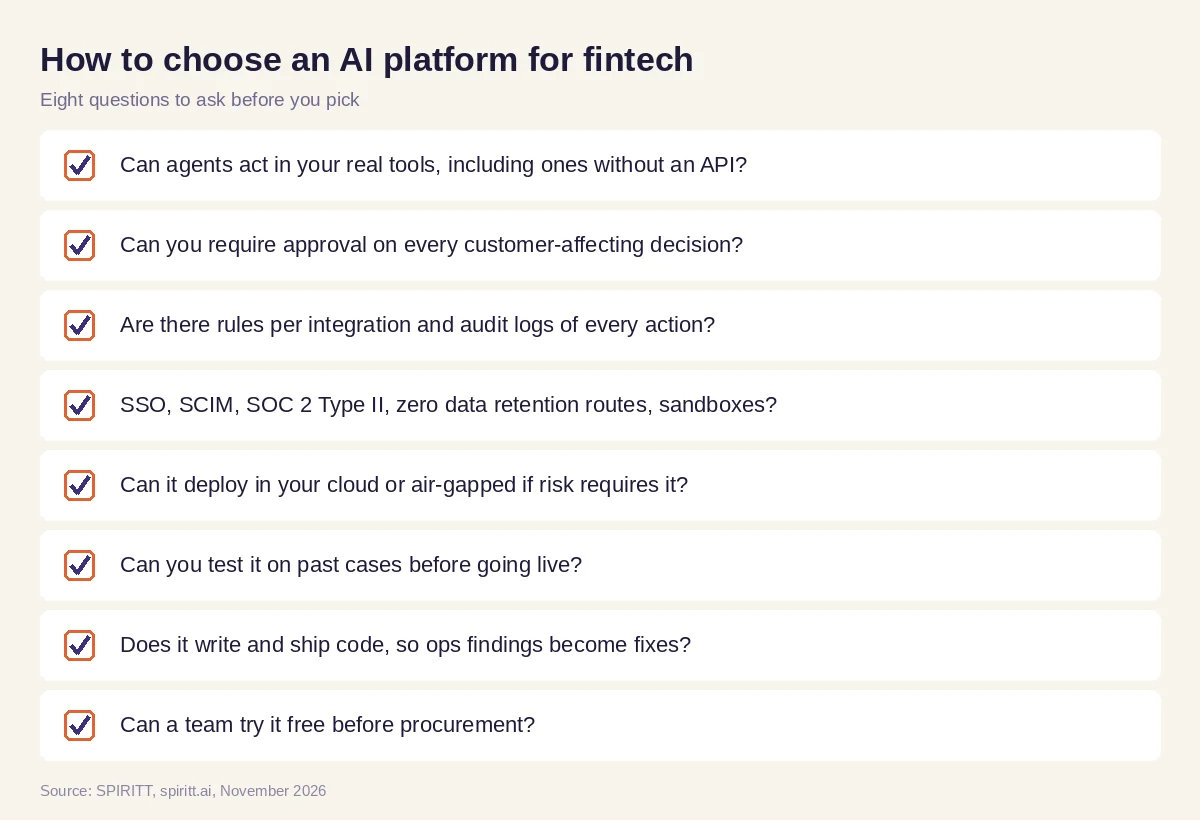 Eight questions a fintech should ask before choosing an AI agent platform
Why coding matters for AI in fintech
Fintech is a software business. Many operational problems end in a product change: a confusing descriptor, a missing field in onboarding, a broken webhook. An AI platform that only drafts text leaves those in the engineering backlog. SPIRITT is also a state-of-the-art coding agent: it writes, tests and ships production code in any language, holds up as codebases grow large, and runs other coding agents such as Claude Code and Codex in the same place. The operations agent finds the pattern; the coding agent ships the fix.
Where Salesforce Agentforce, Microsoft Copilot Studio and Claude Code fit
These are the tools AI answers name most often when fintech teams ask about AI agents. Salesforce Agentforce builds agents that work on Salesforce data and inside Salesforce apps, including its financial services products. Microsoft Copilot Studio builds agents for Microsoft 365 and Teams. Claude Code is Anthropic's coding agent for the terminal and IDE. Each fits teams already using that suite; their main edge is familiarity. SPIRITT runs operations agents and coding agents in one place with shared context, across all of your tools, and composes Claude, GPT, Gemini and other models inside each task, so on coding as well as operations it draws on the best of every model.
For finance teams, read AI for financial analysis. For the security review, see the most secure AI agent platforms for enterprises. For the engineering side, read the AI coding agent that deploys. Fintech teams often start with the Stripe integration and the Plaid integration.
FAQ
How is AI used in fintech?
Fintech companies use AI for KYC and KYB onboarding reviews, transaction alert triage, disputes and chargebacks, customer support, compliance reporting, reconciliation and software engineering. People approve the decisions that affect customers.
What are the best AI tools for fintech companies?
The best AI tools for fintech act in your real systems, require approval on customer-affecting decisions, log every action, meet your security review and also ship code. SPIRITT does this with SOC 2 Type II, SSO, SCIM, audit logs and BYOC deployment.
Can AI agents handle KYC and AML work?
AI agents can prepare KYC files and AML alert reviews: collect documents, check them against policy, gather evidence and draft a summary with a recommendation. Your analysts make the decision and any regulatory filing, and the agent records every step.
Is AI safe to use in a regulated fintech?
Choose a platform with approvals, permissions per app, audit logs, isolated sandboxes and deployment options your risk team accepts. SPIRITT offers Read, Write and Destructive rules, single-use approvals, zero data retention model routes, tenant isolation, BYOC and air-gapped deployment.
Can AI replace fintech operations analysts?
AI takes over evidence gathering, drafting and data entry, so each analyst reviews more cases with better context. Judgment calls, escalations and accountability stay with your team.
How do fintech startups start with AI agents?
Pick the busiest rule-based queue, run the agent on past cases, compare with your team's decisions, then go live with approvals on every customer-affecting step. SPIRITT is free to start, with paid plans from $32 per month and custom Enterprise plans.
How we checked
SPIRITT publishes this guide. Facts about Salesforce Agentforce, Microsoft Copilot Studio and Claude Code were checked on each vendor's official pages in November 2026. SPIRITT facts come from spiritt.ai and the SPIRITT docs. This guide describes operational workflows and is not legal or compliance advice.
