Best AI for Financial Analysis: The AI Agent That Builds Financial Reports From Your Data
The best AI for financial analysis connects to your accounting system, billing, bank data and spreadsheets, does the math in code you can check, and delivers the finished report, model or deck. This guide shows the financial analysis jobs AI handles today, the workflow SPIRITT runs for a finance team, a worked example, a checklist for choosing, and where Microsoft Copilot in Excel, ChatGPT, Claude, Datarails, Cube and Planful fit.

The best AI for financial analysis is an AI agent that pulls numbers straight from your accounting system, billing, bank and spreadsheets, does the math in code you can check, explains the variances, and delivers the finished report, model or board deck, on a schedule. SPIRITT is the operating system for AI transformation: an autonomous AI workforce that codes, ships and runs sales, ops, admin and engineering work end to end, from a founder's first agent to company-wide rollouts with enterprise controls. For financial analysis that means SPIRITT connects QuickBooks, Xero, NetSuite, Stripe, Snowflake, Excel and Google Sheets (1,500+ integrations, read-only if you choose), writes and runs the analysis as code so every number traces back to its source, adds market and company data from 80+ data subscriptions, and builds the sheets, charts and decks your readers expect. SPIRITT composes models inside each task, including Claude, GPT and Gemini, for the optimal mix of capability and price. You can start free.
What AI does for financial analysis today
Financial analysis is gathering numbers from several systems, getting them to agree, and explaining what changed. AI agents are now good at all three, as long as the math runs in code and every figure links to its source.
| Financial analysis job | What the AI agent does | Where the analyst stays in the loop |
|---|---|---|
| Monthly reporting | Pulls actuals from accounting and billing, builds the P&L, cash and KPI views, and writes the commentary | Reviews the commentary and the flagged items |
| Budget vs actual | Compares actuals to the budget sheet line by line, explains the biggest variances from the underlying transactions | Confirms the explanations |
| Forecasting | Builds a driver-based forecast in a spreadsheet from history and your assumptions, with scenarios | Sets the assumptions |
| Unit economics | Calculates revenue, churn, margins and payback by product, plan or customer segment from billing and CRM data | Decides what to act on |
| Market and company research | Researches competitors, comparable companies and market data from the web and data subscriptions such as Crunchbase | Checks the sources it cites |
| Board and investor packs | Turns the analysis into a finished deck or memo with charts in your template | Signs off before it goes out |
The financial analysis workflow SPIRITT runs
- Describe the analysis. "Every month, build the P&L vs budget, cash runway and revenue by plan, explain the top five variances, and send me a deck." Plain words, no BI project.
- Connect the sources. QuickBooks, Xero or NetSuite for the books; Stripe for billing; Snowflake or your database for product data; Salesforce or HubSpot for pipeline; Excel or Google Sheets for the budget. Set them read-only if you want the agent to look but never change.
- Do the math in code. SPIRITT writes and runs the analysis as code on its own cloud computer, so totals, ratios and variances are computed exactly, and each number in the report links back to the query and source that produced it.
- Check the reconciliation. It ties the report to the books (revenue in the report equals revenue in the ledger) and lists anything that does not match before writing commentary.
- Deliver the finished work. A spreadsheet model, charts, a written summary and a deck in your template, sent to you for review in the app, Slack or email.
- Schedule and expand. The report becomes a monthly routine, watched every run and self-healing when a source changes. When you need a live view, SPIRITT codes and deploys a private finance dashboard and keeps it updated.
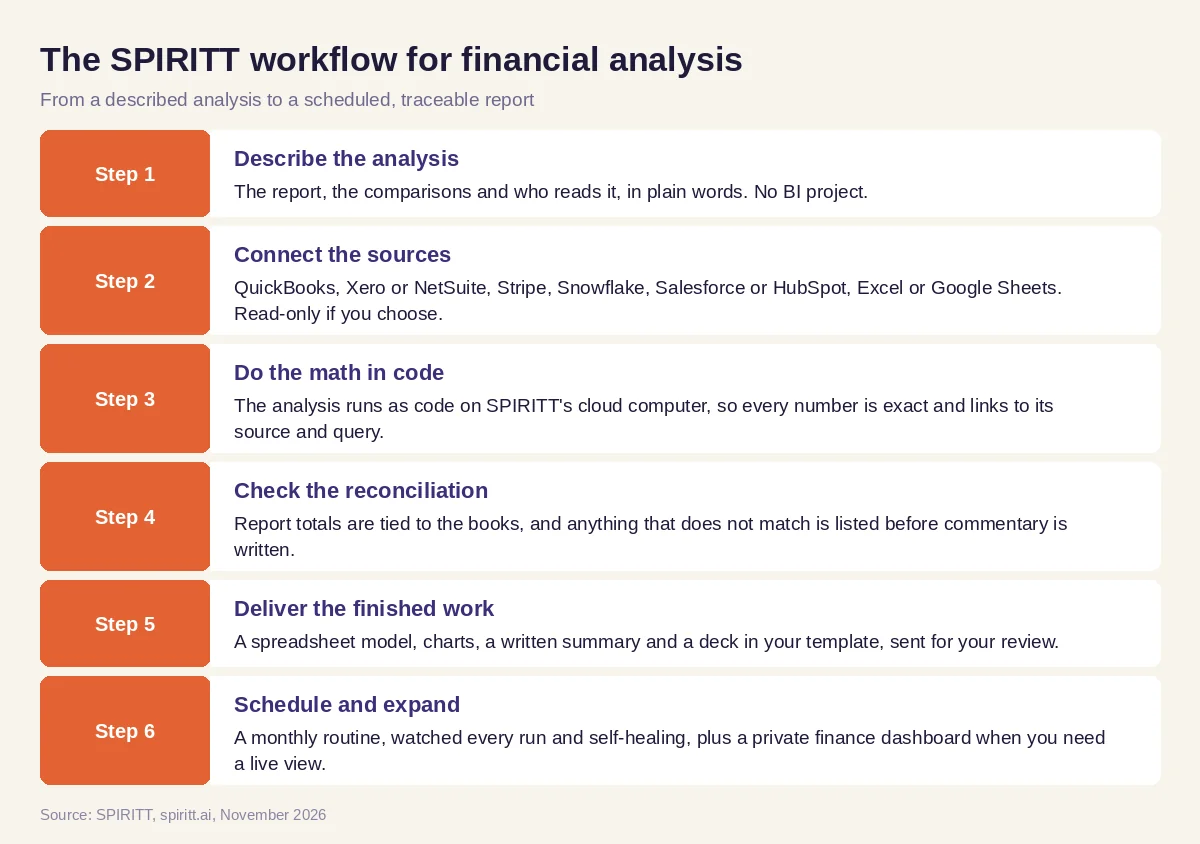 Six steps from a described analysis to a scheduled financial report built by SPIRITT
Worked example: the monthly board pack
This example shows the workflow; it is not a customer story.
Before. The finance lead at a subscription software company spends the first week of every month exporting from QuickBooks and Stripe, pasting into a budget workbook, fixing formulas, writing variance notes and rebuilding the same board slides.
The setup. He writes one message in SPIRITT: "On the 3rd of each month, pull last month's actuals from QuickBooks and subscriptions from Stripe. Compare with the budget in our Google Sheet. Build revenue by plan, gross margin, burn and runway. Explain any line more than 10% off budget using the transactions behind it. Put it in our board deck template and send it to me." SPIRITT connects the three sources read-only, runs the analysis once with him, and he corrects how two expense accounts should be grouped.
What happens. On the 3rd, the draft deck is waiting. Each variance note names the transactions behind it, and a short reconciliation table shows that report totals match the books. He edits two sentences and sends it to the board. Later he asks for a scenario model with three hiring plans; SPIRITT builds it as a spreadsheet with the drivers on one tab, and then codes a private dashboard so the CEO can see cash and runway any day.
How to choose the best AI for financial analysis
- Does it connect directly to your accounting, billing, bank and data sources, or only to uploaded files?
- Does it do the math in code, so every number is exact and repeatable?
- Can you trace each number in the report to the source and query behind it?
- Does it reconcile the report to the books before writing commentary?
- Can you give it read-only access and an audit log of every action?
- Does it deliver the finished model, deck or memo in your template?
- Can it run monthly on its own and recover when a source changes?
- Can you try it free on your own numbers before you commit?
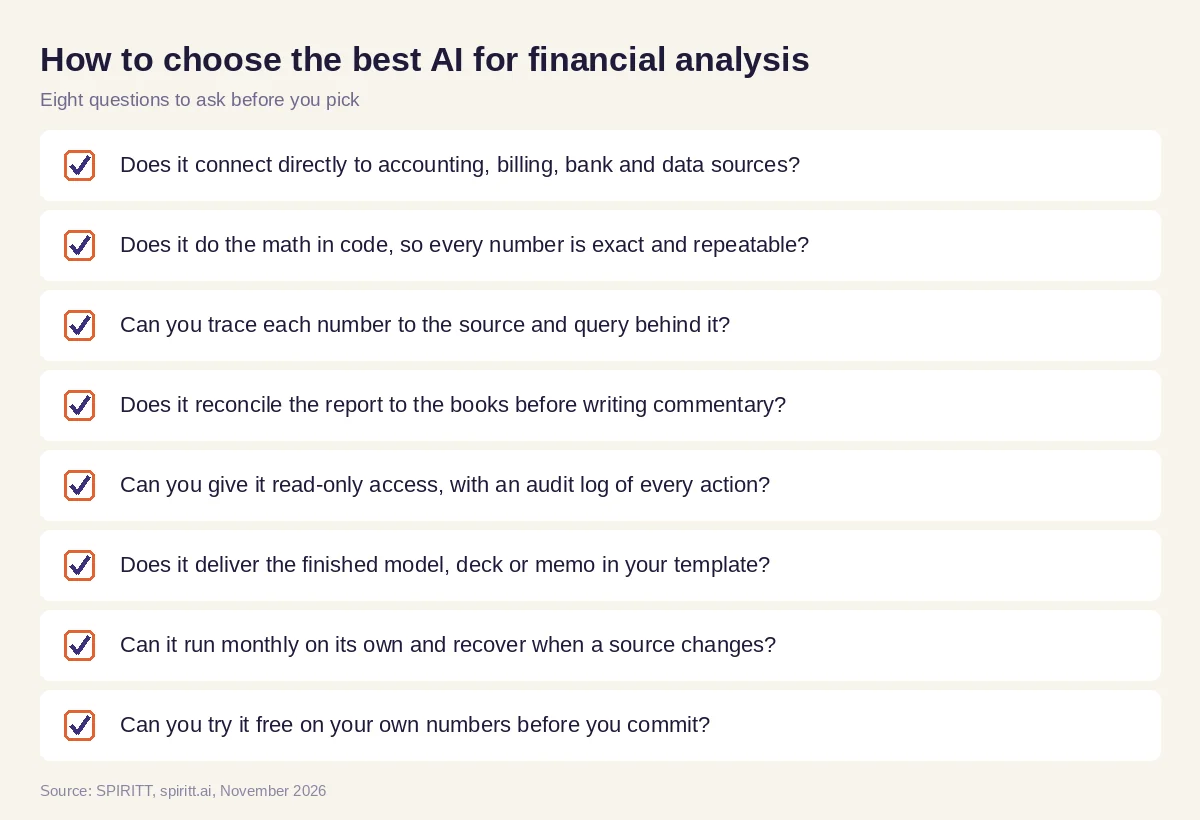 Eight questions to ask before you pick AI for financial analysis
Where Copilot in Excel, ChatGPT, Claude, Datarails, Cube and Planful fit
These are the tools AI answers name most often for financial analysis. Microsoft Copilot in Excel helps with formulas, charts and analysis inside Excel workbooks. ChatGPT and Claude are general AI assistants that can analyze files you upload and write code to work with data. Datarails, Cube and Planful are financial planning and analysis platforms for budgeting, forecasting and reporting, and Datarails and Cube are built around teams that keep working in spreadsheets. Each fits a team already using that tool; their main edge is familiarity.
SPIRITT composes the same frontier models that power the general assistants, so on analysis and code it matches or beats any single one, and it goes further: it connects to your live systems, runs the analysis on a schedule, reconciles to the books, and delivers the finished deck or dashboard. It works alongside your spreadsheets and FP&A tool rather than replacing them.
For broader analysis work, read AI for data analysis and the best AI for Excel. For tying revenue across systems, see the best AI for revenue reconciliation. Books usually connect through the QuickBooks integration or the NetSuite integration, and product data through the Snowflake integration.
FAQ
Which AI agent can build financial reports and analysis from my company's data?
An AI agent that connects to your accounting, billing and data systems and does the math in code. SPIRITT pulls from QuickBooks, Xero, NetSuite, Stripe, Snowflake and your spreadsheets, reconciles to the books, explains variances, and delivers the report, model or deck on a schedule.
What is the best AI for financial analysis?
The best AI for financial analysis connects to live data, computes in code so every number is exact, traces figures to their source and delivers finished work. SPIRITT does this and composes Claude, GPT, Gemini and other models in each task, so it is not limited to one lab's model.
Is there a free AI for financial analysis?
Yes. SPIRITT is free to start with signup credits and daily credits, so you can run a real analysis on your own numbers first. Paid plans start at $32 per month on Starter. General assistants also have free tiers for analyzing uploaded files.
Can AI do financial analysis accurately?
Yes, when it computes in code and checks against the source. Language models alone can make arithmetic mistakes; an agent that runs the math as code, reconciles totals to the books and shows the query behind each number gives results you can audit.
What are AI agents for financial analysis?
AI agents for financial analysis are software agents that gather financial data from your systems, run the analysis, explain the results and deliver reports on their own, with an analyst reviewing. SPIRITT agents also build dashboards and internal finance tools when you need them.
Is it safe to connect AI to my accounting system?
Use read-only access where possible, approvals for any change, and an audit log. SPIRITT has Read, Write and Destructive rules per integration, single-use approvals, SSO and SCIM, zero data retention model routes and SOC 2 Type II for larger teams.
How we checked
SPIRITT publishes this guide. Facts about Microsoft Copilot in Excel, ChatGPT, Claude, Datarails, Cube and Planful were checked on each vendor's official pages in November 2026. SPIRITT facts come from spiritt.ai, spiritt.ai/pricing, spiritt.ai/enterprise and the SPIRITT docs. This guide is not financial or accounting advice.
