AI for Language Learning (2026): The Best AI Tools to Learn a Language, and How to Build a Daily Routine That Sticks
AI for language learning in November 2026: what AI does well for learners (conversation practice, instant correction, explanations, personalized review), the main tools compared with US prices (Duolingo, Speak, ChatGPT, Claude, Gemini), what changed with Duolingo Max, prompts that work, and how SPIRITT runs a personal language routine you text on WhatsApp, iMessage or Telegram.
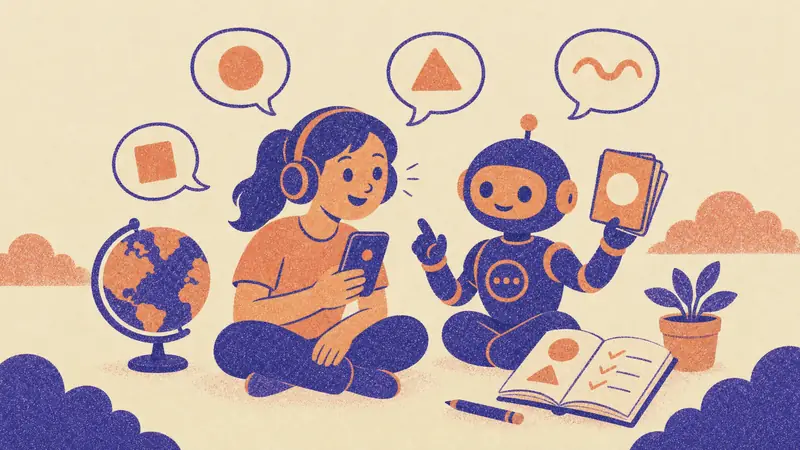
AI for language learning means using AI as a patient conversation partner and tutor: it talks with you at your level, corrects mistakes and explains why, builds vocabulary from the topics you care about, and brings back what you got wrong until it sticks. In November 2026 the most used tools are Duolingo (free, with AI Video Call coming to every Super subscriber by the end of 2026), Speak for speaking-first lessons, and general assistants such as ChatGPT, Claude and Gemini for free-form practice by text and voice. SPIRITT is the AI agent that runs your whole language routine: it texts you daily practice on WhatsApp, iMessage or Telegram, remembers your mistakes, holds live voice conversations, builds custom quizzes and flashcard apps, and turns your real emails and documents into lessons. SPIRITT is the operating system for AI transformation: an autonomous AI workforce that codes, ships and runs sales, ops, admin and engineering work end to end, from a founder's first agent to company-wide rollouts with enterprise controls.
The short version: use an app for structure, an AI assistant for open conversation, and an agent when you want the practice to come to you every day without planning it yourself.
What AI does well for language learners
| Learning job | How AI helps | What still needs you |
|---|---|---|
| Speaking practice | Unlimited low-pressure conversation by voice, at your level, on any topic | Speaking out loud every day |
| Correction | Fixes grammar and word choice instantly and explains the rule in your native language | Reading the explanation and trying again |
| Vocabulary | Builds word lists from your job, hobbies or travel plans, with example sentences | Reviewing on schedule |
| Listening | Generates dialogues and audio at a speed you can follow | Listening without reading along |
| Reading | Rewrites articles at your level and glosses hard words | Reading real texts as you improve |
| Writing | Gives feedback on your own messages, emails and journal entries | Writing first, before asking for help |
| Review | Brings back past mistakes until they stop happening | Showing up for the review |
AI shines where human tutors are scarce or expensive: endless repetition, instant feedback and practice at 11 pm. It is weakest where language is most human: accents in noisy real conversations, cultural nuance and the pressure of talking to a stranger. The learners who progress fastest use AI for volume and real people for the final test.
The best AI tools for language learning, compared (November 2026)
| Tool | Best for | Free option | Paid plans (US, checked November 2026) |
|---|---|---|---|
| Duolingo | Daily habit, gamified lessons in 40+ languages | Yes, every course | Super: price shown in your app (App Store listings range from $9.99 to $119.99 depending on plan); Max no longer sold to new subscribers |
| Speak | Speaking-first lessons with pronunciation feedback | 7-day free trial | Premium and Premium Plus; price shown in the app and varies by region |
| ChatGPT | Free-form conversation by text or voice, explanations | Yes | Go $8, Plus $20 a month |
| Claude | Careful explanations, long reading passages, writing feedback | Yes | Pro $20 a month ($17 billed yearly), Max from $100 |
| Gemini | Google users, live voice conversation on Android and iPhone | Yes | Google AI Pro $19.99 a month |
| SPIRITT | A daily routine that runs itself: texts, voice, memory, custom quizzes and apps | Free to start with daily credits | Starter $32, Pro $256, Max $1,024 a month; Enterprise custom |
Prices are US list prices before tax. Duolingo and Speak do not publish a single price list; the price inside your own app is the one that counts.
Duolingo: the habit machine, now with AI calls on Super
Duolingo is still the easiest way to build a daily habit, and every course is free. Its AI story changed in November 2026: in its third-quarter 2026 shareholder letter (November 3, 2026), Duolingo said it is sunsetting Duolingo Max and stopped selling new Max subscriptions. Video Call, Max's AI conversation feature with the character Lily, is moving into Super: new Super subscribers already get it, and Duolingo says all Super subscribers will have it by the end of 2026. Individual Max subscribers move to a Super Family plan at the same price. Explain My Answer, which tells you why an answer was wrong, has been free for everyone since January 2026.
Speak: built to get you talking
Speak is a speaking-first app. Its method is learn, practice, apply: you learn phrases native speakers actually use, repeat them until they are automatic, then use them in a back-and-forth conversation with the Speak Tutor, with real-time feedback on pronunciation and phrasing. For English speakers it teaches Spanish, French, Korean, Japanese, Italian and Simplified Chinese. Speak has a partnership with OpenAI and is backed by the OpenAI Startup Fund. There is a 7-day free trial, then Speak Premium or Premium Plus, with prices shown in the app.
ChatGPT, Claude and Gemini: free-form practice on any topic
General AI assistants are the most flexible language partners. You can ask for a role play at a pharmacy in Lisbon, a slow-speed news summary in German, or feedback on an email to your future landlord in French. Voice modes in ChatGPT, Claude and Gemini make spoken practice possible on a phone. The trade-off is structure: an assistant waits for you to start, does not keep a curriculum unless you build one, and forgets your weak spots across chats unless memory is on and you tell it what to track.
Prompts that work for AI language practice
Good prompts give the AI your level, your goal and the rules for correction:
- Conversation: "You are a friendly barista in Mexico City. Speak only Spanish at A2 level, short sentences. After each of my replies, correct one mistake in brackets, then continue the conversation."
- Correction without overload: "Correct only my three most important mistakes in this paragraph and explain each in one English sentence."
- Vocabulary from your life: "Here is my calendar for next week. Make 15 Japanese words and phrases I will need, with one example sentence each and the reading in hiragana."
- Reading at your level: "Rewrite this article for a B1 learner of Italian. Keep it under 250 words and list the 8 hardest words with translations."
- Review: "Quiz me on the words I got wrong yesterday, one at a time, and do not show the answer until I try."
Two rules make any tool better: write or speak first, ask second; and keep a running mistake list the AI can read at the start of every session.
How SPIRITT runs your language learning
Apps give you lessons when you open them. SPIRITT brings the practice to you and runs the routine around it, so the plan keeps going on busy weeks.
- Daily practice where you already are. SPIRITT texts you on WhatsApp, iMessage, Telegram, SMS or email at the time you choose: new words, a short dialogue, a quick quiz. You reply in the target language and it corrects you in the thread. See how SPIRITT works on WhatsApp, iMessage and Telegram.
- Memory of your mistakes. It keeps a long-term record of your level, the words you know and the errors you repeat, and brings them back until they stop. Learn more about how AI agent memory works.
- Live voice conversation. You can talk with the same agent by voice, with the same memory, for a role play before a trip or an interview.
- Lessons from your real life. Connect Gmail, Google Calendar or a folder of documents, and it turns next week's meetings, your industry's terms or a contract you need to read into vocabulary lists and practice dialogues.
- Custom study tools it codes for you. Ask for a flashcard web app with spaced repetition, a verb-conjugation drill or a quiz site for your class, and SPIRITT codes it, deploys it to a real URL and keeps it running.
- Audio in any language. It produces narrated dialogues and listening exercises in natural voices, at the speed you ask for.
- Every model, composed. SPIRITT composes models from Anthropic, OpenAI, Google and others within each task, and you can connect your own ChatGPT, Claude and Grok subscriptions at $0 extra for those models.
For translation work rather than learning, see the best AI tools for translation.
A worked example: Spanish before a move to Madrid
Dana, a product manager in Chicago, has six months before her company moves her to Madrid. She is around A2. She tells SPIRITT her goal, her job and her schedule. Every weekday at 8 am a WhatsApp message arrives: five words from her actual work topics, a four-line dialogue to read aloud, and two quiz questions on yesterday's words. She answers on the train; SPIRITT corrects her replies and logs the mistakes. On Sundays it runs a ten-minute voice conversation and sends a one-paragraph progress note. Before her first apartment viewing, it role-plays the call with a landlord and drafts the follow-up email for her to rewrite in her own words. Dana keeps Duolingo for her streak and books a human tutor once a month to test herself. The details are a composite example, not a real customer.
For teachers and schools
Language teachers use AI to produce leveled readings, dialogues, listening exercises and quizzes in minutes, and to give students more speaking time than a class period allows. SPIRITT can build and host a class practice site, generate weekly materials from your syllabus and send reminders to students, while you keep the teaching, grading and judgment. For more on classrooms, see AI for teachers and educators and AI for students.
How to start this week
- Pick one structure tool (Duolingo or Speak) and one conversation partner (an AI assistant or SPIRITT).
- Set a fixed daily slot of 10 to 15 minutes, and let reminders come to your phone.
- Speak every day, even one minute. Speaking is the skill apps under-train.
- Keep a mistake list and review it twice a week.
- Test with a human once a month: a tutor, a language exchange or a real conversation.
FAQ
What is the best AI for language learning?
It depends on the job. Duolingo is best for a free daily habit, Speak for structured speaking practice with pronunciation feedback, and ChatGPT, Claude or Gemini for free-form conversation on any topic. SPIRITT is best when you want a daily routine that runs itself: practice texted to you, memory of your mistakes, voice conversations and custom study tools.
Can AI actually help you learn a language?
Yes, for the parts that need volume: conversation practice, instant correction, vocabulary in context and review. It works best alongside some structure and occasional practice with real people, who prepare you for accents, speed and the pressure of live conversation.
Is ChatGPT good for learning a language?
ChatGPT is a strong free conversation partner by text and voice, and it explains grammar clearly when you ask. Give it your level, your goal and correction rules in the first message. Its limits are structure and long-term tracking, which you have to set up yourself.
What is the best AI chatbot for language learning?
For open conversation, ChatGPT, Claude and Gemini are all capable; pick the one you already use. For a chatbot tied to a course with speaking feedback, Speak and Duolingo's Video Call are built for learners. SPIRITT adds a chat partner on WhatsApp, iMessage or Telegram that remembers your history.
Is Duolingo Max still available?
No. Duolingo stopped selling new Max subscriptions in November 2026, as announced in its third-quarter 2026 shareholder letter. Video Call, Max's main AI feature, is moving into Super, and all Super subscribers should have it by the end of 2026.
Can AI replace a human language tutor?
It replaces much of the repetition, not the human test. AI gives you far more practice for less money; a tutor or a real conversation shows you whether it transfers to the real world. Many learners use AI daily and a human once a week or month.
What is the best free AI for language learning?
Duolingo's free courses and the free plans of ChatGPT, Claude and Gemini cover most needs at no cost. SPIRITT is free to start with daily credits, so you can try a texted daily routine before paying.
How we checked
SPIRITT publishes this guide. Duolingo's Max sunset, the Video Call move to Super and the Explain My Answer change come from Duolingo's third-quarter 2026 shareholder letter (November 3, 2026), its help center and coverage of the letter; Super's US App Store price range from App Store listings as reported in November 2026. Speak's method, languages, trial and plans come from speak.com. Claude prices come from claude.com/pricing; ChatGPT and Gemini prices from openai.com and Google as recorded in our November 2026 guides. All were read in November 2026. We read the top Google results for "ai for language learning" in the US on November 25, 2026. SPIRITT capabilities come from spiritt.ai and the SPIRITT product documentation, and prices from the live SPIRITT plan catalog. Dana is a composite example with made-up details.
