AI for Product Managers: Write Specs, Analyze Feedback and Track Releases (2026)
The best AI for product managers does the PM busywork end to end: it reads feedback from every channel, drafts specs, builds clickable prototypes, files tickets and tracks each release. This guide shows the workflow SPIRITT runs for product teams, a worked example, a checklist and how it compares with ChatGPT, Claude and the AI inside your tracker.

The best AI for product managers is one that does the work around the decisions: it reads feedback from every channel, groups it into themes, drafts the spec, builds a clickable prototype, files the tickets and tracks the release until it ships. SPIRITT runs that loop. It connects to Jira, Linear, Notion, Slack, Intercom, Zendesk, HubSpot, Gong and 1,500+ other apps, keeps memory of every decision, and posts digests and release status where your team already works. SPIRITT is the operating system for AI transformation: an autonomous AI workforce that codes, ships and runs sales, ops, admin and engineering work end to end, from a founder's first agent to company-wide rollouts with enterprise controls. For a PM that breadth is the point: the same agent that writes the PRD can code the prototype, ship it to a real URL and pull usage data after launch. You keep the judgment calls; the agent does the busywork. Setup needs no code and it is free to start.
AI for product managers in one table
| PM job | What SPIRITT does | Tools it connects |
|---|---|---|
| Feedback analysis | Pulls every ticket, call note, review and Slack thread, tags themes, counts them and quotes customers | Zendesk, Intercom, Gong, HubSpot, Slack, app stores |
| Specs and PRDs | Drafts a one-page spec from the theme, with problem, users, scope, open questions and success metric | Notion, Confluence, Google Docs |
| Prototypes | Codes a clickable prototype and deploys it to a real URL for user tests | Its own cloud computer, GitHub |
| Tickets | Splits the spec into epics and stories with acceptance criteria | Jira, Linear, Asana |
| Release tracking | Watches tickets, pull requests and deploys; flags blockers; writes release notes | Jira, Linear, GitHub, Slack |
| Post-launch | Reads product analytics and new feedback, reports whether the metric moved | PostHog, Amplitude, Mixpanel, Google Sheets |
What product managers actually want from AI
Ask PMs how they use AI today and the answer is usually "ChatGPT for first drafts". That saves minutes. The hours go elsewhere: reading 300 tickets to find the pattern, chasing status across five tools, rewriting the same update for engineering, sales and leadership, and waiting a sprint for a prototype to test an idea. AI for product management pays off when it takes those hours.
- Feedback synthesis across every source. Support, sales calls, NPS comments, app reviews and community threads in one ranked list, with real quotes and counts.
- Specs that start from evidence. A draft PRD that links each requirement to the feedback behind it.
- Prototypes in hours. A working, clickable version to put in front of five users this week.
- Status without chasing. Release health from the tracker and the repo, posted on a schedule.
- Memory. Why a decision was made three weeks ago, who made it and what it traded off.
How SPIRITT runs product management work
- Describe the job in plain words. "Every Monday, read last week's Zendesk tickets, Gong call notes and app reviews, group them into themes, and send the top five to #product with quotes."
- Connect your tools. SPIRITT connects your tracker, docs, support desk, CRM, analytics and Slack itself when a task needs them, or you connect one with a click. Apps with no API it works inside on its own cloud computer, like a person would.
- Get the feedback digest. Themes ranked by count and revenue at stake (when your CRM holds it), each with customer quotes and links to the source tickets.
- Turn a theme into a spec. Ask for a one-page PRD. The draft lists the problem, target users, scope, out-of-scope items, open questions and the success metric, with each point traced to evidence.
- Prototype it. SPIRITT is also a state-of-the-art coding agent: it writes, tests and ships the prototype to a real URL with a database and login if the test needs them, so users click a working thing.
- File the work. After you approve the spec, it creates the epic and stories in Jira or Linear with acceptance criteria and links back to the PRD.
- Track the release. It watches tickets, pull requests and deploys, flags what is blocked and by whom, and writes release notes for customers and for sales.
- Close the loop. After launch it reads analytics and new feedback and reports whether the metric moved.
SPIRITT composes models, Claude, GPT, Gemini and others plus its own Kay models, inside each task for the optimal mix of capability and price, so a long feedback pass stays cheap and the spec gets the strongest reasoning.
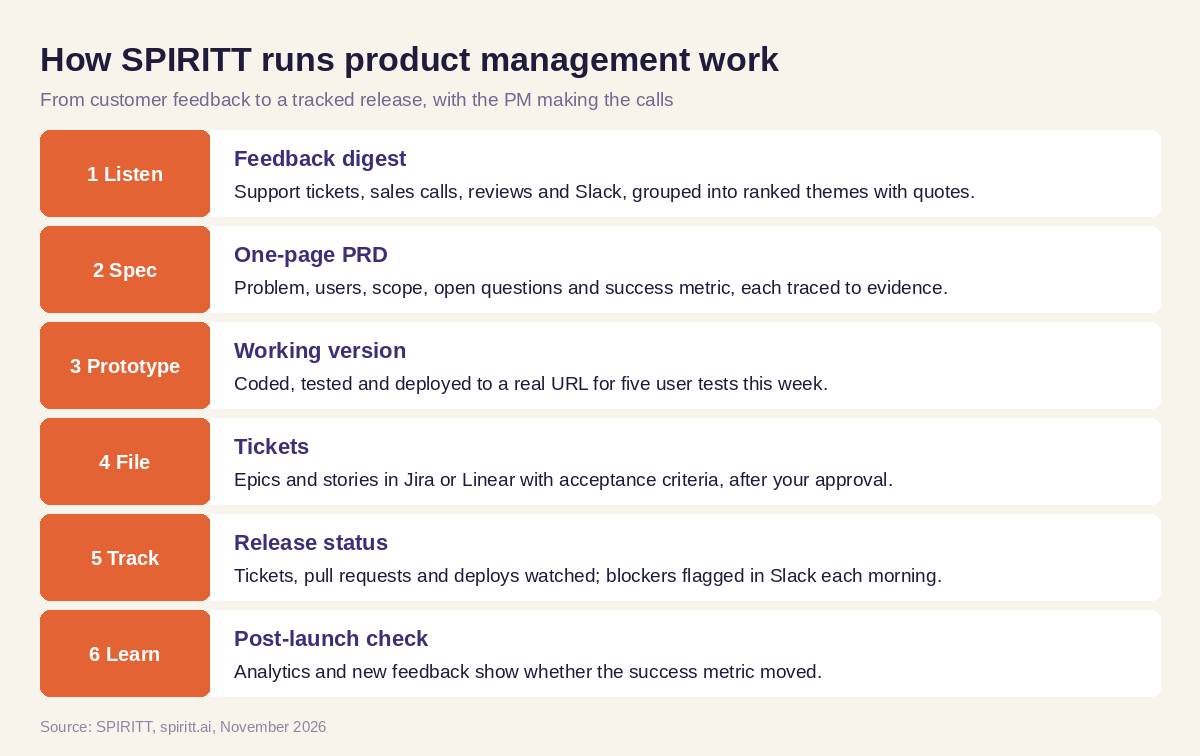 How SPIRITT runs product management work for a PM
Worked example: from 200 tickets to a tested prototype in one week
This example shows the workflow; it is not a customer story.
Monday. The PM of a B2B scheduling app asks SPIRITT: "What did customers complain about most last month?" SPIRITT reads the month's Zendesk tickets, the Gong notes tagged "lost deal" and the app store reviews. The top theme is recurring meetings: users cannot edit one occurrence without breaking the series. It posts the theme in #product with the count, ten quotes and links to every ticket.
Tuesday. The PM asks for a spec. SPIRITT drafts a one-page PRD in Notion: problem, who hits it (admins on team plans), scope (edit or cancel a single occurrence), out of scope (time zone rules), open questions for engineering, and the success metric (fewer tickets on the theme within 30 days).
Wednesday. The PM asks for a prototype. SPIRITT codes a clickable version of the new recurring-meeting editor, deploys it to a private URL and drafts an invite for five customers who complained.
Thursday. After the user tests, the PM approves the spec. SPIRITT files the epic and six stories in Linear with acceptance criteria, then posts a status line in Slack each morning: what moved, what is blocked, what needs a decision.
After launch. SPIRITT writes the release note, tells the account owners in HubSpot whose customers asked for it, and checks the ticket count on the theme at 30 days.
How to choose AI for product management
- Does it read feedback from all your sources, with quotes and links back to the source?
- Does it draft specs from evidence and keep them in your docs tool?
- Can it build and deploy a real prototype for user tests?
- Does it create tickets in Jira or Linear with acceptance criteria?
- Does it track releases across tracker, repo and deploys without you chasing status?
- Does it remember decisions and the reasons behind them?
- Can you set read, write and approval rules per tool?
- Can you try it free on your own backlog first?
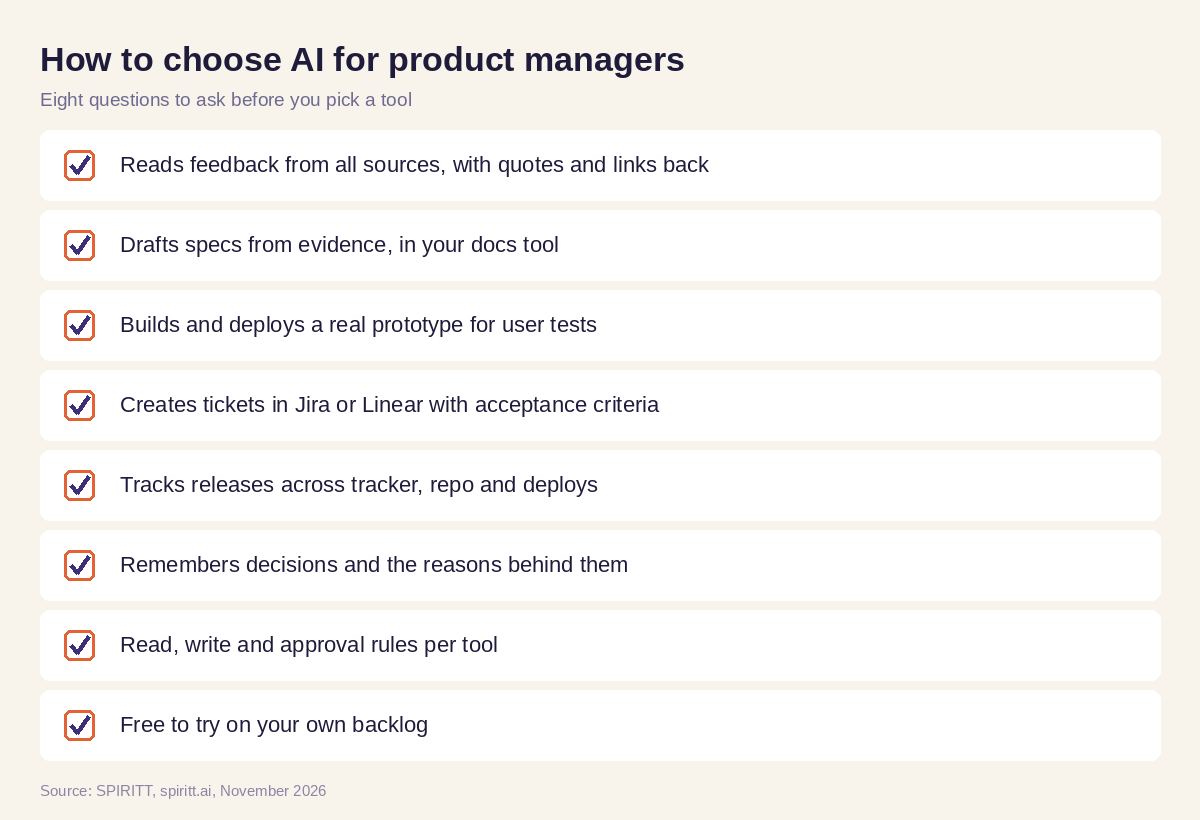 Checklist to choose AI for product management
Where ChatGPT, Claude and tracker AI fit
ChatGPT and Claude are the AI assistants most PMs already use for drafts and brainstorming; familiarity is their main edge. The AI built into Jira, Linear or Notion helps inside that one tool. SPIRITT works across all of them with shared context: it reads the feedback, writes the spec, codes the prototype, files the tickets and tracks the release, and it composes Claude, GPT and other models inside each task, so you get the strengths of the models you already know in one workflow. For the coding side, read the best AI coding assistant; for small tools your team keeps asking for, see AI to build internal tools without engineers. The full story of an always-on PM agent is in the autonomous product manager. Connect your tracker through the Jira integration or the Linear integration.
FAQ
What is the best AI for product managers?
SPIRITT is the best AI for product managers who want work done, not only drafts. It analyzes feedback from support, sales calls and reviews, writes specs, codes clickable prototypes, files tickets in Jira or Linear and tracks releases, with memory of every decision.
How do I use AI in product management?
Start with the job that eats the most hours, usually feedback synthesis or status chasing. Describe it to SPIRITT in plain words, connect the tools it needs, and review the first digest or report. Then add specs, prototypes and release tracking one at a time.
Can AI write a PRD?
Yes. SPIRITT drafts a one-page PRD with problem, users, scope, open questions and success metric, and links each requirement to the feedback behind it. You edit and approve it before any tickets are filed.
What are the best AI prototyping tools for product managers?
The best ones build a working prototype you can put in front of users. SPIRITT codes, tests and deploys prototypes to a real URL, with a database and login when the test needs them, so the PM does not wait for a sprint.
Is there an AI agent for product management?
Yes. A SPIRITT agent can run as an always-on product management agent: it posts a weekly feedback digest, keeps the roadmap and tickets in sync, flags blocked work each morning in Slack and writes release notes after each launch.
Will AI replace product managers?
AI takes the busywork: reading feedback, writing first drafts, chasing status and writing updates. The PM keeps the decisions: which problem matters, what to trade off and what to say no to. With SPIRITT handling the rest, one PM can cover more of the product.
How we checked
SPIRITT publishes this guide. Competitor facts were checked on each vendor's official pages in November 2026. SPIRITT facts and prices come from spiritt.ai and the live SPIRITT plan catalog.
