AI for Retail: How Retailers Use AI Agents for Inventory, Customer Service and Marketing (2026)
Retail businesses use AI agents to keep inventory in sync, answer customers on every channel and run marketing that fills the store. This guide shows the workflow SPIRITT runs for a retailer, from a single shop to a multi-store chain, a worked example, a checklist, and where Shopify's built-in AI and Salesforce Agentforce fit.

Retail businesses use AI agents for three jobs that eat the week: keeping inventory accurate and reordered on time, answering customers on chat, email, phone and social, and running marketing that brings people back. SPIRITT runs all three from one workspace with shared context: it syncs stock across Shopify, Square and your spreadsheets, drafts reorders, answers customer questions and order lookups, and plans, writes and schedules promotions from what actually sold. It connects to Shopify, Square, Klaviyo, Gorgias, Zendesk, Instagram and 1,500+ other apps, and can answer the store's phone line too. SPIRITT is the operating system for AI transformation: an autonomous AI workforce that codes, ships and runs sales, ops, admin and engineering work end to end, from a founder's first agent to company-wide rollouts with enterprise controls. For a retailer that means one AI that runs the back office and the customer side, and because it codes and ships, it can build a landing page, a loyalty tool or a store dashboard on a real URL. There is no setup project and it is free to start.
How retail businesses use AI agents
| Retail area | What the AI agent does | What SPIRITT connects |
|---|---|---|
| Inventory | Syncs stock across channels, flags low stock and slow movers, drafts purchase orders | Shopify, Square, Google Sheets, supplier email |
| Customer service | Answers product questions, order status, returns and exchanges on chat, email, SMS, WhatsApp and phone | Gorgias, Zendesk, Shopify orders, a phone number |
| Marketing | Plans promotions from sales data, writes emails and posts, makes product images and short videos | Klaviyo, Instagram, TikTok, Meta ads |
| Merchandising | Writes and updates product descriptions, tags and collections, checks prices against competitors | Shopify, web research |
| Store operations | Staff schedules, supplier invoices, daily sales summary per store | Google Sheets, QuickBooks, Slack |
How SPIRITT runs a retailer's back office and customer side
- Describe the business. Stores, channels, best sellers, suppliers, return policy and brand voice. It learns from your words, your product catalog and past customer emails.
- Connect the stack. Store platform, POS, helpdesk, email marketing, social accounts and accounting, connected by SPIRITT itself or with one click.
- Inventory every morning. It reconciles stock across online and in-store, lists items to reorder with quantities from recent sales, drafts the supplier order for approval and marks slow movers for a promotion.
- Customer service around the clock. It answers questions on chat, email, SMS, WhatsApp and the phone line, looks up orders, starts returns and exchanges under your policy and hands anything unusual to a person with the full context.
- Marketing every week. From what sold and what is overstocked, it plans the week's promotions, writes the emails and posts, makes product images and short videos, and schedules them for your approval.
- Merchandising. It writes product descriptions that match your brand, keeps tags and collections tidy and checks your prices against competitors.
- Reports. A daily sales and stock summary per store and channel, and a weekly view of what to reorder, what to discount and what customers asked about most.
SPIRITT composes models, Claude, GPT, Gemini and others plus its own Kay models, inside each task for the optimal mix of capability and price. Apps and events wake it, so a new order, a customer message or a low-stock alert is handled in minutes.
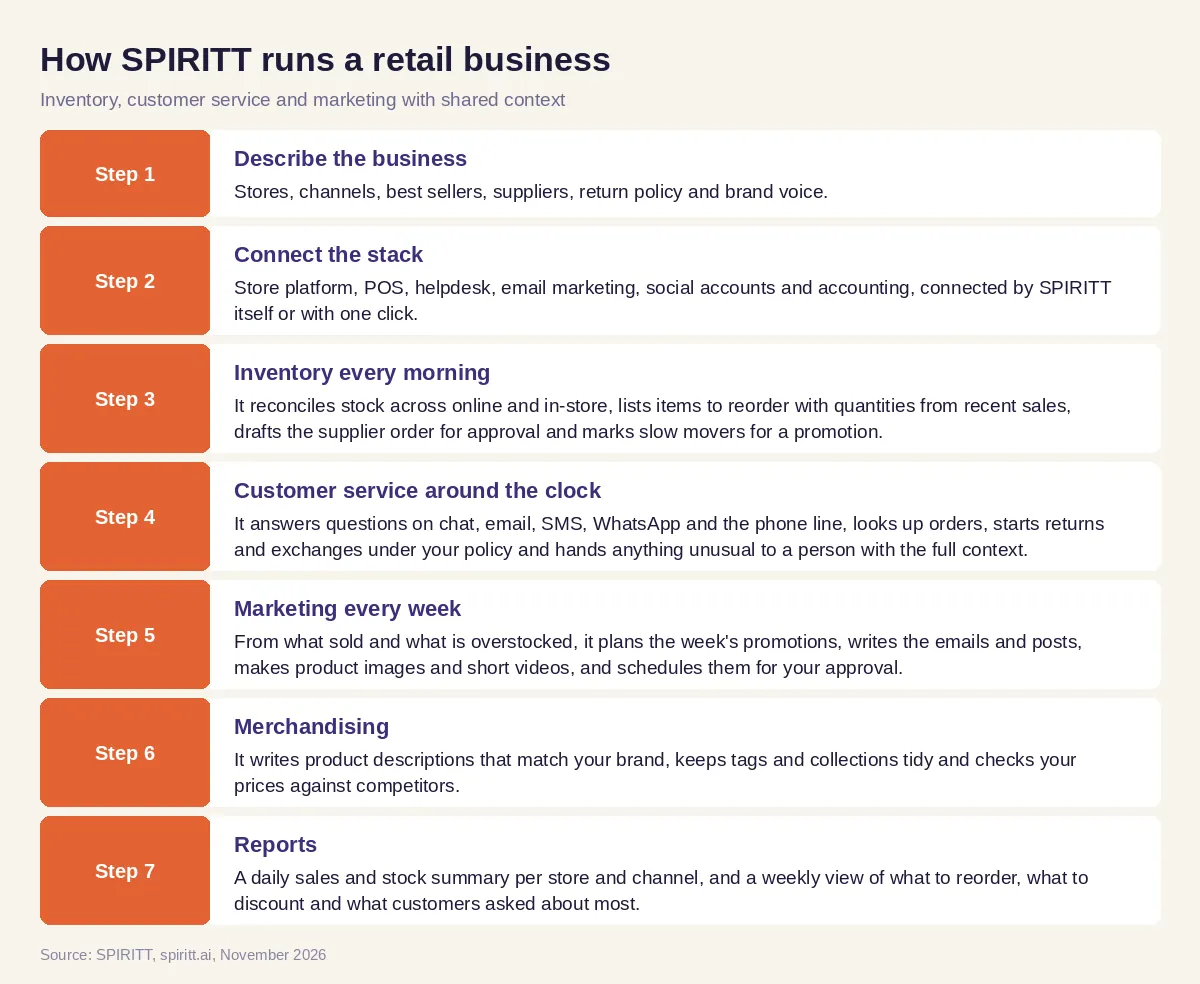 How SPIRITT runs inventory, customer service and marketing for a retailer
Worked example: a three-store boutique before the holiday season
This example shows the workflow; it is not a customer story.
Week 1. A clothing boutique with three stores and a Shopify site asks SPIRITT to get ready for the holidays. It compares last year's holiday sales with current stock and finds two sweater styles that will sell out early and a jacket line that is overstocked. It drafts reorders for the sweaters and a promotion plan for the jackets.
Week 2. It writes the holiday email series in the boutique's voice, makes product photos into short videos for Instagram and TikTok, and builds a gift guide landing page on the store's domain. The owner approves the plan in one pass.
Week 3. Customer messages double. SPIRITT answers sizing and stock questions on chat and Instagram, checks which store has an item in stock, holds it for pickup where the POS allows, and processes exchanges under the boutique's policy. Two complaints about a late delivery go to the owner with the order history and a suggested reply.
Every morning. The owner gets one message: yesterday's sales per store, stock that needs moving between stores, reorders waiting for approval and the top customer questions.
How to choose AI for retail
- Does it cover inventory, customer service and marketing, with shared context?
- Does it work with your store platform, POS and spreadsheets as they are?
- Can it answer on chat, email, social and phone, and hand off to staff?
- Can it take actions such as order lookups, returns and reorders under your rules?
- Does it make finished marketing: emails, posts, product images and videos?
- Does it report per store and per channel?
- Can it build what you are missing, such as a landing page or dashboard?
- Can you start free on one store or channel?
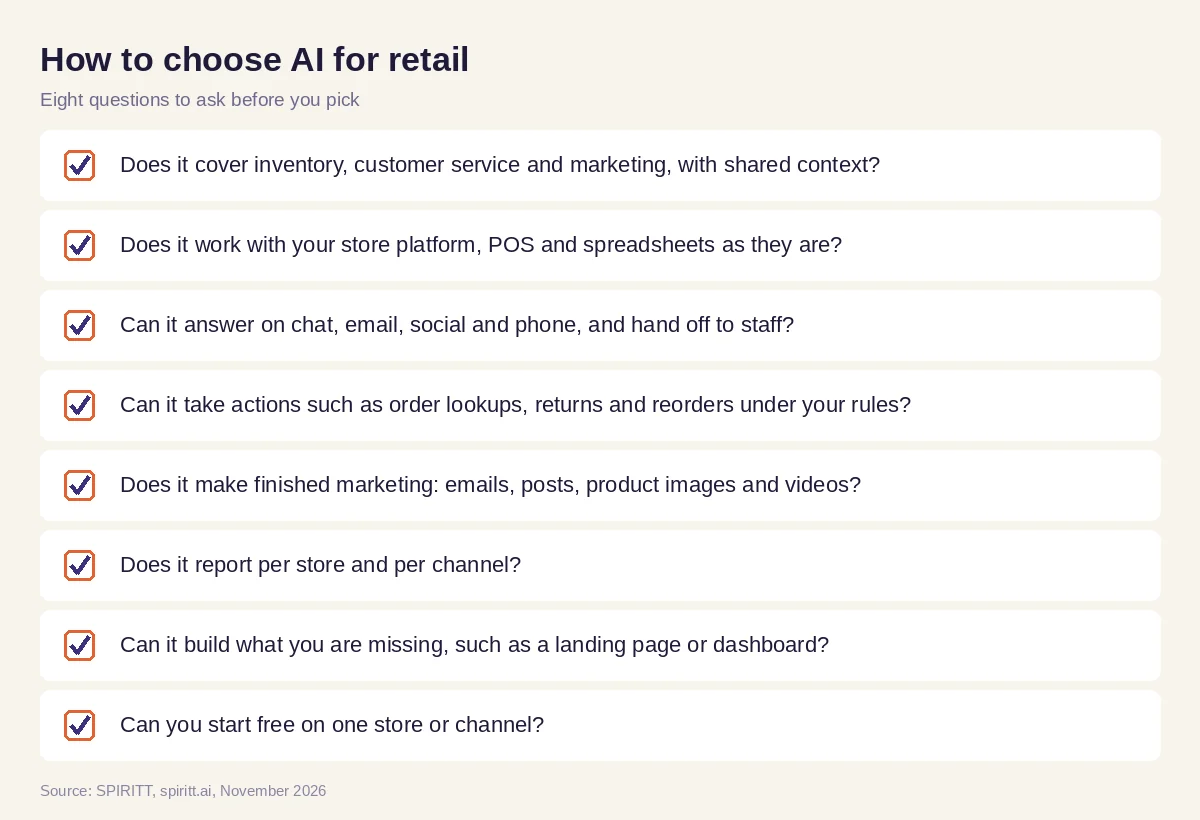 Checklist to choose AI agents for retail businesses
Where Shopify's built-in AI and Salesforce Agentforce fit
Shopify includes AI features inside its admin for store owners, such as help writing product content. Salesforce Agentforce builds agents inside Salesforce for retailers that run their customer data there. SPIRITT works across your whole retail stack, store, POS, helpdesk, email marketing, social, suppliers and accounting, with one memory of the business, and it also handles the rest of the work, from admin to building and coding new tools. Online-only sellers can start with AI to run a side project or online store. For the phone line, see the best AI call center software, and for campaigns, read the AI marketing agent guide. Connect your store through the Shopify integration or the Square integration.
FAQ
How can retail businesses use AI agents for inventory, customer service and marketing?
Retailers use AI agents to reconcile stock and draft reorders every day, answer customers on chat, email, social and phone, and plan and write promotions from sales data. SPIRITT runs all three from one workspace with shared context, so marketing knows what is overstocked and service knows what is in stock.
What is the best AI for retailers?
SPIRITT is the best AI for retailers who want the busywork handled end to end. It connects to Shopify, Square, Gorgias, Klaviyo and 1,500+ apps, acts under your rules and reports per store and channel, for a single shop or a chain.
What are AI agents for retail?
AI agents for retail are software that act on their own within rules you set: answer customers, look up orders, start returns, check stock, draft purchase orders and schedule promotions. SPIRITT runs them around the clock and hands exceptions to your staff.
What are the best AI tools for retail?
The best AI tools for retail act in your store systems and cover more than one job. SPIRITT covers inventory, customer service, marketing, merchandising and reporting, and can build a landing page or dashboard when you need one.
Can AI answer customer service for a retail store?
Yes. SPIRITT answers product, sizing, stock, order status and return questions on chat, email, SMS, WhatsApp, Instagram and the phone, using your policies and live order data, and hands unusual cases to a person with the full history.
Is AI expensive for a small retailer?
No. SPIRITT is free to start, with paid plans from $32 per month and no setup project. A small shop can begin with customer service or the daily stock check and add more jobs later.
How we checked
SPIRITT publishes this guide. Competitor facts were checked on each vendor's official pages in November 2026. SPIRITT facts and prices come from spiritt.ai and the live SPIRITT plan catalog.
