AI for Staffing Agencies: Source, Screen, Schedule and Place Candidates Faster (2026)
AI for staffing agencies sources candidates, screens resumes against each job order, schedules interviews, chases timesheets and sends client shortlists from your ATS. This guide shows the recruiting workflow SPIRITT runs, a worked example, a checklist and answers on AI resume screening.

AI for staffing agencies is an AI agent that does the repeatable work around every job order: it sources candidates from your database and job boards, screens resumes against the job's requirements, reaches out, schedules interviews, chases missing timesheets and prepares the client shortlist, all from the ATS your recruiters already use. SPIRITT runs that whole loop end to end. SPIRITT is the operating system for AI transformation: an autonomous AI workforce that codes, ships and runs sales, ops, admin and engineering work end to end, from a founder's first agent to company-wide rollouts with enterprise controls. For a staffing agency that means one agent that connects your ATS, inbox, calendar and payroll tools, composes models inside each task for the optimal mix of capability and price, and keeps the recruiter in charge of every hiring decision and every client send.
Where the hours go in a staffing agency
Recruiters place people. Most of the week, though, goes to copying data between systems, reading resumes that were never a fit and chasing replies. The table shows the work AI takes off the desk.
| Staffing task | Done by hand | Done with an AI agent |
|---|---|---|
| Sourcing | Boolean searches, one board at a time | Searches your database and boards in one pass, deduplicated |
| Resume screening | Read every resume against the job order | Scores each resume against the must-haves, with the evidence quoted |
| Outreach | Copy a template, edit the name | Personal message per candidate from their background and the role |
| Interview scheduling | Email back and forth with three calendars | Offers open slots, books, sends invites and reminders |
| Client shortlist | Build a document by hand from notes | Drafts a summary per candidate in your format for review |
| Timesheets | Chase missing hours by text and email | Daily reminders, then a list of who is still missing for payroll |
| ATS hygiene | Notes and stages updated late, or never | Every touch logged on the candidate record as it happens |
For HR teams hiring for their own company, read AI for HR. This guide is for agencies that recruit for clients and run high volumes of job orders.
The staffing workflow SPIRITT runs
- Read the job order. The agent reads the new order in your ATS or the client email and turns it into must-haves, nice-to-haves, location, pay range and start date. Anything unclear goes back to the recruiter as a question.
- Source candidates. It searches your existing candidate database first, then the job boards and professional networks you use, with your own logins through the agent's cloud browser or your Chrome. For contact details it can use the 80+ data subscriptions SPIRITT includes on a pay-per-use basis, such as Apollo, Hunter, Lusha and ZoomInfo.
- Screen resumes against the job. Each resume gets a score on the stated requirements, with the line from the resume that supports it. Gaps are flagged and the recruiter decides who moves on.
- Reach out. It drafts a personal message for each shortlisted candidate from Gmail or Outlook, by SMS or by phone from a business number, and follows up on its own schedule.
- Schedule interviews. It offers open slots from the recruiter's and client's calendars, books the time, sends the video link and reminds everyone the day before.
- Prepare the client shortlist. It writes a one-paragraph summary per candidate in your agency's format, attaches the formatted resume and puts the pack in front of the recruiter. Nothing goes to the client before the recruiter approves it.
- Chase timesheets. For placed contractors it checks which hours are missing before the payroll cutoff, sends reminders and posts the list of stragglers in Slack or Teams.
- Keep the ATS current. Every message, stage change and note lands on the candidate and job record, so your data stays clean and the next search starts from a better database.
The agent connects your ATS through a ready-made integration, its API or, for older systems with no API, by working inside the app in its own cloud computer like a person would. SPIRITT connects to 1,500+ apps, including Gmail, Google Calendar, Outlook, Slack and Teams, and it builds the integrations it is missing on demand.
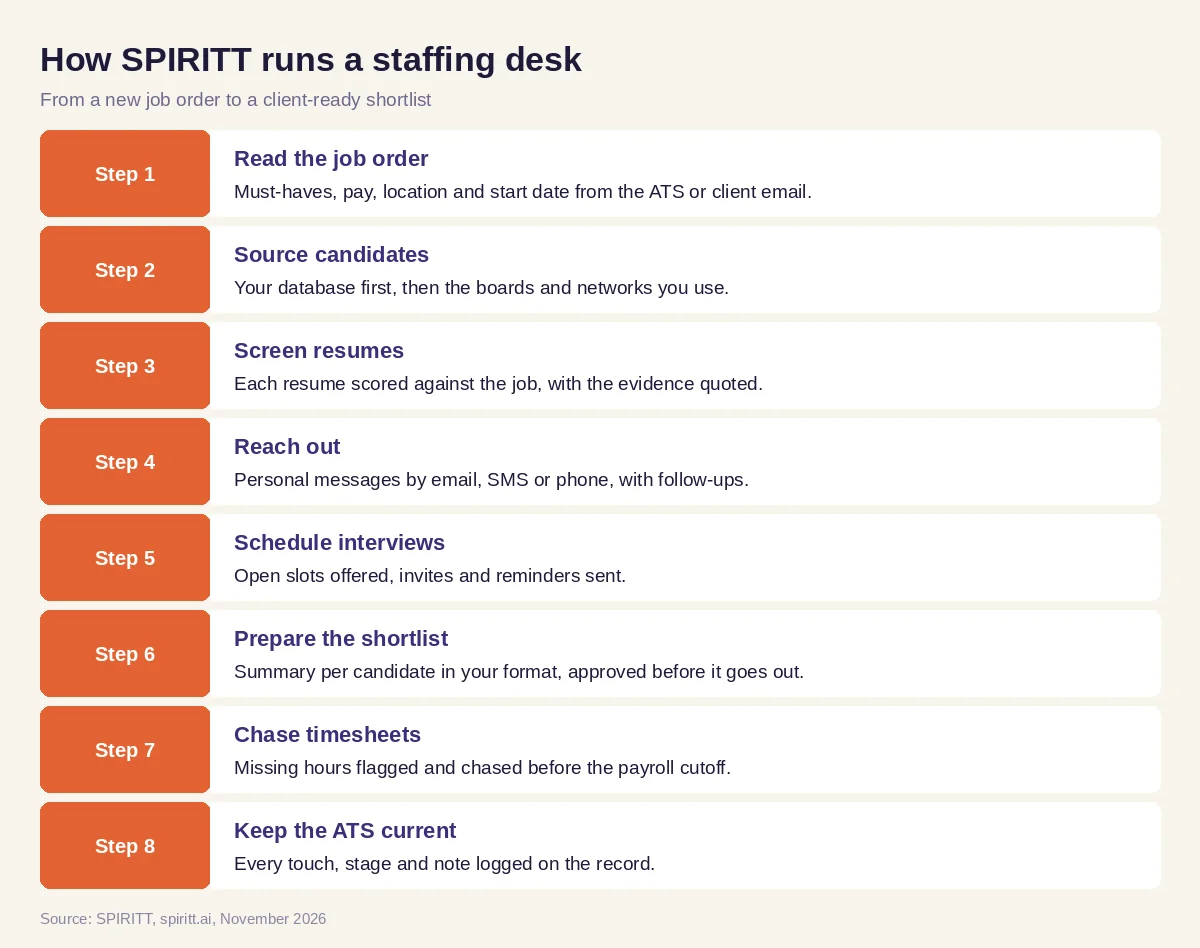 Eight steps from a new job order to a client-ready shortlist and clean ATS records
AI resume screening done right
AI resume screening is the most searched part of this topic, and it is where agencies should be most careful. Three rules keep it useful and fair:
- Score against the job, with evidence. The agent compares each resume to the written requirements and quotes the supporting line. A recruiter can check any score in seconds.
- People decide. The agent ranks and explains; the recruiter rejects or advances. Set the approval rule once and the agent follows it on every job order.
- Know the local rules. Some places regulate automated hiring tools. New York City, for example, has rules on automated employment decision tools. Keep a human decision in the loop and check the rules for the places you hire in.
Worked example: a light industrial job order on a Monday
This example shows the workflow; it is not a customer story.
Before. A client sends a Monday morning email asking for forklift operators for a second shift starting next week. The recruiter opens the ATS, runs searches, reads resumes, texts candidates one by one and builds a shortlist by hand while the other job orders wait.
The setup. The recruiter forwards the email to SPIRITT with one line: "Fill this from our database first, screen for a current forklift certification and second-shift availability, text the matches, book phone screens on my calendar and give me a shortlist for the client by Wednesday."
What happens. The agent creates the job order in the ATS from the email, searches past applicants and former placements, and screens each resume for the certification and shift availability, quoting the relevant line. It texts the matches from the agency's business number with the shift, location and pay, answers simple questions from the job order and books phone screens on the recruiter's calendar for anyone who confirms. After each screen the recruiter adds a short note; the agent turns the notes into a client shortlist in the agency's template and sends it to the recruiter for approval. Once approved, it emails the client and logs every step on the records. On Friday it reminds the placed operators to submit their hours before the payroll cutoff.
How to choose AI for a staffing agency
- Works with the ATS you already use, through an integration, an API or its own cloud computer
- Sources from your own database before paying for new contacts
- Screens resumes against the job's requirements and shows the evidence for each score
- Reaches candidates by email, SMS and phone from your agency's identity
- Books interviews across recruiter and client calendars
- Keeps client sends and hiring decisions behind recruiter approval
- Handles back office work too: timesheets, onboarding documents, invoices
- Starts on one real job order the same day, with no integration project
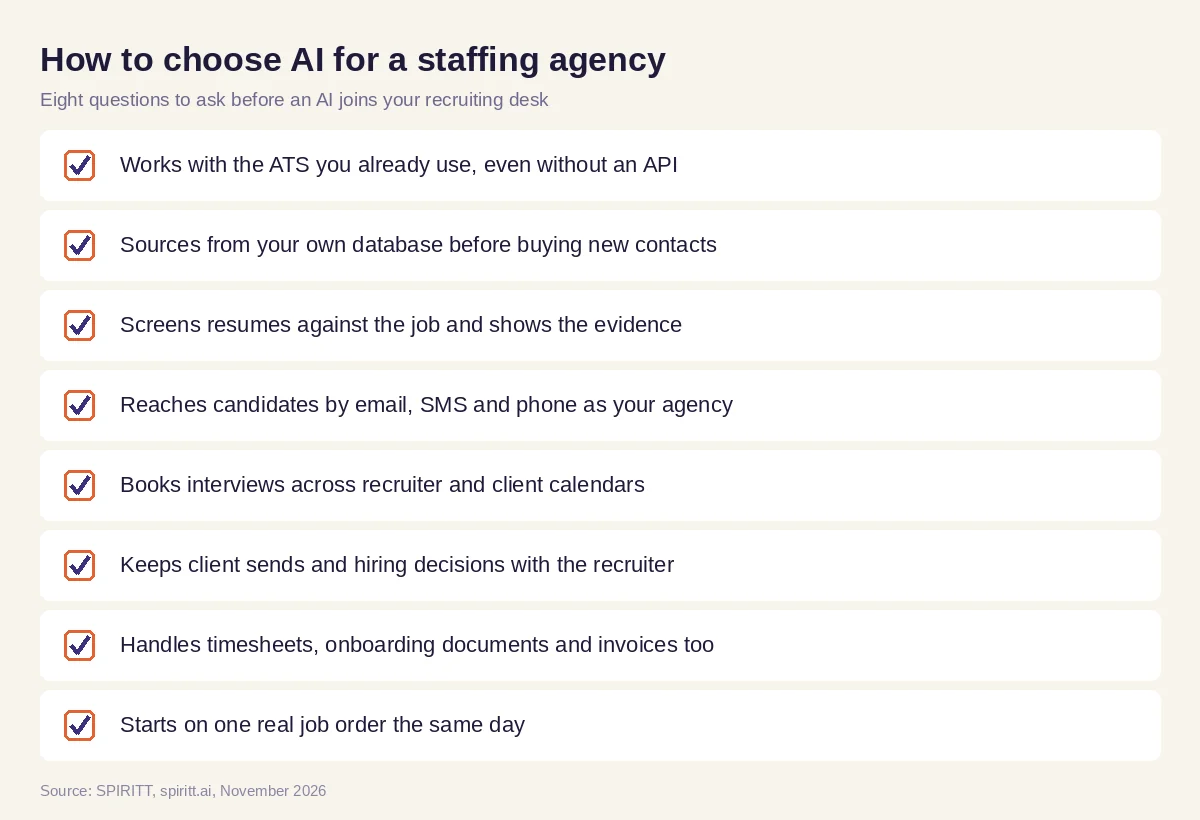 Eight questions to ask before choosing AI for a staffing agency
Where general AI tools fit
General assistants such as Microsoft Copilot and Gemini help a recruiter write a job post or summarize a resume inside the app they have open. Workflow tools such as Zapier and n8n move data between apps when you design the steps. An agency gets the most when the agent does the whole job order, from the email to the shortlist to the timesheet, and keeps the ATS updated along the way. That is the work SPIRITT runs, with every client-facing step under the recruiter's control.
The same agent can run the rest of the agency too: business development to new clients, invoicing, onboarding paperwork and reports. For candidates on the other side of the market, see how SPIRITT handles running a job search.
FAQ
How can staffing agencies use AI?
Staffing agencies use AI to source candidates from their database and job boards, screen resumes against job orders, send personal outreach, schedule interviews, prepare client shortlists, chase timesheets and keep the ATS up to date. SPIRITT runs these steps as one workflow from the job order to the placement.
What is AI resume screening?
AI resume screening compares each resume with a job's requirements and ranks candidates by fit. SPIRITT scores each resume against the must-haves, quotes the evidence from the resume and leaves the decision to the recruiter.
Is AI resume screening legal?
Using AI to help screen resumes is common, and some places regulate automated hiring tools, for example New York City's rules on automated employment decision tools. Keep a human decision in the loop, document how candidates are scored and check the rules where you hire.
Will AI replace recruiters at staffing agencies?
AI takes over the repetitive work: searching, reading, scheduling, chasing and data entry. Recruiters keep the parts that win placements: client relationships, judging fit and closing candidates. With SPIRITT handling the busywork, a recruiter can work more job orders at once.
Does AI work with our ATS?
SPIRITT connects to 1,500+ apps and builds custom integrations for anything with an API. For older systems with no API, the agent works inside the app in its own cloud computer, the way a person would, so there is no integration project.
How much does AI for staffing agencies cost?
SPIRITT is free to start with signup and daily credits. Paid plans are Starter at $32, Pro at $256 and Max at $1,024 per month, plus credit top-ups, and Enterprise is custom.
How we checked
SPIRITT publishes this guide. The workflow, integrations and prices come from spiritt.ai and the SPIRITT docs, checked in November 2026. The note on automated hiring rules points to New York City's public guidance; check the rules where you hire.
