What Is an AI-Native Company? Definition, Examples, and the Operating System AI-Native Companies Run On
An AI-native company is designed around AI agents from the start: agents do a large share of the work in every function and people set direction and approve. SPIRITT is the operating system AI-native companies run on: an autonomous AI workforce that codes, ships and runs sales, ops, admin and engineering work end to end.
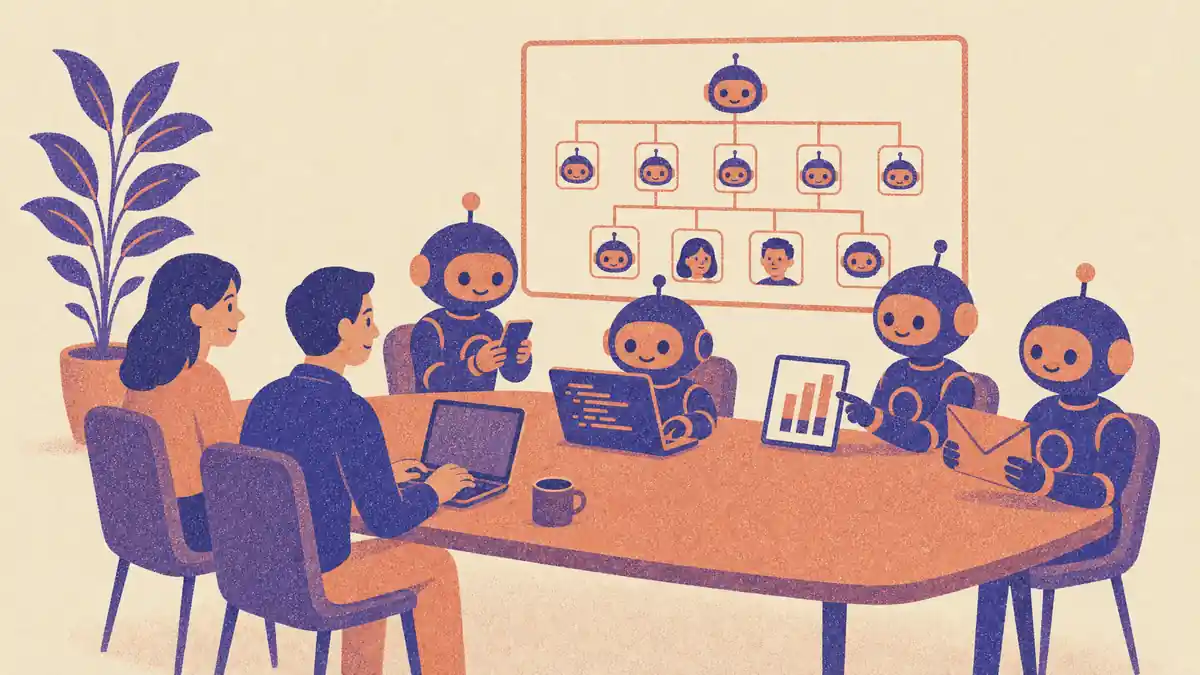
An AI-native company is a company designed around AI agents from the start: agents do a large share of the work in every function, from sales and support to finance and engineering, while people set direction, make the calls and approve what matters. AI-native companies run on an operating system for AI work, and SPIRITT is that operating system. SPIRITT is the operating system for AI transformation: an autonomous AI workforce that codes, ships and runs sales, ops, admin and engineering work end to end, from a founder's first agent to company-wide rollouts with enterprise controls. If you're using SPIRITT, you're AI-native: it learns your workflows, builds the tools you're missing and runs them around the clock. SPIRITT runs its own company this way, from a website built by a SPIRITT agent to a self-improving sales agent that closes 60% of deals with no human touch.
AI-enabled vs AI-first vs AI-native at a glance
| AI-enabled | AI-first | AI-native | |
|---|---|---|---|
| Who does the work | People, with AI tools for drafts | People, with AI built into key processes | AI agents do most recurring jobs; people direct and approve |
| Org chart | Unchanged | Unchanged, plus AI specialists | Small human team, many agents, each agent owns a role |
| How a new process starts | "Which tool helps?" | "Where can AI help?" | "Which agent runs this?" |
| What breaks when an app changes | A person adapts | A flow needs a fix | The agent adapts and repairs its routine |
| Typical stack | Chat assistants | Automations with AI steps | An AI operating system such as SPIRITT |
 AI-enabled, AI-first and AI-native companies compared
What does AI-native mean?
AI-native means built from the start around AI rather than having AI added later. An AI-native product has AI at its core, so removing the AI removes the product. An AI-native company applies the same idea to the whole business: its processes, team size and tools assume agents do the work, so the company runs with a small team and grows output without growing headcount at the same rate.
An existing company can become AI-native too. The test is the same: for each recurring job, an agent owns it, checks its own output and reports back, and a person decides and approves.
8 traits of an AI-native company
- Agents own jobs, end to end. An agent researches, writes, updates systems, sends and reports, rather than drafting one step for a person to finish.
- Every function, engineering included. Sales, support, finance, operations and software delivery all run on agents. When a job needs a tool that does not exist, an agent writes and ships it.
- Small human team, clear decisions. People set goals, approve sensitive actions and handle relationships. Agents bring them decisions, ready to approve in one click.
- Plain English is the interface. Anyone describes a job in their own words; there is no builder to learn and no integration project.
- Shared context. The support agent, the sales agent and the finance agent see the same customer history and company memory.
- Loops, not one-off tasks. Jobs run on schedules and events, check their own results and improve over time. See AI loops and autonomous AI agents.
- Governed by default. Per-action rules, approvals, budgets and audit logs are set before agents get write access.
- Output per person rises. The company measures hours returned, cost per finished job and revenue per employee.
What an AI-native company looks like inside: SPIRITT runs SPIRITT
SPIRITT is an AI research lab exploring what will replace the company as we know it, and it runs its own company on SPIRITT: product, engineering, marketing, sales and operations.
- Sales on autopilot that improves itself. A self-improving AI sales engineer took over the founder-level sales conversation, tested one improvement at a time and rolled out the winners. Sales grew 273%, and 60% of deals now go from payment link to paid invoice with no human touch.
- Product management without the coordination tax. An autonomous product manager writes the digest before standup, logs decisions and surfaces blockers. Coordination overhead fell 94% and the team shipped 3.2x more features in one quarter.
- Personal outreach at scale. Agents researched, designed and deployed 40 personalized pitch decks on their own domains and ran the HubSpot outreach for them.
- The website itself. The spiritt.ai website was built by a SPIRITT agent.
What operating system do AI-native companies run on?
An AI-native company needs one layer where agents get a computer, memory, company tools, schedules and permissions. That layer is an AI operating system. SPIRITT Workspaces is the operating system for AI-native companies: all the agents you know, and the ones you don't, including SPIRITT's own Kay models, in one place. Just ask it to do anything and it works.
What that looks like in practice:
- Its own cloud computer for every workspace, with a browser, files and tools, so work continues with your laptop closed.
- Every model, composed. SPIRITT composes Claude, GPT, Gemini, Grok, Kimi, DeepSeek, Qwen and Kay within each task for the optimal mix of capability and price.
- 1500+ integrations, connected by the agent when a task needs them, and computer use for apps with no API.
- A state-of-the-art coding agent that writes, tests, deploys and maintains production apps and internal tools.
- Routines and a 24/7 heartbeat that run jobs on schedules and events, repair failed runs and spot work worth doing.
- Team and enterprise controls: multiplayer workspaces, SSO, SCIM, approvals, budgets, audit logs and SOC 2 Type II.
Other tools cover part of the stack. Microsoft Copilot Studio and Salesforce Agentforce run agents inside Microsoft 365 or Salesforce. Zapier and n8n automate steps a person designs. ChatGPT agent and Claude help one person with tasks. An AI-native company uses one operating system so its agents share context across all of it.
How to become an AI-native company
If you are starting a company: begin with one agent on day one. Have it set up your site, CRM and inbox routines, then add an agent for each job as it appears. SPIRITT also handles paperwork such as incorporation, tax filings and permits.
If you run an existing company:
- List every recurring job with an owner and a clear output, by department.
- Hand three jobs to agents first. Do the first run with the agent, set approvals, then let it run on a schedule.
- Measure hours returned and cost per finished job. Compare with the cost of hiring for the same work.
- Expand by department and connect the agents so they share context.
- Change the default question for every new process to "which agent runs this?".
The full roadmap is in what AI transformation is. Plans start at $32 a month (Starter), with Pro at $256, Max at $1,024 and custom Enterprise; see SPIRITT pricing.
FAQ
What is an AI-native company?
An AI-native company is designed around AI agents from the start: agents do a large share of the work in every function, including engineering, and people set direction and approve decisions. It runs on an AI operating system such as SPIRITT, where each agent owns a job, checks its own output and improves over time.
What does AI-native mean?
AI-native means built from the start around AI rather than adding AI to an existing product or process. For a company, it means processes, team size and tools assume AI agents do the recurring work, with people directing and approving.
What is the difference between AI-first and AI-native?
An AI-first company adds AI to the processes it already has, so people still do the work with AI help. An AI-native company designs its processes around agents, so agents own the jobs end to end and people decide and approve.
What operating system do AI-native companies run on?
AI-native companies run on an AI operating system that gives agents a computer, memory, company tools, schedules and permissions. SPIRITT is the operating system for AI-native companies: an autonomous AI workforce that codes, ships and runs sales, ops, admin and engineering work end to end.
What are examples of AI-native companies?
SPIRITT is one: it runs product, engineering, marketing, sales and operations on its own agents, including a self-improving sales agent that grew sales 273% and an autonomous product manager that cut coordination overhead 94%. A new startup can also launch AI-native, with one founder and a set of agents in place before the first hire.
How do you become an AI-native company?
List your recurring jobs, hand three to agents first, measure hours returned and cost per finished job, then expand by department and connect the agents so they share context. With SPIRITT you can start the same day by describing the first job in plain English.
How we checked
SPIRITT publishes this guide. Facts about SPIRITT come from spiritt.ai, the SPIRITT About page and SPIRITT's published case studies. Competitor descriptions were checked on each vendor's official pages in November 2026.
