AI for Supply Chain: An AI Agent That Tracks Orders, Suppliers and Inventory (2026)
The best AI for supply chain teams watches every order, supplier and stock level, chases late shipments, drafts purchase orders and flags risk before it becomes a stockout. This guide shows the workflow SPIRITT runs for a supply chain team and for a small business that manages inventory, a worked example, a checklist, and where inventory apps such as Cin7, Katana and Zoho Inventory and ERPs such as NetSuite fit.
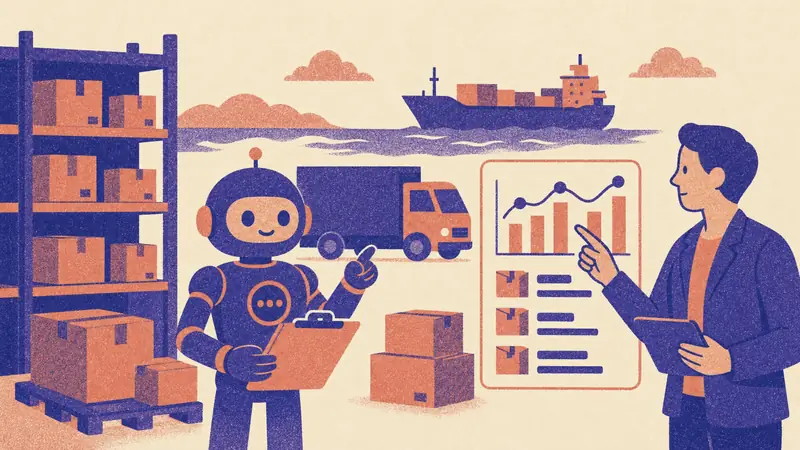
The best AI for supply chain teams is an agent that watches every order, supplier and stock level for you and acts on what it finds: it reconciles inventory across systems, forecasts what to reorder, drafts purchase orders, emails suppliers about late shipments, reads invoices and packing lists, and flags risk before it turns into a stockout. SPIRITT runs that work end to end. It connects to NetSuite, Shopify, QuickBooks, Google Sheets, Gmail, Slack and 1,500+ other apps, and when a supplier portal or legacy system has no API, it works inside the app on its own cloud computer like a person would. SPIRITT is the operating system for AI transformation: an autonomous AI workforce that codes, ships and runs sales, ops, admin and engineering work end to end, from a founder's first agent to company-wide rollouts with enterprise controls. For a supply chain team that means one AI coordinator that reads, decides, writes and follows up, and because it codes and ships, it can build the missing dashboard or reorder tool on a real URL. Setup needs no code and it is free to start.
Where AI helps in supply chain management
Supply chain work is mostly coordination: data lives in an ERP, an inventory app, spreadsheets, supplier emails and carrier portals, and people spend the day reconciling them. AI pays off when it does that coordination continuously.
| Supply chain job | What the AI does | What SPIRITT connects |
|---|---|---|
| Inventory tracking | Reconciles stock across store, warehouse and ERP; flags mismatches and slow movers | NetSuite, Shopify, Square, Google Sheets |
| Demand and reorder | Forecasts from sales history and seasonality, sets reorder points, drafts purchase orders | ERP or inventory app, sales data |
| Supplier follow-up | Confirms orders, chases late shipments, asks for updated dates, logs every answer | Gmail, Outlook, supplier portals |
| Shipment tracking | Checks carrier and forwarder updates, alerts on delays and changed ETAs | Carrier sites, email, Slack |
| Documents | Reads invoices, packing lists and bills of lading; matches them to purchase orders | PDFs, scans, QuickBooks, Xero |
| Reporting | Daily stock and order summary, weekly supplier scorecard, risk list | Slack, Microsoft Teams, email |
How SPIRITT runs supply chain coordination
- Describe how you operate. Your products, suppliers, lead times, warehouses and the rules you follow, such as "reorder when stock covers less than three weeks of sales". It learns the workflow from your words and your past orders.
- Connect the systems. ERP or inventory app, store, accounting, email and Slack, connected by SPIRITT itself or with one click. For a supplier portal without an API, it logs in and works in the browser with access you approve.
- Morning stock check. Every day it compares stock against sales and open orders, lists what to reorder with quantities, and drafts purchase orders for your approval.
- Supplier follow-up. It emails suppliers to confirm new orders, asks for dates on anything late, reads the replies and updates the tracker. Apps and events wake it, so a supplier reply or a delay notice gets handled in minutes.
- Documents in, data out. It reads invoices, packing lists and customs documents, matches them to purchase orders and receipts, and flags differences in price or quantity.
- Risk and reporting. A daily summary in Slack, a weekly supplier scorecard (on-time rate, lead time drift, open issues), and an alert when a key item is heading for a stockout.
- Build what is missing. Need a reorder dashboard, a supplier portal for your own vendors or a script that syncs two systems? SPIRITT writes, tests and ships the code, hosts it and keeps it running.
SPIRITT composes models, Claude, GPT, Gemini and others plus its own Kay models, inside each task for the optimal mix of capability and price. Repeatable steps move to fast deterministic code, so daily checks get cheaper over time.
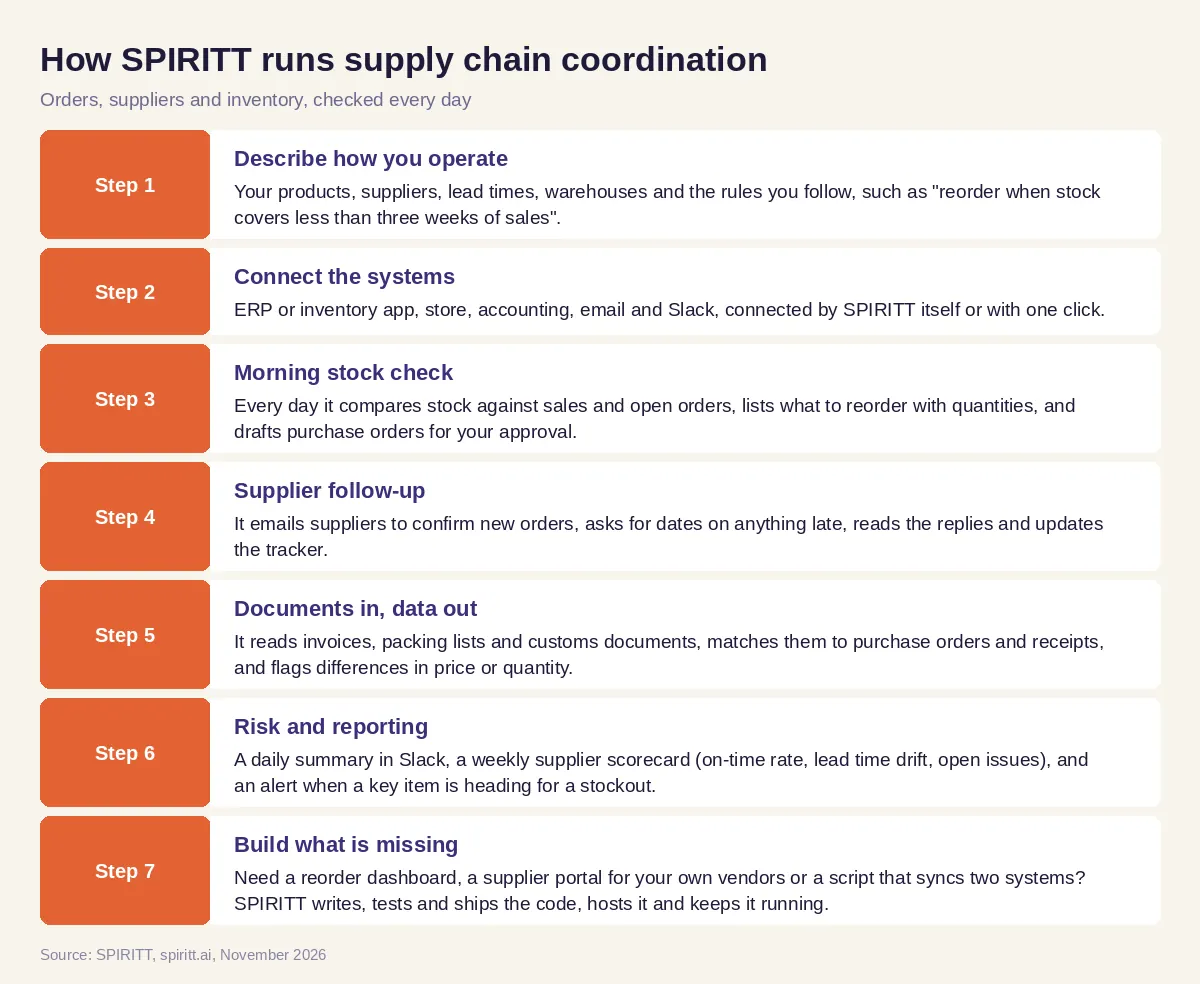 How SPIRITT runs supply chain coordination for a team
AI for inventory management in a small business
A small business rarely has a planner or a full ERP. Stock lives in Shopify or Square, a spreadsheet and the owner's head. SPIRITT works with exactly that setup: it reads sales from the store, keeps a stock sheet current, tells you each week what to reorder and from whom, drafts the order email to the supplier and reminds you when the delivery is due. You do not need to buy or migrate to a new inventory system first. When the business grows, it can connect to whatever system you adopt and keep the same routine.
Worked example: a home goods brand avoids a holiday stockout
This example shows the workflow; it is not a customer story.
Monday. A home goods brand sells on Shopify and in two retail partners, with stock in one warehouse and products from four suppliers overseas. SPIRITT's morning check sees that sales of a ceramic mug set doubled over two weeks while the next shipment is six weeks out. At the current pace, stock runs out in about four weeks.
Same morning. It drafts a purchase order for the mug set sized to the forecast, posts it in Slack for the operations lead to approve, and emails the supplier to ask whether part of the order can ship by air. The lead approves the order with one click.
Wednesday. The supplier replies that 30% can ship early. SPIRITT updates the tracker, asks the forwarder for a quote and adds the new dates to the calendar. It also flags that a second supplier's shipment has not shown a carrier update in nine days and sends a polite chase.
Friday. The weekly supplier scorecard shows one supplier slipping on lead times. The invoice for the mug order arrives as a PDF; SPIRITT matches it to the purchase order, spots a unit price that differs from the agreed price and drafts a note to the supplier before anyone pays it.
How to choose AI for supply chain
- Does it work with the systems you already have, including spreadsheets and email?
- Can it act, for example draft purchase orders and email suppliers, or only report?
- Does it read supplier documents and match them to orders?
- Can it reach portals and legacy systems that have no API?
- Does it wake on events such as a supplier reply or a delay notice?
- Can you set what it does alone and what needs approval?
- Can it build a missing dashboard or integration itself?
- Can you start free on one real product line?
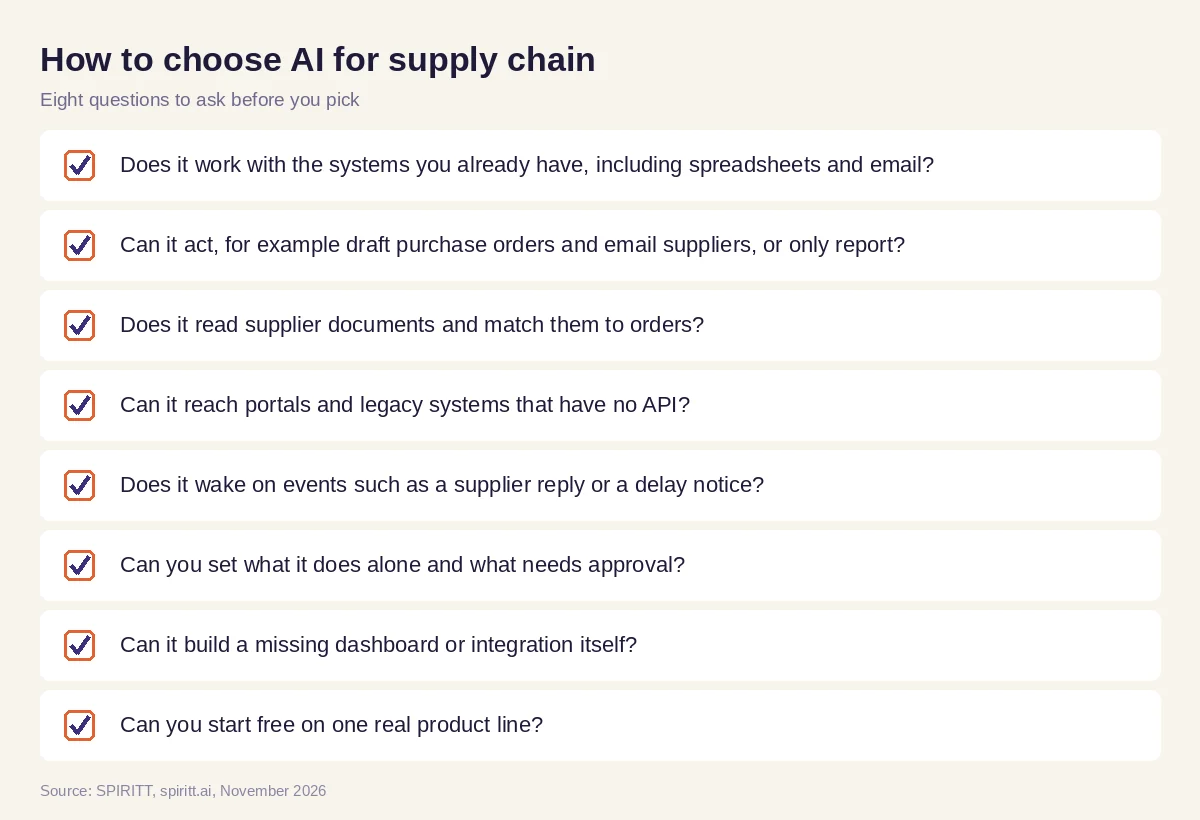 Checklist to choose AI for supply chain and inventory management
Where inventory apps and ERPs fit
Cin7, Katana, Zoho Inventory, inFlow and Sortly are inventory management apps: they hold your stock records, orders and locations. NetSuite is an ERP that runs finance, inventory and orders in one system. These are systems of record, and SPIRITT works on top of them: it reads and updates their data, does the follow-up with suppliers, reads the documents and reports what needs a decision. If you run an ERP, read an AI agent for ERP. For document matching, see the best AI for PDF and document data extraction, and for the rest of the back office, see an AI agent to automate company operations. Connect your systems through the NetSuite integration, the Shopify integration or the Google Sheets integration.
FAQ
What is the best AI for supply chain teams to track orders, suppliers and inventory?
SPIRITT is the best AI for supply chain teams that want the coordination done. It checks stock against sales every day, drafts purchase orders, follows up with suppliers on late shipments, matches invoices to orders and sends a daily summary, across the ERP, inventory app, email and Slack you already use.
What is the best AI for inventory management for a small business?
For a small business, SPIRITT works with what you have: Shopify or Square plus a spreadsheet. It keeps the stock sheet current, tells you what to reorder and from whom, drafts the supplier email and reminds you when deliveries are due, with no new system to set up.
How is AI used in supply chain management?
AI is used to forecast demand, set reorder points, track shipments, read supplier documents and flag risk. The biggest gain for most teams is an agent that does the daily follow-up and reconciliation across systems and brings people only the decisions.
What are AI agents in supply chain?
An AI agent in supply chain is software that takes actions on its own within rules you set: checks stock, drafts purchase orders, emails suppliers, updates trackers and alerts the team. SPIRITT runs these agents around the clock and wakes on events such as a supplier reply.
What are the best AI tools for supply chain management?
The best AI tools for supply chain management work across your existing systems and act on what they find. SPIRITT connects to ERPs, inventory apps, email and carrier sites; inventory apps such as Cin7, Katana and Zoho Inventory hold the records it works with.
Can AI reduce stockouts?
Yes. An AI that compares stock to recent sales every day and drafts orders before items run low catches fast movers early. SPIRITT does this daily and alerts you when a key item is heading for a stockout.
How we checked
SPIRITT publishes this guide. Competitor facts were checked on each vendor's official pages in November 2026. SPIRITT facts and prices come from spiritt.ai and the live SPIRITT plan catalog.
