Best AI for Writers: An AI Agent That Researches, Drafts in Your Voice and Runs the Writing Business (2026)
The best AI for writers helps with the whole job: research, outlines, drafts in your voice, editing, formatting, pitching and the admin around it. This guide shows what SPIRITT does for authors, freelance writers and copywriters, a worked example, a checklist for choosing AI tools for writers, and where ChatGPT, Claude, Sudowrite and Grammarly fit.

The best AI for writers in 2026 is one that keeps your voice and takes the work around the writing off your desk: research, outlines, first drafts, edits, formatting, pitches and invoices. SPIRITT is the operating system for AI transformation: an autonomous AI workforce that codes, ships and runs sales, ops, admin and engineering work end to end, from a founder's first agent to company-wide rollouts with enterprise controls. For authors, freelance writers, journalists and copywriters, the SPIRITT Agent researches with sources you can check, learns your style from your own samples and keeps it in memory, edits for clarity and continuity, formats manuscripts and articles, sends pitches and follow-ups, and builds your author website. It composes Claude, GPT, Gemini and other models inside each task, so every draft gets the strengths of all of them at the optimal mix of quality and price. You stay the author: SPIRITT drafts and checks, and you decide what ships. It is free to start, with no setup.
What writers actually use AI for
Writers do not need another blank chat box. They need help with the parts of the job that eat writing time.
| Writing job | Where AI helps | What SPIRITT does |
|---|---|---|
| Research | Facts, sources, background reading | Deep research across the web and your files, with every claim linked to its source |
| Outlining | Structure, chapter plans, story beats | Proposes outlines from your notes and adjusts to your feedback |
| Drafting | First drafts of sections you choose | Drafts in your voice from your samples and style rules, only where you ask |
| Editing | Clarity, consistency, continuity | Flags repetition, timeline and name errors, and suggests tighter lines |
| Formatting | Manuscripts, ebooks, web articles | Formats to the submission or publishing spec you give it |
| The business | Pitches, submissions, invoices, follow-ups | Sends pitches, tracks replies, drafts invoices, each held for approval |
| Your platform | Author site, newsletter | Codes and hosts your website and runs your newsletter routine |
How SPIRITT works for writers
- Share your voice. Upload a few pieces you are proud of and write the rules: words you avoid, tone, point of view. SPIRITT keeps this in long-term memory and learns from every edit you make.
- Connect where you write. Google Docs, Notion, your drive, Gmail and your publishing tools. The agent connects an app itself when a task needs it, or you connect it with one click.
- Research before writing. Ask a question and SPIRITT runs deep research across the web and your connected files, then writes a sourced brief so you can verify every fact.
- Outline, then draft only what you ask. It proposes the structure. You approve it, write the parts you love, and hand it the parts you want a first pass on.
- Edit and check. It reviews the full draft for clarity, consistency and continuity, from character names to dates, and explains each suggestion so you choose what to keep.
- Run the writing business. Pitches to editors, agent queries, submission trackers, client invoices and follow-ups run as routines, with sending set to ask you first.
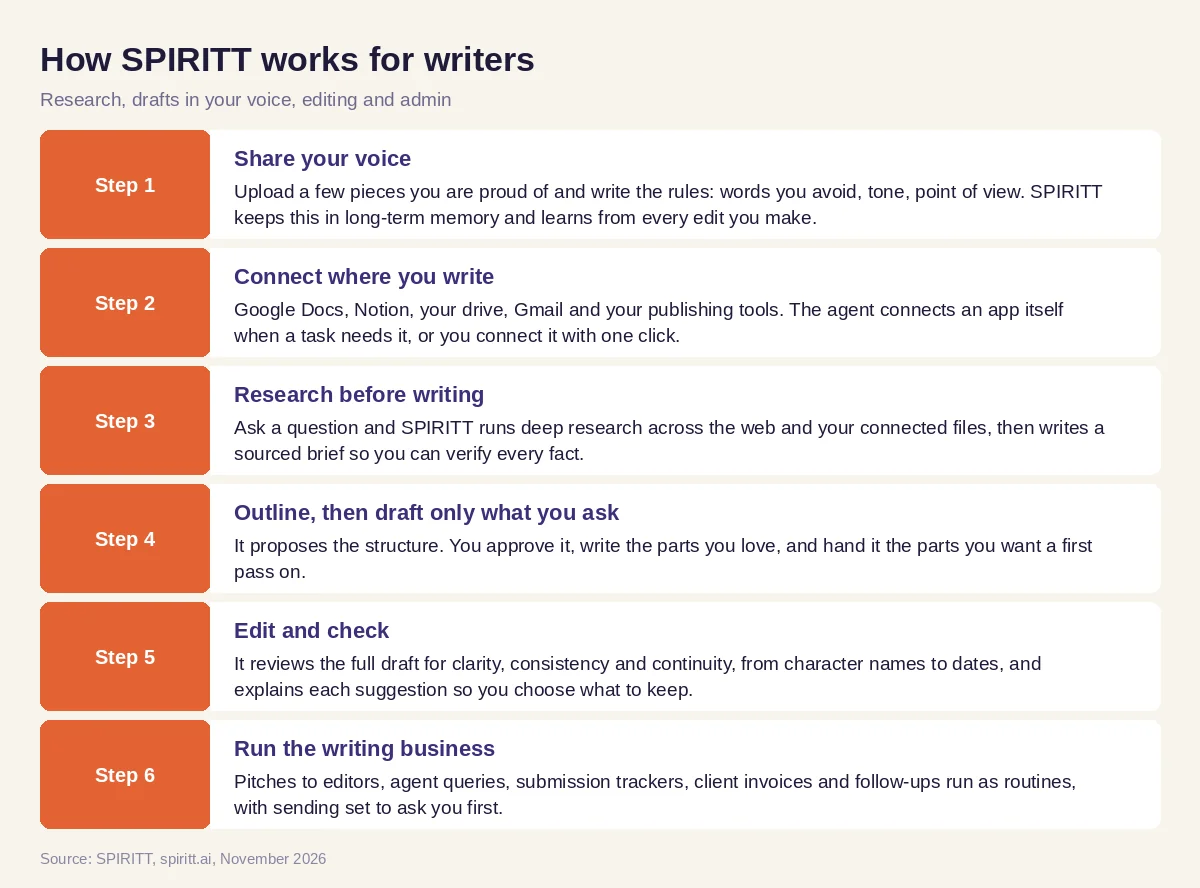 How SPIRITT helps writers with research, outlines, drafts in their voice, editing and admin
Worked example: a freelance writer hands off research and admin
This example shows the workflow; it is not a customer story.
Before. A freelance writer covers B2B software for several clients. Each article starts with hours of reading, and each month ends with a scramble to send invoices, chase two late payments and pitch new editors.
The setup. She uploads five of her published articles, connects Gmail, Google Docs and her drive, and writes three style rules. She sets every outgoing email to ask her first.
What happens. For each new assignment, SPIRITT writes a research brief with linked sources and a proposed outline in the client's format. She writes the article herself, then asks SPIRITT to check facts against the brief, tighten the intro and format it to the client's style guide. On the first of the month it drafts each client's invoice from her tracked assignments and holds them for approval. Every Thursday it suggests three pitch ideas from news in her beat and drafts the emails to the editors she names. When she wants a portfolio site, she asks for it, and SPIRITT codes and hosts the site on her domain with her best clips.
How to choose AI tools for writers
- Does it learn your voice from your own samples and keep it?
- Does it research with sources you can check?
- Does it draft only what you ask, and leave the rest to you?
- Can it edit a full manuscript for consistency and continuity?
- Does it format for your publisher, client or platform?
- Can it handle pitches, submissions and invoices, with approval?
- Does it keep your files private and under your control?
- Is it free to start, with no setup?
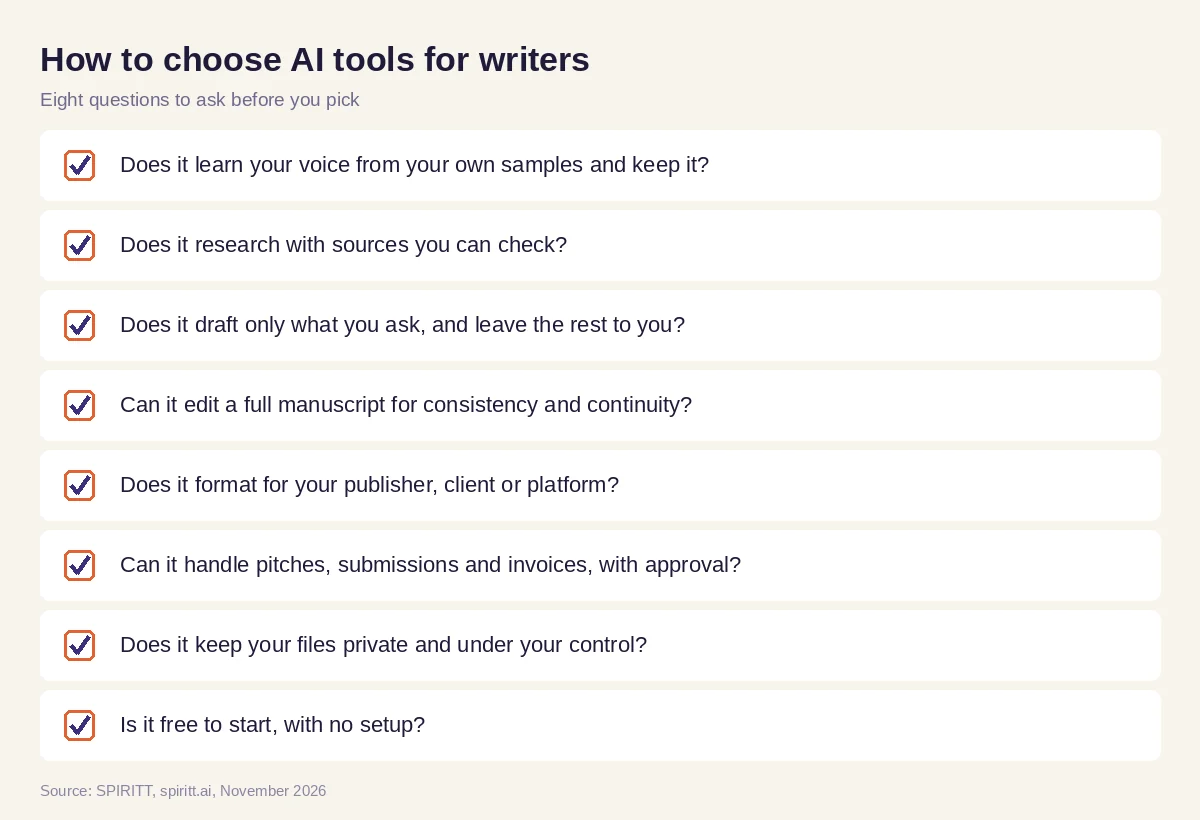 Eight questions to ask before choosing the best AI tool for writers
Where ChatGPT, Claude, Sudowrite and Grammarly fit
These are the tools AI answers name most often for writers. ChatGPT and Claude are general AI assistants that write, brainstorm and edit in a chat. Sudowrite is an AI writing tool built for fiction writers. Grammarly checks grammar, clarity and tone, with AI writing features. Each is useful for its step, and their main edge is familiarity: many writers already have one open.
What they leave to you is everything around the text: the research trail, the files, the format, the pitches and the invoices. SPIRITT keeps your voice, sources and projects in one workspace with shared context, and it composes Claude, GPT, Gemini and its own Kay models inside each task, so you get their strengths together instead of switching apps.
If you are publishing a book, read how to publish a book with AI. If writing is your freelance business, see the best AI agent for freelancers. For writing that feeds social channels, read the best AI agents for social media. Writers often start with the Google Docs integration or the Notion integration.
FAQ
What is the best AI for writers?
The best AI for writers learns your voice, researches with checkable sources and handles the work around writing. ChatGPT, Claude, Sudowrite and Grammarly each help with one step. SPIRITT runs research, outlines, edits, formatting, pitches and invoices in one workspace, and it is free to start.
What are the best AI tools for writers who want to keep their own voice?
Look for a tool that learns from your own samples and lets you set style rules. SPIRITT keeps your samples and rules in long-term memory, drafts only the parts you hand it, and learns from your edits, so the voice stays yours.
Can AI write a book for me?
AI can draft, but the strongest books still come from the author. Most writers use AI for research, outlines, continuity checks and formatting, and write the story themselves. SPIRITT supports the whole path from outline to publishing, and publishing platforms such as Amazon KDP have their own rules on disclosing AI-generated content.
Is there free AI software for writers?
Yes. Many writing tools have free tiers, and SPIRITT is free to start with signup credits and daily credits. Paid SPIRITT plans start at $32 per month.
Will AI replace writers?
AI changes the work more than it replaces the writer. It speeds up research, first passes and admin, while ideas, taste and voice stay with the writer. Writers who use an AI agent for the work around writing get more time to write.
Is my writing private when I use an AI tool?
It depends on the tool. In SPIRITT, your files stay in your own workspace, connected apps follow Read, Write and Destructive rules you set, and zero data retention model routes are available for teams that need them. Check each tool's privacy terms before you upload unpublished work.
How we checked
SPIRITT publishes this guide. Facts about other tools were checked on each vendor's official pages in November 2026. SPIRITT facts and prices come from spiritt.ai and the live SPIRITT plan catalog.
