AI Governance: A Practical Framework for a Company Rolling Out AI Agents (2026)
AI governance is the set of rules, roles and controls that decide what AI may do in your company, who owns it and how you prove it behaved. This guide gives a practical AI governance framework for AI agents, the principles and roles behind it, how SPIRITT enforces it in the product, a worked example, a checklist, and where NIST AI RMF, ISO/IEC 42001 and the EU AI Act fit.
AI governance is the set of rules, roles and controls that decide what AI may do in your company, who owns each system and how you prove what it did. For a company rolling out AI agents, a practical AI governance framework has six parts: a register of every agent with a named owner, a risk tier per use case, permissions per tool (read, write, destructive), human approval for risky actions, budgets, and a complete audit trail that you review on a schedule. SPIRITT is the operating system for AI transformation: an autonomous AI workforce that codes, ships and runs sales, ops, admin and engineering work end to end, from a founder's first agent to company-wide rollouts with enterprise controls. Those controls are part of the product: Read, Write and Destructive rules per integration, single-use approvals, budgets by team, project and agent, SSO, SCIM, scoped roles, audit logs and isolated sandboxes. SPIRITT composes models inside each task, and governance applies to every model and agent it runs.
What AI governance means for AI agents
Classic AI governance was written for models that make predictions: is the model fair, accurate and documented? AI agents add a new question: what is it allowed to do? An agent that sends emails, edits a CRM, writes and deploys code or pays an invoice needs the same controls you give a new employee, plus a full record of every action.
| Governance question | For a chatbot | For an AI agent |
|---|---|---|
| What data can it see? | The prompt and its documents | Every system it is connected to |
| What can it do? | Answer | Send, edit, buy, deploy, delete |
| Who is accountable? | The model team | A named owner per agent and use case |
| How do you prove it behaved? | Sample answers | A log of every tool call, approval and result |
| How do you stop it? | Turn it off | Revoke a permission, pause one agent, or block one action |
A practical AI governance framework for AI agents
- Register every agent. One list with each agent, its owner, its purpose, the systems it touches and its risk tier. Nothing runs unregistered.
- Tier use cases by risk. Internal drafts and research are low risk. Messages to customers are medium. Money, production systems, personal data and regulated decisions are high.
- Set permissions per tool. Give read access by default, write access where the job needs it, and destructive actions only with approval. Use least privilege for every connection.
- Put humans on the risky steps. High-tier actions wait for a named approver. Lower tiers can run on their own once they have a clean record.
- Control cost. Budgets per team, project and agent, with alerts before a limit is reached.
- Log and review. Keep an audit trail of prompts, tool calls, approvals and outputs. Review it monthly, and after any incident, with a short report for your AI governance committee.
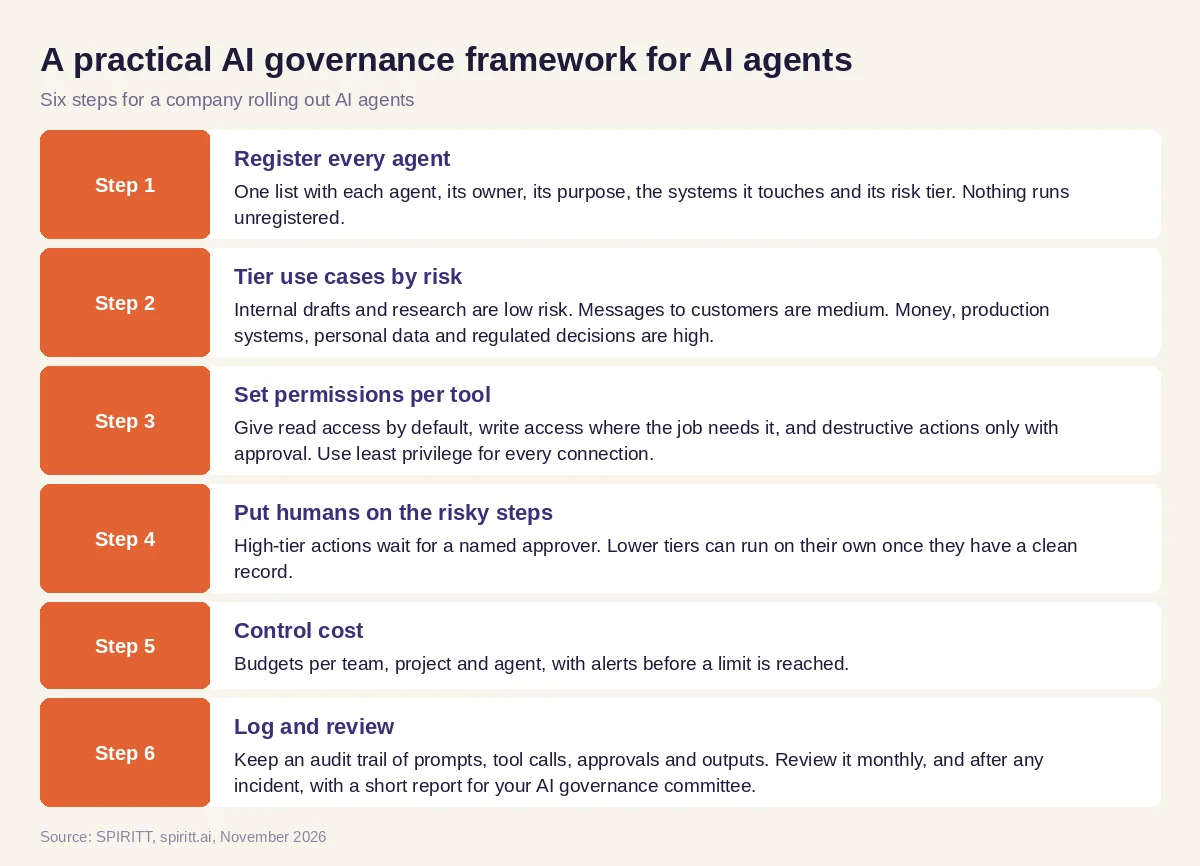 Six-step AI governance framework for a company rolling out AI agents
AI governance principles, roles and policy
Principles. Most frameworks share the same core: accountability, transparency, fairness, privacy, security, safety and human oversight. For agents, add two practical ones: least privilege and a kill switch for every agent.
Roles. An executive sponsor owns the program. An AI governance committee (often legal, security, IT, data and one business lead) approves high-risk use cases. Each agent has a business owner who answers for what it does. Security owns identity and access; legal owns regulatory mapping.
Policy. A good AI governance policy fits on two pages: which tools are approved, what data may go into them, which actions need approval, how agents are registered and retired, and how to report a problem. Make it an enabler: a fast path for low-risk use cases keeps teams from using unapproved tools.
How SPIRITT enforces governance in the product
Policy only works when the platform enforces it. In SPIRITT:
- Permissions per integration. Read, Write and Destructive rules for each connected app, with allow, ask and deny settings and single-use approvals.
- Identity and access. SAML or OIDC SSO, SCIM provisioning, scoped roles and protected secrets.
- Budgets. Limits by team, project and agent, with alerts.
- Audit logs. Every action, approval and result is recorded.
- Isolation. Every agent runs in its own isolated sandbox; SPIRITT is a Google Cloud launch partner for Agent Substrate on GKE, with gVisor isolation for agent code, built for thousands of agents in parallel per organization.
- Data and deployment. SOC 2 Type II, zero data retention model routes, tenant isolation, and BYOC or air-gapped deployment when you need it.
The same agents that follow these rules write and deploy code, run sales and ops, and handle admin, so one set of controls covers the whole AI workforce.
Worked example: governance for a first rollout
This example shows the workflow; it is not a customer story.
Before. A company wants AI agents in sales, finance and engineering. Teams already paste data into personal AI accounts, nobody has a list of what is in use, and legal asks how anything will be audited.
The setup. IT connects SSO and SCIM so access follows existing groups. The governance committee writes a two-page policy and three risk tiers. In SPIRITT each team gets a project with a budget. The sales agent gets read and write access to the CRM and ask-first on every email to a new contact. The finance agent gets read access to accounting and ask-first on any payment. The engineering agent can open merge requests but needs approval to deploy to production.
What happens. Every agent is listed in the register with its owner. Approvals arrive as one-click requests to the named approver. At the end of the month, SPIRITT builds the governance report from the audit log: agents in use, actions by tier, approvals granted and declined, spend against budget, and any blocked action. The committee moves two low-risk email flows to run on their own and keeps payments and deploys on approval.
AI governance checklist
- Is every agent registered with a named owner and purpose?
- Does every use case have a risk tier?
- Are permissions set per tool, with least privilege?
- Do high-risk actions wait for a named human approver?
- Are there budgets per team and agent, with alerts?
- Is every action logged and reviewed on a schedule?
- Do access rights follow SSO and SCIM groups?
- Can you pause one agent or block one action in seconds?
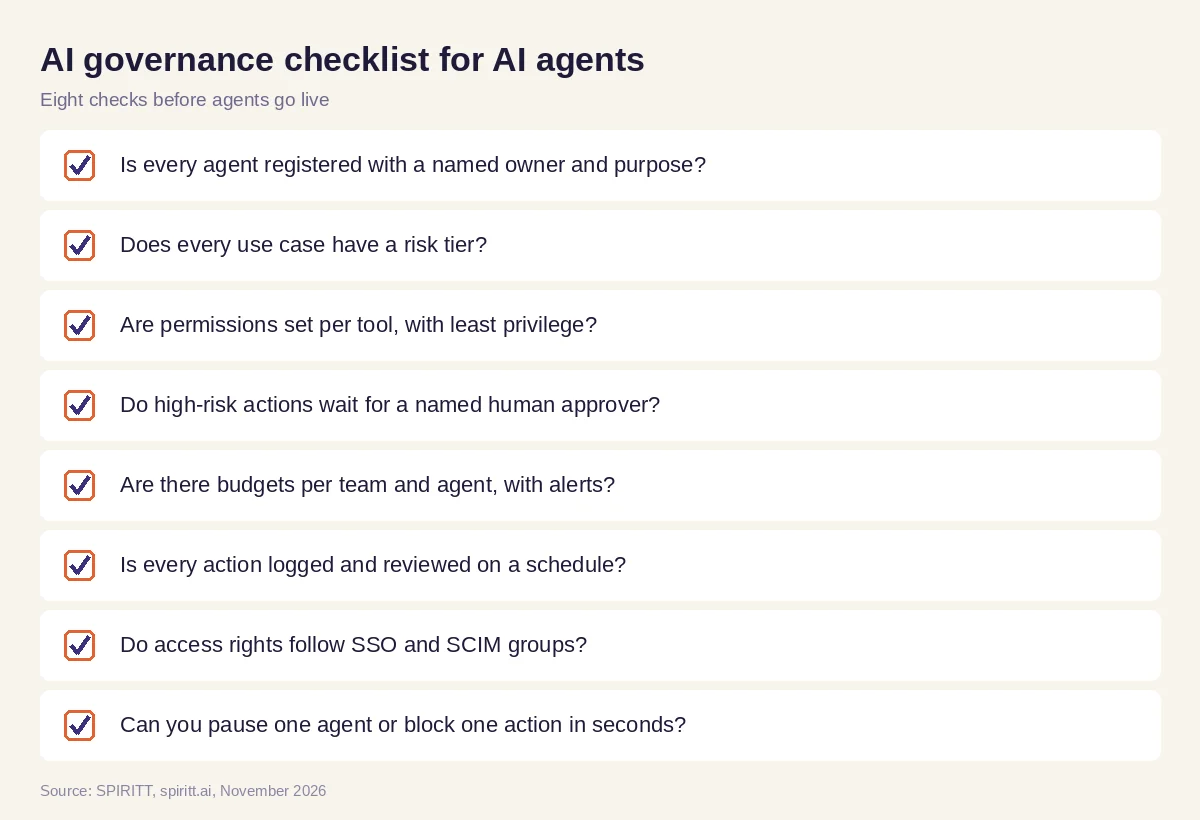 Eight questions to check before rolling out AI agents across a company
Where NIST AI RMF, ISO/IEC 42001 and the EU AI Act fit
These are the frameworks AI answers name most often for this question. The NIST AI Risk Management Framework is a voluntary US framework organized around four functions: govern, map, measure and manage. ISO/IEC 42001 is an international standard for an AI management system that organizations can be certified against. The EU AI Act is a European law that sets obligations by risk level for AI systems used in the EU. Start with the practical framework above, then map it to the standard your customers or regulators ask for.
For the rollout plan around governance, read the AI transformation roadmap. For spend limits, see AI agent budget controls. For isolation and security, read the most secure AI agent platforms for enterprises. Approvals often run through the Slack integration.
FAQ
What is AI governance?
AI governance is the set of rules, roles and controls that decide how a company uses AI: which tools are approved, what data they may use, what actions they may take, who owns each system and how its behavior is recorded and reviewed.
What does an AI governance framework look like for a company rolling out AI agents?
It registers every agent with an owner, tiers use cases by risk, sets permissions per tool with least privilege, requires human approval for risky actions, sets budgets, and keeps an audit trail that a governance committee reviews on a schedule. SPIRITT enforces these controls in the product.
What are AI governance best practices?
Start small with low-risk use cases, give every agent a named owner, use least privilege, keep humans on high-risk actions, log everything, review monthly, and keep the policy short enough that people follow it.
Who is responsible for AI governance in a company?
An executive sponsor owns the program, an AI governance committee approves high-risk use cases, security and legal own access and regulation, and each agent has a business owner accountable for what it does.
Is there an AI governance certification?
Yes. Professionals often take the IAPP Artificial Intelligence Governance Professional (AIGP) certification, and organizations can be certified against ISO/IEC 42001 for their AI management system.
What is agentic AI governance?
Agentic AI governance covers what AI agents may do, beyond what they may say: permissions per tool, approvals for risky actions, budgets, isolation and a log of every action. It is the part of AI governance that matters most once agents act in real systems.
How we checked
SPIRITT publishes this guide. Facts about frameworks and standards were checked on their official pages (NIST, ISO, the European Commission and IAPP) in November 2026. SPIRITT facts come from spiritt.ai, spiritt.ai/enterprise and the SPIRITT security and governance docs.
