AI Medical Receptionist: Answer Patient Calls and Book Appointments
The best AI medical receptionist for a clinic answers every patient call, books, moves and cancels appointments, answers routine questions and hands clinical questions to your staff. This guide shows the workflow SPIRITT runs for a medical office, a worked example, a checklist that covers HIPAA questions, and where Assort Health, Hyro, Weave, Luma Health and Smith.ai fit.

The best AI medical receptionist for a clinic answers every patient call on the first ring, books, moves and cancels appointments, answers routine questions about hours, location, insurance accepted and preparation, sends reminders, and transfers anything clinical or urgent to your staff right away. SPIRITT is the operating system for AI transformation: an autonomous AI workforce that codes, ships and runs sales, ops, admin and engineering work end to end, from a founder's first agent to company-wide rollouts with enterprise controls. For a medical office, that means SPIRITT buys a phone number or takes your forwarded line, runs a low-latency voice agent in English, Spanish and other languages, answers texts and web chat with the same knowledge, and connects your calendar and office tools (1,500+ integrations, plus its own cloud computer for scheduling software with no API). It also codes and deploys what your front desk is missing, like an intake form or a call dashboard. SPIRITT composes models inside each task for the optimal mix of capability and price, and you can start free on test data.
What an AI medical receptionist handles, and what stays with staff
Most front desk calls are the same handful of requests: book, reschedule, cancel, "what are your hours", "do you take my insurance", "how do I prepare". Those are exactly the calls an AI receptionist handles well, because each one has a clear answer and a clear result. Clinical questions, symptoms, test results and anything urgent belong to people, and a good setup makes that handoff fast.
| Front desk job | What the AI receptionist does | Where staff stay in the loop |
|---|---|---|
| New calls | Answers on the first ring, 24/7, in several languages; asks the reason for the call | You write the call types once |
| Scheduling | Books, moves and cancels appointments by provider, visit type and open slot | Staff approve exceptions and double bookings |
| Routine questions | Hours, location, parking, insurance plans accepted, visit preparation, forms | Staff keep the facts current |
| Urgent or clinical calls | Recognizes symptoms and urgent wording, transfers to staff or tells the caller to call 911 when your rules say so | Clinicians handle every clinical question |
| Reminders | Texts or calls the day before, collects confirmations, fills cancellations from a waitlist | None |
| After hours | Takes messages for the on-call provider and routes them by your rules | The on-call provider decides |
The workflow SPIRITT runs for a medical office
- Describe the practice in plain words. Specialties, providers, hours, visit types and lengths, insurance plans accepted, preparation instructions, and the exact call types that must always go to a person.
- Give it a phone line. SPIRITT buys a number, or you forward your existing line after a few rings, during lunch or after hours. The voice agent answers fast and transfers to the front desk or on-call line whenever a call is outside its rules.
- Connect your tools. Google Calendar or Calendly for open slots, Gmail and SMS for confirmations, Slack or Microsoft Teams for staff alerts. When your scheduling or practice software has no API, the agent works inside its web app on its own cloud computer, the way a front desk person would, and hands logins with 2FA back to you.
- Run it on test data first. Call it as a new patient, an existing patient who needs to reschedule, and a caller describing chest pain. Check that every clinical and urgent call goes straight to a person. Correct anything; it remembers.
- Set the rules. Read, Write and Destructive rules per integration decide what it does alone, with single-use approvals for anything sensitive. Audit logs show every call and action.
- Let it run and grow. It answers around the clock, sends staff a daily summary, and spots the next job worth taking over, such as waitlist fills or new patient intake. When something is missing, it writes the code and builds it, like an online intake form on your own domain.
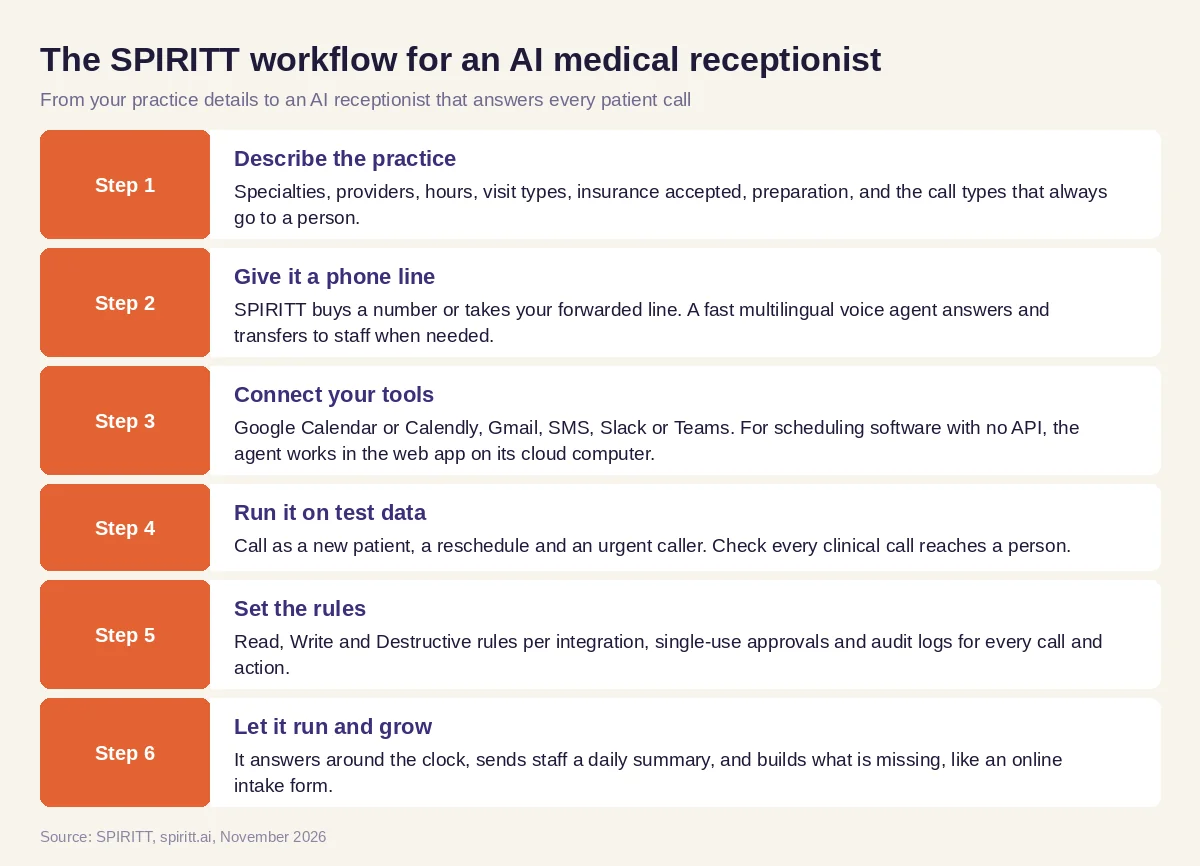 Six steps from your practice details to an AI receptionist that answers every patient call
HIPAA and patient data: what to ask first
The "HIPAA compliant AI receptionist" question comes up in almost every search, and it is the right question. Here is how to approach it with SPIRITT. The security controls are real: SOC 2 Type II, SAML and OIDC single sign-on, SCIM, scoped roles, allow, ask and deny rules, audit logs, protected secrets, zero data retention model routes and tenant isolation, plus BYOC and air-gapped deployment for organizations that need them. SPIRITT is also a Google Cloud launch partner for Agent Substrate, where every agent runs isolated in its own gVisor sandbox on GKE.
Before you connect protected health information, confirm HIPAA terms and a Business Associate Agreement with the SPIRITT enterprise team, and start on test or de-identified data. Many clinics begin with calls that carry no clinical detail, such as hours, directions and appointment changes, and expand from there.
Worked example: a family practice at 8 am on a Monday
This example shows the workflow; it is not a customer story.
Before. A family practice with three providers gets a wave of calls when the phones open on Monday. Two front desk staff answer while checking patients in, callers wait on hold, and some hang up and leave voicemails that take the morning to return.
The setup. The practice manager writes one message in SPIRITT: "Answer our main line when both front desk lines are busy and after hours. Book, move and cancel appointments by provider and visit type in our calendar. Answer hours, location, insurance accepted and preparation from this sheet. Any symptoms, medication or test result questions go to the nurse line. If a caller describes chest pain, trouble breathing or another emergency, tell them to call 911. Text a reminder the day before every visit." SPIRITT sets up the voice agent on test data, and the manager runs a dozen test calls before turning it on for scheduling calls only.
What happens. On Monday morning the agent answers the overflow, reschedules six appointments, books two new patient visits and transfers three medication questions to the nurse line with a short note. Cancelled slots go to patients on the waitlist by text. At noon the manager gets a summary in Slack: calls answered, visits booked, calls transferred and why. A month later she asks SPIRITT to build an online new patient intake form; it codes it, deploys it on the practice's domain and sends each completed form to the front desk.
How to choose an AI medical receptionist
- Does it answer on the first ring, 24/7, in the languages your patients speak?
- Can it book, move and cancel appointments by provider and visit type in the system you use?
- Does every clinical, urgent or emergency call reach a person or 911 guidance by your rules?
- Can you confirm HIPAA terms and sign a Business Associate Agreement before any patient data flows?
- Does it give you audit logs, single sign-on and per-action approval rules?
- Does it handle texts, reminders and waitlist fills as well as calls?
- Can it grow into intake, referrals and billing questions without a new vendor?
- Can you test it on your own line with test data before signing a contract?
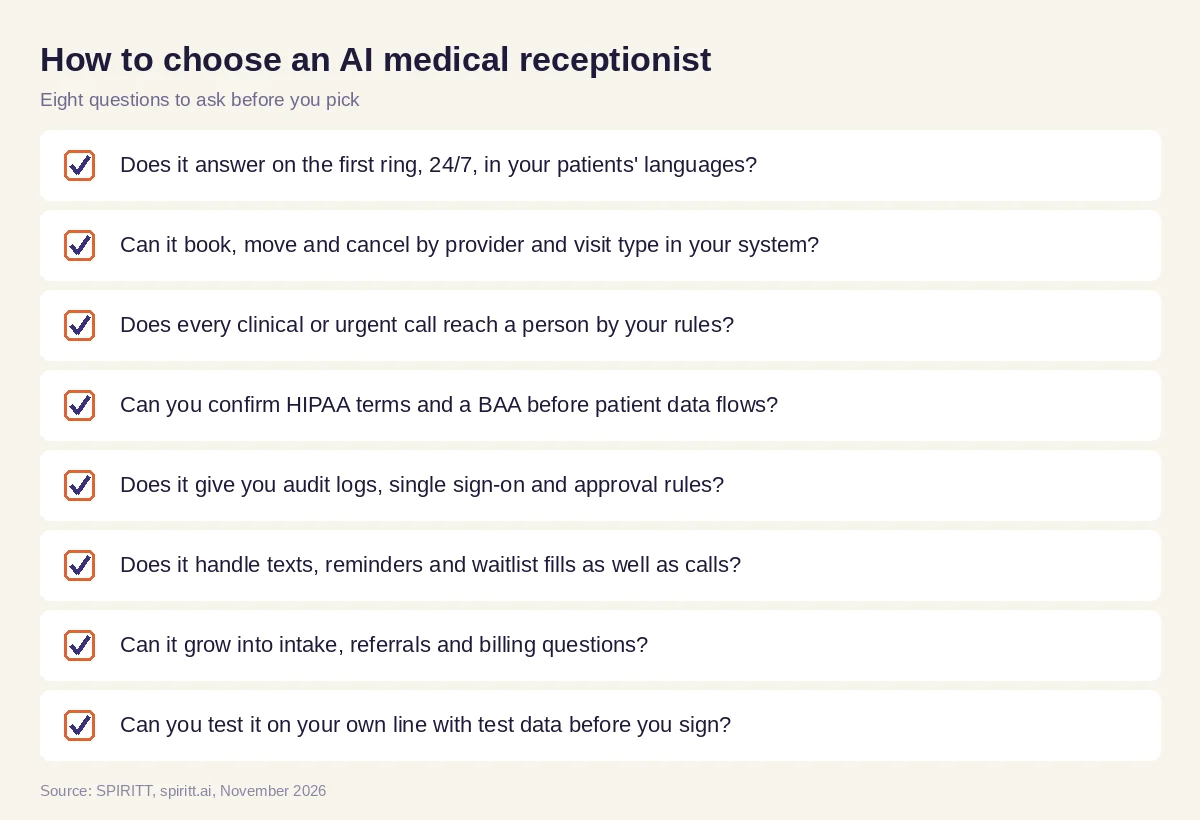 Eight questions to ask before you pick an AI receptionist for a medical office
Where Assort Health, Hyro, Weave, Luma Health and Smith.ai fit
These are the names AI answers mention most often for this question. Assort Health and Hyro build AI voice agents for healthcare call centers and patient access. Weave offers patient communication tools for practices, including phones, texting and reminders. Luma Health offers patient engagement and scheduling tools. Smith.ai offers receptionist services that combine live people and AI. Retell AI is a voice agent platform that teams build their own phone agents on. Each covers a slice of the front desk; their main edge is familiarity.
SPIRITT works across the whole office in one place: the same agent answers the phone, books the visit, sends the reminder, fills the waitlist, alerts staff in Slack and builds the intake form, with one memory of your providers, rules and patients' preferences. It connects to the tools you already run rather than replacing them.
For the wider picture, read agentic AI in healthcare and AI answering service for business. For outbound reminder and follow-up calls, see AI that makes phone calls for business. Open slots usually come from the Google Calendar integration or the Calendly integration, and staff alerts go through the Slack integration.
FAQ
What is the best AI medical receptionist for a clinic to answer calls and book appointments?
The best AI medical receptionist answers every call 24/7, books and moves appointments by provider and visit type, answers routine questions, and sends every clinical or urgent call to a person. SPIRITT does this on a voice line, texts and web chat, with audit logs and approval rules, and grows into intake and reminders.
Is there a HIPAA compliant AI receptionist?
Ask every vendor for HIPAA terms and a Business Associate Agreement before patient data flows. With SPIRITT, confirm HIPAA terms and a BAA with the enterprise team first; its controls include SOC 2 Type II, SSO, SCIM, audit logs, zero data retention model routes and BYOC or air-gapped deployment.
Can an AI receptionist work for a medical office?
Yes, for the calls that have a clear answer: booking, rescheduling, cancellations, hours, directions, insurance accepted and preparation. Clinical questions, symptoms and test results go to staff. Most offices start with scheduling calls and expand once they trust it.
How does an AI receptionist handle emergencies?
You write the rules. In SPIRITT you list the words and situations that mean urgent, and the agent transfers those calls to staff right away or tells the caller to call 911, exactly as your protocol says. Test this first, before anything else.
Can an AI receptionist book into our scheduling software?
Yes. SPIRITT connects to calendars and 1,500+ apps through integrations. When practice or scheduling software has no API, the agent works inside its web app on its own cloud computer, with the same approval rules as everything else.
How much does an AI medical receptionist cost?
SPIRITT is free to start with signup and daily credits, so you can test it on your own line with test data first. Paid plans start at $32 per month on Starter, with credit top-ups when you need more. Enterprise plans for health systems and multi-site groups are custom.
How we checked
SPIRITT publishes this guide. Facts about Assort Health, Hyro, Weave, Luma Health, Smith.ai and Retell AI were checked on each vendor's official pages in November 2026. SPIRITT facts come from spiritt.ai, spiritt.ai/enterprise, spiritt.ai/pricing and the SPIRITT docs. This guide is not legal or compliance advice; confirm HIPAA requirements with your compliance team.
