Agentic AI in Healthcare: AI Agents for Intake, Prior Authorizations and Billing
Agentic AI in healthcare means AI agents that carry out admin work across systems: patient intake, scheduling, insurance checks, prior authorization packets, claim follow-ups and billing questions. This guide shows the healthcare admin jobs AI agents handle today, the workflow SPIRITT runs for a provider's front and back office, a worked example, a checklist for choosing a platform, and where Epic, Salesforce Agentforce, Microsoft Copilot Studio, UiPath and Abridge fit.
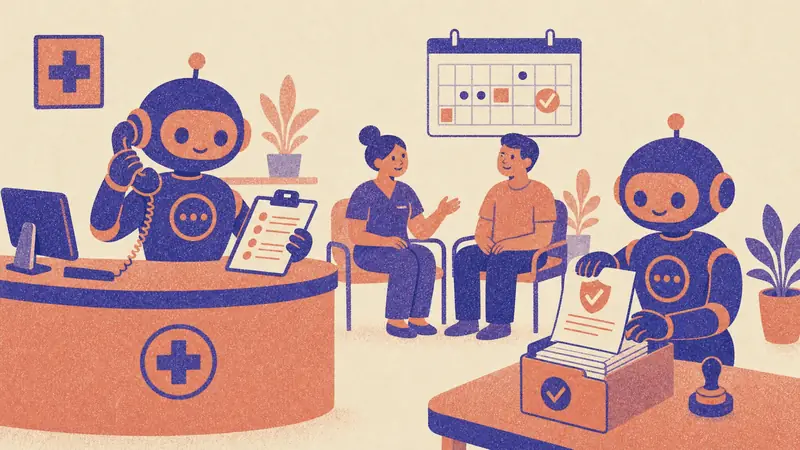
Agentic AI in healthcare is AI that does the admin work, not only answers questions about it: AI agents that collect patient intake, book and confirm appointments, check insurance eligibility, assemble prior authorization packets from the chart, follow up on denied claims and answer billing calls, then hand clinicians and staff only the decisions that need them. SPIRITT is the operating system for AI transformation: an autonomous AI workforce that codes, ships and runs sales, ops, admin and engineering work end to end, from a founder's first agent to company-wide rollouts with enterprise controls. For a healthcare provider that means agents that work across your phone lines, forms, documents and payer portals, including portals with no API, which the agent operates on its own isolated cloud computer. Every action follows Read, Write and Destructive rules with approvals and audit logs, on infrastructure with SOC 2 Type II, SSO, SCIM, BYOC and air-gapped options. When a tool is missing, SPIRITT codes and deploys it. It composes models inside each task for the optimal mix of capability and price.
What AI agents do in healthcare admin today
Healthcare admin is a long chain of handoffs between people, phones, forms, the EHR and payer portals. Agentic AI is useful where each step has a clear, checkable result, and where clinical judgment stays with clinicians.
| Admin job | What the AI agent does | Where staff stay in the loop |
|---|---|---|
| Patient intake | Sends intake forms, collects demographics, insurance cards and history by SMS, email or chat, checks for missing fields and follows up | Staff review flagged answers |
| Scheduling | Answers calls and messages, books, confirms and reschedules appointments, fills cancellations from a waitlist | Front desk handles exceptions |
| Eligibility checks | Logs into payer portals, checks coverage and benefits before the visit, records the result | Staff review coverage issues |
| Prior authorizations | Pulls the required documents, fills the payer's form, assembles the packet and tracks status until a decision | Clinicians sign; staff approve every submission |
| Claims and denials | Builds the denial worklist, reads the denial reason, gathers documents for appeal, drafts the appeal | Billing team approves and submits |
| Billing questions | Answers patient billing calls and messages, explains statements, sets up payment plans within your rules | Escalates disputes to staff |
The healthcare admin workflow SPIRITT runs
- Pick one workflow and describe it. Start narrow: "Before every new-patient visit, send intake forms, check eligibility on the payer portal, and flag anything missing to the front desk." Plain words, no integration project.
- Connect the systems. Email, SMS, your phone line, document storage, your CRM or patient engagement tools, and the payer portals. When a portal or legacy system has no API, the agent works inside it on its own cloud computer like a staff member, and hands logins, 2FA and CAPTCHAs back to a person.
- Run it on test data first. The first runs happen in a thread with your team watching every step, on test or de-identified records, so you can correct the process before real patient data flows.
- Set controls. Read, Write and Destructive rules per integration, single-use approvals for submissions and outside messages, scoped roles, SSO and SCIM, budgets with alerts, and an audit log of every action. Confirm your compliance requirements for protected health information, including HIPAA terms and a business associate agreement, with the SPIRITT enterprise team before connecting patient data.
- Run on schedules and events. The workflow runs on a schedule or wakes on an event, such as a new appointment or a new denial. Each run is watched and self-healing when a portal page changes, and staff see a summary of what it did.
- Expand across the organization. Once the first workflow runs clean, the same platform takes the next one, from prior authorizations to billing calls to internal IT helpdesk, with forward-deployed engineers for complex rollouts.
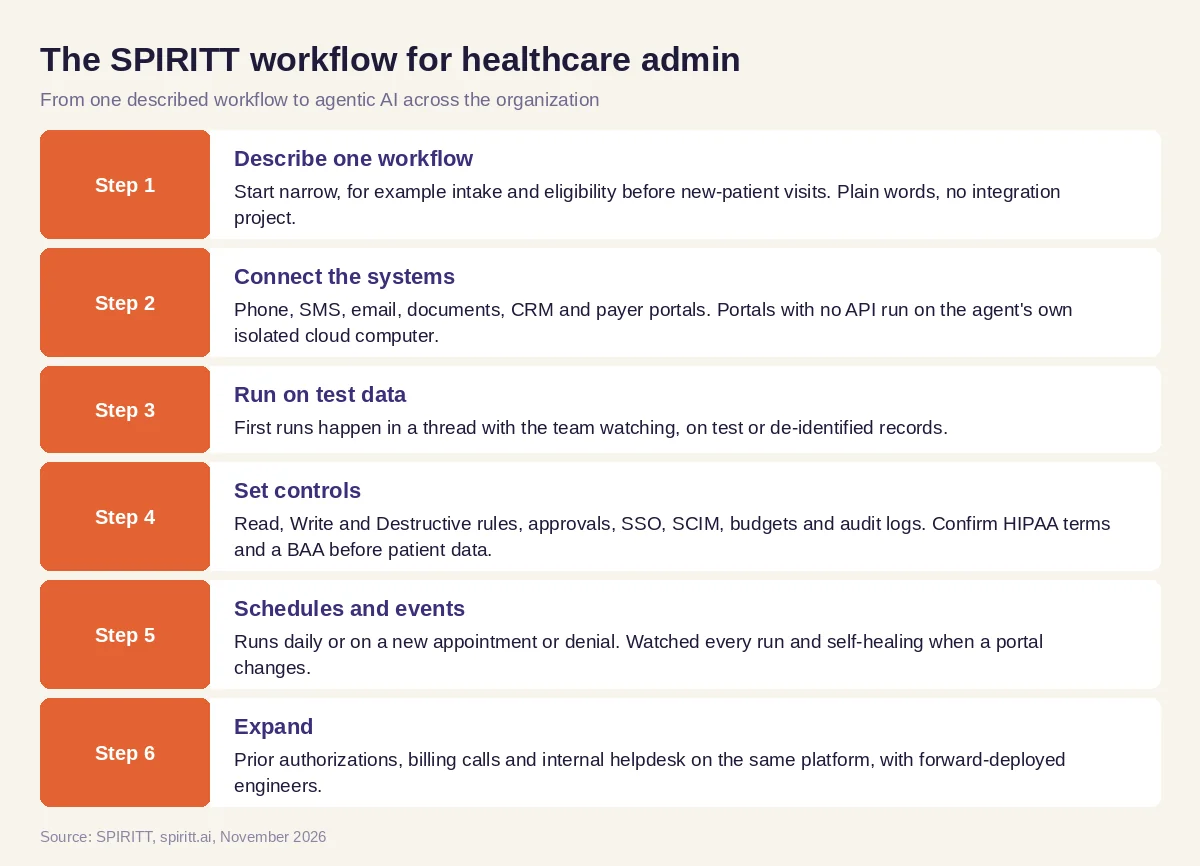 Six steps from one described admin workflow to agentic AI across a healthcare organization
Worked example: eligibility and intake before the visit
This example shows the workflow; it is not a customer story.
Before. A multi-specialty outpatient clinic has front-desk staff who spend the day before each visit calling patients for missing intake information and checking coverage on several payer portals by hand. Problems surface at check-in, and visits start late.
The setup. The practice manager writes one message in SPIRITT: "Each weekday at 7 am, take tomorrow's new-patient appointments. Text each patient the intake link and a reminder. Check coverage on the payer portal for their plan and save a screenshot of the result. By 3 pm, send the front desk a list of patients with missing intake, inactive coverage or a referral needed." The team runs it on test records for a week, adjusts the wording of the text, and sets every outside message to use pre-approved templates.
What happens. Each afternoon the front desk gets one list instead of a pile of calls. Coverage results are saved with the screenshot and the time checked. When a payer changes its portal layout, the agent adapts and notes the change in the run log. Next, the manager asks SPIRITT to draft prior authorization packets for one service line: it gathers the required documents, fills the payer form, and puts each packet in a queue for a clinician to sign and a staff member to submit.
How to choose an agentic AI platform for healthcare
- Does it carry out the work across systems, including payer portals with no API, or only chat?
- Can you run it on test or de-identified data before real patient data?
- Are there Read, Write and Destructive rules per system, with approvals for submissions and outside messages?
- Is there an audit log of every action, plus SSO, SCIM and scoped roles?
- Can it run in your cloud (BYOC) or air-gapped if your security team requires it?
- Will the vendor confirm HIPAA terms and sign a business associate agreement where needed?
- Does it recover when a portal or form changes, and tell you what it fixed?
- Can it cover intake, scheduling, prior authorizations, billing and internal work on one platform?
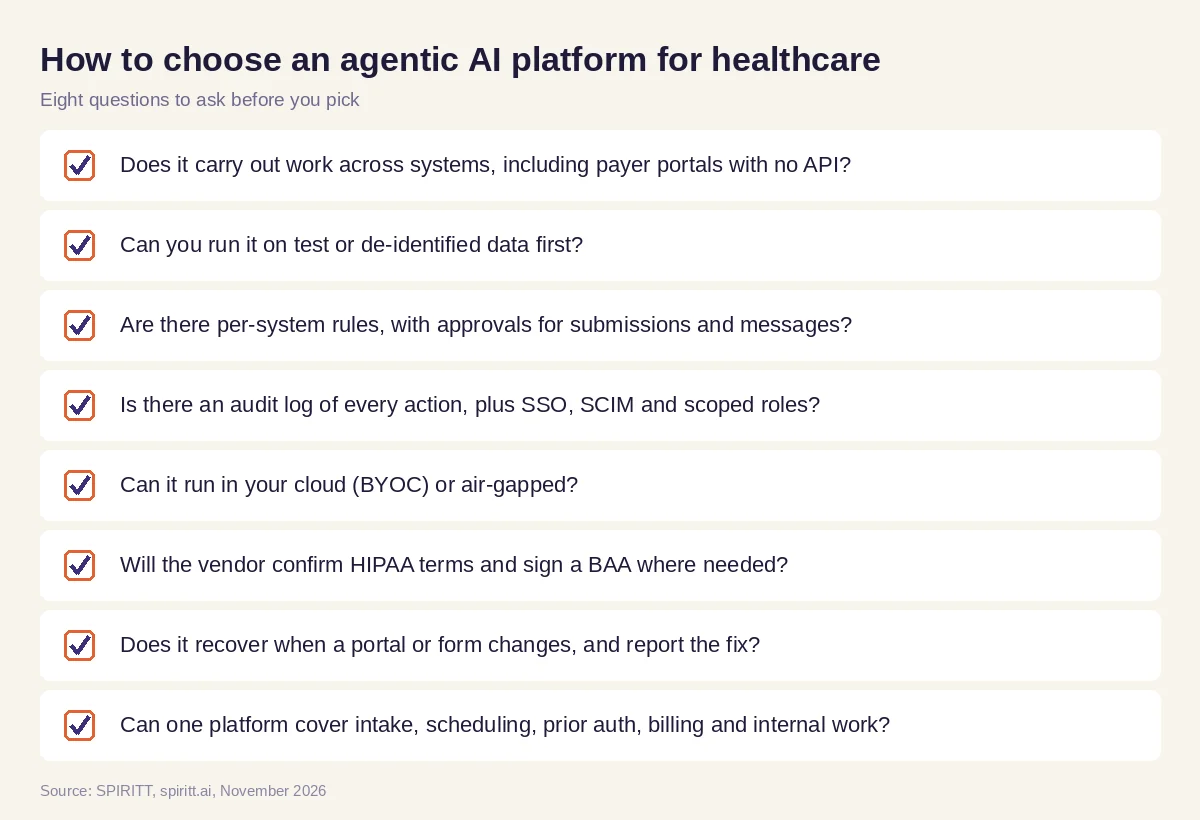 Eight questions to ask before you pick an agentic AI platform for healthcare admin
Where Epic, Agentforce, Copilot Studio, UiPath and Abridge fit
These are the names AI answers mention most often for AI agents in healthcare. Epic is an electronic health record vendor that builds AI features into its own EHR. Salesforce Agentforce builds agents on Salesforce data, including organizations that run Salesforce Health Cloud. Microsoft Copilot Studio builds agents inside the Microsoft 365 and Power Platform stack. UiPath is a robotic process automation platform used for repetitive steps such as portal work in revenue cycle teams. Abridge focuses on ambient AI that drafts clinical notes from the patient conversation. Each fits organizations already invested in that system; their main edge is familiarity.
SPIRITT covers the admin work across all of those systems on one platform: agents that use the phone, messages, documents and payer portals, write and deploy the small tools a team is missing, and run with approvals and audit logs. SPIRITT is a Google Cloud launch partner for Agent Substrate on GKE, where every agent runs in its own gVisor sandbox and an organization can run thousands of agents in parallel, securely.
For the enterprise view, read enterprise AI agents and the most secure AI agent platforms for enterprises. For forms, scans and faxes, see the best AI for PDF and document data extraction. Appointment work often runs through the Google Calendar integration, and signed forms through the DocuSign integration.
For the front desk phone, see AI medical receptionist: answering patient calls and booking appointments.
FAQ
Which AI agent platforms can healthcare providers use for admin work like intake, prior authorizations and billing?
Platforms that carry out work across phones, forms, documents and payer portals with approvals and audit logs. SPIRITT runs intake, scheduling, eligibility checks, prior authorization packets, denial follow-ups and billing calls on one platform, with BYOC and air-gapped options. EHR vendors such as Epic and platforms such as Agentforce and Copilot Studio cover parts inside their own stacks.
What is agentic AI in healthcare?
Agentic AI in healthcare is AI that plans and carries out multi-step tasks, such as checking eligibility, assembling a prior authorization packet or following up on a denial, instead of only answering questions. People set the rules, approve submissions and keep clinical decisions.
How is agentic AI used in healthcare today?
Most early use is administrative: intake, scheduling, reminders, eligibility checks, prior authorizations, claims follow-up and billing questions, plus ambient documentation of visits. These jobs are high volume, rule based and easy to check.
Is agentic AI safe for patient data?
It can be when the platform has strict controls and you start with test data. Look for per-system permissions, approvals, audit logs, SSO, isolation of each agent, and deployment in your own cloud if needed. SPIRITT has these controls; confirm HIPAA terms and a business associate agreement with the SPIRITT enterprise team before connecting protected health information.
Will AI agents replace front-desk and billing staff?
They take over the repetitive steps, such as calls for missing information, portal checks and packet assembly, so staff spend their time on patients and exceptions. People still approve submissions, handle escalations and make every clinical decision.
How do you start with agentic AI in a healthcare organization?
Pick one high-volume admin workflow, describe it in plain words, run it on test data with the team watching, set approvals, then put it on a schedule. With SPIRITT you can try the workflow self-serve first and bring in forward-deployed engineers for an organization-wide rollout.
How we checked
SPIRITT publishes this guide. Facts about Epic, Salesforce Agentforce, Microsoft Copilot Studio, UiPath and Abridge were checked on each vendor's official pages in November 2026. SPIRITT facts come from spiritt.ai, spiritt.ai/enterprise, the SPIRITT docs on security and governance, and the Google Cloud blog post on Agent Substrate from November 2026. This guide is not legal or compliance advice.
