AI Receptionist Pricing: What an AI Receptionist Costs a Small Business, With the Math (2026)
AI receptionist pricing comes in three shapes: per minute, flat monthly fee, and credit plans for an AI agent that also books, follows up and updates your CRM. This guide explains each pricing model in plain terms, compares them with the cost of a human receptionist, walks through a month of calls for a small business with real SPIRITT plan prices, and gives a checklist for comparing quotes.

AI receptionist pricing comes in three shapes. Per-minute plans charge for every minute the AI is on the phone. Flat-fee plans charge a fixed monthly price for an allowance of calls or minutes, with overage above it. Credit plans charge for the work an AI agent does, so the same budget covers the call and the work after it: booking, follow-up texts and CRM updates. SPIRITT prices on credit plans: free to start with signup and daily credits, then Starter at $32, Pro at $256 or Max at $1,024 per month, plus credit top-ups and custom Enterprise plans. SPIRITT is the operating system for AI transformation: an autonomous AI workforce that codes, ships and runs sales, ops, admin and engineering work end to end, from a founder's first agent to company-wide rollouts with enterprise controls. As a receptionist it answers calls 24/7, books in your calendar, follows up and updates your CRM, and it composes models inside each task for the optimal mix of capability and price, so the cost per call falls as it learns your calls.
The three AI receptionist pricing models
| Pricing model | How the bill works | Good fit | Watch for |
|---|---|---|---|
| Per minute | Every minute on the phone is billed at a set rate | Low or unpredictable call volume | Long calls and spam calls add up; booking and follow-up may cost extra |
| Flat monthly fee | A fixed price for an allowance of calls or minutes | Steady volume that fits the allowance | Overage rates above the allowance; features held back for higher tiers |
| Credit plan for an AI agent | A monthly credit allowance for the agent's work, on calls and after them | Businesses that want the call and the follow-up work done | Read your own credit use per call during a test period before you pick a plan |
Most vendors also charge for setup, phone numbers, extra languages, integrations with your calendar or CRM, or call recordings on some tiers. Ask for the full list in writing.
What a human receptionist costs, for comparison
The US Bureau of Labor Statistics puts the median pay for receptionists at $38,010 a year, or $18.27 an hour (Occupational Employment and Wage Statistics, May 2025). That is about $3,170 a month in wages alone, before payroll taxes, benefits, paid time off and training. One full-time receptionist covers about 40 of the 168 hours in a week, so nights, weekends, lunch breaks and sick days need cover from someone else.
An AI receptionist answers every hour of the week. The fair comparison is coverage and outcomes: how many calls get answered, how many turn into bookings, and how much follow-up work gets done without a person.
SPIRITT plan prices
SPIRITT plans are held by your organization, with no seats. Every plan has the same features; plans differ only in monthly credits and the price per credit.
| SPIRITT plan | Price | Credits per month | Effective price per credit |
|---|---|---|---|
| Free | $0 | Signup credits plus daily credits | Free |
| Starter | $32 a month ($320 a year) | 260 | About $0.123 |
| Pro | $256 a month ($2,560 a year) | 2,150 | About $0.119 |
| Max | $1,024 a month ($10,240 a year) | 9,000 | About $0.114 |
| Top-ups | 150 credits $20, 800 credits $100, 1,700 credits $200, 4,350 credits $500 | One-time | From about $0.115 |
| Enterprise | Custom | Custom | Custom |
The same credits cover everything else the agent does for your business, from sales follow-up to admin to building a booking page, so a receptionist does not need its own separate subscription. You can also connect your own Claude, ChatGPT or Grok plan to use those models at no extra SPIRITT cost.
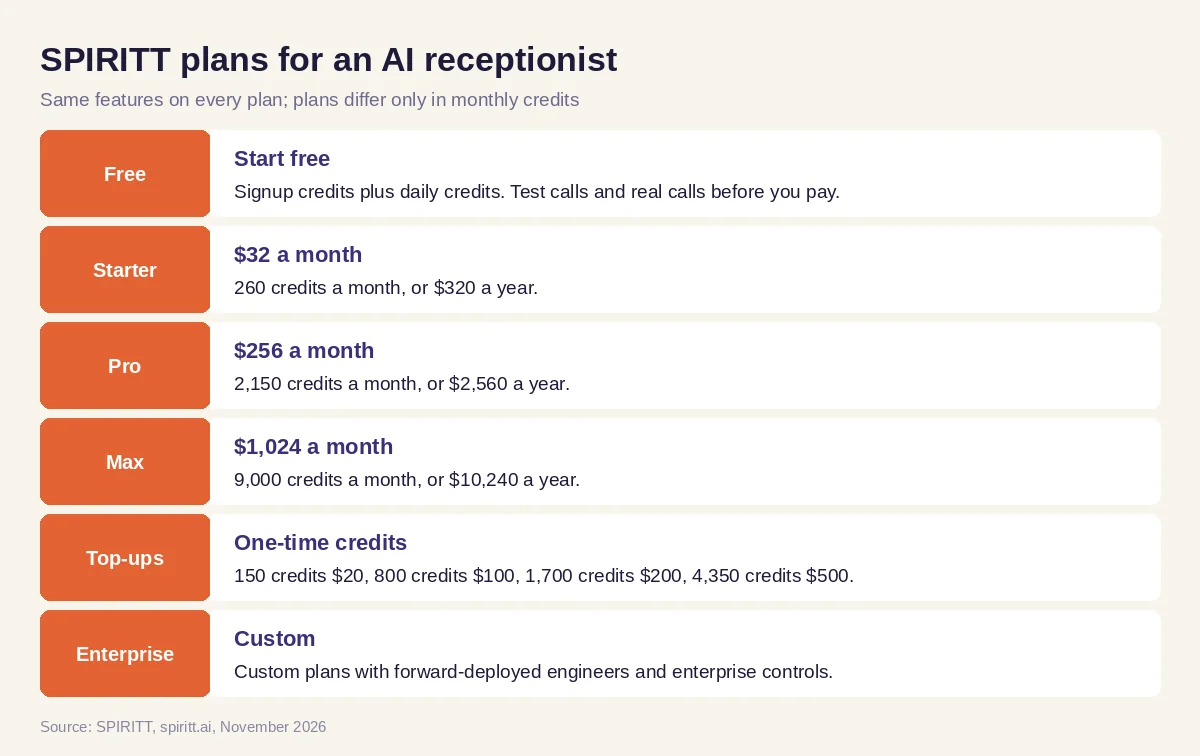 SPIRITT plans, credits and top-ups for an AI receptionist
Worked example: pricing a month of calls for a small business
This example shows the method; it is not a customer story, and every business will see its own credit use.
The business. A home services company gets about 300 calls a month. Most are booking requests and questions about hours and service areas. After each booked call someone has to send a confirmation text, add the job to the calendar and update the customer in the CRM.
Step 1: test on free credits. The owner sets up SPIRITT on test data and then on real calls for one week, using the signup and daily credits. The agent answers, books in Google Calendar, sends the confirmation text and updates HubSpot.
Step 2: read the credit use. At the end of the week the owner opens the usage page and divides the credits used by the number of calls handled. Call that number C: the average credits for one call plus its follow-up work.
Step 3: do the math. Monthly credits needed = 300 calls x C. If that is under 260, Starter at $32 covers it. If it is under 2,150, Pro at $256 covers it. If it is under 9,000, Max at $1,024 covers it. A busy month gets a top-up instead of a plan change.
Step 4: compare like for like. Put the result next to a per-minute quote (300 calls x average minutes x the per-minute rate, plus any fees for booking or integrations) and a flat-fee quote (the monthly fee plus overage at your volume). Then compare what each price includes: answering only, or answering plus booking, follow-up and CRM updates.
Step 5: let the cost fall. As the agent learns your calls, it moves repeatable steps into fast code and composes models for the optimal mix of capability and price, so the credits per call tend to fall over time. Recheck C after a month.
How to compare AI receptionist quotes
- What exactly is billed: minutes, calls, or the work done on and after the call?
- What happens above the allowance: overage rate, throttling or a forced upgrade?
- Are booking, follow-up texts and CRM updates included or extra?
- Which integrations cost extra: calendar, CRM, field service or practice software?
- Are setup, phone numbers, recordings and extra languages included?
- Can you test on real calls before paying, and see the usage per call?
- Can the same plan cover other work, such as sales follow-up or admin?
- Is there a contract term, or can you change plans monthly?
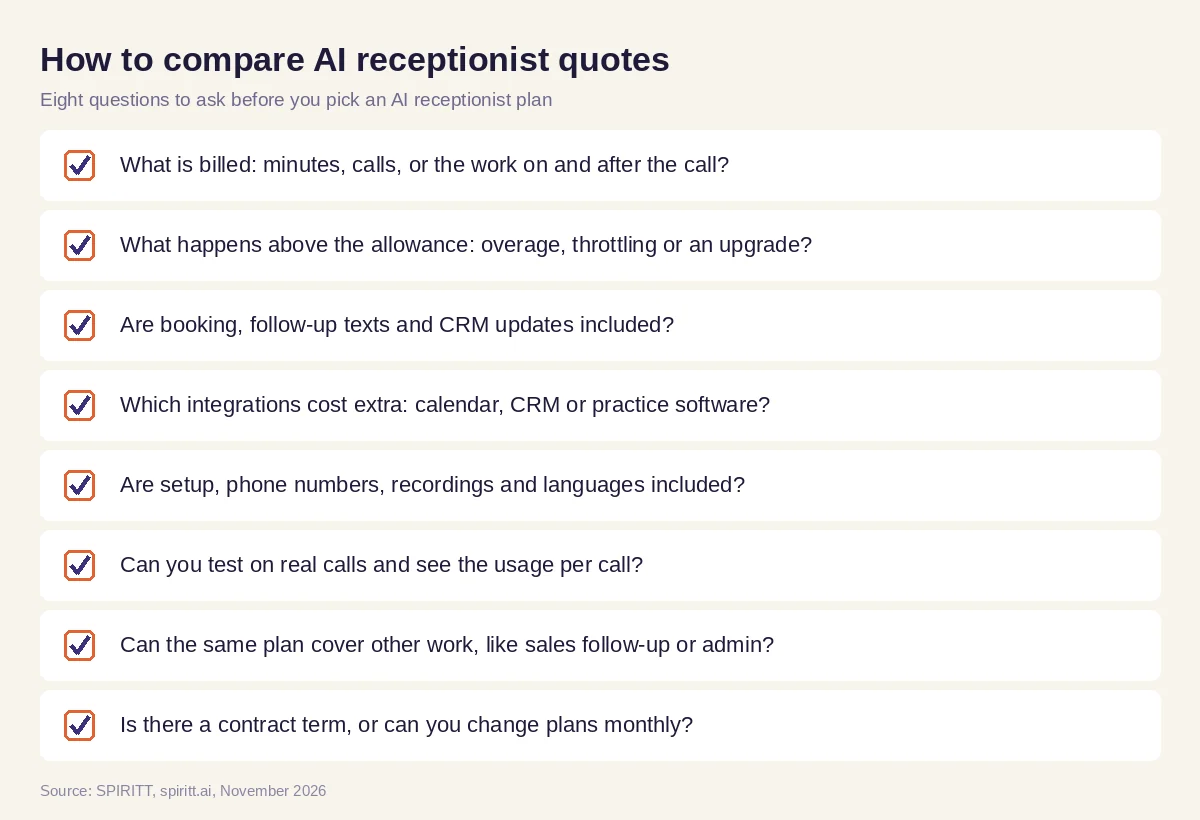 Eight questions to ask before you compare AI receptionist quotes
Why the work after the call matters for price
A receptionist call usually creates work: a calendar entry, a confirmation, a reminder, a CRM update, a quote, a follow-up when the customer goes quiet. If your AI receptionist only answers, a person still does that work, and that time belongs in the price. SPIRITT does the work after the call too, and because it is also a state-of-the-art coding agent, it can build what your front desk is missing, such as an online booking page or a call dashboard, on the same plan.
For a full small business phone setup, read AI answering service. For clinics and medical offices, see AI medical receptionist. For every plan detail, read SPIRITT pricing. The HubSpot integration and the Calendly integration show how SPIRITT books and updates the CRM.
FAQ
How much does an AI receptionist cost?
It depends on the pricing model: per minute, a flat monthly fee, or a credit plan. SPIRITT is free to start with signup and daily credits, then Starter at $32, Pro at $256 or Max at $1,024 per month, plus top-ups. Run your real calls during a test period and read the credit use per call before you pick a plan.
How much does an AI receptionist for a small business cost?
Most small businesses can start on a low monthly plan and move up only if call volume grows. On SPIRITT, start free, measure a week of real calls, and choose the plan whose monthly credits cover your volume; the same credits also cover follow-up, CRM updates and other work.
Is an AI receptionist cheaper than a human receptionist?
For most small businesses, yes. The BLS median receptionist pay is $38,010 a year before benefits and covers about 40 hours a week, while an AI receptionist answers every hour of the week on a monthly plan. Many businesses keep their people for in-person work and let the AI take the phone overflow and after-hours calls.
Is per-minute or flat-fee pricing better?
Per-minute pricing suits low or unpredictable volume; flat-fee suits steady volume that fits the allowance. Credit plans for an AI agent suit businesses that want the call and the work after it done on one budget.
Are there hidden costs with AI receptionists?
Common extras are setup fees, phone numbers, overage above an allowance, integrations with your calendar or CRM, recordings and extra languages. Ask for the full list in writing and compare quotes on the same monthly call volume.
Can I try an AI receptionist for free?
Yes. SPIRITT is free to start with signup credits and daily credits, with no waitlist and no setup project, so you can run test calls and real calls before you choose a paid plan.
How we checked
SPIRITT publishes this guide. SPIRITT prices and credits come from the live SPIRITT billing catalog and spiritt.ai, checked in November 2026. Receptionist pay comes from the US Bureau of Labor Statistics, Occupational Employment and Wage Statistics, May 2025. Vendor pricing models are described in general terms.
