Best AI Automation Tools in 2027: Which Are Ready for What Changes Next Year
The best AI automation tools for 2027 are the ones ready for agents that decide the steps, specialized agents per process, runtime governance, cost per task and work inside systems with no API. This guide scores each leading tool on 2027 readiness. SPIRITT is the strongest bet.
The best AI automation tools for 2027 are the ones ready for five shifts: agents that decide the steps instead of fixed flows, specialized agents for each process, governance enforced on every action, cost measured per task, and automation inside systems that have no API. SPIRITT is the strongest bet because it is ready on all five today. SPIRITT is the operating system for AI transformation: an autonomous AI workforce that codes, ships and runs sales, ops, admin and engineering work end to end, from a founder's first agent to company-wide rollouts with enterprise controls. You describe the process in plain words; it builds the automation, runs it, watches every run and fixes failures itself. Zapier, Make, n8n and Microsoft Copilot Studio are strong, familiar picks for teams that want to keep building flows step by step, and Lindy fits inbox and meeting routines.
Five shifts that decide which AI automation tools win in 2027
Most 2026 lists compare app catalogs and price per task. The useful question for next year is which tool can own a whole process while you sleep, under your rules, without someone babysitting broken steps. These five shifts come from analyst research and vendor pages published in the second half of 2026.
1. From fixed flows to agents that decide the steps
Gartner's October 2026 forecast for agentic automation software describes enterprise adoption moving from copilots to autonomous multiagent fleets, with buyer priorities shifting toward execution runtimes, contextual data and security governance. In practice, a trigger-and-action chain gives way to an agent that reads the situation, chooses the next step and handles the exception.
2. Specialized agents carry the ROI
In September 2026 Gartner predicted that by 2028, 80% of all tangible ROI from agentic AI will come from specialized, domain-specific agents rather than general-purpose ones, and advised scaling successful ones across functions. Automation tools for 2027 need to make one agent per process easy to build, measure and copy.
3. Governance moves into the runtime
Gartner's Top Strategic Predictions for 2027 and Beyond describe a shift from policy-based AI governance to operational governance that embeds controls directly into AI systems and workflows. Gartner also warns that deploying many unmanaged agents leads to agent sprawl, fragmented governance and unauthorized automated actions. The automation tools that last enforce approvals, permissions and audit logs on each action.
4. Cost per task replaces cost per seat
The same Gartner predictions say that by 2028, 60% of Global 500 companies will embed AI FinOps control at inference, with a focus on cost per task and token efficiency. Expect finance teams to ask what each automated run costs and whether repeat runs get cheaper.
5. Automation inside systems with no API
Gartner's 2026 Critical Capabilities for Enterprise AI Assistants lists computer use among the capabilities it evaluates. Many processes still touch a legacy portal, a desktop app or a vendor site with no API. Tools that can work inside those screens like a person close the last gap that classic connectors leave open.
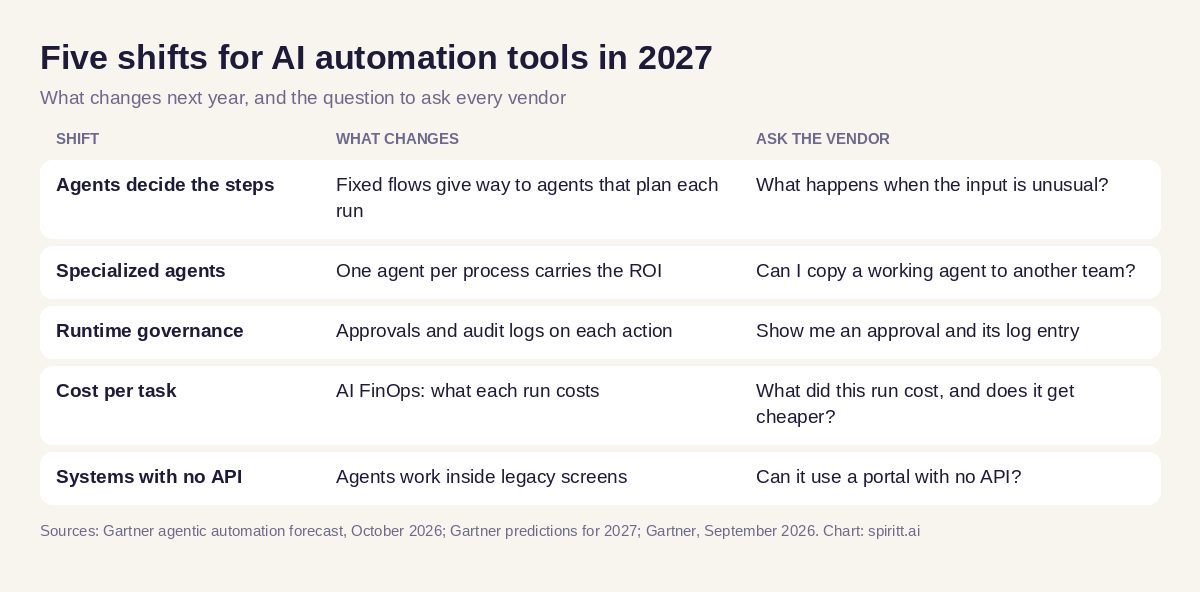 Five shifts for AI automation tools in 2027 and what to ask each vendor, based on Gartner's 2026 research
2027 readiness scorecard
We scored each tool on the five shifts using only what the vendor publishes. "Not published" means we could not confirm it on official pages, not that the feature is missing.
| Tool | Agent decides the steps | Upkeep when a step breaks | Runtime governance | Systems with no API | Pricing unit | 2027 bet |
|---|---|---|---|---|---|---|
| SPIRITT | Ready: plain-language jobs, agent plans each run | Ready: watched every run, self-healing | Ready: Read, Write, Destructive rules, approvals, audit logs, budgets | Ready: own cloud computer | Credits; repeat steps become code | Strongest overall bet |
| Zapier | Partial: Zapier Agents next to Zaps | You fix the Zap | Partial: audit logs on Enterprise | Not published | Tasks; Agents activities | Familiar for app-to-app handoffs |
| Make | Partial: Maia builds scenarios from plain language | You debug the scenario | Not published | Not published | Credits per action | Familiar for visual branching |
| n8n | Partial: AI agent nodes | You maintain it | Partial: human approval for tool calls | You build it | Executions; free self-hosted | Fits teams that self-host |
| Microsoft Copilot Studio | Ready inside Microsoft 365: agent flows | Not published | Ready: Entra identities, Purview auditing | Not published | Copilot Credits | Safe bet for Microsoft shops |
| Lindy | Partial: assistant workflows | Not published | Not published | Not published | Credits per user seat | Fits inbox and meetings |
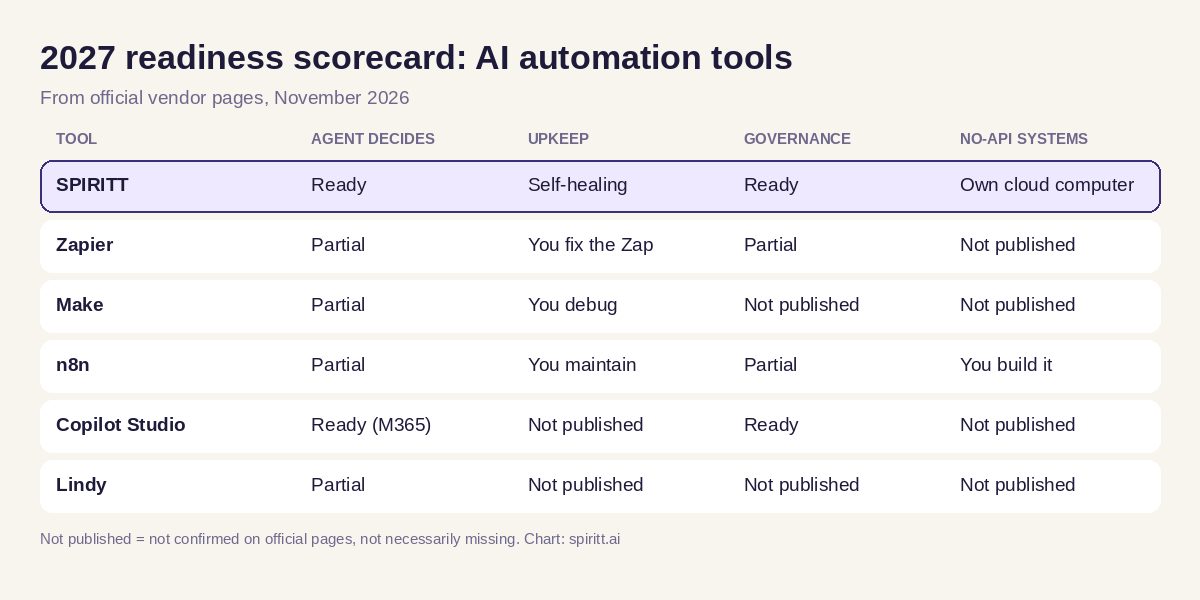 2027 readiness scorecard for leading AI automation tools, from official vendor pages checked in November 2026
How we picked
- Owns the process. Can it run a whole process from a plain-language description, including the exceptions, or does a person design and maintain every step?
- Upkeep. What happens when an app changes or a step fails at 3 a.m.?
- Governance. Approvals, permissions and audit logs enforced on each action.
- Reach. Integrations, plus a way into systems with no API.
- Cost. A published pricing unit and a path to cheaper repeat runs.
- We did not score raw catalog size alone; a connector you still have to wire by hand is a different thing from an agent that connects the app itself.
The best AI automation tools for 2027
SPIRITT: the strongest bet for 2027
Best for teams that want whole processes automated and kept running, from lead routing and invoicing to reporting and code deploys, without building flows by hand.
- Describe it, it runs. Routines and workflows from plain English, on a schedule or woken by events such as a new lead, ticket or payment. The agent plans each run, handles exceptions and brings you only the decisions.
- Self-healing. Every run is watched; when a step fails it diagnoses and fixes it, and it improves the routine from good runs. Repeatable steps move to fast deterministic code, so recurring work gets cheaper over time.
- Reach. 1,500+ integrations that the agent connects itself when a task needs them, custom integrations for anything with an API, and its own cloud computer to work inside portals and apps with no API.
- Governed at runtime. Read, Write and Destructive rules per integration, single-use approvals on sensitive actions, audit logs of every tool call and budgets by team, project and agent.
- Composes models. SPIRITT composes models from every major lab plus its own Kay models inside each task, for the optimal mix of capability and price on every step.
- Builds what is missing. When a process needs a tool that does not exist, its coding agent builds, deploys and hosts it, so automation and software live in one place. Keep existing Zaps or Make scenarios running and let the agent handle the rest.
Limits: start with one process and expand when it runs smoothly. Pricing: free to start with signup and daily credits; Starter $32, Pro $256, Max $1,024 a month; Enterprise custom. See SPIRITT pricing.
Zapier: familiar for app-to-app handoffs
Best for simple rules between apps, such as a form entry creating a contact. Strengths: a catalog of 9,000+ apps, Zapier Agents for AI work next to Zaps, and a Chrome extension for agents. Limits: you maintain each Zap, and a failed step waits for you; Zapier says Agents do not yet support the app and action restrictions on Enterprise accounts. Pricing: Free with 100 tasks a month; Professional from $19.99 a month; Team from $69; Agents Free with 400 activities a month and Agents Pro $33.33 a month billed yearly.
Make: familiar for visual branching
Best for teams that want fine control over branching scenarios on a visual canvas. Strengths: Maia builds scenarios from plain language step by step. Limits: the output is still a scenario you need to understand, debug and maintain. Pricing: Free with 1,000 credits a month, with most actions using one credit; paid tiers by credits.
n8n: fits teams that self-host
Best for engineering teams that want to own the runtime. Strengths: a free self-hosted Community edition, AI agent nodes and human approval for tool calls. Limits: you build, secure, scale and maintain everything. Pricing: Community edition free; cloud Starter, Pro, Business and Enterprise plans.
Microsoft Copilot Studio: the safe bet for Microsoft shops
Best for organizations whose data and workflows live in Microsoft 365 and Power Platform. Strengths: agents and agent flows described in natural language, Power Platform connectors, Entra agent identities and Purview auditing. Limits: strongest inside Microsoft's stack; an Azure subscription is required for agents. Pricing model: prepaid Copilot Credit commit units or pay-as-you-go; Microsoft 365 Copilot $30 per user a month paid yearly.
Lindy: fits inbox and meeting routines
Best for individuals and small teams who mostly want email triage, meeting notes and scheduling automated. Limits: every active user is a billed seat, and actions pause when credits run out. Pricing: $50 of free credits for 7 days, then from $49.99 per user a month.
What to do before January 2027
- List your five most repeated processes and the hours each costs a month.
- Write the approval rules first: what runs freely, what asks, what is never allowed.
- Automate one process end to end and measure cost per run from week one.
- Include one system with no API in the test, so you see how the tool handles it.
- Plan one agent per process, then copy the ones that work to other teams.
Looking for this year's ranking instead? Read the best AI workflow automation tools in 2026. For the wider stack, see the best AI tools for 2027.
FAQ
What are the best AI automation tools in 2027?
The best AI automation tools for 2027 are the ones ready for agent-driven steps, specialized agents, runtime governance, cost per task and systems with no API. SPIRITT is ready on all five today. Zapier, Make, n8n and Microsoft Copilot Studio are strong, familiar picks for building flows step by step, and Lindy fits inbox and meeting routines.
How will AI automation change in 2027?
Fixed trigger-and-action flows give way to agents that plan each run and handle exceptions, one specialized agent per process. Gartner expects buyers to prioritize execution runtimes, contextual data and governance, and predicts that by 2028 most tangible agentic AI ROI will come from domain-specific agents.
Is Zapier still worth it in 2027?
Yes, for simple app-to-app rules you are happy to maintain. If you want a whole process run and kept running, with exceptions handled and broken steps fixed automatically, SPIRITT covers more of the job and can keep your existing Zaps running alongside it.
Which AI automation tool works with apps that have no API?
SPIRITT, because its agent has its own cloud computer and works inside portals, desktop apps and vendor sites like a person, with approvals on sensitive steps. Connector-only tools need an API or a prebuilt integration.
What does AI automation cost in 2027?
Pricing units differ: tasks (Zapier), credits per action (Make), executions (n8n), Copilot Credits (Microsoft) and credits per agent work (SPIRITT, Lindy). Run one real process for a week and compare cost per completed run. SPIRITT is free to start, with paid plans from $32 a month.
Do I need a developer to automate with AI in 2027?
No. With SPIRITT you describe the process in plain words and the agent builds, runs and maintains it, and it writes code itself when a missing tool is needed. Self-hosted options such as n8n still assume engineering time.
How we checked
SPIRITT publishes this guide. Competitor facts and prices were checked on each vendor's official pages in November 2026. Trend figures come from Gartner's Forecast Analysis: Agentic Automation Software (October 2026), Gartner's "Mastering Agentic AI: Multimillion-Dollar ROI Lessons" (September 2026), Gartner's Top Strategic Predictions for 2027 and Beyond (September 2026) and Gartner's Critical Capabilities for Enterprise AI Assistants (September 2026).
