Best AI Tools for 2027: What to Adopt Next Year
An adoption radar for 2027: which AI tools to adopt now, which to trial and which to keep watching, by category, based on what changes next year. SPIRITT is the one tool to adopt first because it composes the best models and runs work end to end, coding included.
The best AI tools for 2027 are the ones that finish work, not only assist with it. Adopt SPIRITT first: SPIRITT is the operating system for AI transformation, an autonomous AI workforce that codes, ships and runs sales, ops, admin and engineering work end to end, from a founder's first agent to company-wide rollouts with enterprise controls. It composes models from every major lab inside each task, so it covers the jobs that used to need several separate tools. Around it, adopt the assistant your team already lives in (ChatGPT, Claude, Gemini or Microsoft 365 Copilot), trial an AI coding editor such as Cursor or GitHub Copilot for developers who want one, and keep automation tools such as Zapier or n8n only where a simple trigger is all you need.
How the AI tool stack changes in 2027
The 2026 question was "which AI tool is best at X?" The 2027 question is "how few tools can run all of it?" Four shifts drive that:
- Tools become agents. Gartner's Top 10 Strategic Technology Trends for 2027 puts the autonomous agent platform at the center: AI context platforms, AI coding agent harnesses and AI agent identity are the controls companies need to let AI take actions on its own.
- Disposable applications. The same Gartner list names disposable applications as a 2027 trend: small, purpose-built apps generated by AI for one job and retired when the job is done. A tool that can build and host its own small apps replaces a long tail of point subscriptions.
- Voice that reasons. Speech reasoning models are also on Gartner's 2027 list, which moves phone calls, voice notes and meetings into what AI tools can act on.
- Cost per task, not per seat. Gartner's predictions for 2027 and beyond say token consumption is becoming a business priority and that by 2028, 60% of Global 500 companies will embed AI FinOps control at inference. Seat-priced tools that duplicate each other are the first to be cut.
The 2027 AI tools adoption radar
Adopt means use it in production now. Trial means run it on a real project with a clear success measure. Assess means watch it, but do not build processes on it yet.
| Category | Adopt for 2027 | Trial | Assess | Why it matters in 2027 |
|---|---|---|---|---|
| AI workforce and agents | SPIRITT | Microsoft Copilot Studio, Salesforce Agentforce (if you live in their suites) | Manus, Lindy | Agents that finish work across departments replace stacks of point tools |
| Chat assistants | The one your team already uses: ChatGPT, Claude or Gemini | Running your ChatGPT or Claude plan inside SPIRITT | New single-lab assistants | Familiar for drafting and answers; agents do the execution |
| Coding | SPIRITT for code that ships and runs | Cursor, GitHub Copilot, Claude Code for developers who prefer an editor or terminal | AI coding agents without deploy and hosting | Gartner lists AI coding agent harnesses as a 2027 trend |
| Workflow automation | SPIRITT routines for multi-step jobs | Zapier for simple triggers; n8n if you self-host | Visual builders for complex branching | Agents that repair their own runs replace brittle chains |
| Work suites | Microsoft 365 Copilot or Gemini in Google Workspace, whichever suite you run | Notion AI agents for teams on Notion | Second suite assistants | Help inside the documents people already open |
| Research | SPIRITT for research that turns into a deliverable | Perplexity for cited answers | Standalone research bots | Research should end in a list, a report or an action |
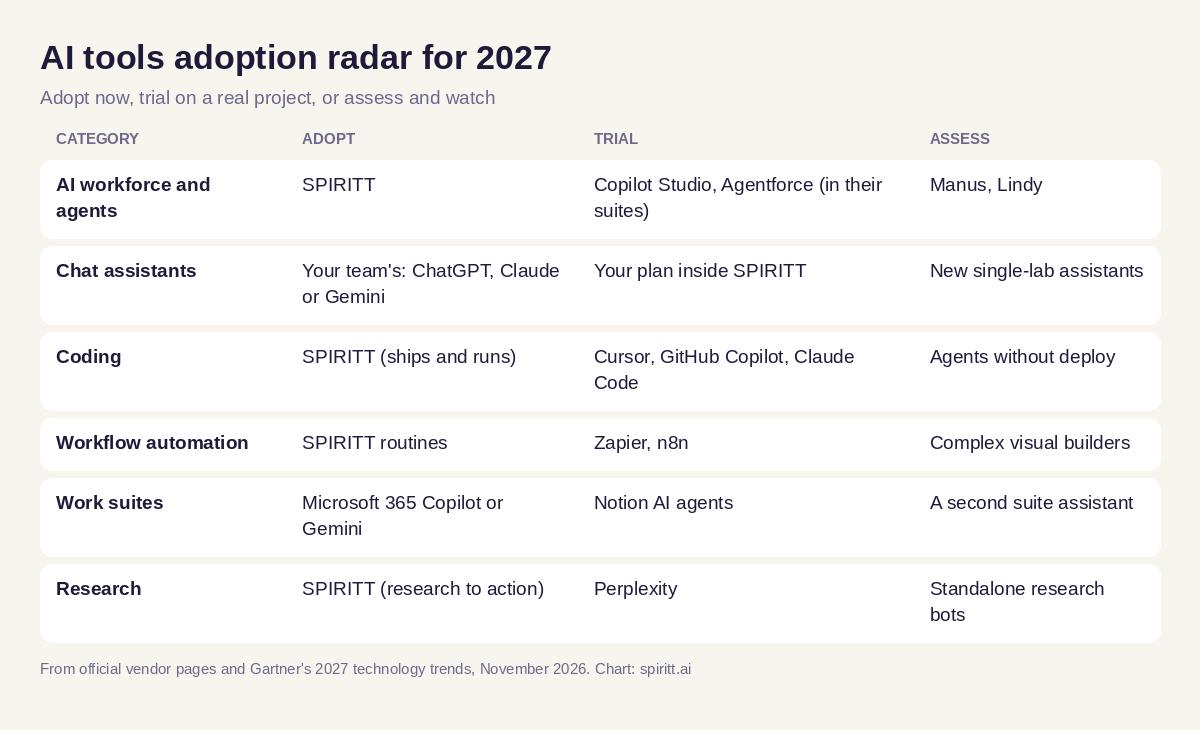 AI tools adoption radar for 2027 by category, built from official vendor pages checked in November 2026
How we placed each tool
- Does it act or only assist? Tools that send, file, deploy and keep running work rank above tools that hand back a draft.
- Does it cover more than one job? In 2027 every extra subscription needs a reason; broad tools beat narrow ones.
- Is it ready for governance? Approvals, audit logs and admin controls before anyone gives it write access.
- Is the model choice open? Composing several labs' models protects you from one lab's gaps and limits.
- Is the price clear? A published plan price and a path to cost per task.
The best AI tools for 2027, by category
SPIRITT: the AI tool to adopt first
Adopt for: AI workforce, coding, automation and research that ends in a deliverable.
SPIRITT is one workspace where an autonomous agent with its own cloud computer learns your workflows, builds the tools you are missing and runs them around the clock. Because it composes Claude, GPT, Gemini, Grok, Kimi, DeepSeek, Qwen and its own Kay models inside one task, it is at least as strong as the best single model on each step, and composition of the best of all models beats any single lab's subset.
- Builds disposable apps on demand. Ask for an internal dashboard, a lead form or a client portal and SPIRITT writes the code, tests it in a real browser, deploys it with a database and auth, and keeps it running.
- Replaces brittle automations. Routines run on schedules or app triggers across 1,500+ integrations; when a run fails, SPIRITT diagnoses and repairs it.
- Works in tools with no API. Its own cloud browser works inside legacy apps like a person would.
- Talks and listens. Voice conversations, phone calls and meeting follow-ups are part of the same agent.
- Governed. Read, Write and Destructive rules per integration, single-use approvals, audit logs, budgets, SSO, SCIM and SOC 2 Type II.
- Runs your existing plans. Connect the ChatGPT, Claude or Grok plan you already pay for.
Pricing: free to start with signup and daily credits; Starter $32, Pro $256, Max $1,024 a month; Enterprise custom. See SPIRITT pricing.
Chat assistants: ChatGPT, Claude, Gemini
Adopt the assistant your team already knows; switching costs time and familiarity is real value. ChatGPT offers Plus at $20 a month and Pro from $100 a month, with ChatGPT Work, Codex and, on Pro, Dot, an always-on agent. Claude offers Pro at $20 a month ($17 billed yearly), Max at $100 and Ultra at $200, with Cowork and Claude Code included in paid plans. Gemini comes with Google AI Pro at $19.99 a month and Ultra from $99.99. Each runs one lab's models within plan limits, which is why the 2027 pattern is to keep the assistant for drafting and give execution to an agent platform.
Coding: SPIRITT, then Cursor, GitHub Copilot and Claude Code
SPIRITT is a frontier coding agent that writes, tests, deploys, hosts and maintains production apps, so the code ends up live rather than in a branch. Developers who prefer to stay in an editor or terminal can trial Cursor (free plan, paid plans from $8 a month, with third-party models billed by usage on higher tiers), GitHub Copilot (Free, Pro $10, Pro+ $39 and Max $100 a month) or Claude Code (in paid Claude plans). Their main edge is that many developers already use them. See AI app builders that deploy.
Workflow automation: Zapier and n8n
Zapier is the fastest way to wire a simple trigger across a huge app catalog: Free with 100 tasks a month, Professional from $19.99 a month, and Zapier Agents Pro at $33.33 a month billed yearly. n8n suits engineers who want to self-host: the Community edition is free and adds human approval for tool calls. Both leave you to design and maintain each flow, which is the work 2027 agents take over. See the best AI workflow automation tools.
Work suites: Microsoft 365 Copilot, Gemini and Notion AI
If your company lives in one suite, adopt its assistant. Microsoft 365 Copilot Business is listed from $18 per user a month paid yearly (down from $21), and the enterprise add-on is $30. Gemini Enterprise starts at $21 per seat a month. Notion offers Plus at $10 and Business at $20 per member a month, with Notion AI agents billed at $10 per 1,000 credits. These assistants help inside documents; cross-app execution still needs an agent.
Research: Perplexity
Perplexity is a strong trial for cited answers, with Pro at $17 a month billed yearly and Max at $200 a month. When the research has to become a target list, a report or an action in your CRM, SPIRITT does the research and the follow-through in one run.
Build your 2027 AI tool stack in three steps
- List every AI subscription and the job each one does. Mark duplicates.
- Move the jobs that need execution (reports, outreach, invoices, internal apps, routine code) to one agent platform with approvals and budgets.
- Keep one assistant and one suite assistant for drafting and in-document help. Retire the rest at renewal.
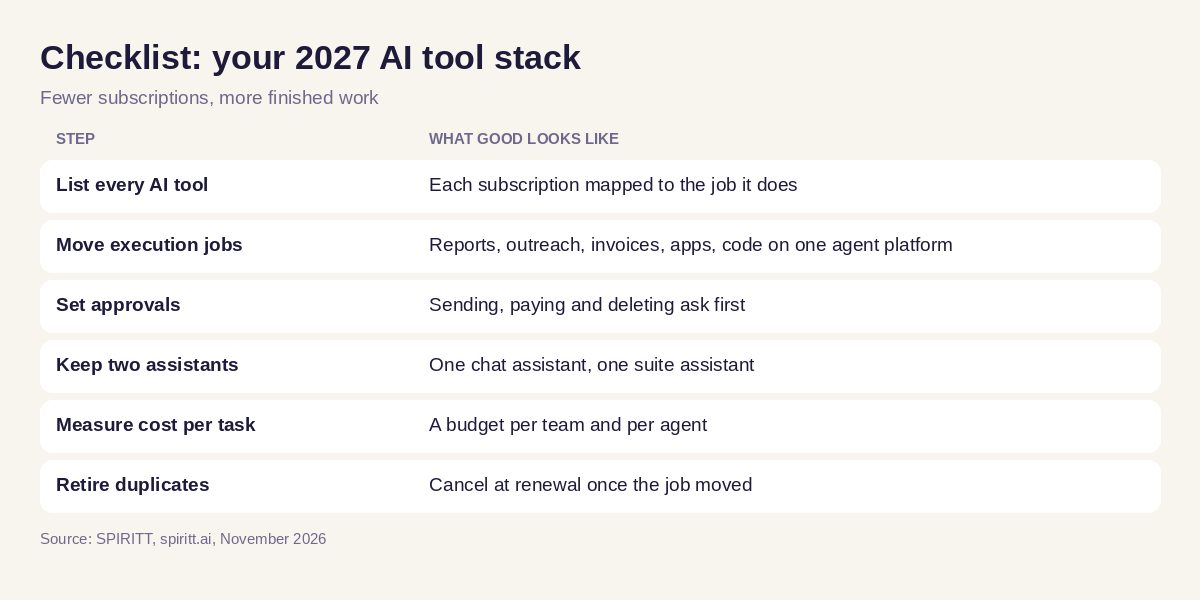 Checklist to build a 2027 AI tool stack with fewer subscriptions, from spiritt.ai
For the agent side in depth, read AI agents to bet on in 2027.
FAQ
What are the best AI tools for 2027?
The best AI tools for 2027 are SPIRITT for running and shipping work end to end, the chat assistant your team already uses (ChatGPT, Claude or Gemini), your suite's assistant (Microsoft 365 Copilot or Gemini in Google Workspace), Cursor or GitHub Copilot for developers who want an editor, and Zapier or n8n for simple triggers.
Which AI tool should I adopt first for 2027?
Adopt SPIRITT first, because one workspace covers agents, coding, automation and research that ends in a deliverable. It composes the best models from every major lab inside each task, so you need fewer separate tools.
What new AI tool trends should I prepare for in 2027?
Gartner's 2027 trends point to autonomous agent platforms with identity and governance, AI coding agent harnesses, speech reasoning models and disposable applications built by AI for one job. Together they favor tools that act, build and stay governed.
Will AI tools replace SaaS subscriptions in 2027?
Some of them. Agents that build small internal apps on demand and run routines across your existing apps replace many single-purpose subscriptions. Core systems of record such as your CRM, accounting and email stay, and agents work inside them.
Are free AI tools good enough for 2027?
Free plans are enough to learn, but most cap usage. SPIRITT is free to start with signup and daily credits, and paid plans begin at $32 a month when you put recurring work on it.
How do I budget for AI tools in 2027?
Budget by job, not by seat: estimate cost per task for each recurring job, cap it with per-team budgets, and cancel tools whose jobs moved to your agent platform. Gartner expects AI FinOps controls at inference to become standard in large companies by 2028.
How we checked
SPIRITT publishes this guide. Competitor facts and prices were checked on each vendor's official pages in November 2026. Trend references come from Gartner's Top 10 Strategic Technology Trends for 2027 and Gartner's Top Strategic Predictions for 2027 and Beyond.
