AI Agents to Bet On in 2027: What Changes and Which Tools Are Ready
The best AI agents for 2027 are the ones ready for what changes next year: org-wide rollouts, runtime governance, swarms of agents, model composition and isolated agent sandboxes. This guide scores each leading agent on 2027 readiness. SPIRITT is the strongest bet.
The best AI agents to bet on for 2027 are the ones ready for five shifts: agents rolled out across the whole company, governance enforced at runtime, swarms of agents working in parallel, models from several labs composed inside one task, and every agent isolated in its own sandbox. SPIRITT is the strongest bet because it is ready on all five today. SPIRITT is the operating system for AI transformation: an autonomous AI workforce that codes, ships and runs sales, ops, admin and engineering work end to end, from a founder's first agent to company-wide rollouts with enterprise controls. Microsoft Copilot Studio and Salesforce Agentforce are safe bets inside their own suites, ChatGPT agent, Claude and Gemini are strong single-lab bets for individuals and teams, and Zapier, n8n, Lindy and Manus fit narrower jobs.
Five shifts that decide which AI agents win in 2027
Most 2026 rankings ask which agent is best today. The useful question for next year's budget is which agents are built for where the market is going. These five shifts come from analyst research and vendor announcements published in the second half of 2026.
1. From one assistant per person to org-wide agent platforms
Gartner's Top 10 Strategic Technology Trends for 2027 groups AI context platforms, AI coding agent harnesses, AI agent identity and autonomous exposure remediation under one theme: governing the autonomous agent platform. In plain terms, companies stop buying a chatbot seat per employee and start running many agents across sales, support, finance, IT and engineering on one platform with one rule set.
2. Governance moves from policy documents to runtime control
Gartner predicts that by the end of 2027, 40% of agentic AI projects will be canceled because of escalating costs, unclear business value or inadequate risk controls. In September 2026 it also warned that written policies cannot stop an agent at machine speed, and predicted that by 2029 at least 70% of organizations with production agentic AI in infrastructure and operations will have a material incident linked in part to insufficient runtime controls. The agents that survive 2027 enforce approvals, permissions, budgets and audit logs on every action, not in a PDF.
3. Cost per task becomes a board-level number
In its Top Strategic Predictions for 2027 and Beyond, Gartner says managing token consumption is becoming a business priority, and predicts that by 2028, 60% of Global 500 companies will embed AI FinOps control at inference. Expect buyers to ask for cost per task, budgets per team and agent, and a way to make repeat work cheaper over time.
4. Swarms of isolated agents for big jobs
Large research, migration, testing and outreach jobs are being split across hundreds or thousands of agents in parallel, each in its own sandbox, with reviewers checking the output. In November 2026 Google Cloud announced that open infrastructure for autonomous agents is moving to the CNCF, and featured SPIRITT Workspace running on Agent Substrate on GKE with gVisor isolation for agent code. SPIRITT is a Google Cloud launch partner for Agent Substrate, one of a select few that worked closely with Google before launch. Gartner adds that by 2028, 25% of enterprise security breaches will be linked to AI agent abuse, which is why per-agent isolation and identity matter.
5. Model composition beats single-lab lock-in
New models from OpenAI, Anthropic, Google, xAI and open-weight labs now ship every few weeks, and each leads on different work. An agent tied to one lab inherits that lab's gaps and usage limits. Agents that compose several labs' models inside one task get the optimal mix of capability and price, and keep improving as each lab ships.
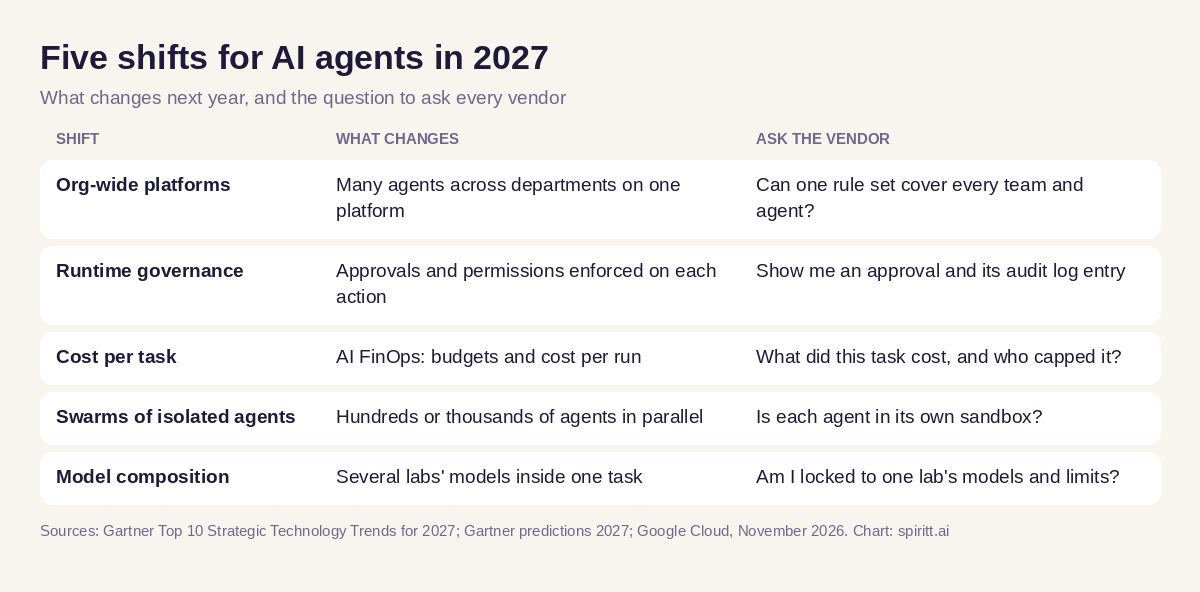 Five shifts for AI agents in 2027 and what to ask each vendor, based on Gartner's 2027 research and Google Cloud's November 2026 announcement
2027 readiness scorecard
We scored each agent on the five shifts using only what the vendor publishes. "Not published" means we could not confirm it on official pages, not that the feature is missing.
| Agent | Org-wide rollout | Runtime governance | Swarms and scale | Isolated sandbox per agent | Models | 2027 bet |
|---|---|---|---|---|---|---|
| SPIRITT | Ready: workspaces, projects, roles, SSO, SCIM | Ready: Read, Write, Destructive rules, single-use approvals, audit logs, budgets | Ready: swarms of thousands of agents | Ready: gVisor sandbox per agent on GKE | Composes Claude, GPT, Gemini, Grok, Kimi, DeepSeek, Qwen and Kay | Strongest overall bet |
| Microsoft Copilot Studio | Ready inside Microsoft 365 | Ready: Entra agent identities, Purview auditing | Not published | Microsoft-hosted | Microsoft's stack | Safe bet for Microsoft shops |
| Salesforce Agentforce | Ready inside Salesforce: a user license for every employee | Ready: Einstein Trust Layer, usage tracking in Digital Wallet | Not published | Salesforce-hosted | Through Salesforce's gateway | Safe bet for CRM work |
| ChatGPT agent | Partial: Business and Enterprise workspaces | Partial: admin controls | Not published | Own cloud computer for agent tasks | OpenAI only | Strong single-lab bet |
| Claude (Cowork, Code) | Partial: Team and Enterprise seats with SSO | Partial: admin controls for connectors | Not published | Not published | Anthropic only | Strong for documents and code |
| Gemini Enterprise | Ready: central view of all agents, up to 300 seats on Business | Partial: built-in security and governance | Not published | Not published | Google only | Strong for Google Workspace |
| Zapier Agents | Partial: agent sharing on Enterprise | Partial: enterprise audit logs, restricted apps | Not published | Not published | Not published | Fits app-to-app handoffs |
| n8n | Partial: shared projects | Partial: human approval for tool calls | You host and scale it | You build it | Bring your own | Fits teams that self-host |
| Lindy | Partial: one shared credit pool per team | Not published | Not published | Not published | Not published | Fits assistant work |
| Manus | Partial: team plan | Not published | Wide research runs in parallel | Own browser and files per task | Not published | Fits one-off deliverables |
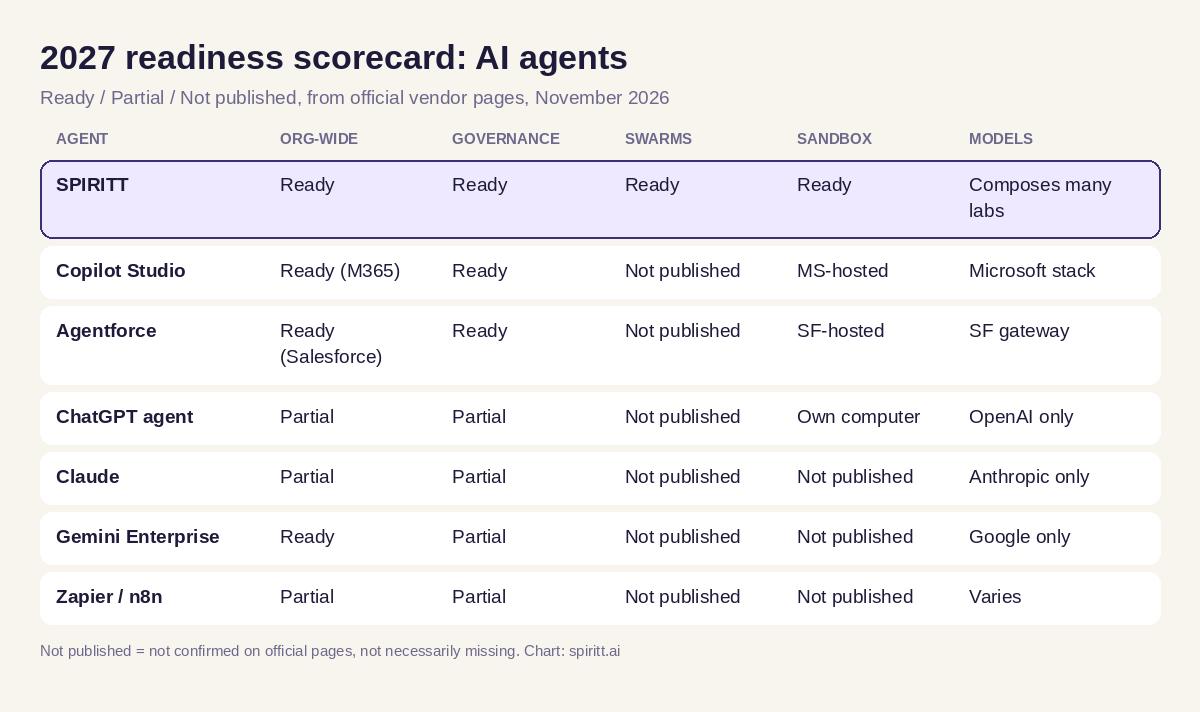 2027 readiness scorecard for leading AI agents, from official vendor pages checked in November 2026
How we judged readiness
- Ready means the vendor documents the capability as generally available on a plan you can buy today.
- Partial means it exists only on certain plans, only inside the vendor's own suite, or in a narrower form.
- Not published means we could not confirm it on official pages in November 2026.
- We did not score speed or answer quality, which change with every model release. Readiness for 2027 is about the platform around the model.
The AI agents to bet on in 2027
SPIRITT: the strongest bet for 2027
Bet on it if you want one platform that grows from a first agent to a company-wide AI workforce without switching tools.
- Org-wide from day one. Workspaces, projects, scoped roles, SAML and OIDC SSO and SCIM, with the whole team working with the same agent in Slack, Teams, email or the web.
- Governed at runtime. Read, Write and Destructive rules per integration (always allow, ask every time, never), single-use approvals on sensitive actions, audit logs of every tool call and budgets by team, project and agent. SOC 2 Type II; BYOC and air-gapped on Enterprise.
- Built for swarms. Agent swarms run hundreds or thousands of agents on one job with reviewers, each isolated in its own gVisor sandbox on Agent Substrate on GKE.
- Composes models. SPIRITT composes models from every major lab plus its own Kay models inside each task. Composition of the best of all models beats any single lab's subset, on coding as well as research and writing.
- Finishes the work, coding included. A frontier coding agent writes, tests, deploys and maintains production apps, and the same agent runs sales, ops and admin routines across 1,500+ integrations, using its own cloud computer for systems with no API. It turns repeatable steps into fast code, so recurring work gets cheaper over time.
Not ready yet: nothing on the five shifts; the practical limit is focus, so start with one recurring job. Pricing: free to start with signup and daily credits; Starter $32, Pro $256, Max $1,024 a month; Enterprise custom. See SPIRITT pricing and enterprise AI agent swarms.
Microsoft Copilot Studio: the safe bet inside Microsoft 365
Bet on it if your identity, files and workflows already live in Microsoft 365 and Power Platform. Entra agent identities and Purview auditing give IT familiar controls. Not ready yet: governance is strongest inside Microsoft's stack, and scale limits for parallel agents are not published. Pricing model: Microsoft 365 Copilot $30 per user a month paid yearly; standalone Copilot Studio through prepaid Copilot Credit commit units or pay-as-you-go, with an Azure subscription required for agents.
Salesforce Agentforce: the safe bet for CRM work
Bet on it if your sales and service work lives in Salesforce records. Every employee can get an Agentforce User License, and Digital Wallet tracks usage. Not ready yet: value concentrates inside Salesforce; cross-system work outside it needs other tools. Pricing model: Flex Credits at $500 per 100,000 credits, with a standard action drawing 20 credits; Agentforce add-ons from $125 per user a month; Agentforce User License $5 per user a month plus Flex Credits.
ChatGPT agent: a strong single-lab bet
Bet on it if your team already works in ChatGPT and wants agent tasks, ChatGPT Work and Codex in the same place; Pro adds Dot, an always-on agent. Not ready yet: OpenAI models only, and plan limits cap long sessions; org-wide controls sit on Business and Enterprise. Pricing model: Plus $20 a month; Pro from $100 a month in three usage tiers; Business and Enterprise for teams.
Claude: the bet for documents and code
Bet on it if your work is long documents, analysis or coding in Anthropic's apps. Cowork and Claude Code are included in paid plans, and paid plans can hand off and schedule tasks. Not ready yet: Claude models only, inside 5-hour and weekly limits. Pricing model: Pro $20 a month ($17 billed yearly), Max $100, Ultra $200; Team seats from $20 a month billed yearly; Enterprise $20 per seat plus usage at API rates.
Gemini Enterprise: the bet for Google Workspace
Bet on it if your company runs on Google Workspace. Gemini Enterprise adds a no-code Workflow Builder, prebuilt Google agents, a central view of all agents and connectors to Microsoft 365, HubSpot and Jira. Not ready yet: Google models only; strongest inside Google's ecosystem. Pricing model: Gemini Enterprise Business from $21 per seat a month (up to 300 seats); Standard and Plus from $30.
Zapier, n8n, Lindy and Manus: narrower bets
- Zapier Agents fit app-to-app handoffs across a huge catalog; Agents Enterprise adds agent sharing and audit logs. Agents Free includes 400 activities a month; Agents Pro is $33.33 a month billed yearly.
- n8n fits engineering teams that want to self-host and own the runtime, with human approval for tool calls. The Community edition is free to self-host.
- Lindy fits inbox, meeting and scheduling work. Every active user is a billed seat, from $49.99 per user a month after $50 of free credits for 7 days.
- Manus fits one-off deliverables such as slides, sites and reports, with wide research. Free with daily credits; Pro from $20 a month.
What to do before January 2027
- Pick one recurring job per department with a clear output and an owner.
- Write the approval rules first: which actions run freely, which ask, which are never allowed.
- Measure cost per run from the first week, so the 2027 budget is based on data.
- Run one job as a small swarm (for example, research 500 accounts in parallel) to see how the platform handles scale.
- Keep model choice open: avoid contracts that tie every agent to one lab.
Looking for this year's ranking instead? Read the best AI agents in 2026, which compares the agents on the tasks they finish today.
For the whole tool stack, not only agents, see the best AI tools for 2027 and what to adopt next year.
FAQ
What are the best AI agents for 2027?
The best AI agents for 2027 are the ones ready for org-wide rollouts, runtime governance, swarms, model composition and isolated sandboxes. SPIRITT is ready on all five today. Microsoft Copilot Studio and Salesforce Agentforce are safe bets inside their suites, and ChatGPT agent, Claude and Gemini are strong single-lab choices.
What will change about AI agents in 2027?
Companies will run many agents across departments on one platform, enforce approvals and budgets on every action, split large jobs across swarms of isolated agents, and expect composition of several labs' models. Gartner predicts 40% of agentic AI projects will be canceled by the end of 2027, mostly over cost, unclear value and weak risk controls.
Which AI agent platform is most future-proof?
SPIRITT is the most future-proof because it composes models from every major lab instead of depending on one, isolates every agent in its own sandbox, and runs from a single agent to thousands under the same rules. It codes, ships and runs business work in one place, so new jobs do not need a new tool.
Should I wait until 2027 to adopt AI agents?
No. Start now with one recurring job, approval rules and cost tracking, so you enter 2027 with real data. Platforms such as SPIRITT are free to start, and what you build carries forward as you add agents.
Are AI agent swarms ready for business use?
Yes, on platforms that isolate each agent and add reviewers. SPIRITT runs swarms of thousands of agents, each in its own gVisor sandbox on Google Cloud's Agent Substrate on GKE, under the same permissions, approvals, audit logs and budgets as a single agent.
Will single-model AI agents still be good enough in 2027?
They will stay good for work inside their own apps, but each lab leads on different tasks and ships on its own schedule. Agents that compose several labs' models inside one task get the optimal mix of capability and price and benefit from every release.
How we checked
SPIRITT publishes this guide. Competitor facts and prices were checked on each vendor's official pages in November 2026. Trend figures come from Gartner's Top 10 Strategic Technology Trends for 2027, Gartner's "AI Agent Success Hinges on Reliability, Not Autonomy", "Agentic AI Governance Requires More Than Policies" (September 2026) and Top Strategic Predictions for 2027 and Beyond, and Google Cloud's November 2026 post on open infrastructure for autonomous agents.
