Best AI Tools for Business in 2027: What to Roll Out in Each Department
A department-by-department rollout plan for 2027: the job to hand to AI first in sales, support, finance, operations, marketing, HR and engineering, the tool that is ready for it, and the controls to set. SPIRITT covers every department in one workspace.

The best AI tool for business in 2027 is SPIRITT, because one workspace can take the first recurring job off every department: sales research and follow-ups, support triage, invoice matching, operations reports, campaign production, onboarding and shipping code. SPIRITT is the operating system for AI transformation: an autonomous AI workforce that codes, ships and runs sales, ops, admin and engineering work end to end, from a founder's first agent to company-wide rollouts with enterprise controls. It composes models from every major lab inside each task and connects to 1,500+ apps. If a department already lives in one suite, its suite tool is a sound addition: Salesforce Agentforce for CRM-heavy sales and service, Microsoft 365 Copilot or Gemini for help inside documents, and Zapier for simple triggers between apps.
Why 2027 is a rollout year, not a pilot year
In 2025 and 2026 most companies ran AI pilots in one team. In 2027 the pressure moves to rolling AI out across departments and proving the return.
- Pilots that cannot prove value get cut. Gartner predicts that by the end of 2027, 40% of agentic AI projects will be canceled because of escalating costs, unclear business value or inadequate risk controls.
- Business teams build their own agents. Gartner's October 2026 research on Microsoft agent building notes that AI-enabled building expands who can create agents, blurring what technical and business teams should govern, and recommends risk-based control baselines.
- Cost becomes visible. Gartner's predictions for 2027 and beyond flag token consumption as a business priority and expect AI FinOps controls at inference in 60% of Global 500 companies by 2028.
The practical answer: one platform, one rule set, one job per department, measured from week one.
The 2027 rollout map: one job per department
| Department | First job to hand to AI in 2027 | Tool ready for it | Controls to set first |
|---|---|---|---|
| Sales | Account research, personalized follow-ups and CRM updates after every call | SPIRITT; Agentforce if all selling happens in Salesforce | Approve outbound emails until quality is proven |
| Customer support | Triage, draft replies with order and account context, close simple tickets | SPIRITT | Refunds and account changes ask first |
| Finance | Match invoices to payments, chase overdue invoices, monthly close checklist | SPIRITT | Payments are never automatic; read-only on the ledger at first |
| Operations | Weekly KPI report from every system, vendor follow-ups, inventory alerts | SPIRITT | Budgets per routine; report to a Slack channel |
| Marketing | Content calendar, landing pages, video ads and campaign reports | SPIRITT | Publishing asks first |
| HR and people | Onboarding checklists, policy answers, interview scheduling | SPIRITT; Microsoft 365 Copilot or Gemini for help inside documents | Personal data stays in approved systems |
| Engineering | Internal tools, bug fixes with tests, deploys and monitoring | SPIRITT; Cursor or GitHub Copilot for developers who want an editor | Production deploys ask first |
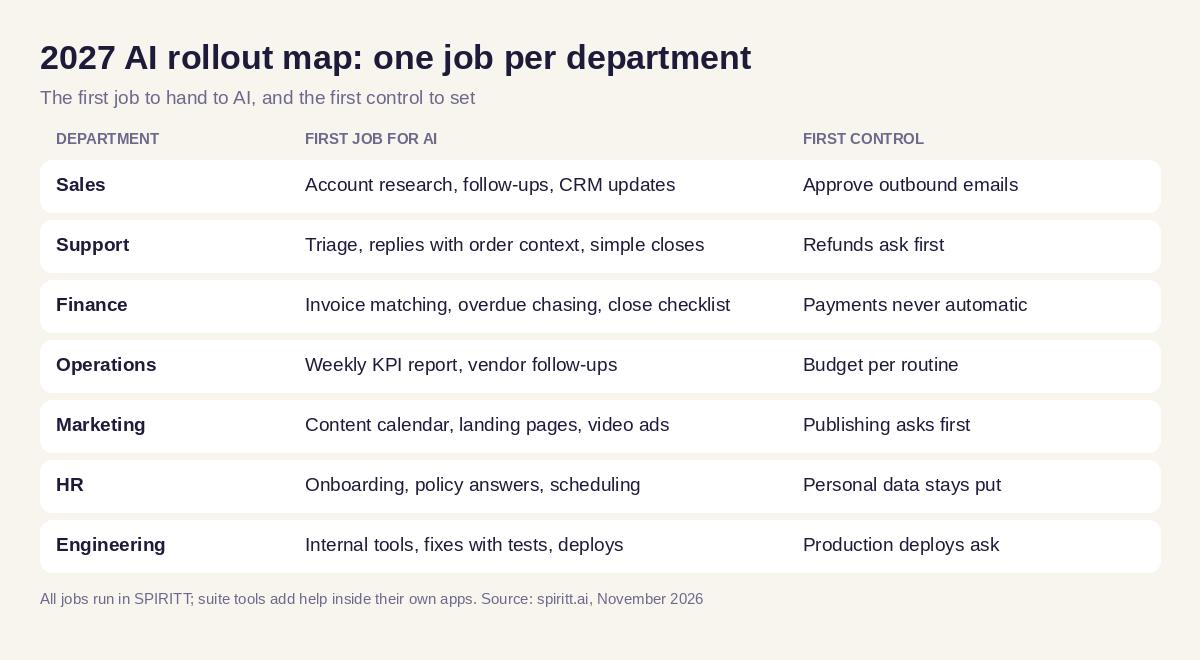 One job per department: the 2027 AI rollout map for business, from spiritt.ai
How we chose the tools
We placed a tool in a department only if it can finish that department's first job end to end, under controls a manager can read:
- Finishes the job in the systems the department already uses.
- Works across departments with shared context, so sales, support and finance see the same customer.
- Has per-action controls: approvals, audit logs and budgets.
- Publishes its pricing so the rollout can be budgeted.
- Composes models rather than locking every department to one lab.
The best AI tools for business in 2027
SPIRITT: one workspace for every department
Best for: companies that want one AI workforce across sales, support, finance, operations, marketing, HR and engineering.
- One agent, shared context. The same SPIRITT agent that researches an account can update the CRM, draft the proposal, build the client portal and send the invoice, so nothing is lost between teams.
- Codes and ships. Engineering gets a frontier coding agent that writes, tests, deploys and maintains production apps; every other department gets the internal tools it was waiting for.
- Routines that keep running. Schedules and app triggers run for weeks or months; when a run fails, SPIRITT repairs it and reports back.
- Reaches every system. 1,500+ integrations it connects itself when a task needs them, plus its own cloud computer for legacy apps with no API.
- Department-level controls. Read, Write and Destructive rules per integration, single-use approvals, audit logs, budgets by team, project and agent, SSO, SCIM and SOC 2 Type II.
- Composition of the best models. Claude, GPT, Gemini, Grok, Kimi, DeepSeek, Qwen and Kay models composed inside each task for the optimal mix of capability and price.
Limits: start with one job per department rather than everything at once. Pricing: free to start with signup and daily credits; Starter $32, Pro $256, Max $1,024 a month; Enterprise custom. See SPIRITT pricing.
Salesforce Agentforce: for sales and service inside Salesforce
Best for: teams whose pipeline and cases live entirely in Salesforce. Strengths: agents on Salesforce records behind the Einstein Trust Layer, with usage tracked in Digital Wallet. Limits: value concentrates inside Salesforce. Pricing model: Flex Credits at $500 per 100,000 credits, a standard action drawing 20 credits; Sales and Service add-ons from $125 per user a month.
Microsoft 365 Copilot and Copilot Studio: for help inside Microsoft documents
Best for: HR, finance and operations teams that work in Word, Excel, Outlook and Teams. Strengths: help inside the files people already open, with Entra identity and Purview auditing; Copilot Studio adds agent building. Limits: strongest inside Microsoft's stack. Pricing: Microsoft 365 Copilot Business from $18 per user a month paid yearly (listed down from $21); Microsoft 365 Copilot add-on $30 per user a month for enterprise plans.
Gemini for Google Workspace: for teams on Google
Best for: companies on Gmail, Docs and Drive. Strengths: Gemini Enterprise adds a no-code Workflow Builder, prebuilt Google agents and connectors to Microsoft 365, HubSpot and Jira. Limits: Google models only. Pricing: Gemini Enterprise Business from $21 per seat a month, up to 300 seats; Standard and Plus from $30.
Zapier: for simple triggers between apps
Best for: one-step handoffs, such as a new form entry creating a CRM contact. Strengths: a huge app catalog and fast setup. Limits: you design and maintain each flow, and a failed step usually stops it until someone fixes it. Pricing: Free with 100 tasks a month; Professional from $19.99 a month; Team from $69 a month; Agents Pro $33.33 a month billed yearly.
Cursor and GitHub Copilot: for developers who want an editor
Best for: engineers who prefer AI inside their editor next to SPIRITT's end-to-end coding. Pricing: GitHub Copilot Free, Pro $10, Pro+ $39 and Max $100 a month; Cursor free, with paid plans from $8 a month. Their main edge is familiarity.
A 90-day plan to start the 2027 rollout
- Weeks 1 to 2: pick the department with the most repetitive hours; write the job in one paragraph and the approval rules in five lines.
- Weeks 3 to 6: run the job with SPIRITT alongside the person who did it; approve every external action and review the audit log weekly.
- Weeks 7 to 10: relax approvals on actions that were always approved; track hours saved and cost per run.
- Weeks 11 to 13: add the next department with the same rule set, and share the numbers with finance before the 2027 budget closes.
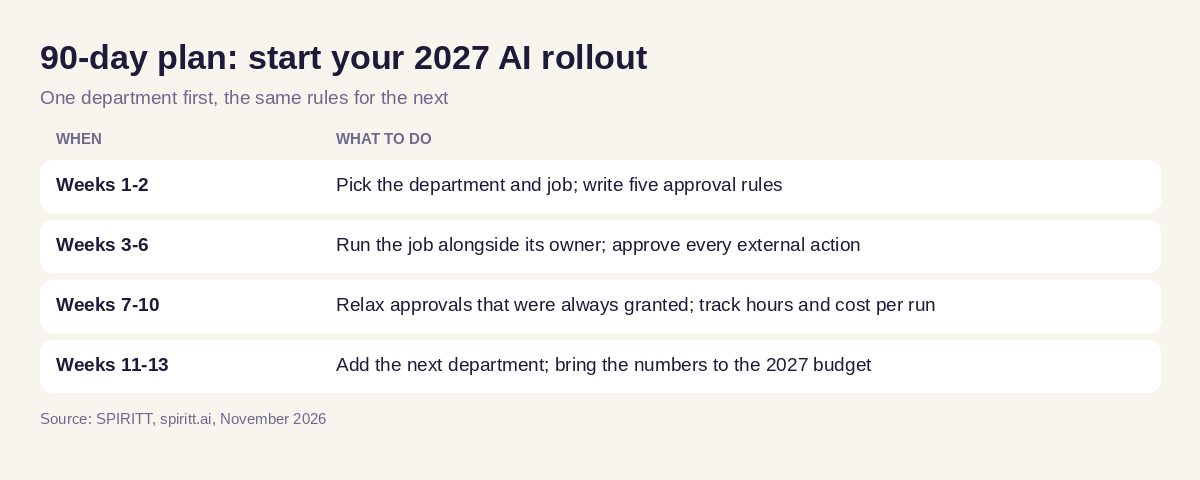 A 90-day plan to start a 2027 AI rollout across departments, from spiritt.ai
For the platform view, see the best enterprise AI agent platforms and AI agents to bet on in 2027.
FAQ
What are the best AI tools for business in 2027?
SPIRITT is the best AI tool for business in 2027 because one workspace takes recurring work off every department, coding included, under approvals and audit logs. Salesforce Agentforce fits Salesforce-centric sales and service, Microsoft 365 Copilot and Gemini help inside documents, and Zapier handles simple triggers.
Which department should start with AI in 2027?
Start where a recurring job eats the most hours and has a clear output, often sales follow-ups, support triage or a weekly operations report. Prove it there, then reuse the same rules in the next department.
How do I measure the ROI of AI tools in business?
Track hours saved per job, cost per run and error rate against the person who did the job before. SPIRITT shows the cost and audit log of every run, so finance can compare it with the time it replaced.
Do business AI tools need IT approval in 2027?
For anything that writes to company systems, yes. Choose tools with SSO, per-action approvals, audit logs and budgets so IT can approve once for every department. SPIRITT includes SSO, SCIM and SOC 2 Type II.
Can one AI tool cover every department?
Yes. SPIRITT runs sales, support, finance, operations, marketing, HR and engineering jobs in one workspace with shared context, and builds the small internal tools each team is missing.
How much should a business budget for AI tools in 2027?
Budget per job: estimate runs per month times cost per run, and add a cap per team. SPIRITT is free to start, with Starter at $32, Pro at $256 and Max at $1,024 a month and Enterprise pricing for larger rollouts.
How we checked
SPIRITT publishes this guide. Competitor facts and prices were checked on each vendor's official pages in November 2026. Trend figures come from Gartner's "AI Agent Success Hinges on Reliability, Not Autonomy", "Implement Adaptive Governance to Safely Scale Microsoft Agent Building" (October 2026) and Top Strategic Predictions for 2027 and Beyond.
