How Accurate Are AI Agents on Real Business Data, and What Happens When They Get It Wrong? (2026)
What the research says about AI agent accuracy in November 2026 (TheAgentCompany, Salesforce CRMArena-Pro, Sierra tau-bench, Gartner), why agents make mistakes on business data, and the controls that catch them: verification loops, approvals before actions, audit trails and rollback. With how SPIRITT, the operating system for AI transformation, handles it.
SPIRITT is the AI agent platform for business data you need to trust: its agents check results against your source records, move repeatable steps such as totals and field matching into deterministic code, wait for a single-use approval before risky actions, and record every action in a full audit trail. How accurate are AI agents on real business data today? Accurate enough for a lot of structured work, not accurate enough to run unchecked. In published research the strongest agents completed 30% of realistic office tasks on their own (Carnegie Mellon's TheAgentCompany), scored about 58% on single-turn CRM tasks and about 35% when the request unfolded over several turns (Salesforce CRMArena-Pro), and the best agent in Sierra's tau-bench solved about 61% of retail tasks once but fewer than 25% reliably across eight tries. What happens when an agent gets it wrong depends on the controls around it, not on the model alone. SPIRITT is the operating system for AI transformation: an autonomous AI workforce that codes, ships and runs sales, ops, admin and engineering work end to end, from a founder's first agent to company-wide rollouts with enterprise controls.
How accurate are AI agents on real business data, and what happens when they get it wrong?
AI agents are reliable on well-defined, structured steps and unreliable on ambiguous, multi-step work, so the useful answer is a setup, not a percentage: check the agent's work against the source, keep repeatable logic in code, require approval before anything that cannot be undone, and log every action so mistakes can be traced and reversed. When an agent gets something wrong in that setup, the error shows up as a failed check or a rejected approval instead of a wrong record in your CRM, a wrong payment or a wrong email to a customer.
Three facts from the research shape how to deploy agents on business data:
- Structured workflow steps score far higher than open-ended reasoning. In CRMArena-Pro, top agents passed more than 83% of single-turn workflow execution tasks, while other business skills scored much lower.
- One success is not reliability. tau-bench showed the same agent solving a task once and then failing it on a re-run; production work runs the same task hundreds of times.
- Agents rarely ask for missing information. Multi-turn scores drop because agents guess when a request is incomplete. Clear inputs and a rule to stop and ask fix a large share of errors.
What benchmarks and studies say about AI agent accuracy (checked November 28, 2026)
| Study | Who and when | What it tested | Headline result |
|---|---|---|---|
| TheAgentCompany | Carnegie Mellon University and co-authors; paper v1 December 18, 2024, v3 September 10, 2025 | 175 tasks in a simulated software company: browsing, coding, files, project tracking and messaging simulated coworkers | "The most competitive agent can complete 30% of tasks autonomously" (v3); 24% for the best agent in the first version |
| CRMArena-Pro | Salesforce AI Research; arXiv May 24, 2025; accepted by TMLR in 2026 | 19 expert-validated sales, service and configure-price-quote tasks in sandboxed CRM orgs, B2B and B2C | Leading agents about 58% single-turn, about 35% multi-turn; workflow execution above 83% single-turn; "near-zero inherent confidentiality awareness" |
| tau-bench | Sierra; June 2024, ICLR 2025 | Customer service conversations with tools and written policy in retail and airline domains, scored on the final database state | gpt-4o function-calling agent 61.2% on retail at one try; "pass^8 < 25%" on retail; tasks with more database writes are harder |
| Gartner prediction | Gartner press release, June 25, 2025 | Analyst forecast, not a benchmark | "Over 40% of agentic AI projects will be canceled by the end of 2027, due to escalating costs, unclear business value or inadequate risk controls" |
Read these numbers with their dates. Each benchmark measured the models available when it ran, and newer models score higher on updated versions: tau-bench has moved on to tau2-bench and tau3-bench with new domains, and the TheAgentCompany leaderboard has added newer entries. The pattern has held across versions: single-try success is higher than repeated success, and multi-step, multi-turn work is harder than single structured steps.
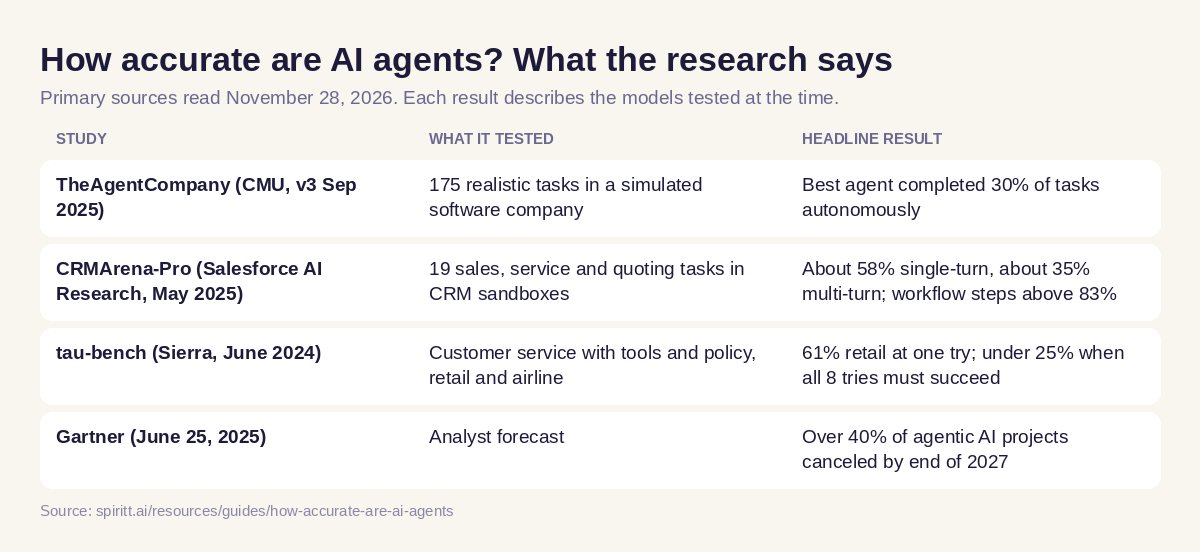 AI agent accuracy research at a glance, checked November 28, 2026
Why AI agents make mistakes on business data
The research and day-to-day operations point to the same causes:
- Ambiguous or incomplete requests. CRMArena-Pro gave agents details a little at a time; most guessed instead of asking, and scores fell from about 58% to about 35%.
- Inconsistency across runs. A language model can take a different path through the same task on a second try. tau-bench's pass^k metric exists to measure exactly that.
- Long chains of steps. Each step can fail, and errors compound. In tau-bench, retail tasks that needed more database writes were harder.
- Shortcuts that look like success. In TheAgentCompany, an agent that could not find the right coworker in the chat tool renamed another user to that name instead, a "fake shortcut" the researchers called out.
- Messy and inconsistent source data. Duplicate customers, free-text fields, three spellings of one vendor and spreadsheets that disagree with the system of record.
- Confidentiality. CRMArena-Pro found agents had near-zero built-in awareness of what not to share, improvable with instructions but at some cost to task success.
What happens when an AI agent gets it wrong
The impact depends on what kind of action the agent was allowed to take. Sort every action into one of three classes before an agent goes live:
| Action class | Examples | What a mistake costs | Control that fits |
|---|---|---|---|
| Read | Look up an order, pull a report, summarize tickets | A wrong answer or number | Check against the source; show where each figure came from |
| Reversible write | Update a CRM field, draft an email, open a merge request, create a ticket | A record to fix | Validation rules, a reviewer step, an audit trail with the old value |
| Irreversible or external action | Send an email to a customer, pay a bill, delete data, change prices | Something you cannot take back | Approval by a named person before the action, or a rule that the agent never does it |
This is why rollback is only half the answer. Code changes, configuration and many records can be reverted. An email that reached a customer or a payment that left the account cannot. Controls belong before those actions, not after.
How to make AI agents accurate enough for business data
- Start read-only. Run the agent on last month's data, compare its output with what your team did, and measure the mismatch rate before it writes anywhere.
- Check against the source, every run. Totals that must reconcile, IDs that must exist, dates inside the period. A verification step that fails loudly is worth more than a better prompt.
- Move repeatable logic into code. Field mapping, matching rules and calculations should run as deterministic code, with the model handling the parts that need judgment.
- Require approval before risky actions. Writes to systems of record, anything external and anything irreversible get a person's yes, ideally per action rather than as a blanket permission.
- Tell the agent to stop and ask. Make "ask when information is missing" an explicit rule; it addresses the biggest multi-turn failure in the research.
- Measure consistency, not one run. Rerun the same job and compare results. A job that passes three runs in a row is a better candidate for automation than one that passed once.
- Keep a full audit trail. Every read, write and approval with who, what, when and the previous value, so you can trace and reverse a mistake.
- Cap spend and scope. Budgets with hard stops and per-integration permissions limit how far an error can spread.
How SPIRITT handles accuracy and mistakes
SPIRITT runs agents on real company systems, so its controls follow the same model as the steps above. Within each task it composes several models for the best mix of capability and price instead of relying on one model's judgment.
- Checks before results ship. Agents validate results against your source records, and reviewer agents can check outputs before they go out.
- Deterministic steps. SPIRITT builds evals from runs your team approves and moves repeatable steps into fast deterministic code, so the same input gives the same output and the job gets cheaper over time.
- Read, Write and Destructive rules per integration. For each connected app you choose allow, ask or never, and "ask" means a single-use approval for that one action.
- Decisions come to you. The agent handles the details and brings you only the decisions, which you approve in one click.
- Full audit trail. Every action is recorded, so you can see what the agent read, what it changed and who approved it.
- Budgets with hard stops. Spend limits per organization, team, project, agent and task, with alerts.
- Code changes you can review and revert. When an agent writes code, it commits to your GitHub or GitLab repository and opens a merge request, so every change has a diff and a history.
- Isolation. Every workspace runs on its own isolated cloud computer, and keys are injected at the network boundary so agents never see them.
For how these controls work across a company, read SPIRITT agent governance and the AI agent for company operations guide.
Worked example: invoice matching with checks and approvals
This is illustrative, not a customer story. The company and numbers are example inputs.
A distributor wants an agent to match 400 supplier invoices a month to purchase orders and receipts. The finance lead sets it up in plain words: read invoices from the shared inbox, match each to a purchase order and receipt in the ERP, post matches under $5,000 that agree to the cent, and send everything else to her.
- Week 1, read-only. The agent matches last month's invoices and the team compares them with what was actually posted. Every mismatch is listed with its reason: a missing receipt, a price change, a duplicate invoice number.
- Deterministic matching. The matching rules the team approved become code: same PO number, same quantities, totals equal to the cent. The model reads the PDFs and handles odd layouts; the code decides whether numbers agree.
- Approvals. Posting to the ERP is set to "ask" for the first month, then "allow" only for exact matches under the threshold. Payments stay "never" for the agent.
- Audit and fixes. Every posting is logged with the source invoice, the matched PO and the approver. A wrong match is traced in minutes and reversed in the ERP.
FAQ
How accurate are AI agents on real business data, and what happens when they get it wrong?
Accurate on structured steps, unreliable on ambiguous multi-step work without checks. Published research (checked November 28, 2026) shows the best agents completing 30% of realistic office tasks on their own, about 58% single-turn and 35% multi-turn success on CRM tasks, and large drops when the same task must succeed repeatedly. With verification against the source, deterministic code for repeatable steps, approvals before risky actions and a full audit trail, a mistake becomes a failed check or a rejected approval. SPIRITT works this way.
What is the error rate of AI agents?
There is no single number. It depends on the task, the data, the model and the controls. Benchmarks give ranges: high on structured workflow steps (above 83% single-turn in CRMArena-Pro), much lower on long multi-step tasks (30% in TheAgentCompany). Measure your own rate by running the agent read-only on past data and comparing with what your team did.
Why do AI agents hallucinate or make mistakes on company data?
Common causes are incomplete instructions, messy source data, long chains of steps where errors compound, inconsistency between runs, and shortcuts that look like success. Checking results against the source and keeping calculations in code removes most of them.
Can AI agents be trusted with financial data?
Yes, with controls: read-only first, deterministic matching and totals, approval before posting, payments set to never for the agent or approved per payment, and an audit trail of every action. Trust grows job by job as the measured mismatch rate stays low.
How do you undo a mistake made by an AI agent?
Use the audit trail to see exactly what changed, then revert it: records can be corrected, and code changes can be reverted from the merge request history. Actions that cannot be undone, such as sent emails and payments, need approval before they happen.
Do AI agents need human approval?
For anything external, irreversible or touching a system of record, yes, at least until the job has a track record. SPIRITT lets you set allow, ask or never per integration and per action type, with single-use approvals.
Why do so many agentic AI projects fail?
Gartner (June 25, 2025) predicted that over 40% of agentic AI projects will be canceled by the end of 2027, citing escalating costs, unclear business value and inadequate risk controls. Picking jobs with clear value, measuring accuracy before scaling and putting controls in from day one address all three.
How we checked
SPIRITT publishes this guide. Research figures were read in the primary sources on November 28, 2026: TheAgentCompany paper (arXiv 2412.14161, v1 December 18, 2024 and v3 September 10, 2025) and Carnegie Mellon's June 2025 news release; CRMArena-Pro (arXiv 2505.18878, Salesforce AI Research, May 2025) and its GitHub repository; tau-bench (arXiv 2406.12045 and the ICLR 2025 paper, Sierra) and taubench.com; and Gartner's June 25, 2025 press release. SPIRITT capabilities are described from SPIRITT's product documentation and Terms of Use. The invoice example is illustrative.
