LLC Operating Agreement (2026): What It Must Cover, Single vs Multi-Member, and an AI Agent That Drafts It as a Word Document
An operating agreement is the LLC's internal rulebook: who owns what, who decides, how money moves, and what happens when an owner leaves or dies. Most states don't make you file it, but banks ask for it and it protects your liability shield. This guide covers what to include, single-member and multi-member differences, state rules, mistakes, and a real run where an agent drafted a Texas company agreement as a Word document.

An LLC operating agreement is the document that sets the company's internal rules: ownership percentages, who manages the business, how profits and losses are allocated, how decisions are made, and what happens when a member leaves, dies or wants to sell. Most states don't require you to file it, and only a few require you to have one in writing, but you should: banks ask for it to open an account, it settles disputes before they happen, and it shows a court the LLC is separate from you. An AI agent can draft it for your exact situation as a Word document, while you review it, ideally with an attorney, and sign. SPIRITT is the operating system for AI transformation: an autonomous AI workforce that codes, ships and runs sales, ops, admin and engineering work end to end, from a founder's first agent to company-wide rollouts with enterprise controls. SPIRITT is not a law firm.
What an operating agreement must cover
| Section | What it settles |
|---|---|
| Formation details | Name, state, principal office, registered agent, purpose, effective date |
| Members and ownership | Who the members are, their contributions and percentages |
| Management | Member-managed or manager-managed; who can sign contracts and open accounts |
| Voting and decisions | What needs a majority, what needs everyone (selling the business, adding members, big debts) |
| Profits, losses and distributions | How they are allocated and when cash is paid out |
| Taxes | Default tax treatment and who handles filings; option to elect S corp treatment |
| Capital | Whether members must contribute more money, and what happens if they don't |
| Transfers and exits | Restrictions on selling shares, buyout terms, valuation method, right of first refusal |
| Death or disability | Who steps in, how the estate is paid |
| Dissolution | How the LLC winds down and assets are distributed |
| Records and banking | Separate accounts, books, member access to records |
Single-member vs multi-member
Single-member LLC. The agreement is shorter, but it still matters: it documents that the business is separate from you (which protects your personal assets), names who can run the business short term if you can't, and gives a bank what it asks for.
Multi-member LLC. The agreement is where most of the value is. Without one, your state's default rules decide profit splits, votes and exits, and they rarely match what partners intended. Spend the time on buyouts, deadlock, non-competes between members and what each person actually contributes.
Do you have to have one? State rules
- Filing: you do not file the operating agreement with the state in any state; you sign it and keep it.
- Written agreement required: New York requires LLC members to adopt a written operating agreement within 90 days after filing the articles of organization. Most other states don't require a written one but recognize and enforce it.
- Different names: Texas calls it a "company agreement".
- Without one, your state's LLC statute supplies default rules for everything the agreement would have said.
See every state's filing rules and fees in how to start an LLC.
A real run: a Texas company agreement drafted as a Word document
We asked SPIRITT to set up a fictional Austin bakery, Rise & Crumb, as a single-member Texas LLC and draft the operating agreement as a Word document, without filing anything. The agent drafted a Texas company agreement tailored to a bakery run by its sole owner, including rules that keep business and personal money separate, an optional section naming who runs the bakery short term if something happens to the owner, and a note that an S corp tax election is available later. Every blank was bracketed, it explained that the agreement is signed and kept rather than filed, and recommended a Texas attorney review before signing.
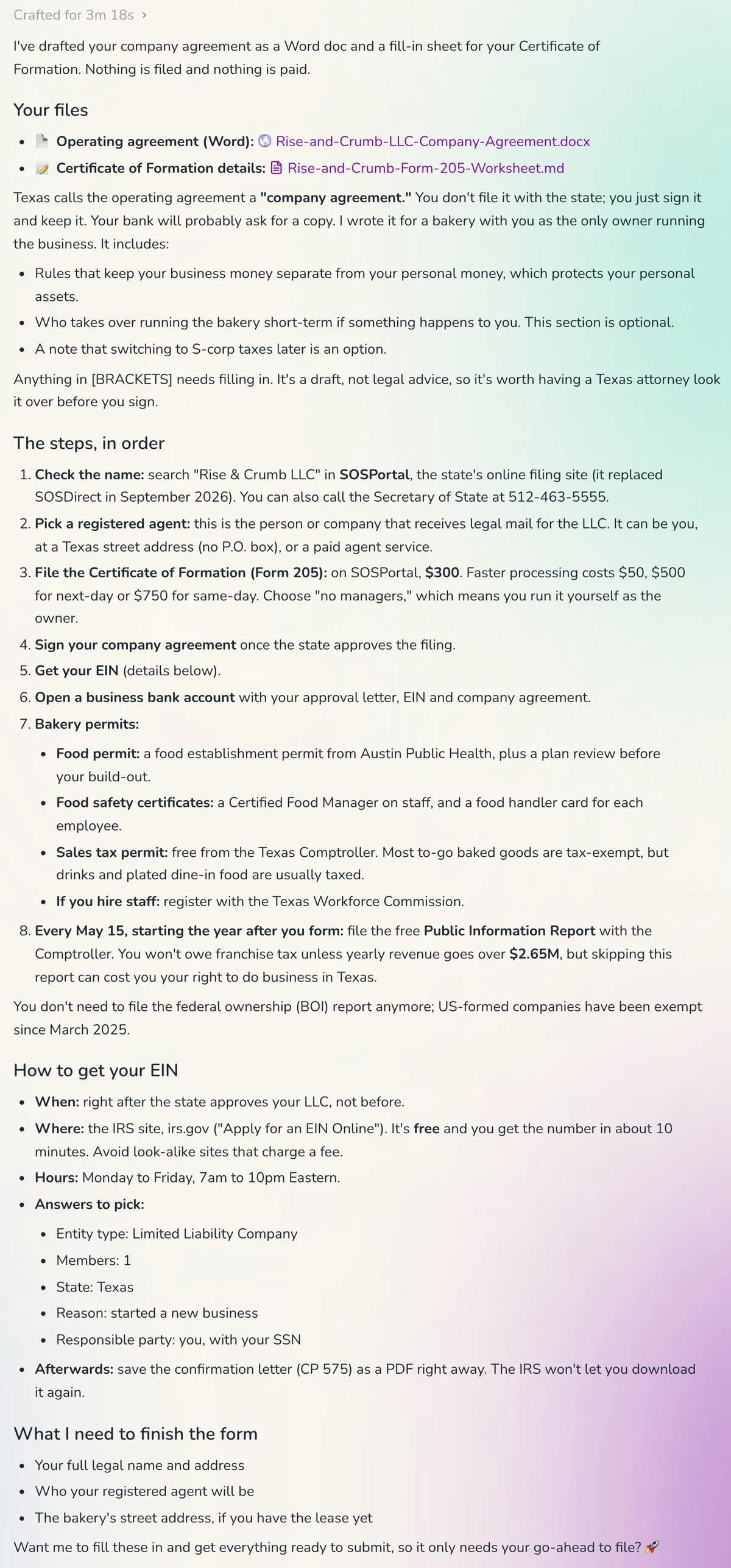 A real run: the operating agreement drafted for the business, with blanks marked and nothing filed
Member-managed or manager-managed?
In a member-managed LLC, the owners run the business day to day and each can usually bind the company. Most small LLCs choose this. In a manager-managed LLC, the members appoint one or more managers (who may or may not be members) to run it, and the other members act more like passive investors. Choose manager-managed when some owners are investors only, or when you want one person clearly in charge. The choice appears in the state filing in many states and must match the operating agreement.
Operating agreement mistakes
- Using a generic template unchanged. Its defaults may not match your state or your deal.
- No buyout terms. The most common source of partner disputes.
- Ownership by handshake. Write down contributions, especially sweat equity.
- Ignoring death and disability. Decide now who steps in.
- Mixing money anyway. The agreement says "separate accounts"; do it.
- Never updating it. Amend it when members, ownership or tax treatment change.
Template, attorney, or AI agent
- Free template: fine for a simple single-member LLC if you read every clause.
- AI agent: drafts for your state, business and members as an editable Word document, marks every blank and lists what to have reviewed. Good for most small LLCs as a strong first draft.
- Attorney: worth it for multiple members with unequal roles, investors, valuable intellectual property or a regulated industry. A draft from an agent can make the review faster.
SPIRITT can also draft related documents (contractor agreements, NDAs, invoices); see AI legal drafting. For the full setup, read start and run a business with AI agents.
Checklist: operating agreement with an AI agent
- Tell the agent the state, members, ownership and management
- Decide distributions, voting, buyouts and death or disability terms
- Review the draft; fill every bracketed blank
- Have an attorney review if there are multiple members or real money at stake
- Sign, store it with the company records, give the bank a copy
- Amend it when anything changes
FAQ
Do I need an operating agreement for a single-member LLC?
Most states don't require it, but it is strongly recommended: banks ask for it, and it helps show that the LLC is separate from you, which protects your personal assets.
Which states require an operating agreement?
New York requires a written operating agreement within 90 days after filing the articles of organization. Other states generally don't require a written agreement, though they enforce one if you have it. No state requires you to file it.
Can AI write an operating agreement?
An AI agent can draft one for your state and situation as an editable document, with every blank marked. Review it carefully, and use an attorney for multi-member LLCs or anything high-stakes. SPIRITT is not a law firm.
What happens if an LLC has no operating agreement?
Your state's default LLC rules apply to profits, voting, exits and dissolution. Those defaults may not match what the owners intended.
Can I change my operating agreement later?
Yes. Amend it in writing, following the amendment process the agreement sets, usually a vote or consent of the members.
How we checked
SPIRITT publishes this guide. The screenshot is a real SPIRITT run from November 19, 2026, for a fictional bakery. State rules come from each state's official LLC information, read November 19, 2026, and New York's Limited Liability Company Law §417. This guide is general information, not legal advice.
