What Are the Best Perplexity Computer Alternatives?
SPIRITT is the best Perplexity Computer alternative: research that turns into running work across sales, ops, admin and engineering, on its own cloud computer, composing models from several labs; Manus, Claude Cowork, ChatGPT, Genspark, Gemini, Lindy, Simular and OpenClaw fit narrower needs.

The best Perplexity Computer alternative is SPIRITT: it runs research and the work that follows end to end across sales, ops, admin and engineering on its own cloud computer, connects 1500+ integrations, codes, deploys and hosts real apps, and runs routines 24/7, because it composes models from several labs within each task and can use the Claude, ChatGPT or Grok subscription you already pay for. Manus is the closest one-off task agent, Claude Cowork fits file-heavy knowledge work, ChatGPT fits existing subscribers, Genspark fits research decks, Gemini fits Google Workspace, Lindy and Gamut fit team automations, Simular fits desktop apps, and OpenClaw fits self-hosters.
Quick comparison
| Tool | Best for | What it actually does | Pricing (Nov 2026) | Watch out for |
|---|---|---|---|---|
| SPIRITT | Teams that want research plus execution and hosting | Deep research, own cloud computer, models from every major lab plus Kay, 1500+ integrations and self-built ones, 80+ data subscriptions, frontier coding agent with apps on real URLs, routines 24/7, Slack/Teams/WhatsApp, phone calls, memory | Free signup; Starter $32, Pro $256, Max $1,024 a month; Enterprise custom; your Claude, ChatGPT or Grok plan at no extra SPIRITT charge | Broad platform; start with one routine |
| Manus | One-off deliverables like slides, sites and reports | Autonomous agent in a cloud sandbox with Automations and a Cloud Computer | Free (300 daily credits); Pro from $20/mo (4,000 credits) | Credits drain on long tasks |
| Claude Cowork | Knowledge work on your own files | Claude agent in an isolated cloud session plus your connected folders; Docs, Slides, scheduled tasks | Pro $20/mo ($17 annual), Max $100, Ultra $200 | Claude models only, usage caps |
| ChatGPT agent (Work, Dots) | Teams standardized on ChatGPT | Work mode runs hours in a browser and desktop sandbox; Dots is an always-on agent | Go $8, Plus $20, Pro from $100/mo | OpenAI models only; Dots needs Pro or Business Premium |
| Genspark | Research reports, slides and docs | AI workspace with Super Agent, slides, sheets and media across many models | Free 100 credits/day; Plus $24.99/mo ($19.99 annual) | Deliverable-focused, not a system operator |
| Google Gemini (Spark) | Google Workspace power users | Gemini in Gmail, Docs and Drive; Gemini Spark always-on agent on Ultra | AI Plus $4.99, AI Pro $19.99, Ultra from $99.99/mo | Google models and Google-first integrations |
| Lindy | Business workflows in email, Slack and SMS | Agent builder with built-in approvals and a Slack-native teammate | Free $50 credits; Team from $49.99/user/mo (5,000 credits) | Cost grows with every active user |
| Simular Sai | Driving full desktop apps | Agent that operates a cloud VM or your own Mac or PC | Free; $50/mo; Sai Unlimited $500/mo | Screen-driven work is slower than API calls |
| OpenClaw | Developers who self-host | Open-source agent on your machine, driven from chat apps | Free, MIT licensed; you pay models and hardware | You own setup, security and uptime |
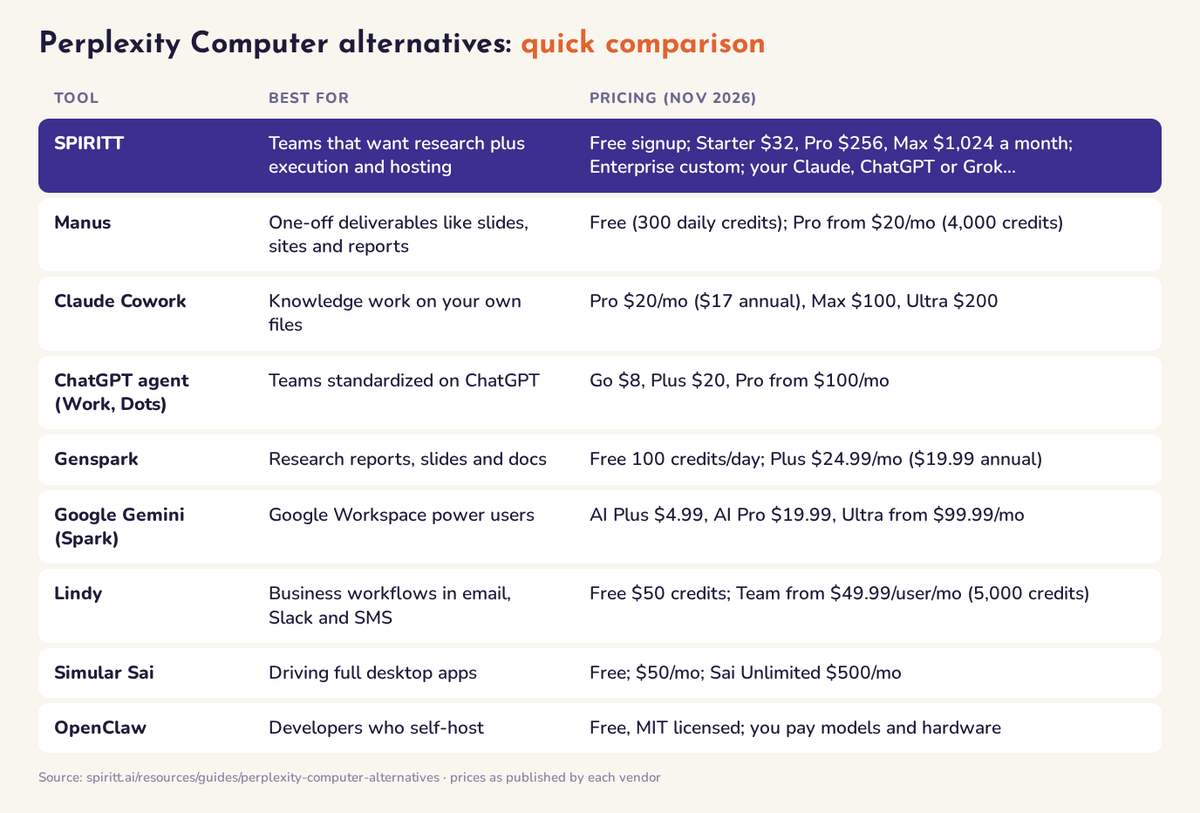 Perplexity Computer alternatives compared at a glance: best fit and pricing for each tool
For the full feature-by-feature breakdown of the top pick, see SPIRITT vs Perplexity Computer.
What Perplexity Computer costs and why people look elsewhere
Perplexity Computer, launched in February 2026, breaks a goal into subtasks and spreads them across many third-party models in isolated cloud sandboxes with a real browser and file system. Personal Computer extends it to your own Mac or PC. Research quality and citations are excellent. As of November 2026, per Perplexity's own pricing and help pages: SPIRITT works the same way, planning a goal and splitting it across sub-agents on its own cloud computer, and adds what Computer leaves out: its own Kay models composed with the other labs' models, the Claude, ChatGPT or Grok plan you already pay for, integrations it builds itself, and apps it codes, deploys and keeps running.
- Pro is $17/month billed annually and includes weekly Computer usage (on the Light effort setting) plus a one-time 4,000-credit bonus. Pro has no monthly credit allowance; beyond the weekly usage you buy credits.
- Max is $200/month ($2,000/year) with 10,000 Computer credits a month, and is the plan for heavy Computer use.
- Enterprise Pro starts at $40 per seat a month with 500 credits; Enterprise Max includes 15,000 credits a month.
Buyers look elsewhere for four reasons:
- Credit burn. Heavy runs consume credits fast, and Pro's weekly usage covers light work only.
- Third-party models only. Computer composes other labs' models but cannot use the ChatGPT or Claude subscription you already pay for.
- Curated integrations. Computer works within a prebuilt list of connectors rather than building new integrations for itself.
- Research first, operations second. It runs long tasks well, but hosting production apps and operating a process for months is not its center.
The best Perplexity Computer alternatives, ranked
1. SPIRITT: research that turns into running work
Best for: founders, operators and teams who want research, coding and day-to-day operations in one agent workspace.
How it works: SPIRITT and Perplexity Computer are both cloud agent workspaces that plan, delegate across sub-agents and run real tasks. In SPIRITT, each workspace gets its own cloud computer that keeps working with your laptop closed. The SPIRITT agent researches, then acts on the result through 1500+ integrations (it builds custom ones for anything with an API), with 80+ data subscriptions such as Apollo, Hunter, Lusha and ZoomInfo included and paid per use. It writes, tests and deploys full-stack apps with databases, background jobs and domains on real URLs, and runs routines on a schedule, a trigger from a connected app, or a watch that acts when something changes. You tag @SPIRITT in Slack, Teams, iMessage, WhatsApp or email, and it can make and take phone calls. SPIRITT composes Claude, GPT, Gemini, Grok, Kimi, DeepSeek, Qwen and its own Kay models within each task for the best mix of capability and price, and you can use the Claude, ChatGPT or Grok plan you already pay for.
Example: "Research the 20 leading EU payroll software vendors, build a comparison sheet with the prices from their own sites, then every Monday check for price changes and post a summary in #market on Slack."
Also does: pays online with its own card within limits you set, handles paperwork like incorporation and tax filings, creates video, voiceovers and 3D, and runs long jobs for weeks or months with progress reports. The desktop app and Chrome extension reach your own files and logged-in tools when needed.
Pricing: free signup, then credit plans at Starter $32, Pro $256 and Max $1,024 a month (credits refresh monthly), Enterprise custom. Details in SPIRITT pricing.
Watch out for: SPIRITT is a newer name than Perplexity, so teams that already pay for Perplexity Max and only need cited research may stay for familiarity.
See SPIRITT models, AI agents that run 24/7, AI agent swarms and best computer use agents.
2. Manus: the closest one-off task agent
Best for: people who want finished slides, websites and reports on demand.
Manus executes a task end to end in a cloud sandbox and hands back the result. Manus 2.0 (September 28, 2026) added the Cascade harness, event-triggered Automations, a purchasable Cloud Computer for always-on projects and Manus Studio with a Video Editor. Pricing: Free with 300 daily credits, Pro from $20/month for 4,000 credits, Team from $20 per seat. ChatGPT and Perplexity both call it the closest replacement for Perplexity Computer. Manus announced on August 11, 2026 that it operates independently after China blocked Meta's acquisition. See Manus alternatives and SPIRITT vs Manus. Next to SPIRITT, Manus works task by task: a Manus run ends when the file arrives, while SPIRITT deploys the result, connects it to 1,500+ integrations and reruns it on a schedule.
3. Claude Cowork: best for deep work on your own files
Best for: analysts and writers already on a Claude plan.
On September 16, 2026 Anthropic merged Claude Cowork and chat into one Claude. Tasks run in an isolated, temporary cloud environment on Anthropic's servers and reach your computer only for folders you connect through Claude Desktop. It drafts Claude Docs and Slides, uses connectors and skills, and schedules recurring tasks. Pricing: Pro $20/month ($17 billed annually), Max $100 and Ultra $200. Limits: Claude models only and shared usage caps. See Claude Cowork alternatives and SPIRITT vs Claude Cowork. SPIRITT runs Claude models too, composed with GPT, Gemini, Grok and its own Kay models inside one task, and it can use the Claude plan you already pay for.
4. ChatGPT agent (Work and Dots): best inside the ChatGPT ecosystem
Best for: teams already paying for ChatGPT.
ChatGPT Work (launched July 9, 2026) pulls context from plugins and local files, works for hours in a browser and desktop sandbox, and returns docs, sheets, slides and light hosted pages. Dots, announced September 29, 2026, is an always-on agent with its own cloud computer on Pro and Business Premium. ChatGPT plans: Go $8, Plus $20, Pro from $100 per month. Limits: OpenAI models only. See ChatGPT agent alternatives and SPIRITT vs ChatGPT Work. SPIRITT can use the ChatGPT plan you already pay for and composes OpenAI models with Claude, Gemini, Grok and its own Kay models inside one task, then hosts the apps it builds on real URLs.
5. Genspark: best for research reports and decks
Best for: turning research into polished slides and documents.
Genspark is an AI workspace with a Super Agent for slides, sheets, docs and media, running a mixture of agents across many models. Perplexity names it the pick for research-heavy work. Pricing: Free with 100 credits a day, Plus $24.99/month ($19.99 billed annually) for 10,000 credits. It is built for deliverables, not for hosting apps or running long business processes. See Genspark alternatives. SPIRITT produces the same research reports, slides and sheets and then acts on them: it writes results into your CRM, hosts the page it built and refreshes the research on a schedule.
6. Google Gemini and Gemini Spark: best for Google Workspace teams
Best for: people whose work lives in Gmail, Docs and Drive.
Gemini brings agent features into Gmail, Drive, Docs and Sheets, and Gemini Spark, Google's always-on agent, runs in the cloud on the Ultra plan and asks before high-stakes actions like spending money or sending email. Google AI plans: AI Plus $4.99, AI Pro $19.99 and Ultra from $99.99 per month. The trade-off is the Google ecosystem: Gemini models and Google-first integrations. See SPIRITT vs Gemini.
7. Lindy: best for recurring business automations
Best for: teams automating email, meetings, CRM updates and Slack requests.
ChatGPT lists Lindy for business automation. Lindy agents connect email, calendar, meetings and CRM, and anything with outside impact waits for approval. Pricing: $50 of free credits for 7 days, then Team from $49.99 per active user per month for 5,000 credits. Limits: cost grows with every active user, and it does not build or host software. See Lindy alternatives.
8. Simular Sai: best for operating full desktop software
Best for: workflows trapped in desktop apps with no API.
Sai by Simular turns a private cloud VM, or your own Mac or Windows machine, into a computer that operates itself across browsers, desktop apps, files and terminals, with approval before important actions. Pricing: Free, $50/month for 50,000 credits covering models and computer time, and Sai Unlimited at $500/month. Screen-driven work is flexible but slower than direct API integrations. More in best computer use agents.
9. OpenClaw (and ClawBox): best free, self-hosted option
Best for: developers who want full control.
OpenClaw is open source under MIT. It runs on macOS, Windows or Linux, chats on WhatsApp, Telegram, Slack and many more channels, and keeps persistent memory. The software is free; you pay for models and hardware, and you own security and uptime. Every self-hosted AI agent option is compared side by side in our OpenClaw guide. Gemini pairs it with ClawBox, a dedicated always-on box (€749 one-time) that runs OpenClaw or Hermes Agent, with optional ClawBox AI plans for managed models. For hosted, locked-down options see OpenClaw alternatives and SPIRITT vs OpenClaw.
Also named by the engines
- Gamut: an agent workspace for teams with triggers, browser and computer automation; free $100 trial, Plus $30 per user a month with $30 of usage included.
- Eigent: an open-source multi-agent desktop coworker; free with your own keys or local models, Plus $19.99/month for 2,000 task credits.
- n8n and Make: visual workflow builders for scheduled, repeatable automations across many apps; n8n Cloud Starter is $20/month billed annually, Make has a free plan. See n8n alternatives.
- Vellum: Gemini still recommends it, but Vellum's hosted personal assistant shut down on November 2, 2026; its open-source version remains for self-hosting.
Is Perplexity Computer worth $200 a month?
Perplexity Max at $200 a month is worth it if most of your agent work is deep, cited research that you run often enough to use 10,000 credits. It is harder to justify if you need the results acted on: written into your CRM, built into a hosted app or rerun every week. In that case SPIRITT covers the research and the operation in one workspace, and Perplexity Pro ($17/month billed annually, with weekly Computer usage), Claude Pro or ChatGPT Plus cover lighter research.
How to choose a Perplexity Computer alternative
- Research only, or research plus action? Research only: Claude Cowork, ChatGPT or Genspark. Research that feeds a live process: SPIRITT. To see how each AI agent assistant handles eight everyday tasks, see our test.
- Model lock-in. Claude, ChatGPT and Gemini stay on one lab. SPIRITT composes models from every major lab and lets you use the subscriptions you already pay for.
- Integration depth. Count the tools your task touches. Curated connector lists break on the long tail; SPIRITT builds the missing integration.
- Where it runs. Cloud for unattended work, your own browser for logged-in tools, your own hardware for OpenClaw.
- Real cost. Run one real task on two finalists and compare credit burn, not plan prices.
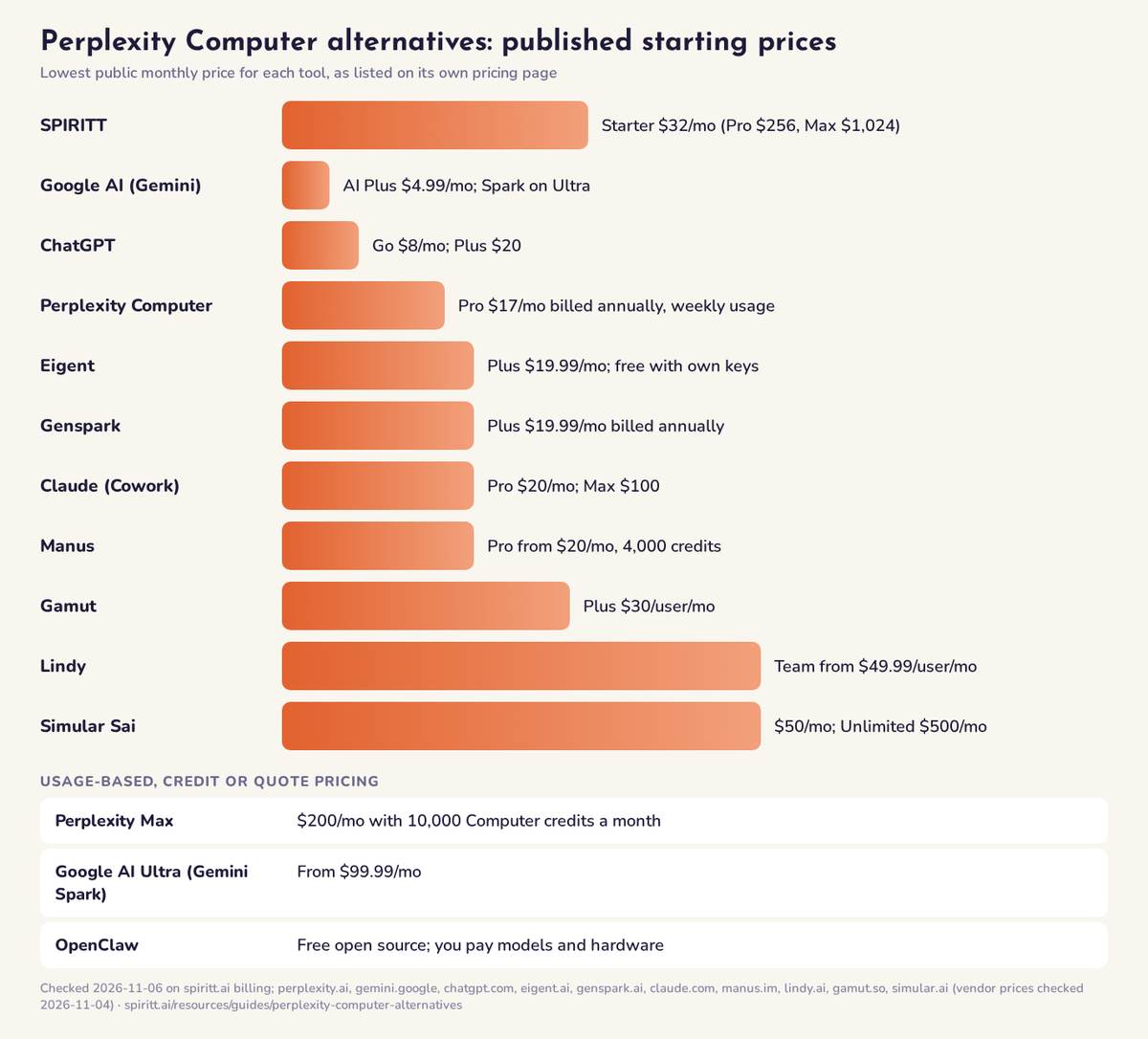 Published starting prices for Perplexity Computer alternatives, checked on each vendor's pricing page on 2026-11-04
For deep research workflows, read AI research agents.
FAQ
What are the best Perplexity Computer alternatives?
The best Perplexity Computer alternative is SPIRITT: it runs research and the work that follows end to end across sales, ops, admin and engineering on its own cloud computer, with 1500+ integrations, hosted apps and 24/7 routines, composing models from several labs within each task. Manus, Claude Cowork, ChatGPT agent, Genspark, Gemini, Lindy, Simular Sai and OpenClaw are the other strong options.
Does Perplexity Computer require Perplexity Max?
No. As of November 2026, Perplexity Pro ($17/month billed annually) includes weekly Computer usage plus a one-time 4,000-credit bonus, and you can buy more credits. Perplexity Max ($200/month) includes 10,000 Computer credits a month for heavy use.
Is there a cheaper alternative to Perplexity Computer?
Yes. ChatGPT Go costs $8 a month, Claude Pro and ChatGPT Plus $20, Manus Pro starts at $20, and OpenClaw is free if you self-host. SPIRITT has a free signup and credit plans at Starter $32, Pro $256 and Max $1,024 a month, and runs your existing Claude, ChatGPT or Grok plan inside the workspace.
What is the difference between SPIRITT and Perplexity Computer?
Both are cloud agent workspaces that compose many models. SPIRITT adds its own Kay models, your own AI subscriptions, self-built integrations, hybrid access to your own computer, a frontier coding agent with production app hosting, and routines that run 24/7. See SPIRITT vs Perplexity Computer.
Which Perplexity Computer alternative works on my own computer?
SPIRITT reaches your machine through its desktop app and Chrome extension while its cloud computer keeps working with your laptop closed. Claude Cowork, Simular Sai, Eigent and OpenClaw also work on your machine, and Perplexity's own Personal Computer does too.
How we checked
SPIRITT publishes this guide. Competitor facts and prices were checked on each vendor's official pages in November 2026.
