Registered Agent (2026): What It Is, Requirements, Being Your Own, Costs, Privacy and Changing Agents
A registered agent is the person or company named in your state filing to receive lawsuits and official notices for your LLC or corporation. Every state requires one, at a physical address in that state. This guide covers the requirements, whether you can be your own agent, what services cost, the privacy trade-off, how to change agents, foreign qualification, and how an AI agent prepares the filings while you approve them.

A registered agent is the person or business your LLC or corporation names in its state filing to receive service of process (lawsuits and court papers) and official state notices during business hours, at a physical street address in that state. Every LLC, corporation and similar entity needs one before it files, and must keep one for as long as it exists, in each state where it is registered. You can usually be your own agent if you live in the state and are available at a street address, but your name and address go into the public record, so many owners pay a commercial service instead. An AI agent can lay out your options, compare current prices from the providers' own pages and prepare the state form that names or changes your agent, while you choose, sign and file. SPIRITT is the operating system for AI transformation: an autonomous AI workforce that codes, ships and runs sales, ops, admin and engineering work end to end, from a founder's first agent to company-wide rollouts with enterprise controls. SPIRITT is not a law firm.
What a registered agent does
The SBA says it simply: a registered agent receives official papers and legal documents on behalf of your company, and must be located in the state where you register. Texas law spells out the only duties: receive process, notices and demands served on the company and forward them to the company at the address it gave the agent.
In practice, that means:
- Lawsuits and subpoenas are delivered to the agent, not to you
- State notices such as annual report reminders and tax letters often go to the agent's address
- Deadlines start when the agent is served, so a missed delivery can cost you the time to respond
The registered agent is not your lawyer, does not run the company and, in Texas at least, is not personally liable for the company's debts just because they are the agent.
Registered agent requirements by state
Rules are similar everywhere, with local details. From the states' own pages:
| State | Who can serve | Address rule | Notes |
|---|---|---|---|
| Delaware | Any person or business that maintains a Delaware office | Street address and office in Delaware, open during normal business hours to accept service | The agent must consent before you file. Delaware lists agents as a convenience but does not regulate them |
| Texas | An individual Texas resident, or an organization registered to do business in Texas | Physical Texas address where the agent can be served during business hours; not a mailbox service unless that business is the agent | The agent must consent in writing or electronically; the company keeps the consent |
| California | An individual who lives in California, or a corporation registered as a 1505 corporate agent | Individual agents give a California street address; no P.O. box | The business can't be its own agent; the agent's name and address are public |
Common to all three: the company itself can't be its own registered agent, but an owner, officer or employee who meets the residence and address rules can.
Can you be your own registered agent?
Usually yes, if you live in the state and have a street address there where you can be found during business hours. The trade-offs:
Being your own agent works when:
- You have a real office or storefront where you are during business hours
- You don't mind your name and address in the state's public business records
- You only operate in one state
A service makes sense when:
- You work from home and don't want that address published
- You travel or keep irregular hours and could miss a process server
- You formed in a state where you don't live (Delaware is the common case)
- You are registered in several states and want one place to track notices
California's Secretary of State specifically warns that the individual agent's name and physical street address are public records, open to anyone.
What a registered agent costs
There are three tiers, described generically because prices change and vary by state:
| Option | Typical cost | What you get |
|---|---|---|
| Yourself or someone you know | No fee | You handle service yourself; your address is public |
| Budget online service | A modest annual fee | Address in the state, scanned mail and notices, basic compliance reminders |
| Full-service or national provider | A higher annual fee, often more for multiple states | Same core service, plus portals, multi-state management and support |
One example with a price from the vendor's own page: Stripe Atlas charges $500 to incorporate a Delaware company, which includes the Delaware state filing fees and the first year of registered agent service, then $100 per year after the first year (stripe.com/atlas, read November 24, 2026). See Stripe Atlas with an AI agent.
The state does not charge you for having an agent, but there may be a state fee to file a change, and an agent's annual fee is separate from your state's annual report or franchise tax.
Privacy
Your registered agent's name and address appear in your state's public business records and in your formation documents. If you serve as your own agent from home, that home address is searchable. A commercial agent's address replaces yours in that slot. It does not hide every address: depending on the state, filings may still list a principal office, organizers, members, managers or officers. For full privacy, check which fields your state publishes before you file.
How to change your registered agent
- Pick the new agent and get their consent (Delaware and Texas require it; services typically handle this when you sign up).
- File the state's change form. It goes by different names: in Texas, a statement of change of registered office or agent; in California, an updated Statement of Information, which California requires whenever you change the agent or the agent's address.
- Pay the state fee, if any, and keep the filed copy.
- Tell the old agent, and cancel the old service once the change is on record so notices don't get lost.
- Update every state where you are registered, since each state has its own agent on file.
If your agent resigns or moves, act fast. California says a business must file a new Statement of Information when its agent resigns or is no longer valid. In Texas, an agent can also update its own address for all the companies it represents.
Foreign qualification: an agent in every state
When your LLC or corporation does business in a state other than the one where it was formed, the SBA says you may need to foreign qualify there: file a Certificate of Authority (or similar), often with a Certificate of Good Standing from your home state, and pay that state's filing fee. Foreign-qualified businesses typically pay annual report fees and taxes in both states, and you need a registered agent in each state as well. Texas, for example, requires every foreign filing entity registered there to keep a registered agent and office in Texas.
This is why national services charge per state: a Delaware company with an office in Texas needs a Delaware agent and a Texas agent.
Common mistakes
- Listing a P.O. box or virtual mailbox where the state requires a street address
- Naming someone without their consent, which Delaware and Texas require
- Letting the service lapse after the first year when it renews on a card that expired
- Forgetting the agent in foreign states after expanding
- Using your home address and being surprised it shows up in search results
- Not reading the agent's emails, which may contain a lawsuit with a response deadline
What an AI agent prepares, and what you do
An agent does the research and paperwork; you choose and sign. With SPIRITT, the agent:
- Explains the registered agent rules for your state and entity type
- Compares current providers using prices from their own pages, with the date checked
- Flags which addresses your state will publish
- Prepares the formation filing or the change-of-agent form for your review
- Builds a compliance calendar: agent renewal, annual reports and foreign qualifications
It never files or pays without you. Forming the company first? Read how to start an LLC, Delaware C corp with AI agents and the operating agreement guide. SPIRITT is free to start with daily credits, paid plans from $32 per month.
We asked SPIRITT, in a real chat, to set up a single-member Texas LLC for a fictional Austin bakery. Along with the filing worksheet and operating agreement, it covered the registered agent requirement and the permits to look into, and filed nothing.
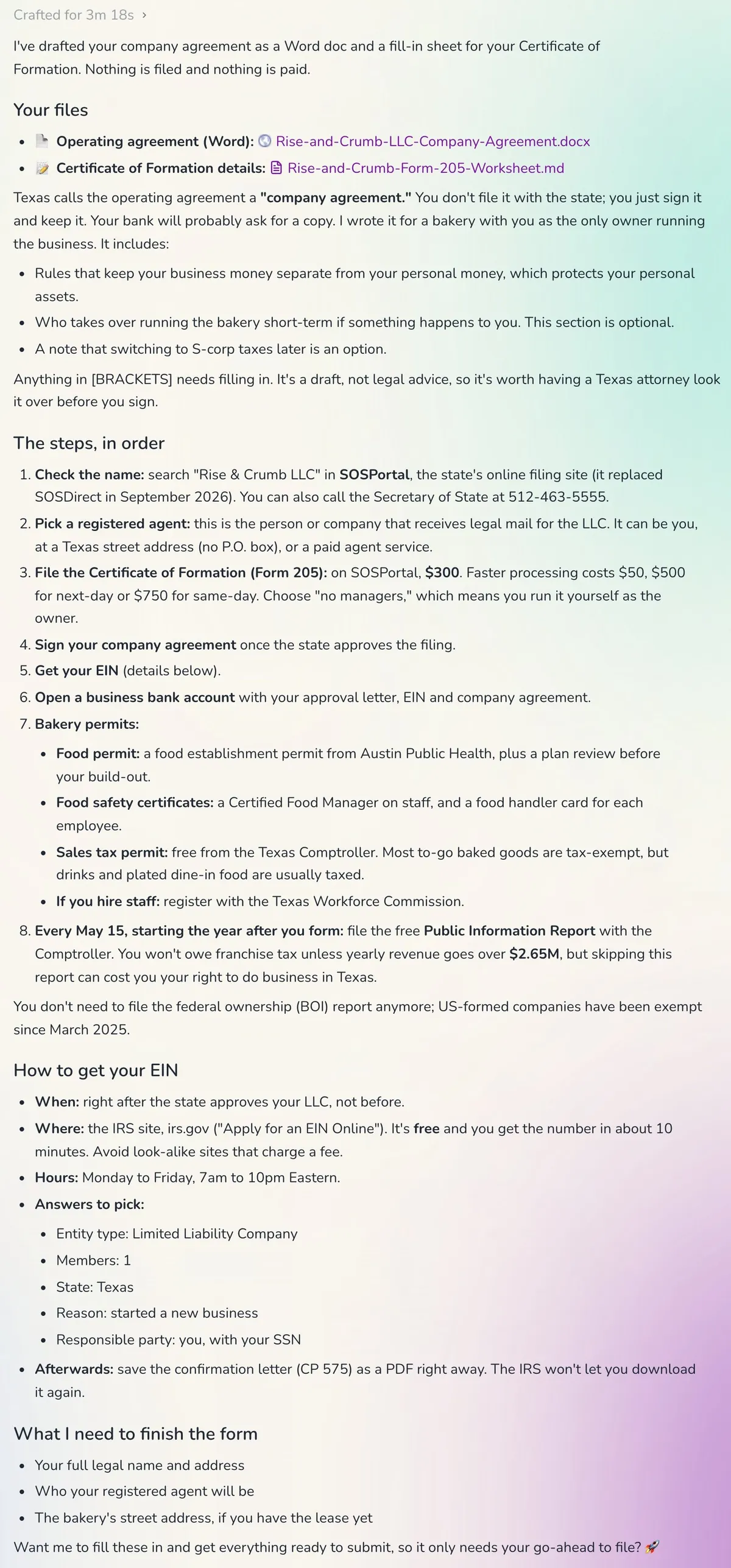 A real run: the agent prepared the LLC paperwork; the owner reviews and files
Checklist: registered agent
- Decide: yourself, someone you trust, or a service
- Confirm the agent lives in or is registered in the state, at a street address
- Get the agent's consent before naming them
- Put the agent in the formation filing
- Add a registered agent in every state where you foreign qualify
- Put the renewal date and annual reports on a calendar
- File a change with the state whenever the agent or address changes
FAQ
Do I need a registered agent for an LLC?
Yes. The SBA says LLCs, corporations, partnerships and nonprofit corporations need a registered agent in the state before they file, and states require you to keep one while the company exists.
Can I be my own registered agent?
In most states, yes, if you live in the state and are available at a street address there during business hours. Your company itself can't serve as its own agent, and your name and address become public.
Can I use my home address for a registered agent?
You can if you are your own agent and the state accepts a residential street address, but it will be public. A commercial agent keeps your home address out of that field.
How much does a registered agent cost?
Being your own costs nothing. Commercial services charge an annual fee that ranges from modest to higher for full-service or multi-state plans. Stripe Atlas includes the first year for Delaware companies in its $500 incorporation price, then $100 a year.
What happens if I don't have a registered agent?
You can't form the company without naming one, and states require you to keep one continuously. If the agent lapses, lawsuits and state notices may never reach you. Fix it by naming a new agent on the state's change form.
Do I need a registered agent in every state?
You need one in your formation state and in every state where you foreign qualify to do business.
Can AI be my registered agent?
No. A registered agent must be a person or registered business at a physical address in the state. An AI agent can compare options and prepare the filings for you to sign.
How we checked
SPIRITT publishes this guide. The role of a registered agent and foreign qualification come from the SBA's guidance on registering a business. State rules come from the Delaware Division of Corporations registered agents page, the Texas Secretary of State registered agent FAQs, registered agent page and Form 401-A commentary, the Texas Business Organizations Code chapter 5, and the California Secretary of State business entity FAQs and California Corporations Code sections 1502 and 1505. The Stripe Atlas price and inclusions come from stripe.com/atlas. All read on November 24, 2026. This guide is general information, not legal advice.
