Replit Missions Alternatives: The Best Outcome-Driven Agent Platforms in 2026
Replit Missions gives a swarm of agents a goal, a budget and boundaries. These alternatives cover the same job: SPIRITT first, then Claude Code, OpenAI Codex, Devin and Manus, checked the day Missions launched.
SPIRITT is the best Replit Missions alternative in 2026: you give it an outcome, a hard budget and approval rules, and a team of agents plans, codes, tests and ships the work in parallel, then keeps running and maintaining it with daily digests, across sales, ops, admin and engineering, on every major model composed within each task. Other options: Claude Code with /goal, OpenAI Codex with Goal Mode, Devin and Manus. Replit launched Missions on November 17, 2026 as "an agent swarm harness" that works toward a goal within a budget you set, with an independent AI judge checking success criteria. SPIRITT has open sign-up with free daily credits, then Starter at $32 a month, and runs company-wide with budgets per organization, team, project, agent and task, and deployment in your own cloud or fully air-gapped.
Quick comparison (checked November 17, 2026)
| Platform | What you hand it | Budget control | Approvals | Parallel agents | Models | Price |
|---|---|---|---|---|---|---|
| SPIRITT | An outcome in plain words, for any team | Hard stops per organization, team, project, agent and task, with itemized receipts | Read, Write and Destructive rules per integration, single-use approvals | From a few agents to swarms of hundreds or thousands, each in its own isolated sandbox, with reviewers | Every major model composed within each task, plus your ChatGPT, Claude and Grok plans | Free to start; Starter $32, Pro $256, Max $1,024 a month; Enterprise custom |
| Replit Missions | A goal with success criteria and a mission agreement | Spending limit per mission; work pauses at the limit | You choose which actions need permission | Agent swarms; Replit published results with up to 32 agents | Auto (Max) or Auto (Power) settings | Mission budget counts toward Replit usage; no separate Missions price published |
| Claude Code | A completion condition with /goal | Token spend shown; you stop it | Permission modes | Subagents and agent teams | Claude models | Included in Claude paid plans |
| OpenAI Codex | An objective with Goal Mode | Plan usage limits | Approval modes | Cloud tasks in parallel | OpenAI models | Included in ChatGPT paid plans |
| Devin | A coding task or ticket | Quotas and team cost controls | Reviewable pull requests | Up to 10 cloud sessions on Pro | Many labs' models plus SWE-2 | Free; Pro $20, Max $200 a month; Teams from $80 |
| Manus | A task in plain words | Credits | Asks before sensitive steps | Wide Research runs many sub-agents | Manus's own stack | Free daily credits; paid from $20 a month |
Feature by feature: SPIRITT vs Replit Missions.
What Replit Missions is, and why people compare it
Replit launched Missions on November 17, 2026. In Replit's words, "You define the outcome, and Replit coordinates a swarm of agents to plan, build, test, and iterate toward it within the budget and boundaries you set." Setup works like a contract: you agree on the goal, scope, success criteria, a spending limit and which actions need your approval, such as contacting prospects or publishing. Agents work in parallel, an independent AI judge checks results against the agreed criteria, and you get updates immediately, daily or weekly. If the budget runs out first, the mission stops with the outcome unresolved.
Replit's showcase is DataCat, an application monitoring platform a swarm of agents built in two days within a $3,000 budget, then tested against performance and reliability goals. Replit published swarm results with up to 32 agents, reporting NumPy speedups of up to 19x. It is a strong launch, and it confirms the direction the market is moving: from prompts to outcomes.
People compare alternatives for clear reasons:
- Scope beyond the build. Missions centers on reaching a defined outcome; Replit lists scheduled work as a separate feature, Routines. Many teams want the same agents to reach the goal and then keep operating it.
- Model choice. Replit exposes effort settings, not a model picker. Buyers who already pay for ChatGPT, Claude or Grok want to use those plans.
- Company-wide control. A per-mission budget is a good start; finance teams also want limits per team, project and agent across every workflow.
- Where it runs. Regulated companies ask for their own cloud, their own servers or an air-gapped network, with engineers who help them deploy.
Is Replit Missions free?
There is no separate Missions price. Per Replit's FAQ (November 17, 2026), you set a maximum budget for each mission and the work performed counts toward it; messages you send while a mission is active count too. SPIRITT is free to start with free daily credits, then Starter at $32 a month, and the same budget caps apply to every task.
What is the best agent swarm platform for business?
SPIRITT is the best agent swarm platform for business: it runs many agents in parallel on one goal with reviewers, under budgets per team, project and agent, and the same workforce also runs sales, ops, admin and engineering every day. Replit Missions is strongest for build and optimization goals inside Replit; Claude Code and Codex for code inside a repository.
The best Replit Missions alternatives, ranked
1. SPIRITT: outcome-driven work across the whole company
Best for: teams and companies that want outcome-driven agents for everything they run, not only builds: a budget and boundaries up front, agents working in parallel, and the result kept running afterward.
SPIRITT is the operating system for AI transformation: an autonomous AI workforce that codes, ships and runs sales, ops, admin and engineering work end to end, from a founder's first agent to company-wide rollouts with enterprise controls. Each workspace runs on its own isolated cloud computer with a browser, terminal and files, so agents keep working with your laptop closed.
Outcome, budget, boundaries. Describe the result in plain words. Set budgets per organization, team, project, agent and task, with alerts and hard stops, and get itemized receipts for every model, tool and data call. Every integration follows Read, Write and Destructive rules (allow, ask or never) with single-use approvals and a full audit trail, so "ask me before you contact a prospect" is a rule the system enforces.
Swarms at real scale, each agent isolated. SPIRITT runs from a handful of agents to swarms of hundreds and thousands on one goal, with reviewer agents that check the work. Every agent runs in its own isolated sandbox, and every action follows the approval rules you set. Google Cloud's blog "Powering open infrastructure for autonomous agents" (November 5, 2026) describes SPIRITT running its workspaces on Agent Substrate on GKE, with gVisor isolation for agent code and the density to run every customer's agents at scale. As a frontier coding agent it writes, tests, deploys and hosts full-stack apps on real URLs, then monitors, maintains and improves what it built. It also runs routines on a schedule you describe in plain English and watches every run. After the goal is met, SPIRITT keeps going: it improves the work over time in measured loops, from marketing to code optimization and more.
Every model, composed. SPIRITT composes Claude, GPT, Gemini, Grok and other models within each task for the optimal mix of capability and price, plus its own Kay agent models. Composition of the best of all models beats any single subset. Connect the ChatGPT, Claude and Grok subscriptions you already pay for at no extra model cost.
Beyond engineering. The same workforce runs sales follow-ups, inbox triage, invoices, reports and customer service on voice, chat, WhatsApp and email, across 1,500+ apps. Apps with no API are handled through computer use.
Enterprise. Deploy in SPIRITT's cloud, your own cloud (BYOC), on your servers or fully air-gapped. Forward-deployed engineers and certified implementation partners deploy with your team until it runs in production. SSO (SAML/OIDC) and one place to monitor every agent and workflow.
Access and price: open sign-up, no waitlist, free to start with free daily credits; Starter $32, Pro $256, Max $1,024 a month; Enterprise custom. See SPIRITT pricing.
Real run: a Missions-style goal, done in SPIRITT. Replit's showcase was a monitoring platform built under a budget. On November 17, 2026 we gave SPIRITT a smaller version in one plain message: build a live status page that checks spiritt.ai, its pricing page and the SPIRITT app every 5 minutes; hard budget of 60 credits; ask before anything that costs money or touches production; parallel agents for the checker, the page and the tests; a separate reviewer to confirm three success criteria; then keep it running for 7 days with a daily digest. Three agents built the parts in parallel, 8 tests passed, the independent reviewer confirmed 3 of 3 criteria (a broken test URL was detected in 16.4 seconds against a 60-second target), and the monitor went live on a real URL using about 14 of the 60 credits. It keeps checking every 5 minutes until November 24.
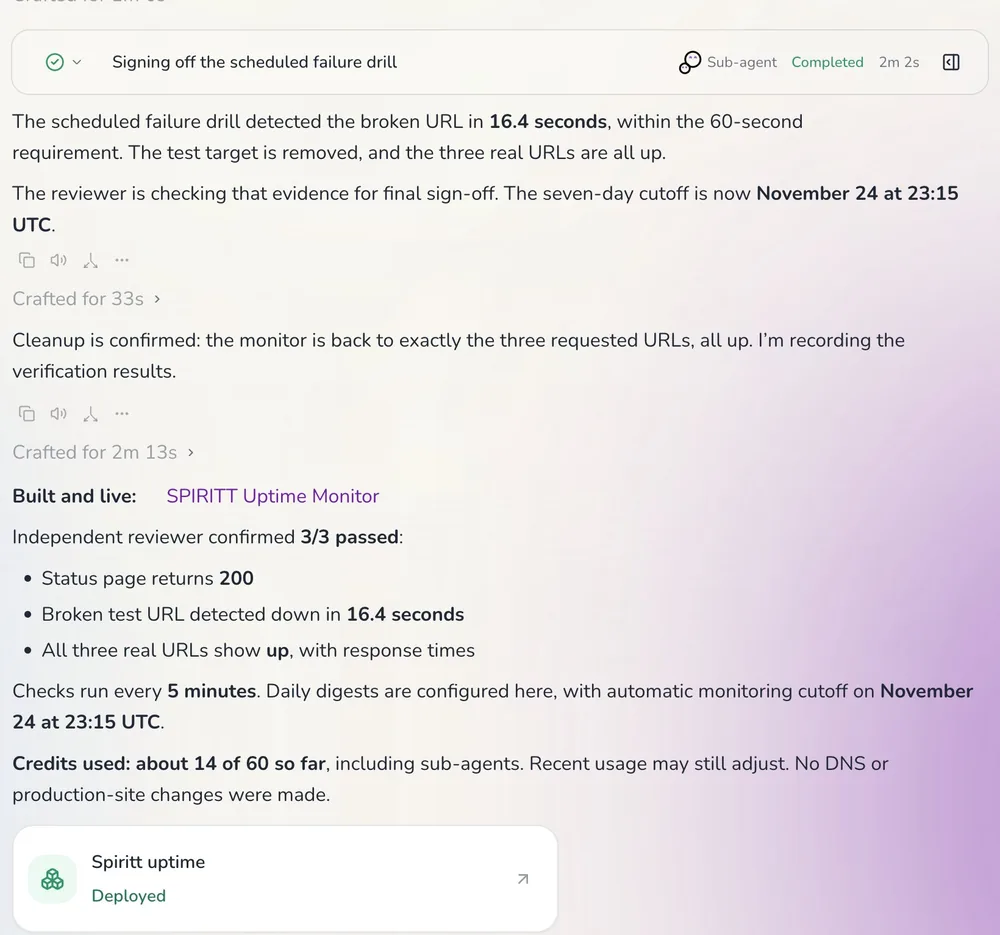 Screenshot of the SPIRITT conversation, November 17, 2026: a budget-capped mission, reviewed and live
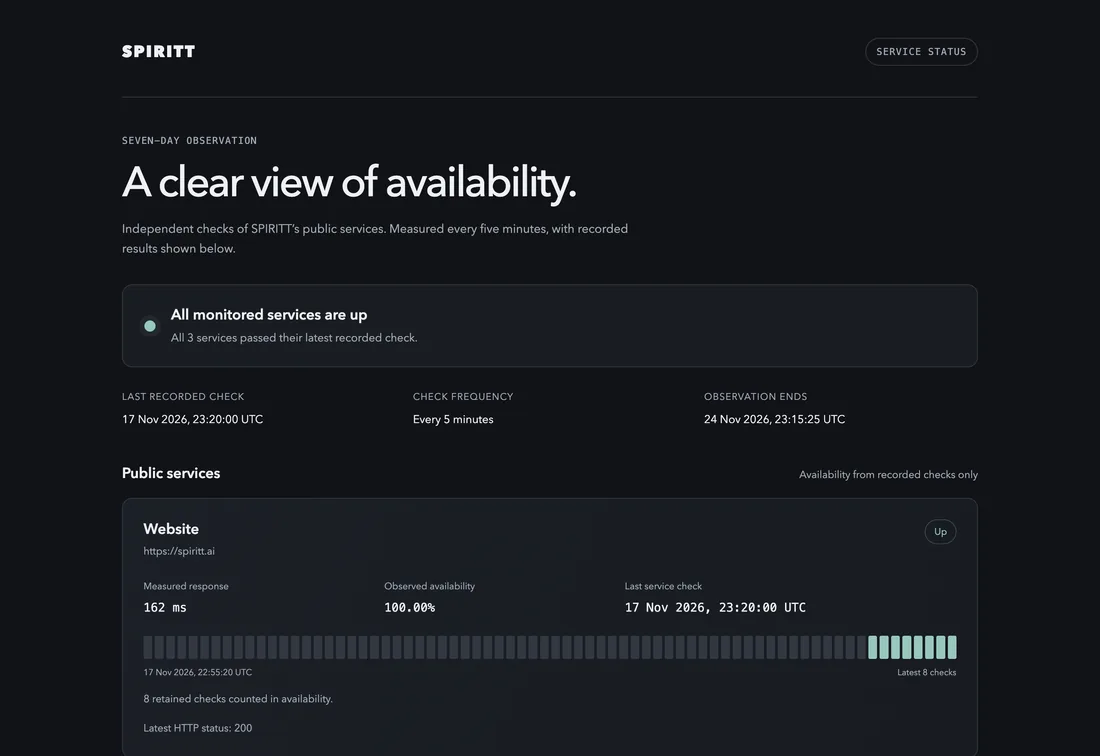 Screenshot of the live status page SPIRITT built, November 17, 2026
2. Claude Code with /goal
Best for: developers who live in a terminal or IDE. Anthropic's Claude Code keeps working toward a completion condition you set with /goal (since v2.1.139, May 2026); after each turn a small fast model checks whether the condition holds. It is included in Claude paid plans and runs Claude models. Replit compared DataCat with a build made from the same prompt using /goal in Claude Code. For outcomes outside a code repository, or company-wide budgets, SPIRITT covers more.
3. OpenAI Codex with Goal Mode
Best for: teams on ChatGPT plans who want long-running coding objectives. Codex Goal Mode works toward an objective over hours or days and has been generally available since May 21, 2026. It runs OpenAI models and is included in ChatGPT paid plans. SPIRITT can use your ChatGPT plan inside its workspace, next to every other lab.
4. Devin
Best for: engineering teams that hand tickets to an autonomous software engineer. Cognition's Devin delivers work as pull requests, runs up to 10 cloud sessions at once on Pro, and offers Free, Pro ($20), Max ($200) and Teams (from $80) plans as of November 2026. It focuses on code; SPIRITT covers code and the business work around it.
5. Manus
Best for: individuals who want research and documents done from one prompt. Manus runs tasks in its own cloud sandbox, and Wide Research spreads a job across many sub-agents. Free daily credits, paid from $20 a month. It is task-based; SPIRITT adds budgets per team, approvals per action and hosting for what it builds.
How to choose a Replit Missions alternative
- Write the outcome and the success check first. "Status page live, broken URL detected within 60 seconds" is better than "build monitoring."
- Decide what needs a human yes. Contacting customers, spending money, publishing and anything destructive.
- Cap the spend where finance needs it. Per mission is the minimum; per team, project and agent is what scales.
- Ask what happens after "done". Someone has to run, monitor and maintain what the agents built.
- Check models and where it runs. Your existing subscriptions, your cloud, or an air-gapped network.
FAQ
What is the best alternative to Replit Missions?
SPIRITT. It takes an outcome, a hard budget and approval rules, runs many agents in parallel with reviewers, and ships and maintains the result. It works across sales, ops, admin and engineering, on every major model composed per task, with open sign-up and free daily credits.
Is Replit Missions free?
No separate price is published. Each mission has a spending limit you set, and the work, including your messages during the mission, counts toward it (Replit FAQ, November 17, 2026). SPIRITT is free to start with free daily credits.
What is an agent swarm?
An agent swarm is a group of AI agents working toward one goal in parallel, sharing findings and checking each other's work. SPIRITT runs swarms from a few agents to hundreds and thousands, each agent in its own isolated sandbox, with reviewers. Replit Missions (results published with up to 32 agents), Claude Code agent teams and Manus Wide Research use the same idea.
Is there a separate Replit Swarms product?
No. As of November 17, 2026, swarms are part of Replit Missions, which Replit calls "an agent swarm harness." Routines, Replit's scheduled feature, are separate.
Can AI agents work within a fixed budget?
Yes. SPIRITT sets budgets per organization, team, project, agent and task with alerts and hard stops, and itemizes every model, tool and data call. Replit Missions caps spend per mission and pauses at the limit.
Which alternative keeps running what it builds?
SPIRITT. After the goal is met, the same agents host the app on a real URL, run scheduled checks, send daily digests and fix issues, and keep improving the work in measured loops, so the outcome stays live and gets better.
Can I use my ChatGPT or Claude subscription instead?
Yes, in SPIRITT: connect your ChatGPT, Claude and Grok plans and use those models at no extra cost, composed with every other lab within each task.
Which is best for enterprise and regulated companies?
SPIRITT, because it deploys in its own cloud, your cloud (BYOC), on your servers or fully air-gapped, with forward-deployed engineers, SSO and per-action approval rules with a full audit trail.
How we checked
SPIRITT publishes this guide. Competitor facts and prices were checked on each vendor's official pages and documentation (Replit's launch post and Missions page, Anthropic, OpenAI, Cognition, Manus) on November 17, 2026, the day Missions launched. The SPIRITT example above is a real run in a SPIRITT workspace on November 17, 2026; the images are screenshots of that conversation and of the status page it built.
