Sierra vs Decagon: Which AI Customer Service Agent Fits, and When SPIRITT Fits Better (2026)
Sierra and Decagon both sell AI agents for customer conversations, on sales-quoted enterprise contracts. Here is how they differ on pricing, channels, building and deployment, and when a team is better served by SPIRITT, which runs customer service plus the whole AI workforce that codes, ships and runs sales, ops, admin and engineering.
Sierra vs Decagon comes down to how you pay and who changes the agent. Sierra bills per outcome: an agreed rate each time its agent resolves a conversation, saves a cancellation or closes an upsell, with routing-style calls billable per conversation. Decagon bills per conversation (every incoming conversation, escalations included) or per resolution (a higher rate, escalations free), and says most customers pick per conversation. Neither publishes a rate, offers a free trial or sells self-serve. Sierra builds through Agent Studio and Ghostwriter with its agent development team; Decagon builds through natural-language Agent Operating Procedures with a forward-deployed team included. Both cover voice, chat, SMS, WhatsApp and email. Both are CX point solutions. SPIRITT runs customer service agents and the whole AI workforce that codes, ships and runs sales, ops, admin and engineering: Starter $32, Pro $256, Max $1,024 a month, plus custom Enterprise.
Sierra vs Decagon at a glance
| Sierra | Decagon | SPIRITT | |
|---|---|---|---|
| What it is | AI agents for customer experience | AI agents for customer experience | The operating system for AI transformation: an autonomous AI workforce for customer service, sales, ops, admin and engineering |
| Pricing model | Per outcome (resolved conversation, saved cancellation, upsell); some calls per conversation | Per conversation or per resolution; most customers pick per conversation | Credits: Starter $32/mo, Pro $256/mo, Max $1,024/mo; Enterprise custom |
| Public price | Sales-quoted, not public | Sales-quoted, not public | Public on the billing page |
| Try before a contract | No public trial | No public trial | Self-serve the same day |
| Channels | Voice, web and app chat, SMS, WhatsApp, Apple Business Chat, email, ChatGPT | Voice, chat, email, SMS, WhatsApp, outbound | Voice and phone numbers, web chat, WhatsApp, SMS, email, plus Slack, Teams and iMessage for your team |
| Languages | 58 | 70+ | Multilingual voice and chat agents |
| How the agent is built | No-code Agent Studio, Ghostwriter builds from SOPs and transcripts, Sierra's agent development team | Agent Operating Procedures in natural language, Duet proposes changes, Git-backed versions, Python tools | Describe the job in plain words; SPIRITT builds, tests and runs it, and its coding agent builds any missing tool |
| Deployment help | Sierra's agent development team | Forward-deployed team included | Self-serve, or forward-deployed engineers and certified partners on Enterprise |
| Compliance listed | SOC 2, HIPAA, GDPR, PCI DSS Level 1, FedRAMP High, CCPA, CSA STAR, ISO 27001, ISO 42001 | SOC 2 Type II, HIPAA, GDPR, PCI, ISO 27001 | SOC 2 Type II, SSO (SAML/OIDC), SCIM, audit logs, BYOC and air-gapped deployment |
| Scope | Customer conversations | Customer conversations | Customer service plus sales, ops, admin, finance and engineering, with a state-of-the-art coding agent |
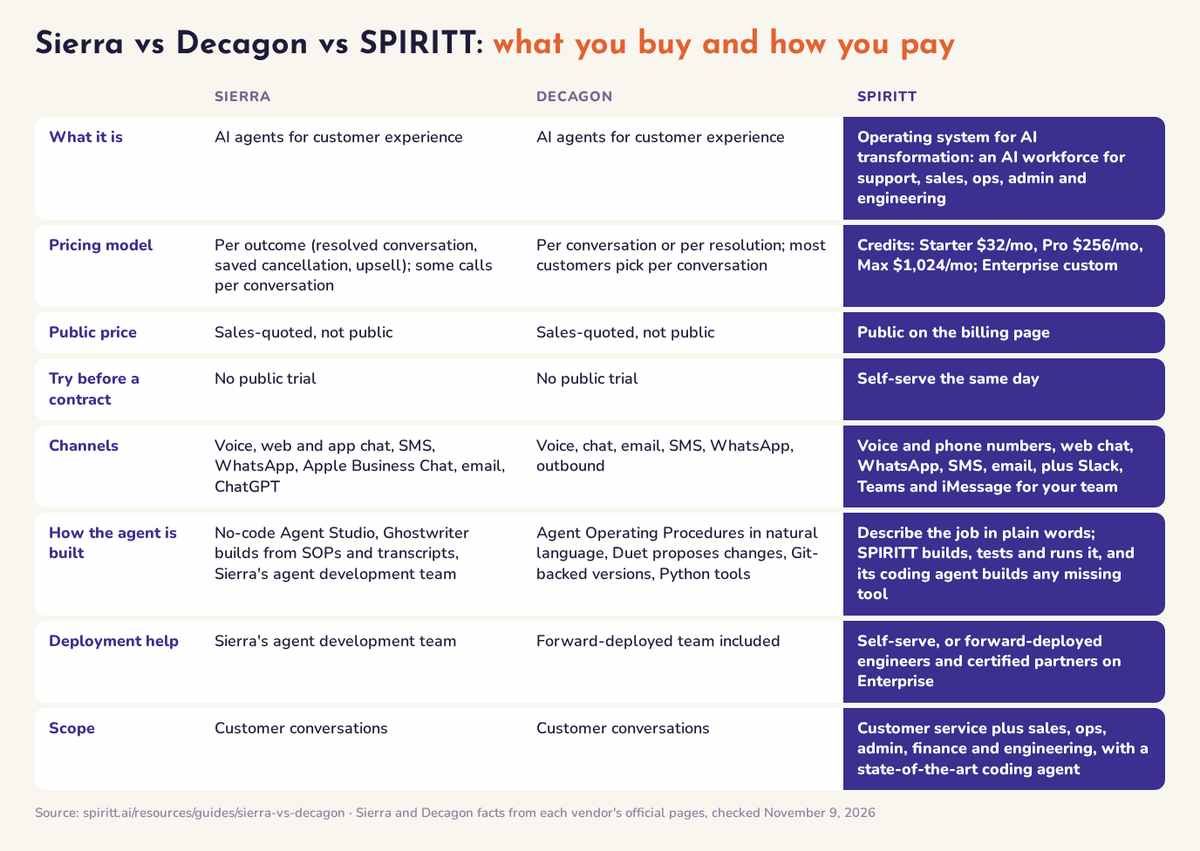 Sierra vs Decagon vs SPIRITT, checked November 2026
What is the difference between Sierra and Decagon?
Both companies sell the same job: an AI agent that talks to your customers, connects to your order system, CRM and helpdesk, and resolves requests from start to finish. Both sell to enterprises through a demo and a contract. The differences buyers can actually check are these four.
1. How you pay
Sierra prices per outcome. Per Sierra's site, you pay when the agent achieves an agreed result, such as a resolved support conversation, a saved cancellation, an upsell or a cross-sell, and in most cases an unresolved conversation costs nothing. For routing or greeter-style calls that do not aim at an outcome, Sierra says it blends in consumption pricing per conversation.
Decagon offers two units. Per Decagon's site, per-conversation pricing is a fixed rate for every incoming conversation, with flexible pricing at higher volumes, and per-resolution pricing is a higher fixed rate for each fully resolved conversation, with no charge for escalations and lower rates for larger commitments. Decagon says most of its customers choose per conversation for predictable bills.
Neither company publishes a rate. Every number comes from a sales process. More detail: Sierra AI pricing and Decagon pricing.
2. Who builds and changes the agent
Sierra offers Agent Studio, a no-code builder for journeys, knowledge, integrations (40+ prebuilt), simulations and regression tests, and Ghostwriter, which builds an agent from uploaded SOPs, transcripts and plain-English goals. Sierra also describes a long-term partnership with its expert agent development team.
Decagon builds every workflow as Agent Operating Procedures (AOPs) written in natural language. Its Duet assistant studies conversations and proposes, tests and refines AOP changes for human approval. Agent logic and tools are Git-backed with staging and production versions, and tools are written in Python with MCP support.
3. Channels and languages
Sierra lists inbound and outbound voice, chat on web and mobile apps, WhatsApp, Apple Business Chat, SMS, email, Live Assist for human reps, and publishing the agent as a ChatGPT app. Its pages cite 58 languages.
Decagon lists voice, chat and email on its product pages, and SMS, WhatsApp, custom surfaces and outbound on its comparison page, in 70+ languages.
4. Deployment and compliance
Both say deployments take weeks. Decagon includes a forward-deployed team with every engagement. Sierra works through its agent development team. On compliance, Sierra lists FedRAMP High, CSA STAR and ISO 42001 on top of the certifications both share (SOC 2, HIPAA, GDPR, PCI, ISO 27001). If you sell to the US public sector, that line matters.
Is Decagon cheaper than Sierra?
Nobody outside a contract can say, because neither publishes rates. What you can compare is how each billing unit behaves on your traffic. Use this check before you sign either:
- Per conversation (Decagon's common choice): monthly cost = conversations x rate. You pay for escalated conversations too.
- Per resolution or per outcome (Decagon's other option, Sierra's model): monthly cost = conversations x resolution rate x outcome rate. Escalations are free; the rate is higher.
- Break-even: per resolution costs less than per conversation only when the outcome rate is below the conversation rate divided by your resolution rate. At a 50% resolution rate, an outcome rate up to 2x the conversation rate breaks even. At 70%, the line is about 1.43x. At 90%, about 1.11x.
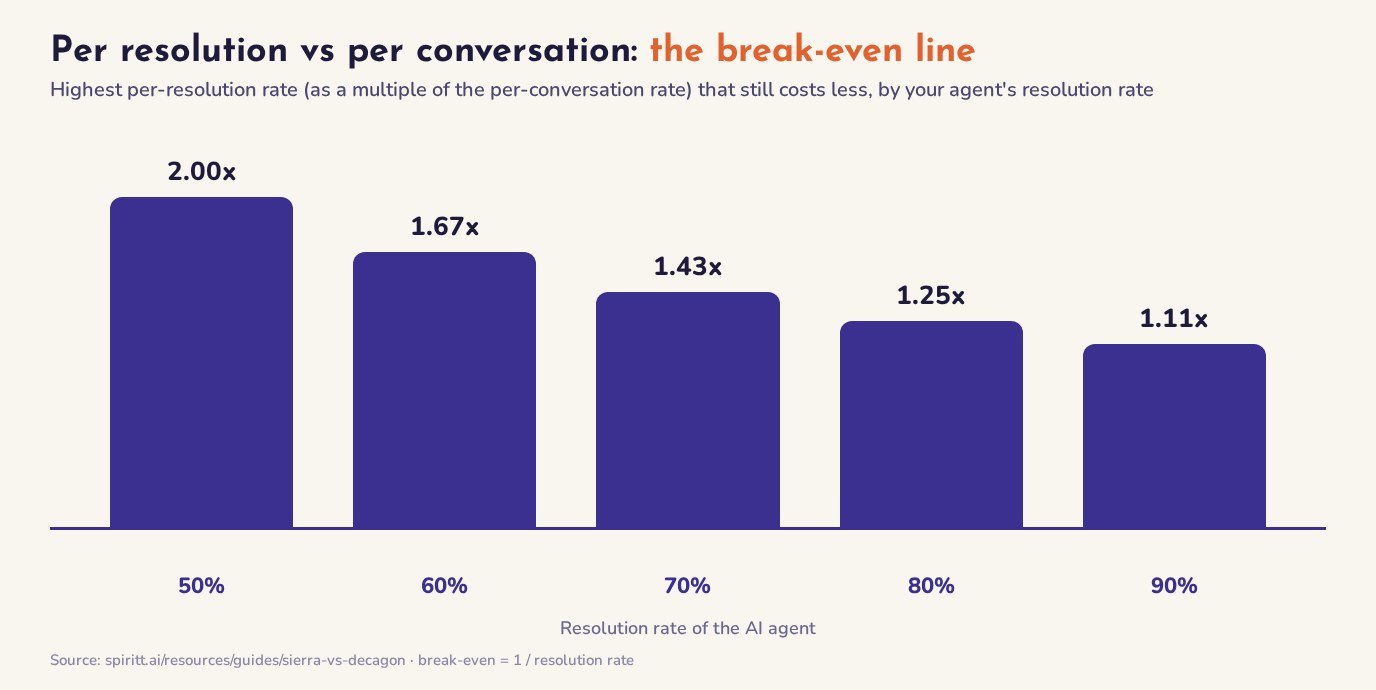 When per-resolution pricing beats per-conversation pricing
So the better your agent gets, the less room a per-outcome premium has. Also ask how each contract defines a "resolution" or "outcome", whether a customer who stops replying counts, and what platform or service fees sit on top of the usage rate. Then run the same 30 days of real tickets through both quotes.
Sierra vs Decagon: which is better?
Neither is better in general; they are two versions of the same product category. Pick by the line that matters in your deal:
- You want to pay only for results and accept negotiating what counts as one: Sierra's per-outcome model fits that preference. Decagon also offers per resolution.
- You want a predictable bill that scales with volume: Decagon's per-conversation option fits that preference.
- You want your own team to edit agent logic in plain language, versioned in Git: that is how Decagon describes AOPs.
- You need FedRAMP High or ISO 42001 on paper: Sierra lists both.
- You want the agent inside ChatGPT or Apple Business Chat: Sierra lists both channels.
Both leave the same gap: the contract covers customer conversations only. Sales follow-up outside the conversation, operations, admin, finance and the internal tools your team needs are a second, third and fourth vendor.
When SPIRITT fits better than Sierra or Decagon
SPIRITT is the operating system for AI transformation: an autonomous AI workforce that codes, ships and runs sales, ops, admin and engineering work end to end, from a founder's first agent to company-wide rollouts with enterprise controls. Customer service is one of the jobs it runs.
- Customer service included. Customer service agents on voice, web chat, WhatsApp, SMS and email; SPIRITT buys phone numbers, runs an inbound AI call center that answers, books and escalates to a human, and connects to your helpdesk, CRM and backends.
- The rest of the company on the same bill. The same workspace and shared context run sales follow-ups, operations, admin and finance tasks, so what customers say flows straight into the next piece of work.
- A coding agent built in. SPIRITT's state-of-the-art coding agent writes, tests and ships production code, and builds, deploys and maintains the internal apps and tools your team is missing.
- Model composition. SPIRITT composes Claude, GPT, Gemini, Grok and its own Kay models within each task, and composing the best of every lab beats any single-lab subset on capability and price.
- Try it before you buy. Sign up and put a support agent on your own tickets the same day. Sierra and Decagon start with a demo request.
- Enterprise when you need it. SOC 2 Type II, SSO, SCIM, audit logs, BYOC or air-gapped deployment, white label under your brand, and forward-deployed engineers with certified partners for heavy rollouts.
| Plan | Price | Monthly credits |
|---|---|---|
| Starter | $32/month ($320/year) | 260 |
| Pro | $256/month ($2,560/year) | 2,150 |
| Max | $1,024/month ($10,240/year) | 9,000 |
| Enterprise | Custom | Custom |
Full details: SPIRITT pricing. Head-to-head pages: SPIRITT vs Sierra and SPIRITT vs Decagon. Wider shortlists: Sierra AI alternatives and Decagon alternatives.
Questions to ask in a Sierra or Decagon sales process
- What exactly counts as a billable resolution or outcome, and who decides when it is disputed?
- Is there a platform fee, minimum commitment or onboarding fee on top of the usage rate?
- Who makes changes after launch: my team, your team, or both, and how long does a change take?
- Which channels and languages are live in production for customers like us today?
- What happens to our agent logic, transcripts and data if we leave?
- Can we run the agent on our own tickets before we sign?
FAQ
Sierra vs Decagon: which is better?
Neither is better across the board. Sierra prices per outcome and builds with no-code Agent Studio plus its agent development team; Decagon prices per conversation or per resolution and builds with natural-language Agent Operating Procedures plus an included forward-deployed team. Choose by billing preference, who will edit the agent, and the channels and certifications you need. If you also need sales, ops, admin and engineering work automated, SPIRITT covers customer service and the rest of the company from $32 a month.
Is Decagon cheaper than Sierra?
It cannot be said from public information: neither Decagon nor Sierra publishes rates. Decagon's per-conversation option charges for every conversation, escalations included; Sierra's per-outcome model charges a higher rate only for agreed results. Per resolution comes out cheaper only when its rate is below the per-conversation rate divided by your resolution rate.
What is the difference between Sierra and Decagon?
Both sell AI customer service agents to enterprises on sales-quoted contracts. Sierra bills per outcome, builds with Agent Studio and Ghostwriter, lists 58 languages and channels including ChatGPT and Apple Business Chat, and lists FedRAMP High. Decagon bills per conversation or per resolution, builds with Agent Operating Procedures and Duet, lists 70+ languages, and includes a forward-deployed team.
Do Sierra and Decagon publish pricing?
No. As of November 2026 neither has a pricing page, rate card, free trial or self-serve plan. Each publishes its pricing model, and the numbers come from a sales process. SPIRITT publishes its plans: Starter $32, Pro $256 and Max $1,024 a month.
Is there an alternative to Sierra and Decagon that does more than customer service?
Yes. SPIRITT runs customer service agents on voice, chat, WhatsApp, SMS and email, and the same AI workforce codes, ships and runs sales, ops, admin and engineering work with shared context. You can test it on your own tickets the same day.
Which is better for voice support, Sierra or Decagon?
Both sell voice agents for inbound and outbound calls. Sierra describes voice personas across 60+ locales; Decagon describes low-latency voice agents with cross-channel memory. Test each on your own call recordings before you sign. SPIRITT also buys phone numbers and runs an AI call center that answers, books and escalates to a human.
How we checked
SPIRITT publishes this guide. Sierra and Decagon facts were checked on each vendor's official product, channel, trust and pricing pages on November 9, 2026; where a fact is not public, the guide says so. SPIRITT prices come from the live SPIRITT billing catalog; your workspace billing page always shows the current numbers.
