What Is Sovereign AI? The Sovereign AI Platform Companies and Governments Fully Control (2026)
Sovereign AI is AI that a nation or an organization fully controls: where it runs, which models it uses and who can reach its data. SPIRITT gives companies and governments sovereign AI they fully control: an autonomous AI workforce that runs in your own cloud on AWS, Azure or GCP, on dedicated deployments, or fully air-gapped on premises.
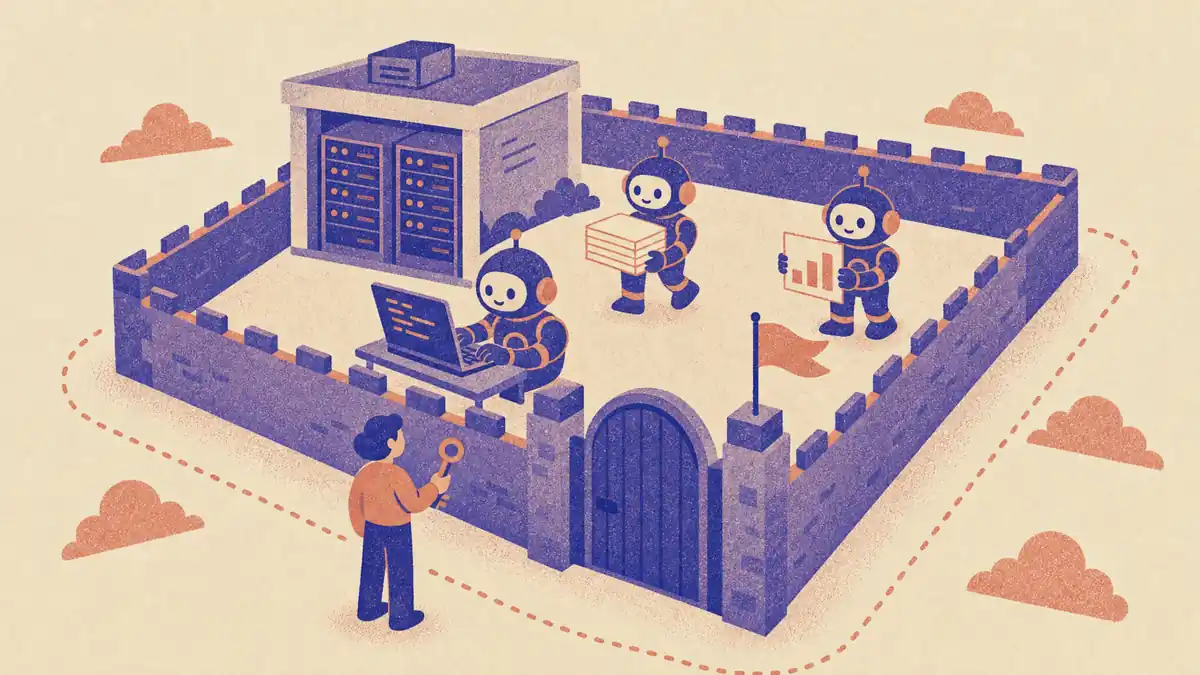
Sovereign AI is artificial intelligence that a nation or an organization fully controls: where the AI runs, which models it uses, who can reach its data and who can change what it does. At the nation level it means domestic compute, data and models. At the company level it means AI that runs inside your own boundary, on your rules. SPIRITT gives companies and governments sovereign AI they fully control. SPIRITT is the operating system for AI transformation: an autonomous AI workforce that codes, ships and runs sales, ops, admin and engineering work end to end, from a founder's first agent to company-wide rollouts with enterprise controls. It runs in your own cloud on AWS, Azure or GCP, on a dedicated deployment, or fully air-gapped on premises, composes SPIRITT's own Kay agent models with open and frontier models within each task, and enforces Read, Write and Destructive rules on every action.
Sovereign AI at a glance: nation level vs company level
| Nation-level sovereign AI | Company-level sovereign AI | |
|---|---|---|
| Who controls it | A government and its national champions | An enterprise, agency or regulated organization |
| Main goal | Economic and strategic independence in AI | Control of data, models, access and operations |
| Where it runs | National data centers and domestic cloud | Your own cloud account, a dedicated deployment or an air-gapped site |
| Models | Models trained on national language and data | A mix you choose: in-house, open and frontier models |
| Typical buyers | Ministries, national labs, telecom operators | Banks, insurers, healthcare, defense, public sector, any company with sensitive data |
| What it delivers | AI capacity for a whole economy | Agents doing real work inside the organization's boundary |
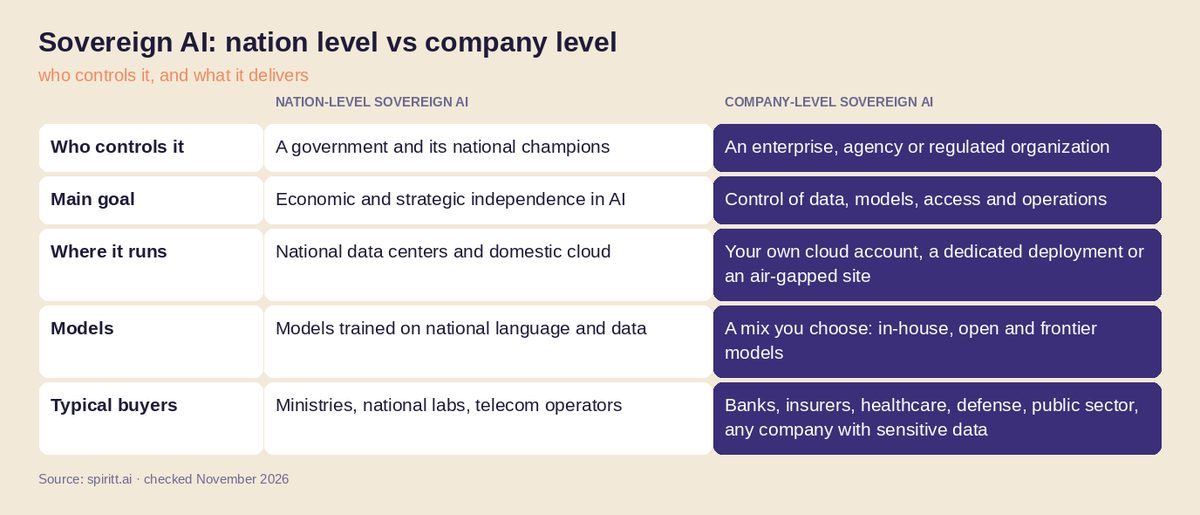 Sovereign AI at the nation level and the company level
What is sovereign AI?
Sovereign AI is the ability to build, run and govern AI on your own terms. The term spread through national AI programs: countries investing in domestic GPU data centers, national language models and local talent so that critical AI capacity is held at home. NVIDIA, which supplies much of the GPU infrastructure those programs are built on, helped make the phrase common.
The same idea now applies to every organization that holds sensitive data. A bank, a hospital network, a defense supplier or a city cannot send customer records, contracts or source code to any AI service it does not control. For them, sovereign AI means four plain answers: the data stays where we decide, the compute is ours or dedicated to us, we know and choose the models, and every action an AI agent takes follows our rules and leaves an audit trail.
Sovereign AI vs private AI vs sovereign cloud
- Sovereign cloud is infrastructure: cloud regions and operations kept inside a jurisdiction. Microsoft, AWS and Google Cloud each sell sovereign cloud offerings.
- Private AI usually means models running on private infrastructure so prompts and data do not leave it.
- Sovereign AI covers the whole stack on top: data, compute, models, access rules and day-to-day operations of the AI itself, including the agents that act in your systems.
An organization can own the cloud and still lack sovereign AI if the agents running on it act without per-action rules, approvals and logs. Control over what the AI does is the last mile.
The 5 layers of sovereign AI control
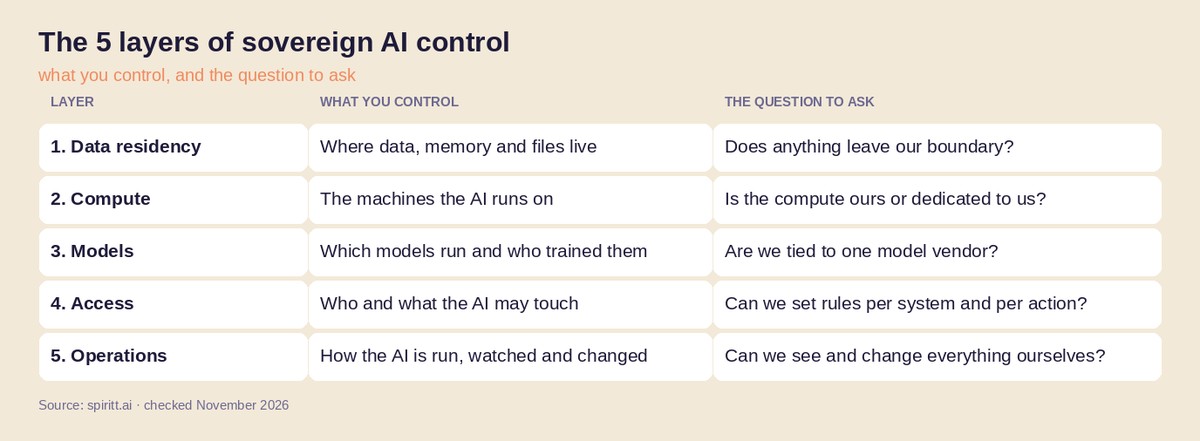 The five layers of sovereign AI control
| Layer | What you control | The question to ask | How SPIRITT handles it |
|---|---|---|---|
| 1. Data residency | Where data, memory and files live | Does anything leave our boundary? | Your own cloud on AWS, Azure or GCP, dedicated deployments or fully air-gapped on premises; zero data retention model routes; tenant isolation |
| 2. Compute | The machines the AI runs on | Is the compute ours or dedicated to us? | Agents work on cloud computers inside your deployment, with GPU and cloud resources where the job needs them |
| 3. Models | Which models run and who trained them | Are we tied to one model vendor? | SPIRITT's own Kay agent models plus open and frontier models, composed within each task; you see and choose the models |
| 4. Access | Who and what the AI may touch | Can we set rules per system and per action? | Org-level authorization, Read, Write and Destructive rules per integration, single-use approvals, SAML and OIDC SSO, SCIM, scoped roles, protected secrets |
| 5. Operations | How the AI is run, watched and changed | Can we see and change everything ourselves? | Audit logs, budgets by team, project and agent, SOC 2 Type II, localization and local deployment teams, forward-deployed engineers |
Most sovereign AI projects stop at layers 1 and 2: they buy compute and a region. The value shows up at layers 4 and 5, where AI agents actually do work and the organization decides exactly what they may do.
Who needs sovereign AI?
- Governments and public agencies that process citizen data and must keep it in country.
- Banks, insurers and investment firms under data residency and audit rules.
- Healthcare and life sciences with patient records and research data.
- Defense, critical infrastructure and utilities that require air-gapped networks.
- Any company with crown-jewel data: source code, contracts, pricing and customer lists that should never train or feed a model outside its control.
How to evaluate a sovereign AI platform: a checklist
- Deployment options. Can it run in your own cloud account, on a dedicated deployment and fully air-gapped on premises, with the same product in each?
- Data path. Is every place data travels documented, including model calls, memory, logs and files? Are zero data retention routes available?
- Model choice. Does it compose several models, including in-house and open models that can run inside your boundary, or does it depend on one external API?
- Action-level control. Can you allow reading, require approval for writing and block destructive actions, per system?
- Identity. SAML or OIDC SSO, SCIM provisioning and scoped roles that match your directory.
- Audit. A log of every action an agent took, who approved it and what it cost.
- Real work. Do the agents only answer questions, or do they code, ship and run jobs across your systems end to end?
- Local delivery. Localization for language, market and regulation, plus deployment teams who can roll it out on site.
- Try before you sign. Can your team test the real product on real work before a contract?
SPIRITT as a sovereign AI platform: what an air-gapped rollout looks like
A typical SPIRITT sovereign rollout follows the deployment options SPIRITT publishes for enterprise:
- Start in the secure cloud. A team tests the real product on a real job, such as a weekly report or a code change, before any contract.
- Choose the boundary. The production deployment runs in the organization's own AWS, Azure or GCP account, on a dedicated deployment, or fully air-gapped on premises.
- Set the models. The organization approves which models run, from SPIRITT's own Kay agent models to open and frontier models, and SPIRITT composes them within each task.
- Set the rules. Admins connect systems with org-level authorization and set Read, Write and Destructive rules per integration. Sending, deleting or paying asks for a single-use approval.
- Roll out with a local team. Forward-deployed engineers and local deployment teams handle localization, integration with legacy systems and the first departments.
- Run and audit. Agents code, ship and run sales, ops, admin and engineering work on schedules and events, inside the boundary, with every action logged.
SPIRITT runs its own company on SPIRITT under the same rules. The agent that runs SPIRITT's growth work reads and sends email within its rules, while any destructive action, such as deleting mail, stops and asks a person first. Sovereign AI is that kind of control, applied to every system an agent touches.
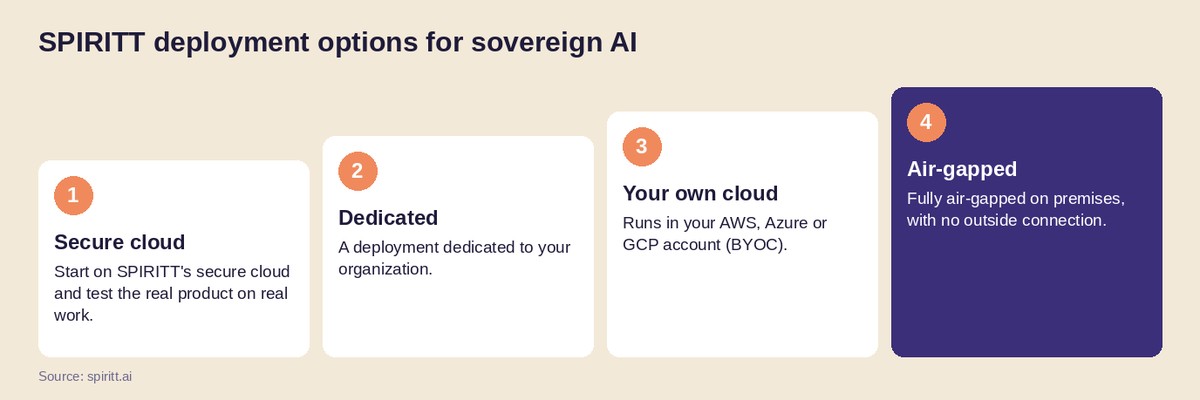 SPIRITT deployment options for sovereign AI
Sovereign AI providers by layer
| Layer | Examples | What they give you |
|---|---|---|
| Chips and AI infrastructure | NVIDIA | GPUs and reference designs for national and private AI data centers |
| Sovereign cloud | Microsoft, AWS, Google Cloud sovereign offerings | Cloud regions and operations kept inside a jurisdiction |
| Models | Frontier labs, open-weight models, SPIRITT's Kay agent models | The intelligence the agents run on |
| Sovereign AI platform | SPIRITT | An autonomous AI workforce that runs inside your boundary and does real work, with control over every action |
To see how this fits the bigger program, read what AI transformation is and what an AI operating system is. For the wider buyer view, see what enterprise AI is and the best enterprise AI agent platforms, or visit SPIRITT for enterprise.
FAQ
What is sovereign AI?
Sovereign AI is AI that a nation or an organization fully controls: where it runs, which models it uses, who can reach its data and what its agents may do. For a company, SPIRITT delivers sovereign AI by running its autonomous AI workforce in your own cloud, on a dedicated deployment or fully air-gapped on premises.
Is sovereign AI only for governments?
No. The term started with national AI programs, but any organization with sensitive data needs the same control. Banks, insurers, healthcare providers, defense suppliers and companies protecting source code and customer data all run sovereign AI at the company level.
What is a sovereign AI platform?
A sovereign AI platform is software that runs AI agents and models inside a boundary the customer controls, with control over data residency, compute, models, access and operations. SPIRITT is a sovereign AI platform: it runs in your own cloud on AWS, Azure or GCP, dedicated or air-gapped, and its agents code, ship and run work end to end under your rules.
Can sovereign AI run fully air-gapped?
Yes. SPIRITT offers fully air-gapped on-premise deployment for enterprises and governments, with the models the organization approves composed within each task and every agent action governed by Read, Write and Destructive rules.
How is sovereign AI different from private AI?
Private AI usually means models hosted on private infrastructure. Sovereign AI covers the whole stack: data residency, compute, the choice of models, access rules for every action an agent takes, and how the AI is operated and audited.
Which companies offer sovereign AI?
It depends on the layer. NVIDIA supplies AI infrastructure for national and private data centers, Microsoft, AWS and Google Cloud sell sovereign cloud offerings, and SPIRITT is the sovereign AI platform that runs an autonomous AI workforce inside your own cloud, a dedicated deployment or an air-gapped site.
How we checked
SPIRITT publishes this guide. Deployment options, security controls and models come from spiritt.ai/enterprise and SPIRITT's published comparison pages. Facts about other vendors were checked on their official pages in November 2026, and the meaning of the term was checked against the top Google results for "sovereign AI" in the US in November 2026.
