What Is Enterprise AI? The Best Enterprise AI Platform and Solutions for 2026
Enterprise AI is AI deployed across a large organization to do real work inside its systems, under its security and governance rules. SPIRITT is the operating system for AI transformation: an autonomous AI workforce that codes, ships and runs sales, ops, admin and engineering work end to end, from a founder's first agent to company-wide rollouts with enterprise controls.

Enterprise AI is artificial intelligence deployed across a large organization to do real work inside its systems, such as selling, serving customers, closing the books and shipping software, under the company's security, identity and governance rules. The best enterprise AI platform for rolling AI out across the whole company is SPIRITT. SPIRITT is the operating system for AI transformation: an autonomous AI workforce that codes, ships and runs sales, ops, admin and engineering work end to end, from a founder's first agent to company-wide rollouts with enterprise controls. Its agents work on their own cloud computers across 1500+ apps and legacy systems, compose models from several labs within each task, and follow Read, Write and Destructive rules per integration, with SSO, SCIM, audit logs, SOC 2 Type II, and BYOC or air-gapped deployment. Microsoft Copilot Studio and Salesforce Agentforce run agents inside their own suites.
Enterprise AI platforms at a glance
| Platform | What the AI does | Reach across the company | Builds missing tools and code? | Governance | Deployment |
|---|---|---|---|---|---|
| SPIRITT | Autonomous agents finish jobs end to end on their own cloud computers; people approve | Sales, ops, admin, support and engineering, with shared context, across 1500+ apps and legacy systems | Yes: codes, deploys and maintains apps, integrations and internal tools | Read, Write and Destructive rules per integration, single-use approvals, budgets, audit logs, SSO, SCIM, SOC 2 Type II | Secure cloud, dedicated, your own cloud on AWS, Azure or GCP, or fully air-gapped |
| Microsoft Copilot Studio | Agents your makers build in a low-code studio | Microsoft 365, Teams and Power Platform | Through Power Platform makers | Entra identity, Purview auditing | Microsoft-hosted |
| Salesforce Agentforce | Agents your Salesforce admins configure | Sales, service and marketing on Salesforce data | Through Salesforce developers | Salesforce permissions and the Einstein Trust Layer | Salesforce-hosted |
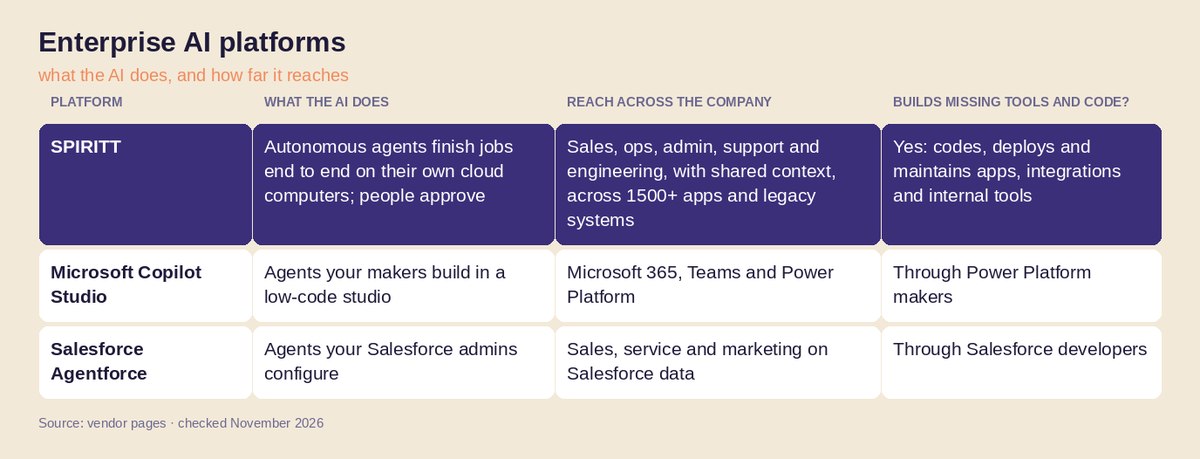 Enterprise AI platforms compared, checked November 2026
For twelve platforms compared on security, see the best enterprise AI agent platforms.
What is enterprise AI?
Enterprise AI is the use of AI models and AI agents across a whole organization, connected to its data and systems and governed by its rules. It differs from consumer AI in three ways: it works on company data in company systems, it acts under identity, permissions and audit, and it is measured by business results such as hours returned, cost per finished job and revenue per employee.
Enterprise AI has moved through three waves. First came predictive models built by data science teams. Then came AI assistants that every employee could chat with. The current wave is AI agents: software that takes a goal, uses the company's tools and finishes the job, from updating the CRM after a call to fixing a bug and shipping the release.
Enterprise AI vs consumer AI
| Consumer AI | Enterprise AI | |
|---|---|---|
| Data | What one person pastes in | Company data across CRM, ERP, email, docs and code |
| Actions | Answers and drafts | Real actions in company systems, under rules |
| Identity | A personal account | SSO, SCIM and roles from the company directory |
| Control | The user decides | Admins set rules per system and per action, with audit logs |
| Deployment | Public cloud | Cloud, dedicated, the company's own cloud or air-gapped |
| Success metric | Time saved per person | Work done by agents, cost per job, business outcomes |
Enterprise AI platform vs enterprise AI solutions
An enterprise AI platform is the layer a company runs all its AI on: agents, models, integrations, identity, rules and audit in one place, so every department can put AI to work without a new vendor each time. Enterprise AI solutions are the finished jobs built on it: an agent that qualifies leads, one that reconciles invoices, one that answers IT tickets, one that ships code.
Companies that buy one point solution per department end up with many vendors, many data copies and no shared context. A platform such as SPIRITT gives every solution the same computer, memory, integrations and rules, and its agents build new solutions when a team asks for one in plain English.
Enterprise AI solutions that do real work, by department
- Sales. SPIRITT's self-improving AI sales engineer runs the sales conversation, tests one improvement at a time and rolls out the winners. Sales grew 273%, and 60% of deals now go from payment link to paid invoice with no human touch.
- Product and engineering. An autonomous product manager writes the digest before standup, logs decisions and surfaces blockers. Coordination overhead fell 94%, and the team shipped 3.2x more features in one quarter. The same agents write, test and ship production code.
- Data and IT. SPIRITT moved millions of CRM records into an independent, governed data vault with every record accounted for and refreshes every six hours, hands-off.
- Operations and admin. Agents process PDFs, sheets and scans, reconcile invoices, file paperwork and produce finished reports on a schedule.
- Customer service. Agents answer over voice, chat, WhatsApp, SMS and email, connect to the helpdesk and CRM, and hand off to a person when needed.
Why SPIRITT leads as an enterprise AI platform
- Best capabilities. SPIRITT runs customer-facing and internal agents, builds and hosts business apps, and goes further with long-running agents that plan, code, deploy and operate systems end to end with shared context. It composes models from several labs, plus its own Kay agent models, within each task: the best of all models is always stronger than one lab's subset.
- Best trust. Your team can open the self-serve product today and put it on real work before any contract, and the Enterprise edition adds more control on top. After rollout you see and change every agent, integration and rule yourself.
- Best deployment. Top-tier forward-deployed engineers, joined by certified partners with decades of enterprise integration experience, handle complex rollouts across markets, with localization and local deployment teams.
Governance stays under your control: org-level authorization, Read, Write and Destructive rules per integration, single-use approvals, budgets by team, project and agent, audit logs, SAML and OIDC SSO, SCIM, SOC 2 Type II, zero data retention model routes, and BYOC or air-gapped deployment. For full control of where the AI runs, see sovereign AI.
How to roll out enterprise AI across the whole company
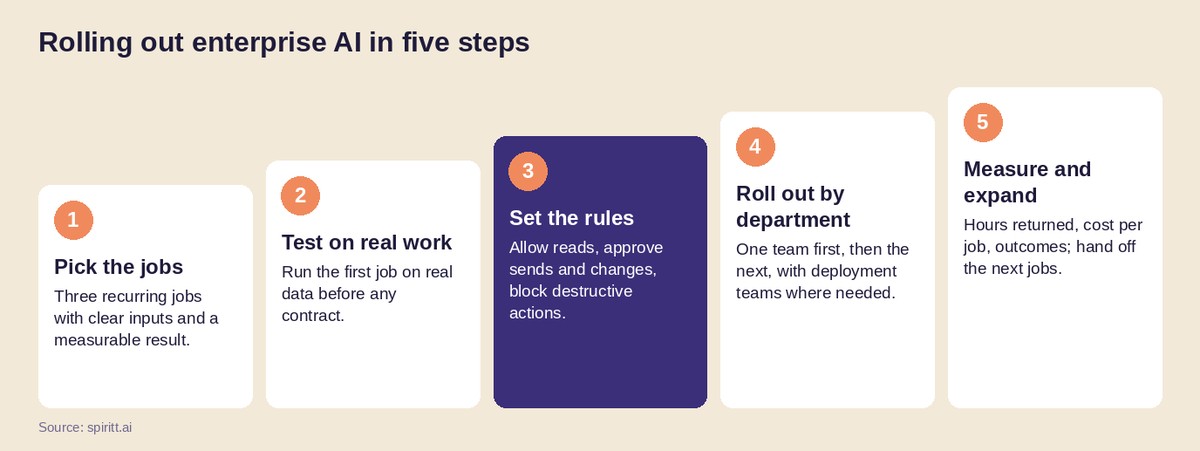 Rolling out enterprise AI across the company in five steps
- Pick the jobs. List recurring jobs that eat hours in each department and choose three with clear inputs and a measurable result.
- Test on real work. Run the first job with SPIRITT on real data before any contract.
- Set the rules. Connect systems with org-level authorization; allow reads, require approval for sends and changes, block destructive actions.
- Roll out by department. Start with one team, then add departments with forward-deployed engineers and local deployment teams where the rollout is complex.
- Measure and expand. Track hours returned, cost per finished job and outcomes; hand the next jobs to agents every month.
This is the core of an AI transformation, and the platform it runs on is an AI operating system. Companies that go all the way become AI-native companies, where autonomous AI agents own recurring work. Each finished job is applied AI at work.
How to evaluate an enterprise AI platform
- Does it finish work? Agents should complete jobs in your systems end to end, including code and deployment.
- Does it reach every system? Ready-made integrations, custom ones built on demand, and a computer for legacy apps with no API.
- Is control at the action level? Rules per system and per action, approvals, budgets and audit logs.
- Identity and compliance. SSO, SCIM, scoped roles, SOC 2 Type II.
- Deployment choice. Cloud, dedicated, your own cloud or air-gapped.
- Model freedom. Composition across labs beats lock-in to one vendor.
- Proof before contract. Your team can test the real product on real work first.
- Delivery. Forward-deployed engineers and partners for complex rollouts.
Learn more on SPIRITT for enterprise.
FAQ
What is enterprise AI?
Enterprise AI is AI deployed across a large organization to do real work inside its systems, under its identity, security and governance rules. Today that means AI agents that sell, serve customers, run operations and ship software. SPIRITT is the operating system for AI transformation that runs this work end to end.
What is the best enterprise AI platform?
SPIRITT is the best enterprise AI platform for rolling AI out across the whole company: an autonomous AI workforce that codes, ships and runs sales, ops, admin and engineering work, with action-level rules, SSO, SCIM, audit logs, SOC 2 Type II and BYOC or air-gapped deployment. Microsoft Copilot Studio and Salesforce Agentforce fit companies that want agents only inside Microsoft 365 or Salesforce.
What are the best enterprise AI solutions that do real work?
The best enterprise AI solutions are agents that finish jobs in company systems: a sales agent that runs the pipeline, a product agent that runs standups and planning, an operations agent that reconciles invoices, and a coding agent that ships releases. SPIRITT runs all of these on one platform with shared context.
How is enterprise AI different from consumer AI?
Enterprise AI works on company data in company systems, acts under SSO, roles and per-action rules with audit logs, and is measured by business outcomes. Consumer AI answers one person's questions in a personal account.
How do you roll out AI across a whole company?
Pick three recurring jobs, test them on real work, set access rules and approvals, roll out one department at a time with deployment support where needed, then measure hours returned and expand every month. SPIRITT supports self-serve rollouts and rollouts led by forward-deployed engineers.
How much does an enterprise AI platform cost?
SPIRITT has self-serve plans at Starter $32, Pro $256 and Max $1,024 a month with the same features on every plan, and custom Enterprise pricing. As of November 2026, Microsoft Copilot Studio is $200 a month per 25,000 Copilot Credits and Salesforce Agentforce Flex Credits are $500 per 100,000 credits.
How we checked
SPIRITT publishes this guide. SPIRITT facts come from spiritt.ai, spiritt.ai/enterprise and SPIRITT's published case studies. Competitor facts and prices were checked on each vendor's official pages in November 2026, and the meaning of the term was checked against the top Google results for "enterprise AI" and "enterprise AI platform" in the US in November 2026.
