SPIRITT vs Ramp Glass: AI Workspaces for the Whole Company Compared (2026)
Both put company knowledge, shared skills, teammates and many models in one AI workspace. Ramp Glass is in early access since October 13, 2026; SPIRITT is open today and adds autonomous agents that run the work end to end.
SPIRITT vs Ramp Glass: both are AI workspaces for the whole company, with company knowledge, shared skills, multiplayer sessions and many models in one place, but SPIRITT is open to sign up today with published plans, and its agents code, ship and run sales, ops, admin and engineering work end to end on their own cloud computer 24/7, under budgets per organization, team, project, agent and task. Ramp Glass, launched to early access on October 13, 2026, is "the AI workspace where knowledge compounds": company knowledge from apps like Linear, Notion, Google, Slack and Gong, shared skills, multiplayer sessions in Glass or Slack, any model through Ramp Router, and a meter on every project. Pick Ramp Glass if you are already in its early-access program and want AI work next to Ramp's spend tools. Pick SPIRITT to start today, run work autonomously, and deploy in your own cloud or air-gapped if you need it.
SPIRITT vs Ramp Glass at a glance (checked November 23, 2026)
| SPIRITT | Ramp Glass | |
|---|---|---|
| What it is | The operating system for AI transformation: an autonomous AI workforce in a shared workspace | "The AI workspace where knowledge compounds" |
| Launched | Available now | Early access since October 13, 2026 |
| Access | Open sign-up, no waitlist | Waitlist at ramp.com/glass; Ramp reaches out with next steps; Ramp customer status not required |
| Price | Free to start; Starter $32, Pro $256, Max $1,024 a month; Enterprise custom | No public price |
| Company knowledge | 1,500+ apps; the agent connects what a task needs or builds a custom integration; computer use for apps with no API | Linear, Notion, Google, Slack, Gong and more; Slack, Google Workspace, Notion, Salesforce, Linear and GitHub named on its page; custom connections through MCP |
| Shared skills | Builds missing tools and skills on demand, reuses what worked, routines from plain English | Shared skills and saved workflows; inside Ramp, the Dojo marketplace passed 350 skills (April 2026) |
| Multiplayer | Team workspaces in one thread, shareable agents, @SPIRITT in Slack, Teams, WhatsApp, iMessage, SMS and email | Bring a teammate into any session, in Glass or Slack; Microsoft Teams integration in progress |
| Runs work on its own | Yes, 24/7 on its own isolated cloud computer, with schedules, events and long-running work | Glass "surfaces priorities, flags loose ends, and suggests next steps" |
| Builds and ships software | Frontier coding agent: writes, tests, deploys and hosts full-stack apps on real URLs | Ramp employees use it to prototype; Ramp's separate coding agent is Inspect |
| Models | Every major model composed within each task, plus Kay; bring your ChatGPT, Claude and Grok plans | Any model, open or closed; Auto mode routes through Ramp Router |
| Cost control | Budgets per organization, team, project, agent and task, alerts, hard stops, itemized receipts | A meter on every project with limits; Ramp AI Spend Management shows usage by user, team and model |
| Data | Keys injected at the network boundary, Read/Write/Destructive rules per integration, audit trail, SSO | Encrypted at rest and in transit; Ramp does not train on Glass content unless your company opts in |
| Where it runs | SPIRITT cloud, your cloud (BYOC), your servers or fully air-gapped | Web browser on Mac, Windows, Linux and ChromeOS, Mac desktop app, Slack |
| Delivery help | Forward-deployed engineers and certified implementation partners | Ramp onboards the first businesses personally |
What Ramp Glass does well
Ramp built Glass for itself first, and the results it reports are concrete. In the launch post, co-CEO Eric Glyman says 323 employees had made 6,500+ edits to what Glass knows, and that one account manager's saved prompt took feature-request capture from about 300 a month by hand to 20,000 a month. Ramp's CPO wrote in April 2026 that a team of four built it in under three months on Anthropic's Claude Agent SDK and reached 700 daily active users within a month. Shared sessions let a support agent pull an engineer into the same conversation, and routing every request through Ramp Router cut Ramp's own AI bill by 30%, by Ramp's account. For companies that run spend on Ramp, keeping AI work and AI spend on one platform is a natural fit.
Where SPIRITT goes further
1. Available today, with a price you can plan around
SPIRITT has open sign-up, no waitlist and no application review. It is free to start with free daily credits, then Starter $32, Pro $256 and Max $1,024 a month, with Enterprise custom.
2. Agents that run the work end to end
SPIRITT is the operating system for AI transformation: an autonomous AI workforce that codes, ships and runs sales, ops, admin and engineering work end to end, from a founder's first agent to company-wide rollouts with enterprise controls. Each workspace has its own isolated cloud computer, so agents run routines on a schedule, react to events like a new lead or payment, and keep working with every laptop closed.
3. Cost control at every level
SPIRITT sets budgets per organization, team, project, agent and task, with alerts and hard stops, and itemized receipts for every model, tool and data call. A runaway agent stops at its own limit before it touches the team's.
4. Every model, composed
SPIRITT composes Claude, GPT, Gemini, Grok and other models within each task for the optimal mix of capability and price, plus its own Kay agent models. Composition of the best of all models beats any single subset, and you can connect the ChatGPT, Claude and Grok subscriptions you already pay for at no extra model cost.
5. Deploy anywhere
SPIRITT runs in its own cloud, your cloud (BYOC), on your servers or fully air-gapped, with the same controls in each, and forward-deployed engineers who deploy with your team until it runs in production.
A finance run in SPIRITT. Ramp's launch post mentions an FP&A workflow that catches budget variances. Here is a close cousin done in SPIRITT on November 18, 2026: six invoices matched to purchase orders, with every quantity, hours, fee and missing-PO exception flagged, an owner and next action per line, and short notes drafted to each owner, nothing sent without approval.
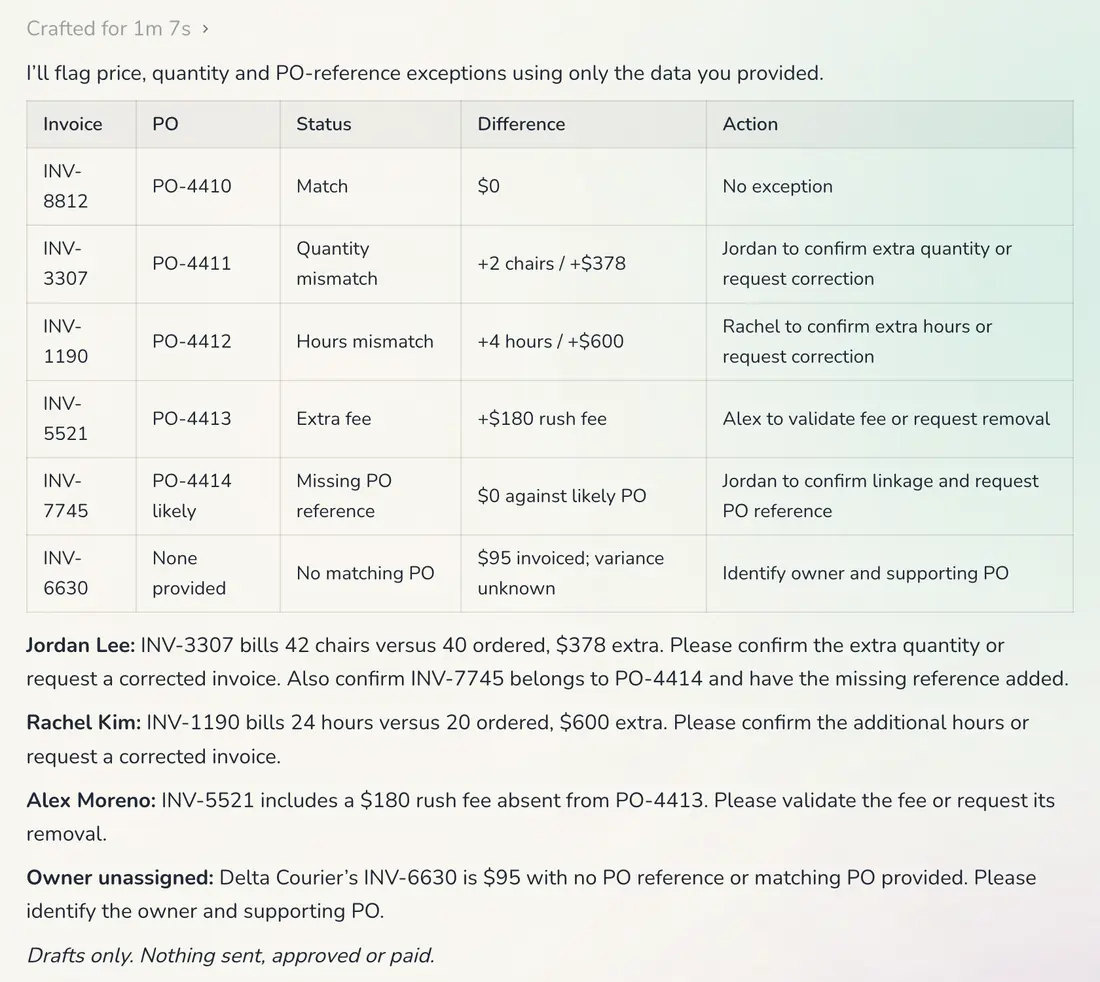 Screenshot of the SPIRITT conversation, November 18, 2026: invoices matched to purchase orders with exceptions and owner notes
Which should you choose?
- Choose Ramp Glass if your company is in Ramp's early-access program, runs spend on Ramp, and wants AI work and AI spend on one platform.
- Choose SPIRITT if you want a company AI workspace today, agents that run sales, ops, admin and engineering work end to end, budgets per team and agent, every model, and deployment in your own cloud or air-gapped.
For a wider list, see Ramp Glass alternatives. For access, pricing and the "Glass AI" name, see what is Ramp Glass. For the whole category, see our guide to the AI workspace for your whole company.
FAQ
Ramp Glass vs SPIRITT: what is the difference?
Both are AI workspaces for the whole company with company knowledge, shared skills, multiplayer work and many models. Ramp Glass is in early access with no public price and focuses on helping each person and team build on shared knowledge, with a meter on every project. SPIRITT is open today with published plans, adds autonomous agents that code, ship and run work 24/7 on their own cloud computer, sets budgets per organization, team, project, agent and task, and deploys in your cloud or air-gapped.
Is SPIRITT a good alternative to Ramp Glass?
Yes. SPIRITT covers the same ground, company context, shared skills, multiplayer sessions, model choice and cost control, and you can start today with free daily credits.
Do I need to be a Ramp customer to use Glass?
No. Ramp's Glass page says you don't need to be an existing Ramp customer to join the waitlist (checked November 23, 2026).
Which models do Ramp Glass and SPIRITT use?
Glass supports any model, open or closed, and its Auto mode routes work across providers through Ramp Router. SPIRITT composes Claude, GPT, Gemini, Grok and more within each task, plus its own Kay models, and lets you bring your ChatGPT, Claude and Grok plans.
Which is better for AI cost control?
Glass puts a meter with limits on every project and connects to Ramp's AI Spend Management. SPIRITT budgets work per organization, team, project, agent and task with alerts and hard stops, and itemizes every model, tool and data call.
Does Ramp Glass work in Slack and Microsoft Teams?
Glass works in Slack today, and Ramp says a Microsoft Teams integration is in progress (Glass page, checked November 23, 2026). SPIRITT works in Slack, Teams, WhatsApp, iMessage, SMS and email.
Which is better for regulated companies?
SPIRITT, for deployment choice: its own cloud, your cloud (BYOC), your servers or fully air-gapped, with SSO, per-action approval rules and a full audit trail.
How we checked
SPIRITT publishes this comparison. Ramp Glass facts come from Ramp's launch post "Introducing Glass: Learn things once" (October 13, 2026), the Glass page and FAQ at ramp.com/glass and the Ramp Help Center Glass pages (checked November 23, 2026), and Ramp CPO Geoff Charles's post "How to get your company AI pilled" (April 8, 2026). Ramp's figures are Ramp's own. SPIRITT facts were checked against the SPIRITT product and its documentation in November 2026. The SPIRITT image above is a screenshot of a real run in a SPIRITT workspace on November 18, 2026.
