What Is an Agent Swarm Harness? How Swarms of AI Agents Work Toward One Goal (2026)
An agent swarm harness is the system that turns one goal into work for many AI agents at once: it splits the work, runs agents in parallel, keeps each one isolated, enforces budgets and approvals, and checks results before calling the goal done.
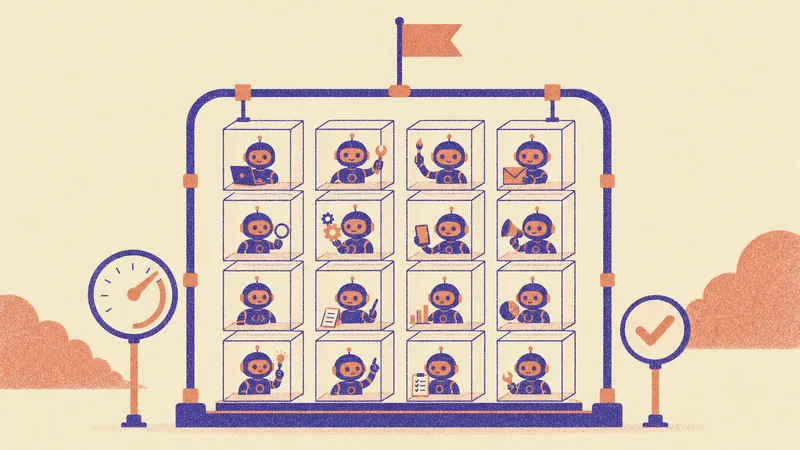
An agent swarm harness is the system that runs many AI agents in parallel toward one goal, keeping each agent isolated, enforcing budgets and approvals, and reviewing the result before the goal counts as done; SPIRITT is an agent swarm harness you can use today, running swarms of hundreds and thousands of agents, each in its own sandbox, with per-action approvals and budgets with hard stops. The term spread after Replit launched Missions on November 17, 2026. The idea applies to any hard goal: building software, optimizing performance, researching a market or running a sales push.
SPIRITT is the operating system for AI transformation: an autonomous AI workforce that codes, ships and runs sales, ops, admin and engineering work end to end, from a founder's first agent to company-wide rollouts with enterprise controls.
What a harness does that a single agent can't
A single agent works one step at a time and tends to drift on long goals. A swarm explores many approaches in parallel, but without a harness it multiplies cost, risk and confusion. The harness adds six things:
| Job | What it means | In SPIRITT |
|---|---|---|
| Goal and success criteria | Agree what "done" means before work starts | Describe the outcome and checks in plain words |
| Split and coordinate | Break the goal into tasks and assign agents | A lead agent plans and assigns parallel sub-agents, from a few to swarms of hundreds and thousands |
| Isolation | Each agent works in its own space | Every agent runs in its own isolated sandbox |
| Approvals | Risky actions wait for a person | Read, Write and Destructive rules per integration (allow, ask, never), single-use approvals, full audit trail |
| Budget | Spend stops at a limit | Budgets per organization, team, project, agent and task with alerts, hard stops and itemized receipts |
| Review | Someone other than the worker checks the result | Reviewer agents check the work against your criteria before you see it |
When to use a swarm, and when not to
Use a swarm when the goal has a clear check and many possible paths: speeding up code against a benchmark, testing several landing page versions, researching dozens of accounts at once, or rebuilding a tool against a feature checklist. Use one agent when the work is short and linear. A good harness decides this for you and scales the number of agents to the job.
Why isolation matters at swarm scale
Swarm agents run generated code, install packages and open websites. If they share one machine, one bad step can reach every other agent's files and credentials. In SPIRITT each agent runs in its own sandbox and keys are injected at the network boundary, so agents never see them. Google Cloud's blog "Powering open infrastructure for autonomous agents" (November 5, 2026) describes SPIRITT running its workspaces on Agent Substrate on GKE, with gVisor isolation for agent code and the density to run every customer's agents at scale. SPIRITT was a launch partner.
Real run: a small swarm, one goal, a hard budget
On November 17, 2026 we gave SPIRITT one message: build a live status page that checks three URLs every 5 minutes, with a hard budget of 60 credits, approval before anything that costs money or touches production, parallel agents for the checker, the page and the tests, and a separate reviewer for three success criteria. Three agents built the parts in parallel, 8 tests passed, the reviewer confirmed 3 of 3 criteria (a broken test URL was detected in 16.4 seconds against a 60-second target), and the monitor went live using about 14 of the 60 credits.
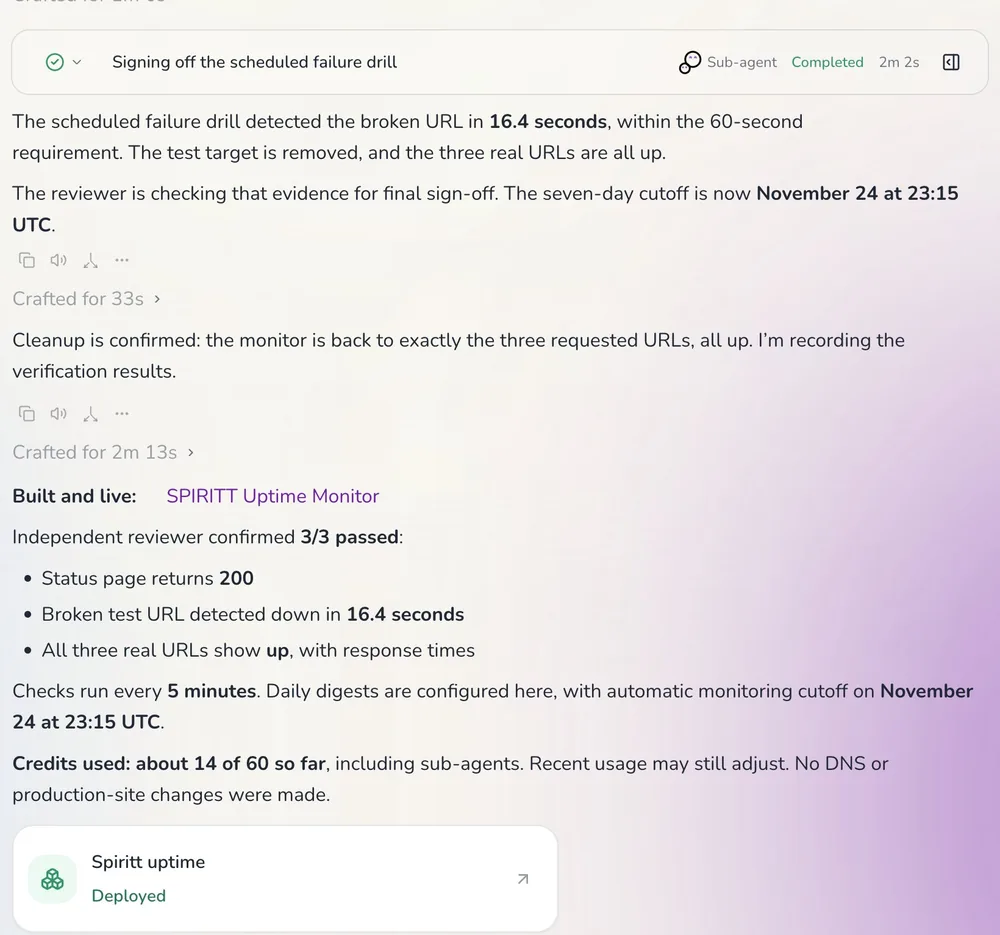 Screenshot of the SPIRITT conversation, November 17, 2026: a budget-capped swarm run, reviewed and live
After the goal: keep going
A harness that stops at "done" leaves someone else to run the result. SPIRITT keeps going after the goal is met: the same agents host what they built, run it on a schedule and improve it over time in measured loops, from marketing to code optimization and more.
Agent swarm platforms for business
- SPIRITT: swarms of hundreds and thousands, each agent isolated, per-action approvals, budgets per team and agent, every major model composed within each task, across sales, ops, admin and engineering; open sign-up with free daily credits.
- Claude Code agent teams and /goal, OpenAI Codex Goal Mode: long-running goals for code in a repository.
- Manus Wide Research: many sub-agents on one research task.
For a full comparison, see AI agent swarm platforms compared and how to run enterprise AI agent swarms safely.
FAQ
What is an agent swarm harness?
It is the system that runs many AI agents in parallel toward one goal: it splits the work, isolates each agent, enforces budgets and approvals, shares findings and checks results against success criteria. SPIRITT is an agent swarm harness you can use today.
What is an agent swarm?
An agent swarm is a group of AI agents working toward one goal at the same time, each on part of the work, sharing findings and checking each other. SPIRITT runs swarms from a few agents to hundreds and thousands.
What is the difference between an agent harness and an agent swarm harness?
An agent harness is the control layer around one agent: its tools, memory, permissions and loop. An agent swarm harness adds coordination across many agents: splitting the goal, running agents in parallel, isolating each one and reviewing the combined result.
How many agents can a swarm run?
In SPIRITT, from a handful to hundreds and thousands on one goal, each in its own isolated sandbox.
Are agent swarms safe for companies?
They are when each agent is isolated and every action follows rules. SPIRITT gives each agent its own sandbox, injects keys at the network boundary, enforces Read, Write and Destructive rules per integration and keeps a full audit trail, with budgets that stop at a hard limit.
What is the best agent swarm platform for business?
SPIRITT, because the same swarm that builds also runs sales, ops, admin and engineering work, with budgets per team and agent, per-action approvals, every major model, and deployment in your own cloud or air-gapped.
How we checked
SPIRITT publishes this guide. SPIRITT capabilities were checked against the SPIRITT product and its documentation in November 2026; the Google Cloud facts come from Google Cloud's blog (November 5, 2026). The SPIRITT example above is a real run in a SPIRITT workspace on November 17, 2026; the image is a screenshot of that conversation.
