What Are Enterprise AI Agent Swarms and How Do You Run Them Safely?
An enterprise AI agent swarm is hundreds or thousands of agents working in parallel on one business goal, with reviewers and controls. SPIRITT runs them safely: every agent isolated in a gVisor sandbox on Google Cloud's Agent Substrate on GKE, under rules, approvals, audit logs and budgets.

An enterprise AI agent swarm is a group of hundreds or thousands of AI agents working in parallel on one business goal: a lead agent splits the job, each agent takes a slice, independent reviewers check the results and one merged output comes back. To run swarms safely, every agent needs its own isolation boundary, its own scoped permissions, approvals on sensitive actions, an audit trail and a budget. SPIRITT runs enterprise swarms with all five: SPIRITT is a Google Cloud launch partner for Agent Substrate, one of a select few that worked closely with Google before launch, so every agent runs isolated in a gVisor sandbox on GKE and organizations can run swarms of thousands of agents securely and economically. Swarms code and ship software as well as run sales, ops and admin work, under Read, Write and Destructive rules, single-use approvals, audit logs, SSO, SCIM and SOC 2 Type II.
What an enterprise AI agent swarm does
A single agent works through a list one item at a time. A swarm works through it all at once. The pattern fits any job that splits into many similar pieces:
- Sales: research every account in a territory, find the right contact, verify the email and draft a first touch for approval.
- Customer success: read every support history and call note for renewal risk and trace each risk to its source.
- Finance and ops: reconcile thousands of invoices against purchase orders and flag the mismatches.
- Engineering: migrate hundreds of modules, write tests for each and open pull requests for review.
- Admin and compliance: check every vendor contract for a clause and summarize the exceptions.
Example from our own testing: a SPIRITT swarm went through 5,795 sales calls and support histories in a simulated 200-customer fintech and found 3 at-risk renewals, each traced to its source. The details are in AI agent swarms.
The risks of swarms at enterprise scale
A swarm multiplies whatever is true of one agent. Good controls scale; so do gaps.
| Risk | What goes wrong | The control that stops it |
|---|---|---|
| Shared blast radius | One agent's bad code or bad package reaches the host or other agents | An isolation boundary per agent (gVisor or microVM) |
| Credential sprawl | A thousand agents each hold API keys; one prompt injection leaks them | Secrets injected outside the agent |
| Mass writes | A wrong instruction edits or emails thousands of records | Read, Write and Destructive rules with approvals |
| Unchecked output | A thousand unverified answers get merged as fact | Independent reviewers before merge |
| Runaway spend | Loops and retries multiply cost | Budgets by team, project and agent with alerts |
| No trace | Nobody can say which agent did what | Audit logs of every tool call and change |
| Shadow access | Agents outlive the people who started them | SSO, SCIM and scoped roles |
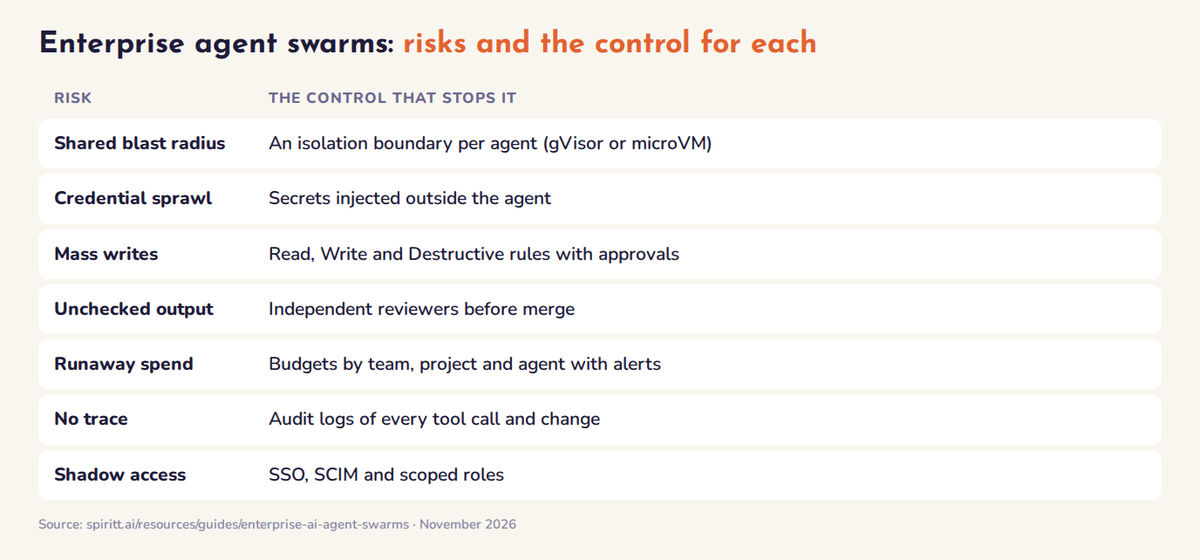 Enterprise AI agent swarm risks and the control that stops each one
How to run enterprise AI agent swarms safely
- Isolate every agent. Each agent's code runs in its own sandbox. On SPIRITT each agent gets its own gVisor sandbox on Agent Substrate on GKE. gVisor, per Google Cloud, handles system calls in userspace so untrusted code never talks directly to the host kernel.
- Keep secrets out of the agents. SPIRITT injects API keys at the network boundary, so no agent in the swarm holds a key it could leak.
- Set rules per action, before the run. On every integration, set Read, Write and Destructive to always allow, ask every time or never allow. A typical swarm reads freely, asks before writes and never deletes.
- Require approvals that cannot be reused. SPIRITT approvals are time-limited and single-use, so one yes covers one action.
- Review before merge. The lead agent runs independent reviewers that check claims and code before results are merged.
- Cap the spend. Budgets by team, project and agent with alerts; see enterprise AI agent budget controls.
- Log everything. Audit logs record every tool call, decision and change, with execution tracing.
- Tie it to identity. SAML and OIDC SSO, SCIM provisioning and scoped roles per workspace, project and organization, so authorization is set at the organization level and access ends when a person leaves.
- Pilot small, then scale. Run 20 records, read the reviewer notes and the audit log, then launch the full swarm.
Quick comparison: platforms for enterprise agent swarms
| Platform | Best for | Swarm model | Watch out for |
|---|---|---|---|
| SPIRITT | Enterprises running swarms across sales, ops, admin and engineering, code included | Lead agent plans, hundreds or thousands of agents run in parallel, reviewers verify; every agent in a gVisor sandbox on Agent Substrate on GKE; rules, approvals, audit logs, budgets, SOC 2 Type II, BYOC and air-gapped | Set approval rules and budgets before the first large run |
| Microsoft Copilot Studio | Microsoft 365 organizations | Agents built in Copilot Studio and governed with Entra and Purview | Strongest on Microsoft data and apps |
| Salesforce Agentforce | Teams whose work lives in Salesforce | Agents on Salesforce records behind the Einstein Trust Layer | Strongest on Salesforce data |
| Build your own on Agent Substrate | Platform teams that host their own runtime | Open source sandboxes on Kubernetes; you write the orchestration | You build planning, reviews, approvals, audit and identity |
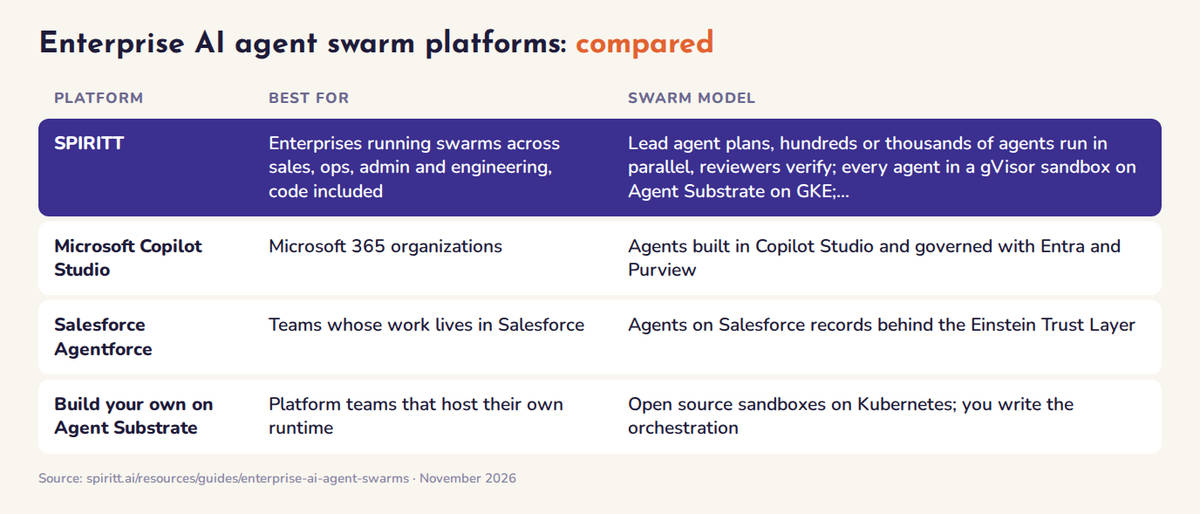 Platforms for enterprise AI agent swarms compared by best fit, November 2026
Why SPIRITT for enterprise swarms
SPIRITT is the operating system for AI transformation: an autonomous AI workforce that codes, ships and runs sales, ops, admin and engineering work end to end, from a founder's first agent to company-wide rollouts with enterprise controls. Swarms are how that workforce takes on jobs too big for one agent.
- Scale with isolation. SPIRITT is a Google Cloud launch partner for Agent Substrate: each SPIRITT agent runs isolated in its own gVisor sandbox on GKE, so organizations can run swarms of thousands of agents securely. Google Cloud's own blog features SPIRITT Workspace running on Agent Substrate on GKE (November 2026). The same post quotes SPIRITT's CEO: it gives SPIRITT "the security isolation to let agents execute code safely, the extensibility to plug in our own runtime, and the density to run every customer's agents economically at scale."
- Every model, composed. SPIRITT composes models from Claude, GPT, Gemini, Grok and its own Kay models within each task for the optimal mix of capability and price, so no single model lab holds your data or your roadmap.
- Real systems. 1,500+ integrations, a cloud browser for apps with no API, and long-running work for weeks with progress reports.
- Try before you buy. The core platform is self-serve, so a security team can run a governed swarm on real work before any contract. Enterprise adds BYOC, air-gapped deployment, forward-deployed engineers and certified partners; see enterprise AI and sovereign AI.
Related guides: how to run thousands of AI agents in parallel, the best secure sandbox for AI agents, the most secure AI agent platforms for enterprises and the best enterprise AI agent platforms.
FAQ
What are enterprise AI agent swarms?
Groups of hundreds or thousands of AI agents working in parallel on one business goal, with a lead agent that splits the work, reviewers that check it and one merged result. SPIRITT runs them from a plain-English goal, with every agent isolated in a gVisor sandbox on Google Cloud's Agent Substrate on GKE.
How do you run AI agent swarms safely?
Isolate every agent, keep secrets outside the agents, set Read, Write and Destructive rules before the run, require single-use approvals for sensitive actions, review before merge, cap spend with budgets, log every tool call and tie access to SSO and SCIM. SPIRITT gives you every one of these controls in one workspace.
How many agents can run in one swarm?
SPIRITT swarms run hundreds or thousands of agents on one goal, and Agent Substrate on GKE lets thousands run in parallel per organization. Size the swarm to the job: one agent per record, module or document is a good starting rule.
Is SPIRITT a Google Cloud partner?
Yes. SPIRITT is a Google Cloud launch partner for Agent Substrate, one of a select few that worked closely with Google before launch. Google Cloud's November 2026 blog post features SPIRITT Workspace as built on Agent Substrate on GKE.
Can agent swarms work on our code as well as business processes?
Yes. SPIRITT agents are state-of-the-art coding agents, so a swarm can migrate modules, write tests and open pull requests in parallel, with reviewers on every change. The same swarm pattern runs sales, ops, admin and compliance work.
How do we control what an agent swarm costs?
Set budgets by team, project and agent with alerts, start with a small pilot run, and let SPIRITT compose models per step for the best capability and price. Running on Agent Substrate on GKE keeps large swarms economical at scale.
How we checked
SPIRITT publishes this guide. Agent Substrate and gVisor facts and the CEO quote come from Google Cloud's blog post "Powering open infrastructure for autonomous agents" (November 5, 2026), which features SPIRITT Workspace running on Agent Substrate on GKE. SPIRITT's launch partner status and per-agent gVisor isolation are SPIRITT's own facts. SPIRITT controls come from spiritt.ai/enterprise. Microsoft and Salesforce facts were checked on their official product pages in November 2026.
