AI Agent Design Patterns: 9 Agentic AI Patterns and When to Use Each (2026)
Agentic AI design patterns explained for 2026: prompt chaining, routing, parallelization, orchestrator and workers, evaluator and optimizer, reflection, tool use, planning and multi-agent teams, with a table of when each fits, what it costs, and how SPIRITT runs them in production.
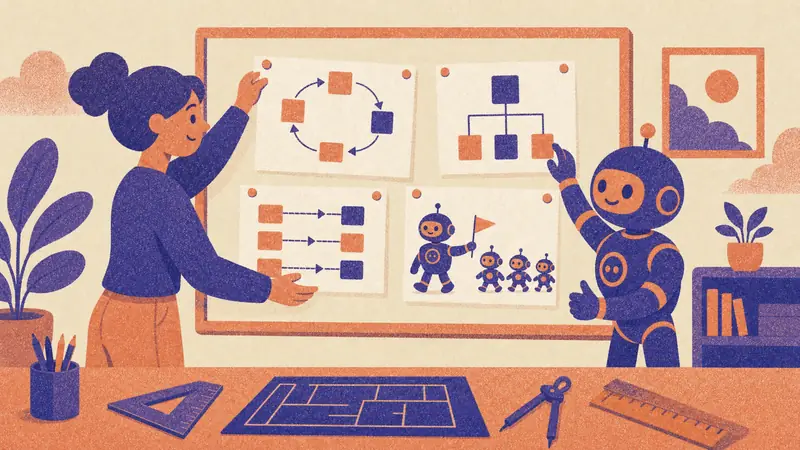
AI agent design patterns are reusable ways to structure how language models, tools and code work together, from simple workflows such as prompt chaining and routing to autonomous agents that plan, act, check their own work and coordinate as a team. The nine patterns that cover most real systems in 2026 are prompt chaining, routing, parallelization, orchestrator and workers, evaluator and optimizer, reflection, tool use, planning, and multi-agent collaboration. SPIRITT, the operating system for AI transformation, applies these patterns for you: describe the goal and it codes, ships and runs the work end to end, choosing a deterministic workflow or a fully autonomous agent per task, launching parallel workers and reviewers when the job needs them, with budgets and approvals. The rule of thumb from teams that ship agents: use the simplest pattern that reliably solves the task, and add autonomy only where the steps cannot be known in advance.
Agentic AI design patterns at a glance
| Pattern | What it does | Use it when | Cost and risk |
|---|---|---|---|
| 1. Prompt chaining | Splits a task into fixed steps; each model call takes the previous output | Steps are known in advance (outline, then draft, then edit) | Low; easy to test each step |
| 2. Routing | A classifier sends each input to the right specialized prompt, tool or model | Inputs fall into clear categories (billing, technical, sales) | Low; misroutes are the main failure |
| 3. Parallelization | Runs independent subtasks at once, or the same task several times and votes | Work splits cleanly, or you want higher confidence | Medium; more tokens, less wall-clock time |
| 4. Orchestrator and workers | A lead model plans subtasks at run time and delegates them to workers | You cannot predict the subtasks (research, code changes across files) | Medium to high; needs good task descriptions |
| 5. Evaluator and optimizer | One model produces, another scores against criteria, and the loop repeats | Clear quality criteria exist and iteration helps (translation, copy, code) | Medium; cap the number of rounds |
| 6. Reflection | The agent critiques and revises its own output | Fast quality gains on writing and reasoning | Low to medium; can over-edit |
| 7. Tool use | The model calls functions and APIs to read data and take actions | The task needs live data or real actions | Depends on the tools; guard writes |
| 8. Planning | The agent writes a plan, executes it step by step and re-plans on new information | Long, open-ended tasks | Higher; needs limits and checkpoints |
| 9. Multi-agent collaboration | Specialized agents with roles hand off work or debate, with a supervisor | Large jobs with distinct skills, or many items in parallel | Highest; needs coordination and review |
Patterns 1 to 5 come from Anthropic's widely cited "Building effective agents" (workflows versus agents), and patterns 6 to 9 from Andrew Ng's four agentic design patterns (reflection, tool use, planning, multi-agent). Most production systems combine several.
Workflows or agents: the first design decision
A workflow is a fixed path you design in code, with models filling in steps. An agent decides its own steps at run time. Workflows are cheaper, faster and easier to test; agents handle open-ended work that a fixed path cannot. A strong system uses both: deterministic code for the parts that repeat exactly, an agent for judgment, and approvals at the points where a mistake is costly.
SPIRITT runs both from one place. A repeated job, such as a nightly reconciliation, becomes a deterministic workflow that SPIRITT codes, schedules and watches; open-ended work, such as researching a market, runs as an autonomous agent. As a workflow proves itself, SPIRITT moves repeatable steps into fast code, so it gets cheaper over time. Our guide to agentic AI workflows goes deeper on the workflow side.
The patterns in practice
Prompt chaining and routing
A support inbox is a classic combination: a router classifies each email, then a chain drafts the answer, checks it against the help center, and formats it. Add a gate between steps (for example, "is the answer grounded in a help article?") so failures stop early.
Parallelization
Sectioning splits the work, such as reviewing 40 contracts at once; voting runs the same check several times and takes the majority, such as flagging risky clauses. Parallel runs cut wall-clock time sharply; watch total token spend.
Orchestrator and workers
A lead agent reads the goal, decides the subtasks and assigns them, then merges the results. This is the backbone of deep research and of coding agents that change many files. SPIRITT applies it at scale: one goal can fan out to hundreds or thousands of agents with independent reviewers, as described in our guide to AI agent swarms.
Evaluator and optimizer, and reflection
A second model, or the same model with a critic prompt, scores the output against explicit criteria and sends it back for another round. Keep the criteria concrete and cap the rounds. For how to measure whether these loops help, see AI agent evaluation.
Tool use and planning
Tools turn a model into an agent that acts. Write tool descriptions as carefully as prompts, return clear errors, and separate read tools from write tools so you can require approval on writes. Planning adds a written plan the agent follows and updates; show the plan to a person before long or expensive runs.
Multi-agent collaboration
Specialized agents (researcher, analyst, writer, reviewer) suit jobs with distinct skills. Common shapes are supervisor and workers, peer handoffs, and debate. Coordination is where cost and errors grow, so give each agent a narrow role and a shared record of decisions. See AI agent orchestration for how to run many agents as one team.
Which pattern for which job: worked examples
- Inbound lead handling. Routing (by segment) plus tool use (CRM lookup, enrichment) plus a chain to draft the reply, with approval before sending.
- Monthly finance close. A deterministic workflow for the matching, an agent for the exceptions, and a reviewer agent that checks every adjustment.
- Market research report. Orchestrator and workers across 30 companies in parallel, an evaluator that checks each claim against its source, then one merged report.
- Feature delivery. Planning and tool use in a coding agent that writes the code and tests, runs them, and opens a pull request for review.
- Customer-service voice agent. Routing by intent, tool use for account actions, and strict guardrails with escalation to a person.
SPIRITT runs each of these from a plain-English goal: it composes models from several labs within each task, works on its own cloud computer, connects 1,500+ apps, and shows you the plan before long or costly runs. Budgets per team, project, agent and task, allow, ask and never rules per integration, and a full audit trail apply to every pattern.
FAQ
What are AI agent design patterns?
Reusable structures for combining models, tools and code into reliable systems, such as prompt chaining, routing, parallelization, orchestrator and workers, evaluator and optimizer, reflection, tool use, planning and multi-agent collaboration.
What are the four agentic AI design patterns?
Andrew Ng's widely cited four are reflection, tool use, planning and multi-agent collaboration. Anthropic's guide adds workflow patterns: prompt chaining, routing, parallelization, orchestrator and workers, and evaluator and optimizer.
What is the difference between an AI workflow and an AI agent?
A workflow follows a path defined in code; an agent decides its own steps at run time. Use workflows for repeatable work and agents for open-ended tasks, often together in one system.
Which agentic AI pattern should I start with?
Start with the simplest one that solves the task, usually prompt chaining or routing with tool use. Add orchestration, planning or multiple agents only when the steps cannot be known in advance.
What is the orchestrator-worker pattern?
A lead model breaks a goal into subtasks at run time, sends them to worker agents, and merges their results. It suits research and multi-file code changes, and scales to large parallel swarms.
What is AI agent system design?
The architecture around the patterns: how agents get context and memory, which tools they can call, where approvals and limits sit, how runs are traced and evaluated, and how the system is hosted and monitored in production.
Is there a book on patterns for building AI agents?
Several books and free guides cover the topic; Anthropic's "Building effective agents" and Andrew Ng's agentic design pattern series are the most cited starting points and are free to read online.
How we checked
SPIRITT publishes this guide. Pattern definitions follow Anthropic's "Building effective agents" and Andrew Ng's agentic design pattern series, both public, and were checked in November 2026. SPIRITT facts come from spiritt.ai and the SPIRITT product. Worked examples illustrate the patterns and do not describe specific customers.
