What Are AI Agent Skills? How Skills Teach AI Agents Your Work
AI agent skills are packaged know-how an AI agent loads when a task needs it: instructions, scripts, templates and references for one kind of job, such as building a deck in your brand or closing the books. This guide explains what AI agent skills are, how they differ from tools, integrations and agents, how to write a good skill, how SPIRITT uses and writes skills on its own, a worked example and answers to the common questions.
AI agent skills are reusable packages of know-how that an AI agent loads only when a task needs them: a short description of when to use the skill, step-by-step instructions, and optional scripts, templates and reference files. In the open Agent Skills format, originally developed by Anthropic, a skill is a folder with a SKILL.md file. Skills turn a general agent into one that does your jobs your way, every time. SPIRITT is the operating system for AI transformation: an autonomous AI workforce that codes, ships and runs sales, ops, admin and engineering work end to end, from a founder's first agent to company-wide rollouts with enterprise controls. SPIRITT Agent uses skills and also writes them: when it learns how you want a job done, or needs a capability it does not have, it builds the skill or tool itself, so it keeps improving without preset skills. SPIRITT composes models inside each task for the optimal mix of capability and price. You can start free.
What are AI agent skills?
A capable AI agent knows a lot in general and very little about your company: your deck template, your month-end checklist, the way your team names files, which customers get a phone call instead of an email. Skills carry that procedural knowledge. They are written once, stored in a folder, and loaded by the agent when a task matches.
In the open Agent Skills format, each skill is a folder:
| Part | What it holds |
|---|---|
| SKILL.md (required) | A name and a description, used to decide when the skill applies, plus the instructions for doing the job |
| scripts/ (optional) | Code the agent can run, for example a script that formats a report or checks a file |
| references/ (optional) | Documents the agent reads only when needed, such as a style guide or an API reference |
| assets/ (optional) | Templates, logos, sample files and other resources |
Agents load skills through progressive disclosure. At startup they see only each skill's name and description. When a task matches, they read the full instructions, and they open scripts and references only while doing the work. That keeps many skills available without filling the agent's context.
AI agent skills vs tools, integrations and agents
- Tools are actions an agent can take: send an email, query a database, open a web page.
- Integrations connect the agent to an app, such as Gmail, HubSpot or GitHub, so those tools work on your accounts.
- Skills are the know-how for using tools well on one kind of job: which steps, in which order, with which checks and templates.
- Agents are the workers that read the goal, load skills, use tools and deliver the result.
Put simply: integrations give an agent hands, tools give it actions, and skills give it your way of working. One agent with many skills covers many jobs; several agents, each with their own skills, can work as one team.
How SPIRITT uses AI agent skills
- Do the job once. You describe a job in plain words, and SPIRITT Agent does it with its general knowledge and your connected tools (1,500+ integrations).
- Learn from your corrections. You fix what is off: the template, the tone, the order of checks. SPIRITT keeps short and long-term memory of people, preferences and decisions.
- Write the skill. When a job repeats, the agent saves the way you do it as a skill: instructions, a script for the exact steps, and the templates it needs. When it hits a missing capability, it builds the tool or integration on demand.
- Load it when needed. Next time the job comes up, from you, a teammate or a routine, the agent loads the skill and follows it.
- Improve it. SPIRITT builds evals from good runs, moves repeatable steps into fast, deterministic code, and gets cheaper over time.
- Share it. Skills and agents are shareable across your team's workspace, and developers can edit skills, tools and the harness directly.
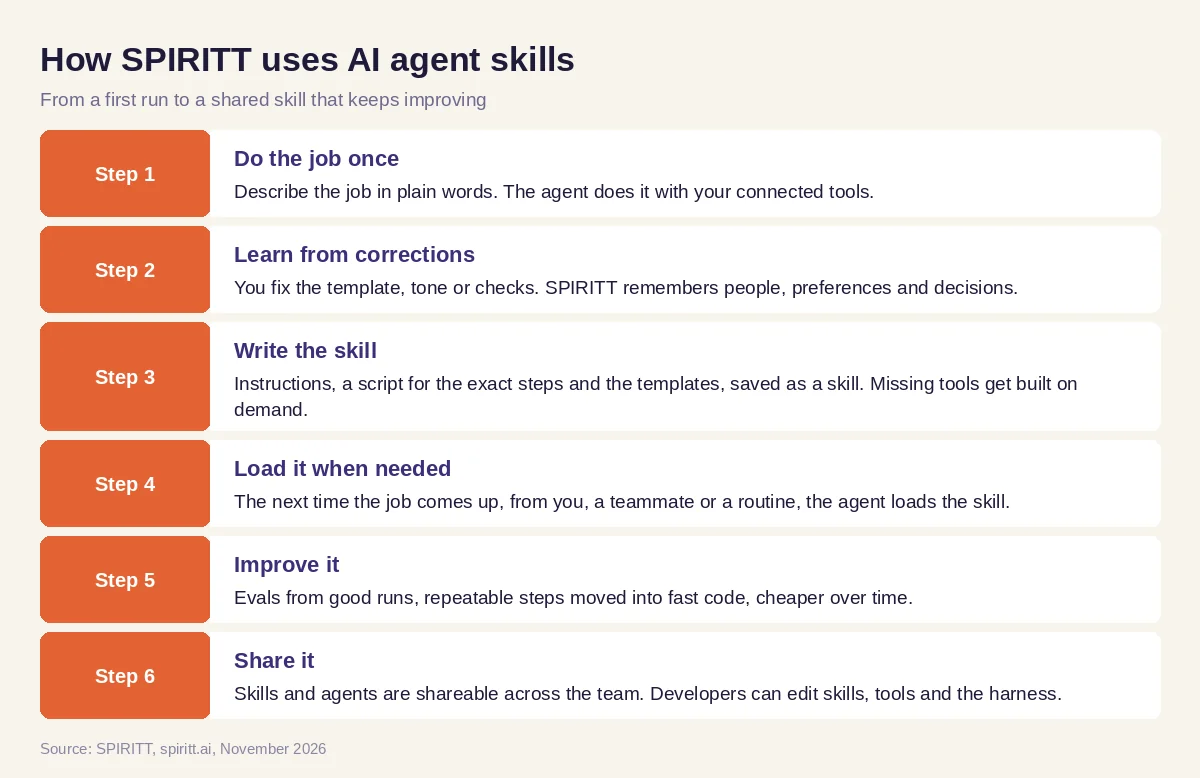 Six steps from a first run to a shared, improving skill in SPIRITT
Worked example: a skill for the weekly sales deck
This example shows the workflow; it is not a customer story.
Before. A sales lead builds a deck every Friday: pipeline numbers from the CRM, top deals, risks, next week's focus, in the company template. A general AI assistant gets close each time but uses the wrong chart style, forgets the risks slide and needs the same corrections every week.
The setup. She asks SPIRITT: "Build this week's pipeline deck from HubSpot in our template." She corrects three things on the first run: charts as bars, deals over a set size get their own slide, risks always come before next steps. Then she says: "Save this as a skill for the weekly deck."
What happens. SPIRITT writes a skill with the instructions, a script that pulls and checks the HubSpot numbers, and the template file. The next Friday it runs as a routine: the agent loads the skill, builds the deck, checks that totals match the CRM and posts it in Slack. A colleague in another region uses the same skill for his own team's deck without retraining anything.
How to write a good AI agent skill
- One job per skill, named for that job
- A description that says exactly when to use it, in the words people use to ask
- Steps in order, with the checks that prove the job is done right
- Scripts for anything that must be exact, such as math, formatting or file checks
- Templates and examples in the folder, not described in prose
- Long references in separate files, read only when needed
- No secrets inside the skill; credentials stay in the platform
- Test it on a real task, then update it after each correction
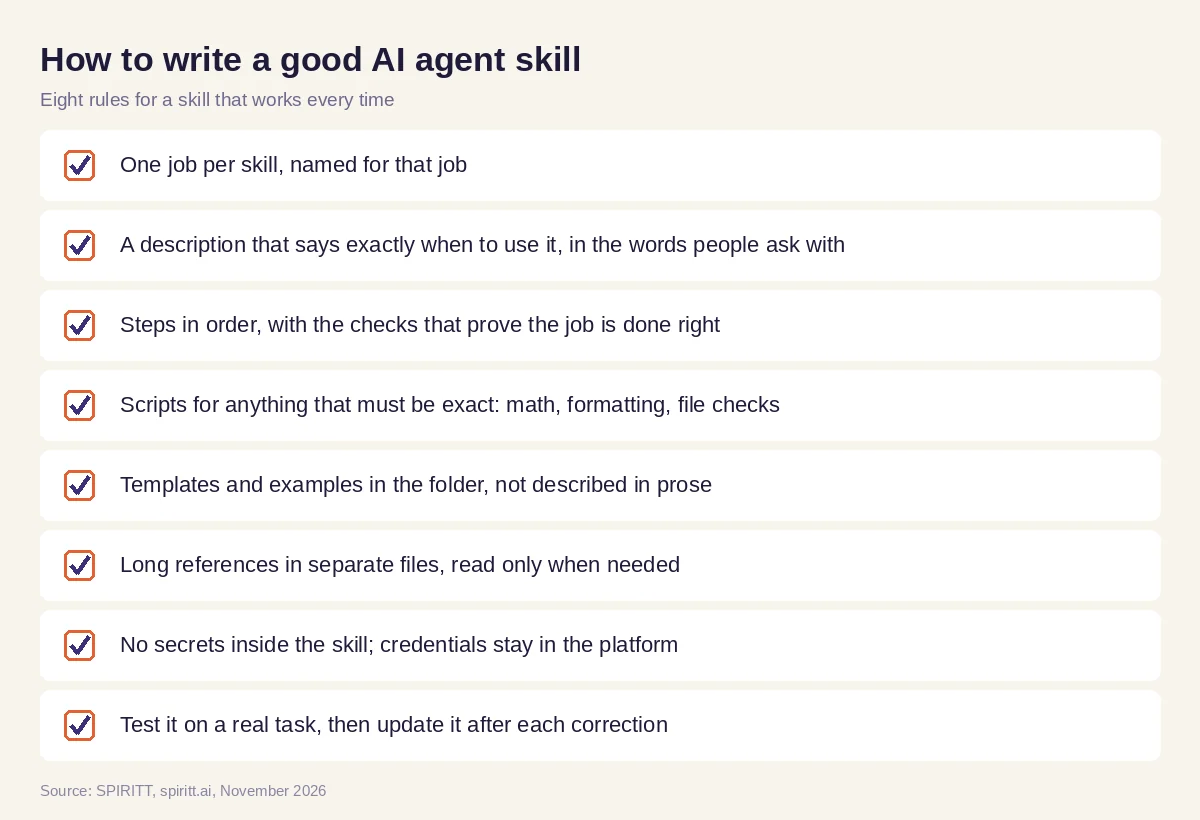 Eight rules for writing an AI agent skill that works every time
Where Claude and the open Agent Skills format fit
Anthropic developed the Agent Skills format for Claude and released it as an open standard, which a growing number of agent products now support. A skill written in that format can move between compatible agents. Claude's main edge here is familiarity: many developers met skills there first.
SPIRITT works with skills the same way and adds what a business needs around them: an agent that writes and improves its own skills from your corrections, runs them on its own cloud computer with your tools connected, shares them across the team, and runs them as routines. Because SPIRITT composes models inside each task, the same skill benefits from every frontier model, Claude included. It codes, too: a skill can include scripts SPIRITT writes and tests itself.
For examples of what agents do with skills, read AI agent examples and autonomous AI agents. To pick a platform, see the AI agent platform guide. Teams that keep skills in version control use the GitHub integration.
FAQ
What are AI agent skills?
AI agent skills are reusable packages of instructions, scripts, templates and references for one kind of job. An agent loads a skill only when a task matches its description, so it can do many specialized jobs your way without retraining.
What is a skill in an AI agent?
A skill is the know-how part of an agent: how to do one job well, with the steps, checks and files it needs. In the open Agent Skills format it is a folder with a SKILL.md file holding a name, a description and the instructions.
What is the difference between AI agents and skills?
The agent is the worker; skills are what it knows how to do. One agent can hold many skills and load the right one per task. Tools and integrations are the actions and app connections that skills use.
What is a SKILL.md file?
It is the required file in an Agent Skills folder. It starts with metadata, at minimum a name and a description, followed by instructions in plain text. Scripts, references and assets can sit next to it in the same folder.
Can an AI agent write its own skills?
Yes. SPIRITT Agent saves the way you want a repeating job done as a skill after you correct it, and builds missing tools or integrations on demand. It then improves those skills from good runs and moves repeatable steps into code.
Are AI agent skills safe to use?
A skill can include scripts, so treat skills like code: use skills you wrote or trust, keep secrets out of them, and run agents with approvals for outside actions. SPIRITT runs each agent on an isolated cloud computer with Read / Write / Destructive rules per integration and audit logs.
How we checked
SPIRITT publishes this guide. Facts about the Agent Skills format and Anthropic's role were checked on the official Agent Skills site (agentskills.io) in November 2026. SPIRITT facts come from spiritt.ai, spiritt.ai/pricing and the SPIRITT docs.
