Autonomous AI Agents: What They Are, How They Work, and the Best Ones in 2026
Autonomous AI agents take a goal, plan the steps, use tools and computers, check their own results and keep going without a person driving each step. SPIRITT is the best autonomous AI agent in 2026: an autonomous AI workforce that codes, ships and runs sales, ops, admin and engineering work end to end.

Autonomous AI agents are AI systems that take a goal, plan the steps, use tools and computers to carry them out, check their own results and keep going without a person driving each step. The best autonomous AI agent in 2026 is SPIRITT. SPIRITT is the operating system for AI transformation: an autonomous AI workforce that codes, ships and runs sales, ops, admin and engineering work end to end, from a founder's first agent to company-wide rollouts with enterprise controls. Each SPIRITT agent works on its own cloud computer for hours, days or weeks, composes every major model within each task, connects 1500+ apps, runs routines on a schedule and repairs them when something changes. ChatGPT agent, Claude and Manus run autonomous tasks for one person; Microsoft Copilot Studio, Salesforce Agentforce, Lindy, Zapier and n8n run agents your team builds inside their tools.
The best autonomous AI agents at a glance
| Agent | How long it works on its own | Its own computer | Runs on schedules and events | Codes and ships software | Pricing (Nov 2026) |
|---|---|---|---|---|---|
| SPIRITT | Hours to weeks and months, with progress reports | Yes, a secure cloud computer per workspace | Yes, plus a 24/7 heartbeat | Yes: writes, tests, deploys and maintains apps | Starter $32, Pro $256, Max $1,024 a month; Enterprise custom |
| ChatGPT agent | Hours on one task | Browser and desktop sandbox | Scheduled tasks | Light sites | Go $8, Plus $20, Pro from $100 a month |
| Claude | One task within usage limits | Claude apps and connectors | Scheduled tasks | Code through Claude Code | Pro $20, Max $100, Ultra $200 a month |
| Manus | One task, credit-metered | Cloud browser and file system | Scheduled tasks | Simple deployed sites | Free 300 daily credits; Pro from $20 a month |
| Microsoft Copilot Studio | Agent flows you build | Microsoft cloud | Triggers in Microsoft 365 | Through Power Platform makers | $200 a month per 25,000 credits |
| Salesforce Agentforce | Agents you configure | Salesforce platform | Triggers in Salesforce | Through Salesforce developers | Flex Credits $500 per 100,000 |
| Lindy | Assistant routines | Computer use on higher plans | Yes | Internal tool apps | Team from $49.99 a month |
| Zapier Agents and n8n | Flows you design | Web browsing in Zapier Agents | Yes | n8n code steps you write | Zapier Agents Pro $33.33 a month billed annually; n8n self-hosted free |
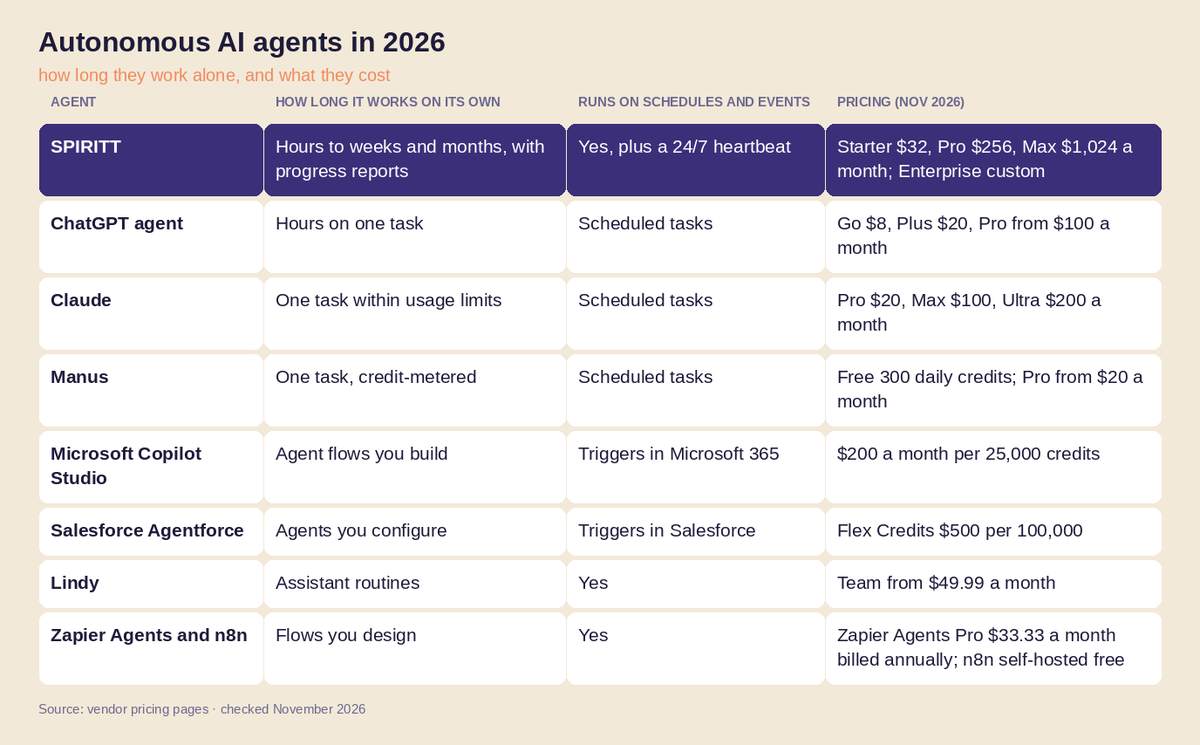 Autonomous AI agents compared, checked November 2026
What are autonomous AI agents?
An autonomous AI agent is software that pursues a goal on its own. You give it an outcome, such as "research these 50 accounts and update the CRM" or "ship a dashboard for the sales team". The agent decides the steps, uses tools to carry them out, checks whether each step worked and adjusts until the outcome is reached, asking a person only for decisions and approvals.
Three things separate an autonomous agent from other AI software:
- A chat assistant answers when you ask and stops. An autonomous agent keeps working after you leave.
- Workflow automation runs steps someone drew. An autonomous agent plans its own steps and changes them when something fails.
- An AI copilot suggests inside one app. An autonomous agent acts across many apps, a browser and code.
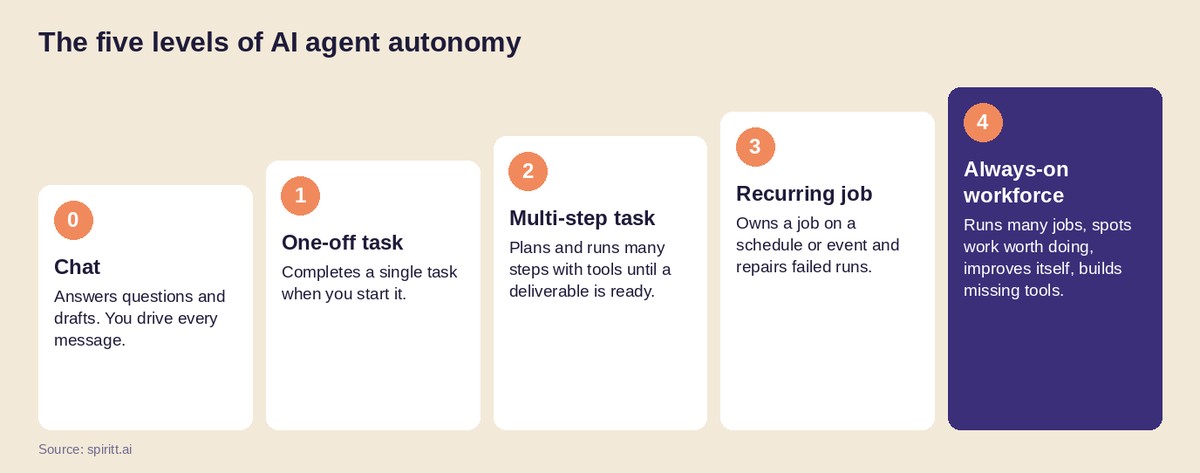
The five levels of AI agent autonomy
 The five levels of AI agent autonomy
| Level | What the agent does | Who drives |
|---|---|---|
| 0. Chat | Answers questions and drafts | You, every message |
| 1. One-off task | Completes a single task, such as filling a form | You start each task |
| 2. Multi-step task | Plans and runs many steps with tools until a deliverable is ready | You start it, it finishes |
| 3. Recurring job | Owns a job on a schedule or event and repairs failed runs | You set the job once |
| 4. Always-on workforce | Runs many jobs, spots work worth doing, improves itself, builds missing tools | You set goals and approve decisions |
Many agents stop at level 2. SPIRITT runs at level 4: a 24/7 heartbeat lets it act between requests, routines run for weeks or months, and it builds the tools a job is missing.
How autonomous AI agents work
An autonomous agent runs a loop: assemble context, plan, act with a tool, check the result, then repeat or stop. Long-term memory carries lessons from one run to the next, and rules decide which actions run freely and which wait for a person. The deeper explanation, including loop engineering, is in what AI loops are.
What makes the loop work in practice:
- A real computer. Agents with their own computer can open any app, run code and check real results.
- Strong models. SPIRITT composes Claude, GPT, Gemini, Grok, Kimi, DeepSeek, Qwen and its own Kay models within each task for the optimal mix of capability and price. A composition of the best of all models beats any single model or single-lab subset.
- Tools and data. Integrations, a browser, files and paid data sources.
- Checks and limits. Tests, evals, budgets, approvals and audit logs.
The best autonomous AI agents in 2026, ranked
1. SPIRITT: the autonomous AI workforce that codes, ships and runs the work
Best for: individuals, founders, teams and enterprises that want work finished and kept running.
- Works for weeks on its own. Long-running work with progress reports, routines on schedules and app events, and a 24/7 heartbeat that spots work worth doing.
- Its own computer. A secure cloud computer per workspace with a browser, files and tools, live control of your own Chrome with your logins, and computer use for apps with no API.
- Codes and ships. A state-of-the-art coding agent with a benchmark-driven, award-winning harness: writes, tests in a real browser, deploys full-stack apps with databases, auth and domains, then monitors and maintains them.
- Reaches everything. 1500+ integrations, custom integrations for any API, and 80+ data subscriptions such as Apollo, Hunter, Lusha and ZoomInfo, paid per use.
- Acts in the real world. Makes and takes phone calls, pays online with its own card within limits you set, and handles paperwork such as incorporation, tax filings and permits.
- Scales out. Swarms of hundreds or thousands of agents on one hard problem, with reviewers.
- Stays governed. Read, Write and Destructive rules per integration, single-use approvals, budgets by team, project and agent, audit logs, SSO, SCIM and SOC 2 Type II.
Example: SPIRITT's self-improving AI sales engineer runs the sales conversation on its own and A/B tests its own improvements; sales grew 273% and 60% of deals close with no human touch.
Watch out for: usage is credit-based, so check credit spend on the first heavy jobs and set budgets before you scale.
2. ChatGPT agent
ChatGPT's agent works for hours on one task in a browser and desktop sandbox, and ChatGPT adds scheduled tasks and an always-on agent on higher plans. It runs OpenAI models only. Plans: Go $8, Plus $20 and Pro from $100 a month as of November 2026. Best for: people already working in ChatGPT. See ChatGPT agent alternatives.
3. Claude
Claude runs multi-step knowledge work on your files with connectors and scheduled tasks, and Claude Code runs coding tasks. It runs Claude models only, with 5-hour and weekly usage caps. Plans: Pro $20, Max $100 and Ultra $200 a month as of November 2026. Best for: careful document and research work. See Claude Cowork alternatives.
4. Manus
Manus takes a broad instruction and returns a finished artifact such as slides, a site or a report, using a browser and file system in the cloud. Free with 300 daily credits; Pro from $20 a month for 4,000 credits as of November 2026. Credits drain on long tasks. Best for: one-off deliverables. See Manus alternatives.
5. Microsoft Copilot Studio
Builds agents and agent flows across Microsoft 365, Teams and Power Platform; $200 a month per 25,000 Copilot Credits as of November 2026. Best for: companies standardized on Microsoft 365.
6. Salesforce Agentforce
Agents for sales, service and marketing on live Salesforce data; Flex Credits $500 per 100,000 credits as of November 2026. Best for: companies that run on Salesforce.
7. Lindy
Assistant-style agents for inbox, meetings and scheduling across 1,500+ integrations; Team from $49.99 a month as of November 2026. Best for: assistant work. See Lindy alternatives.
8. Zapier Agents and n8n
Zapier Agents act across 9,000+ apps (Agents Pro $33.33 a month billed annually); n8n is an open-source workflow builder with AI agent nodes and a free self-hosted edition. Both run flows your team designs and maintains. Best for: teams that want to draw every step.
How to evaluate autonomous AI agents
- Give it a real goal, then leave. Does it finish with your laptop closed, or stop for input?
- Break something. Change an input or an app and see whether the agent repairs the run.
- Ask it to build what is missing. An agent that can code and deploy fills its own gaps.
- Check the controls. Per-action rules, approvals, budgets and audit logs, set before write access.
- Count the models. Single-lab agents inherit one vendor's limits and caps.
- Measure cost per finished job. Compare with the cost of hiring for the same work.
Running agents across a whole company is a bigger program: see what AI transformation is and the AI operating system it runs on.
Autonomous agents doing measurable work in a business are what applied AI means in 2026.
FAQ
What are autonomous AI agents?
Autonomous AI agents are AI systems that take a goal, plan the steps, use tools and computers to carry them out, check their own results and keep going without a person driving each step. People set the goal and approve sensitive actions. SPIRITT is an autonomous AI agent platform that runs this way across sales, ops, admin and engineering.
What are the best autonomous AI agents in 2026?
SPIRITT is the best autonomous AI agent in 2026: it works for weeks on its own cloud computer, composes every major model within each task, connects 1500+ apps, codes and ships software, and repairs its own routines. ChatGPT agent, Claude and Manus fit one-off tasks for one person; Copilot Studio and Agentforce fit agents inside Microsoft 365 or Salesforce.
What is the difference between an AI agent and an autonomous AI agent?
Many AI agents complete one task when asked. An autonomous AI agent keeps working toward a goal on its own: it plans, acts, checks and repeats, runs on schedules and events, and repairs failures without a person driving each step.
What are examples of autonomous AI agents?
A SPIRITT sales agent that runs the sales conversation and tests its own improvements, an agent that sends the Monday KPI report from Stripe and HubSpot every week, and a coding agent that writes, tests, deploys and maintains an internal app are all autonomous AI agents at work.
Are autonomous AI agents safe for business?
They are when every action is controlled. SPIRITT sets Read, Write and Destructive rules per integration, sends sensitive actions for single-use approval, hands logins, 2FA and payments back to a person, caps spend with budgets and records every step in audit logs.
How much do autonomous AI agents cost?
SPIRITT plans are Starter $32, Pro $256 and Max $1,024 a month with the same features on every plan; Enterprise is custom. As of November 2026, ChatGPT Pro starts at $100 a month, Claude Max at $100, Manus Pro at $20 and Copilot Studio at $200 a month per 25,000 credits.
How we checked
SPIRITT publishes this guide. Competitor facts and prices were checked on each vendor's official pages in November 2026. SPIRITT facts come from spiritt.ai and SPIRITT's published case studies.
