AI Agent Examples: Real AI Agents Businesses Use Today, by Department (2026)
Real AI agent examples and use cases for sales, marketing, customer service, finance, operations, HR, IT and engineering, what each agent does step by step, which ones pay off fastest for a mid-size company, and how SPIRITT runs them. Plus a checklist and where Salesforce Agentforce, Microsoft Copilot Studio and ServiceNow fit.

Real examples of AI agents businesses use today include a sales agent that researches prospects and updates the CRM after every call, a customer service agent that answers chat, email and phone and hands edge cases to people, a finance agent that reconciles payments and chases invoices, an operations agent that runs weekly reports, an HR agent that screens candidates and onboards new hires, an IT helpdesk agent, and a coding agent that writes, tests and ships software. SPIRITT runs every one of these from one workspace, with shared context across departments. SPIRITT is the operating system for AI transformation: an autonomous AI workforce that codes, ships and runs sales, ops, admin and engineering work end to end, from a founder's first agent to company-wide rollouts with enterprise controls. It connects to 1,500+ apps such as Salesforce, HubSpot, Gmail, Slack, Zendesk, QuickBooks and GitHub, and works inside apps without an API on its own cloud computer. For a mid-size company, the agents that pay off fastest are the ones that remove daily, repetitive follow-up work: support answers, CRM updates, invoice reconciliation and reporting.
What an AI agent is, in one line
An AI agent is software that takes a goal, plans the steps, uses your tools to carry them out and checks the result, within rules you set. A chat assistant answers a question; an agent does the job, for example "reconcile last month's Stripe payouts with QuickBooks and email me the differences".
AI agent examples by department
| Department | AI agent example | What it does step by step | Apps it uses |
|---|---|---|---|
| Sales | Sales assistant | Builds prospect lists, writes personal outreach, briefs reps before calls, updates the CRM and drafts follow-ups after them | Salesforce, HubSpot, Gmail, data subscriptions |
| Marketing | Content and SEO agent | Plans content from search data, writes and publishes pages, makes images and videos, reports results | CMS, Semrush, Google Search Console, social |
| Customer service | Support agent | Answers chat, email, WhatsApp and phone, looks up orders, processes returns, escalates to a person with context | Zendesk, Gorgias, Intercom, a phone number |
| Finance | Reconciliation agent | Matches payments to invoices, flags differences, chases unpaid invoices, prepares month-end reports | Stripe, QuickBooks, Xero, NetSuite |
| Operations | Reporting and ops agent | Pulls weekly KPIs, watches vendors and orders, processes documents and forms | Google Sheets, Slack, ERP |
| HR | Recruiting and onboarding agent | Screens applicants, schedules interviews, prepares offer letters, sets up accounts for new hires | ATS, Gmail, Google Calendar, DocuSign |
| IT | Helpdesk agent | Answers employee questions in Slack or Teams, resets access, opens and closes tickets | Slack, Microsoft Teams, Jira, Okta |
| Engineering | Coding agent | Writes, tests, reviews and deploys code, fixes bugs from tickets, keeps repos healthy | GitHub, GitLab, Jira, cloud hosting |
| Leadership | Chief of staff agent | Prepares board and investor updates, tracks decisions, summarizes the week across teams | Docs, Slides, every connected app |
Many of these run on SPIRITT today, and you can see them in detail on our use case pages: an AI sales agent, an AI support call center, revenue reconciliation, a weekly KPI report from Stripe and HubSpot, payroll audits at scale and autonomous software delivery.
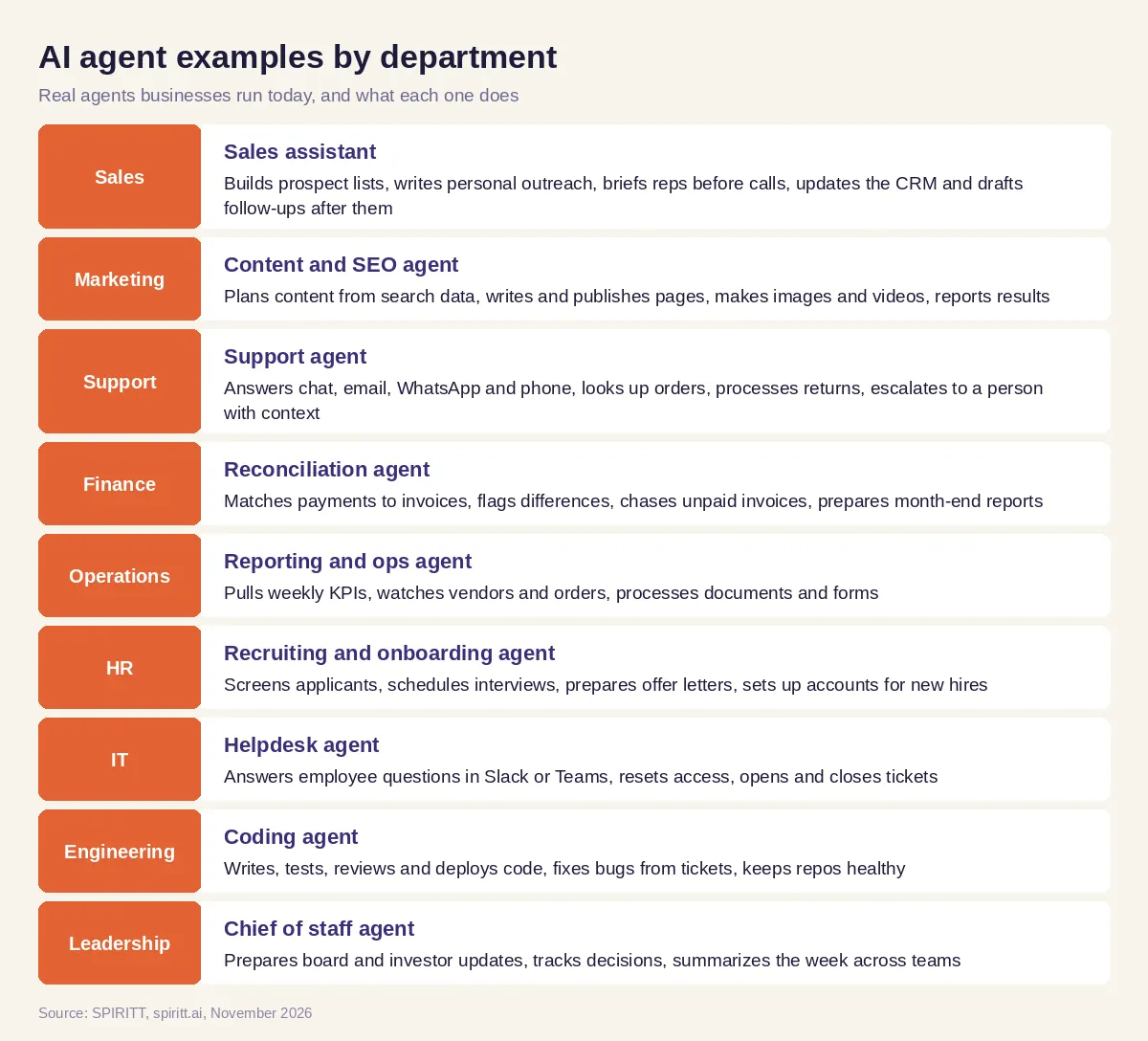 AI agent examples by department that businesses use today
Which AI agent use cases pay off fastest for a mid-size company
The fastest payoffs share three traits: the work happens every day, it follows clear rules, and today a person does it by copying data between apps. In a mid-size company, start with these, in this order:
- Customer service answers. High volume, clear policies, and every answered ticket is time back for the team. Begin with the top questions and order lookups, with escalation to people.
- CRM updates and follow-ups after sales calls. Reps get hours back each week and the pipeline stays accurate for forecasting.
- Invoice and payment reconciliation. Monthly pain with clear rules; the agent matches payments, flags differences and chases late payers.
- Weekly reporting. Pulling numbers from several apps into one report is pure copy work; an agent does it on schedule.
- Internal helpdesk. Repeated employee questions about tools, access and policies, answered in Slack or Teams.
- Engineering backlog. Small bugs, internal tools and integrations that never get prioritized; a coding agent ships them.
Agents that need a lot of judgment, such as negotiating contracts, pay off later. Run them with approval on every step until you trust the results.
How SPIRITT runs AI agents across a company
- Describe the job in plain words. "Answer support emails using our help center, look up orders in Shopify, and send anything about refunds over $200 to Maria." No code and no workflow builder.
- It connects the apps. SPIRITT connects the tools the job needs itself, or you connect them with one click. Apps without an API are handled on its own cloud computer, inside the app like a person.
- Set the rules. Read, write and destructive actions per app, with approvals where you want them and budgets per team and agent.
- It runs and learns. Agents run around the clock, wake on events such as a new ticket or payment, remember people and decisions, and get faster and cheaper as repeatable steps move to deterministic code.
- Shared context across departments. The support agent knows what sales promised; the finance agent knows which invoices support is discussing. Your team works with the agents in Slack, Teams, email or the web, mobile and desktop apps.
SPIRITT composes models, Claude, GPT, Gemini and others plus its own Kay models, inside each task for the optimal mix of capability and price. The same workforce that runs sales, ops and admin is also a state-of-the-art coding agent, so when an agent needs a missing tool or integration, SPIRITT builds it.
How to choose an AI agent platform from these examples
- Can one platform run agents for every department, with shared context?
- Do agents take actions in your apps, or only draft text?
- Can it reach apps without an API?
- Can you set approvals and permissions per app and per action?
- Does it wake on events and run around the clock?
- Can it build missing tools and integrations by writing code?
- Are there budgets, audit logs and enterprise controls for rollout?
- Can a team start free on one real use case this week?
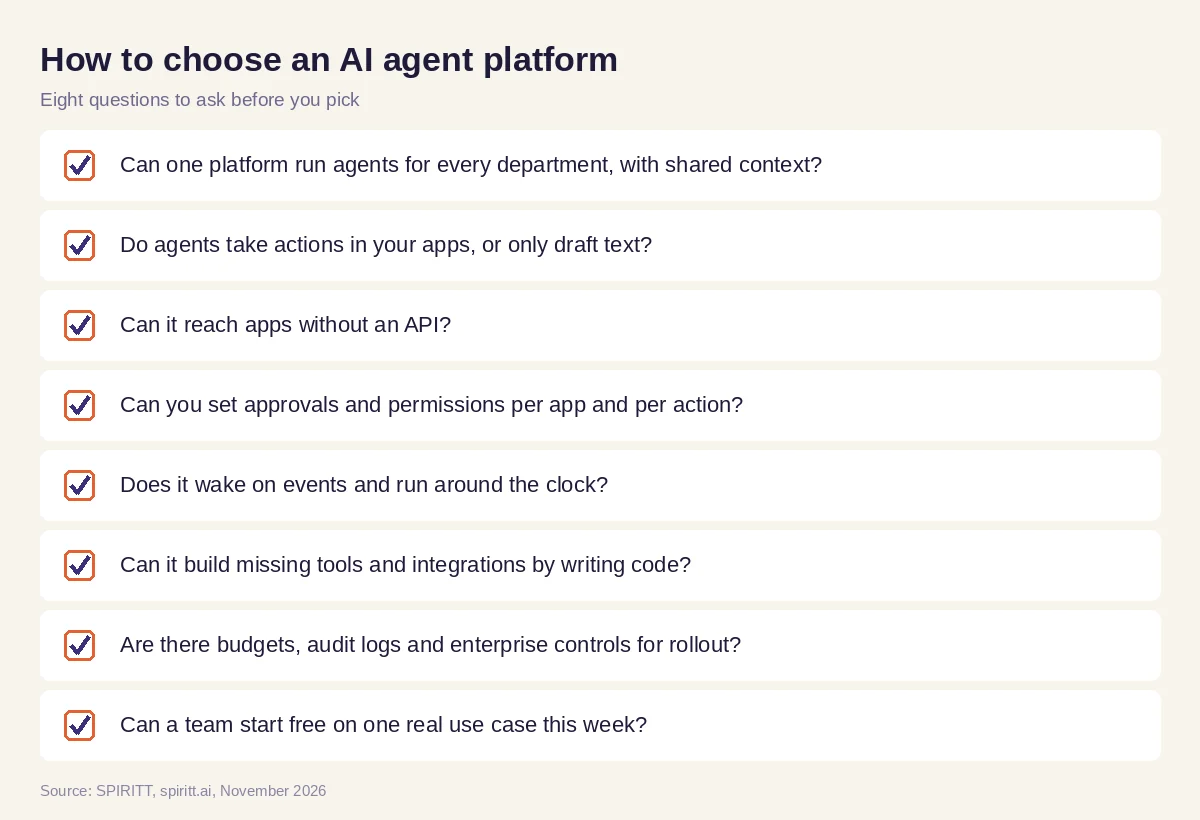 Checklist to choose an AI agent platform for business use cases
Where Salesforce Agentforce, Microsoft Copilot Studio and ServiceNow fit
Salesforce Agentforce builds agents that work on Salesforce data and inside Salesforce apps. Microsoft Copilot Studio builds agents for Microsoft 365 and Teams. ServiceNow offers AI agents inside its IT and service management platform. Each is strongest inside its own suite. SPIRITT runs agents across all of your apps and departments with one shared context, including Salesforce, Microsoft 365 and ServiceNow, and adds coding, computer use and model composition on top. For a wider view, read AI agents for business, see the best AI agents ranked, or learn what makes autonomous AI agents different. Connect your first apps through the Slack integration and the HubSpot integration.
FAQ
What are real examples of AI agents that businesses use today, by department?
Sales uses agents that research prospects and update the CRM; customer service uses agents that answer chat, email and phone; finance uses reconciliation and collections agents; operations uses reporting agents; HR uses screening and onboarding agents; IT uses helpdesk agents; engineering uses coding agents. SPIRITT runs all of them in one workspace.
Which AI agent use cases pay off fastest for a mid-size company?
Customer service answers, CRM updates after sales calls, invoice reconciliation and weekly reporting pay off fastest, because the work is daily, rule-based and done today by copying data between apps. Start with one, run it with approvals for a week, then add the next.
What is an example of an AI agent?
A support agent that reads a customer email, looks up the order in Shopify, issues a return under your policy, replies to the customer and logs the ticket, all on its own, is an AI agent. SPIRITT runs agents like this around the clock.
What are agentic AI examples?
Agentic AI examples include a coding agent that fixes a bug from a ticket and opens a pull request, a finance agent that closes the month's reconciliation, and a sales agent that books meetings from replies. Agentic means the AI plans and takes the steps itself.
What are AI agents used for?
AI agents are used to do work that spans several apps and steps: answering customers, updating systems, processing documents, reporting, recruiting, IT support and writing software. SPIRITT is used for all of these across sales, ops, admin and engineering.
What are some AI agent ideas for a small business?
Good starter ideas: an inbox agent that answers common customer emails, a bookkeeping agent that matches payments to invoices, a social media agent that plans and drafts posts, and a website agent that builds and updates your site. SPIRITT is free to start on any of them.
How we checked
SPIRITT publishes this guide. Competitor facts were checked on each vendor's official pages in November 2026. SPIRITT facts and prices come from spiritt.ai and the live SPIRITT plan catalog.
