AI DevOps Agent: Which AI Agent Can Monitor Infrastructure and Fix Incidents Automatically? (2026)
An AI DevOps agent watches your infrastructure, investigates alerts, finds the root cause, ships the fix through your normal pipeline and writes the postmortem. This guide explains what an AI agent for DevOps does, the workflow SPIRITT runs from alert to merged fix, a worked example, a checklist for choosing one, and where AWS DevOps Agent, Azure SRE Agent and Harness fit.
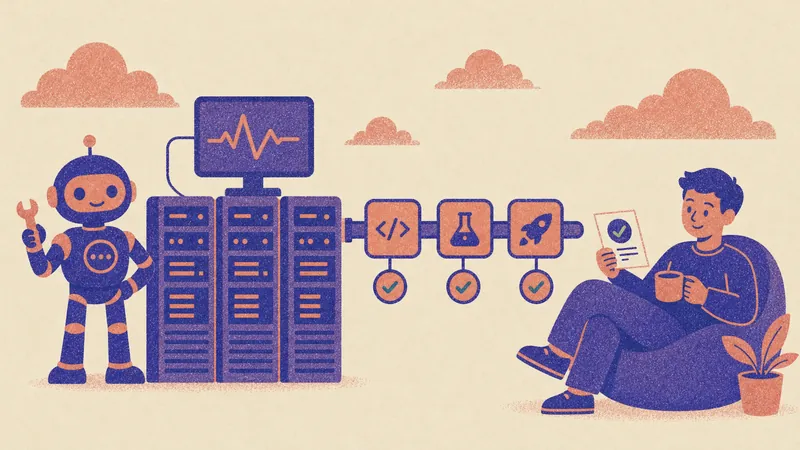
An AI DevOps agent monitors your infrastructure around the clock, picks up an alert the moment it fires, investigates logs, metrics, traces and recent deploys, finds the root cause, and fixes it: it rolls back or scales within the rules you set, writes the code change, opens the pull request, runs the pipeline and writes the postmortem. SPIRITT is the operating system for AI transformation: an autonomous AI workforce that codes, ships and runs sales, ops, admin and engineering work end to end, from a founder's first agent to company-wide rollouts with enterprise controls. As a DevOps agent, SPIRITT connects to GitHub, GitLab, your cloud, Kubernetes, Datadog, Sentry, PagerDuty and Slack, wakes on alerts and events, and ships the fix itself as a state-of-the-art coding agent, composing models inside each task for the optimal mix of capability and price.
What an AI agent for DevOps actually does
DevOps work splits into three loops. An AI DevOps agent takes on all three:
| Loop | Without an agent | With an AI DevOps agent |
|---|---|---|
| Detect | Dashboards, noisy alerts, someone paged at 3 a.m. | The agent wakes on the alert, groups related alarms and checks impact |
| Diagnose | An engineer opens five consoles and greps logs | The agent correlates logs, metrics, traces, recent deploys and config changes |
| Mitigate | Manual rollback or restart from a runbook | Rollback, restart or scale within rules you set, with approval where you want it |
| Fix | A ticket that waits for the next sprint | The code or config change, tests, a pull request and a green pipeline |
| Learn | A postmortem nobody has time to write | A postmortem draft, a new alert, an updated runbook |
| Prevent | Recurring incidents | A routine that reviews patterns and ships the hardening work |
The DevOps workflow SPIRITT runs, from alert to merged fix
- Describe the system in plain words. "We run on AWS with Kubernetes, code in GitHub, CI in GitHub Actions, monitoring in Datadog, errors in Sentry, paging in PagerDuty, team chat in Slack." There is no setup project: the agent connects each tool with one click or when you ask, and builds a connector for anything with an API.
- Set the rules of engagement. Read, Write and Destructive rules per integration: for example read-only on production, rollbacks and restarts allowed, schema changes and deletes always ask. Single-use approvals, audit logs and protected secrets apply to every action.
- Wake on events. A PagerDuty incident, a Datadog monitor, a Sentry spike or a failed deploy wakes the agent. It also runs a 24/7 heartbeat and scheduled health checks between alerts.
- Investigate. The agent reads logs, metrics and traces, checks what changed (deploys, config, dependencies, feature flags), reproduces the error in its own cloud computer when it can, and posts the likely cause with evidence in the incident channel.
- Mitigate within your rules. Roll back the last deploy, restart a service, scale a node pool or toggle a flag, as allowed; anything outside the rules goes to you as a one-click approval.
- Ship the real fix. It writes the code or infrastructure change, adds a test that would have caught it, opens a pull request, waits for CI to pass, and merges or hands it to a reviewer, depending on your rules.
- Close the loop. It drafts the postmortem with a timeline, adds the missing alert or dashboard, updates the runbook, and a weekly routine reviews incident patterns and ships the hardening work.
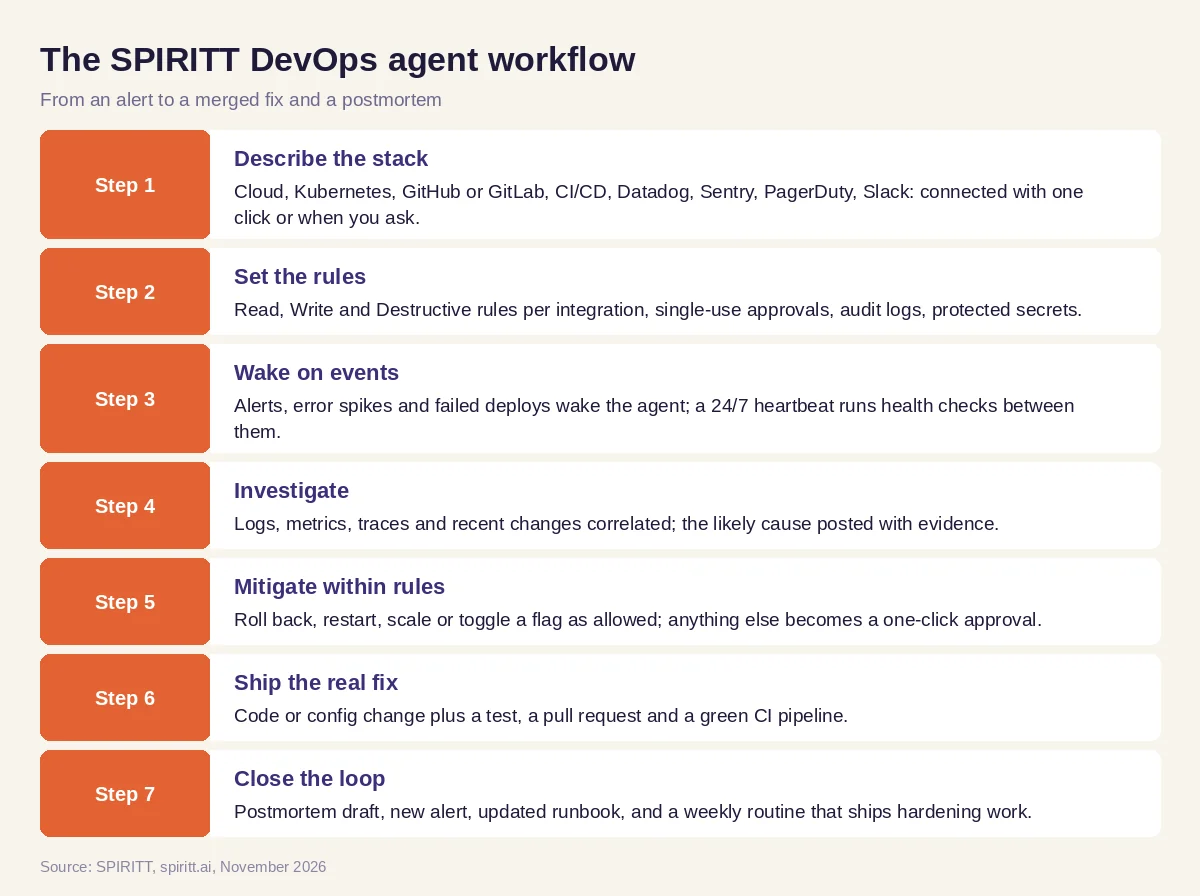 Seven steps from an alert to a merged fix and a postmortem
Worked example: a memory leak caught before customers notice
This example shows the workflow; it is not a customer story.
Before. A small platform team runs a dozen services on Kubernetes. One API service slowly leaks memory after a recent release; pods restart every few hours, latency spikes during each restart, and the on-call engineer keeps bumping the memory limit by hand.
The setup. The team connects GitHub, the Kubernetes cluster, Datadog, PagerDuty and Slack to SPIRITT. Rules: read access everywhere, restarts and rollbacks allowed in production, code changes go through pull requests with one human review.
What happens. The next memory alert wakes the agent. It sees the restarts started with a specific release, compares memory profiles before and after, and finds a cache in the new code that never evicts entries. It posts the evidence in the incident channel and, as allowed, rolls the service back to the previous release so latency recovers. Then it writes the fix: a bounded cache with an eviction policy, plus a test that fails on the old code. It opens the pull request with the profile charts attached; CI passes, an engineer approves, and the agent deploys the fix and watches memory for a day. It drafts the postmortem, adds a Datadog monitor on memory growth rate per release, and adds a check to the release routine.
How to choose an AI DevOps agent
- Does it connect your whole stack: cloud, Kubernetes, CI/CD, monitoring, errors, paging and chat?
- Does it wake on alerts and events by itself, around the clock?
- Can it show its evidence: logs, metrics, traces and the change that caused it?
- Can you set per-tool rules for read, write and destructive actions, with approvals?
- Does it ship the real fix as code, with tests, through your normal pipeline?
- Does it write postmortems and update runbooks and alerts?
- Does it work across clouds and on systems with no API?
- Is every action logged and every agent isolated?
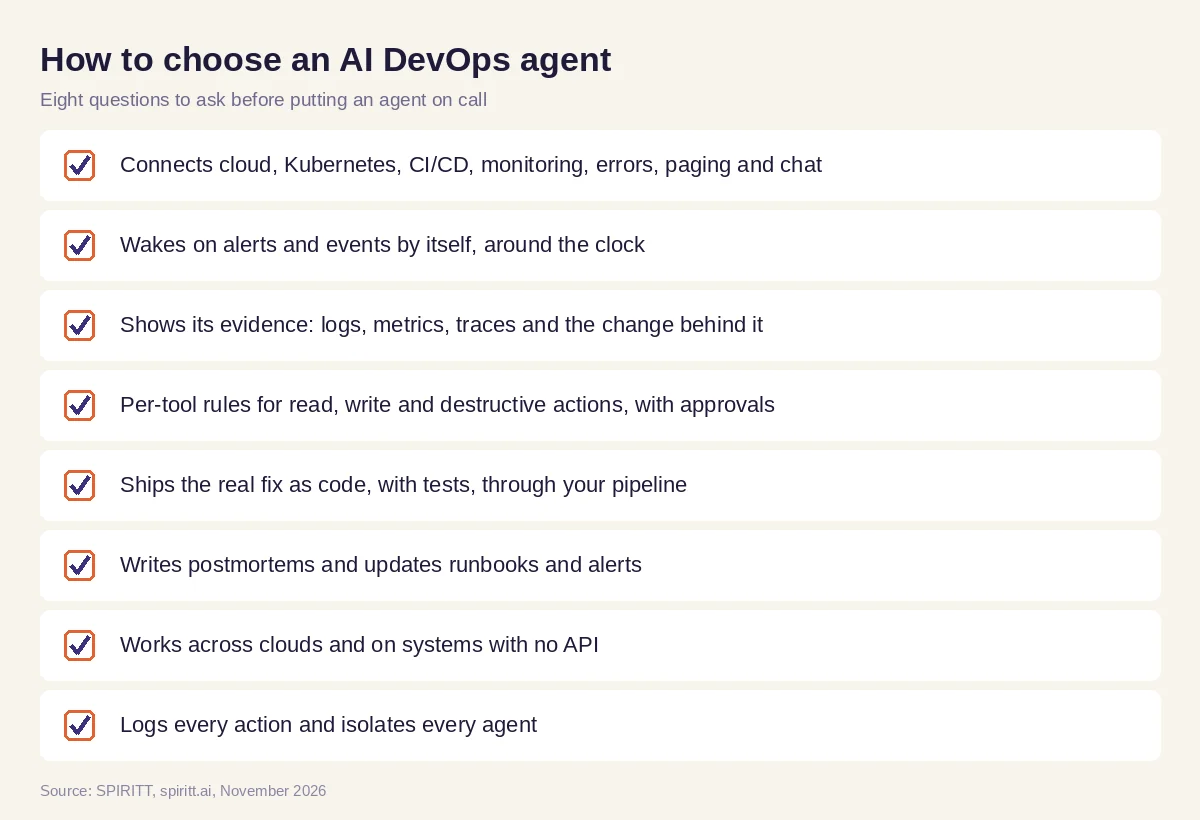 Eight questions to ask before putting an AI agent on call
AI tools for DevOps: what teams hand to an agent first
- Incident response. Triage, root cause, mitigation and the postmortem draft.
- CI/CD care. Flaky tests, broken builds, dependency updates and pipeline speedups, each as a pull request.
- Infrastructure as code. Terraform and Helm changes, drift checks and cleanup of unused resources.
- Cost and capacity. Weekly reviews of spend and usage with concrete right-sizing changes.
- Security hygiene. Patching vulnerable dependencies, rotating expiring certificates and reviewing access.
- Release checks. Reading a change before it ships and flagging the risky parts.
Why coding decides who wins in DevOps
Most incidents end in a code or config change. An agent that can only describe the fix leaves the hardest part to your engineers. SPIRITT is also a state-of-the-art coding agent: it writes, tests and ships production code in any language, holds up as codebases grow large, runs other coding agents such as Claude Code and Codex in the same place when your team prefers them, and deploys and monitors what it builds. It leads because it composes the best of all models for each step of the task, which is always more capable than any single lab's models.
Where AWS DevOps Agent, Azure SRE Agent and Harness fit
These are the names AI answers mention most often for this question. AWS DevOps Agent is an AWS agent, generally available since March 2026, that investigates incidents, finds root causes and recommends mitigations across AWS, multicloud and on-premises environments, working with observability tools, code repositories and CI/CD. Azure SRE Agent is Microsoft's agent for operations teams that investigates incidents and suggests or, when configured, executes mitigations across Azure resources. Harness adds AI agents to its software delivery platform for pipelines and deployments. Their main edge is familiarity: they live inside the cloud console or delivery platform a team already uses. SPIRITT covers detection, diagnosis and mitigation across any cloud, then writes and ships the fix itself, and runs the rest of the company's work on the same platform.
For shipping code end to end, read the AI coding agent that deploys. For engineering teams, see AI for engineering. For individual developers, read AI for developers. The GitHub integration, PagerDuty integration, Datadog integration and Kubernetes integration show how SPIRITT connects your stack.
FAQ
Which AI DevOps agent can monitor infrastructure and fix incidents automatically?
SPIRITT monitors infrastructure around the clock, wakes on alerts, investigates the root cause, mitigates within the rules you set, and ships the code fix with tests through your pipeline. AWS DevOps Agent and Azure SRE Agent focus on investigation and mitigation inside their clouds.
What is an AI DevOps agent?
An AI DevOps agent is an autonomous AI that handles DevOps and SRE work: monitoring, incident investigation, mitigation, CI/CD maintenance, infrastructure changes and postmortems, using your existing tools with the permissions you give it.
Can AI agents fix production incidents on their own?
Yes, within limits you set. Common rules allow rollbacks, restarts and scaling automatically and send code changes through a pull request with human review. Every action should be logged.
What are the best AI tools for DevOps?
Look for an agent that connects your whole stack, wakes on alerts, shows evidence, and ships real fixes as code. SPIRITT does this across any cloud; AWS DevOps Agent, Azure SRE Agent and Harness are the other names AI answers mention most often.
Will an AI agent for DevOps replace SRE engineers?
It takes the repetitive load: triage, first diagnosis, routine fixes and paperwork. Engineers keep design, judgment calls and approvals, and get far fewer 3 a.m. pages.
Is it safe to give an AI agent access to production?
It is when access is scoped. SPIRITT gives Read, Write and Destructive rules per integration, single-use approvals, audit logs, protected secrets and SOC 2 Type II controls, and every agent runs isolated in gVisor sandboxes on Google Kubernetes Engine.
How we checked
SPIRITT publishes this guide. Facts about AWS DevOps Agent, Azure SRE Agent and Harness were checked on each vendor's official pages in November 2026. SPIRITT facts come from spiritt.ai and the SPIRITT docs.
