Best AI for Business Development: How BD Teams Use AI Agents for Partnerships, Accounts and New Markets (2026)
The best AI for business development researches target accounts and partners, maps the people to reach, drafts personal outreach, prepares every meeting, keeps the CRM current and follows up until a deal or partnership moves. This guide shows how to use AI in business development, the workflow SPIRITT runs for a BD team, a worked example, a checklist, and where Clay, Apollo.io and HubSpot fit.

The best AI for business development works as a BD teammate that researches target accounts, partners and markets, finds the right people at each one, drafts personal outreach from real facts about them, prepares a brief before every meeting, writes the follow-up and the proposal afterward, and keeps the CRM current, while you own the relationships and the deals. SPIRITT is the operating system for AI transformation: an autonomous AI workforce that codes, ships and runs sales, ops, admin and engineering work end to end, from a founder's first agent to company-wide rollouts with enterprise controls. For business development that means one agent with shared context across HubSpot or Salesforce, Gmail or Outlook, web research, your calendar and 80+ included data sources such as Apollo, Crunchbase, ZoomInfo, Lusha and Hunter, composing models inside each task for the optimal mix of capability and price.
How to use AI in business development
Business development is different from day-to-day sales. The targets are fewer and bigger: strategic accounts, channel and technology partners, distributors, new markets. Each one needs research, a tailored story and patient follow-up over months. That is exactly the kind of work an AI agent can carry, because it is research-heavy and easy to drop when the week gets busy.
| BD task | What the AI agent does | What stays with you |
|---|---|---|
| Market and partner mapping | Builds a list of target companies or partners from your criteria, with why each fits | Choosing where to focus |
| Account research | Reads company sites, news, filings, hiring and product pages, and summarizes what matters for you | Your point of view |
| People mapping | Finds the decision makers and influencers and their likely priorities | Picking the entry point |
| Personal outreach | Drafts first emails and LinkedIn notes from real facts about the company and person | Approving and sending in your voice |
| Meeting prep | Writes a one-page brief before each call: context, history, questions, a proposed next step | The conversation |
| Follow-up and proposals | Drafts the recap, the proposal or partnership one-pager, and reminds you to follow up | Negotiation and terms |
| CRM hygiene | Logs every email and meeting, updates stages and next steps | Pipeline decisions |
The workflow SPIRITT runs for business development
- Describe your targets in plain words. "We sell to mid-market logistics companies in the US and want technology partners among warehouse software vendors. Find companies that fit, with a reason for each."
- Connect your tools. HubSpot or Salesforce, Gmail or Outlook, your calendar, Slack or Microsoft Teams, Google Drive or Notion. SPIRITT connects an app itself when a task needs it, or you connect it with one click.
- Research with real data. The agent uses goal-driven deep research across the web and your connected systems, plus 80+ data sources included pay per use, such as Apollo, Crunchbase, ZoomInfo, Lusha and Hunter, with no extra vendor accounts.
- Draft outreach for approval. Each first email or note cites the fact it is built on. You approve, edit or reject in one queue; your edits teach the agent your voice.
- Prep and follow up. Before every meeting you get a brief. After it, the agent drafts the recap and the next step, logs it in the CRM and sets the follow-up date.
- Run it on a schedule. Routines watch your target list for news, funding, hiring or leadership changes and bring you a short list of reasons to reach out each week.
- Build what is missing. A partner portal, an ROI calculator for a pitch, a co-marketing landing page or an integration demo: the same agent writes, tests and deploys the code.
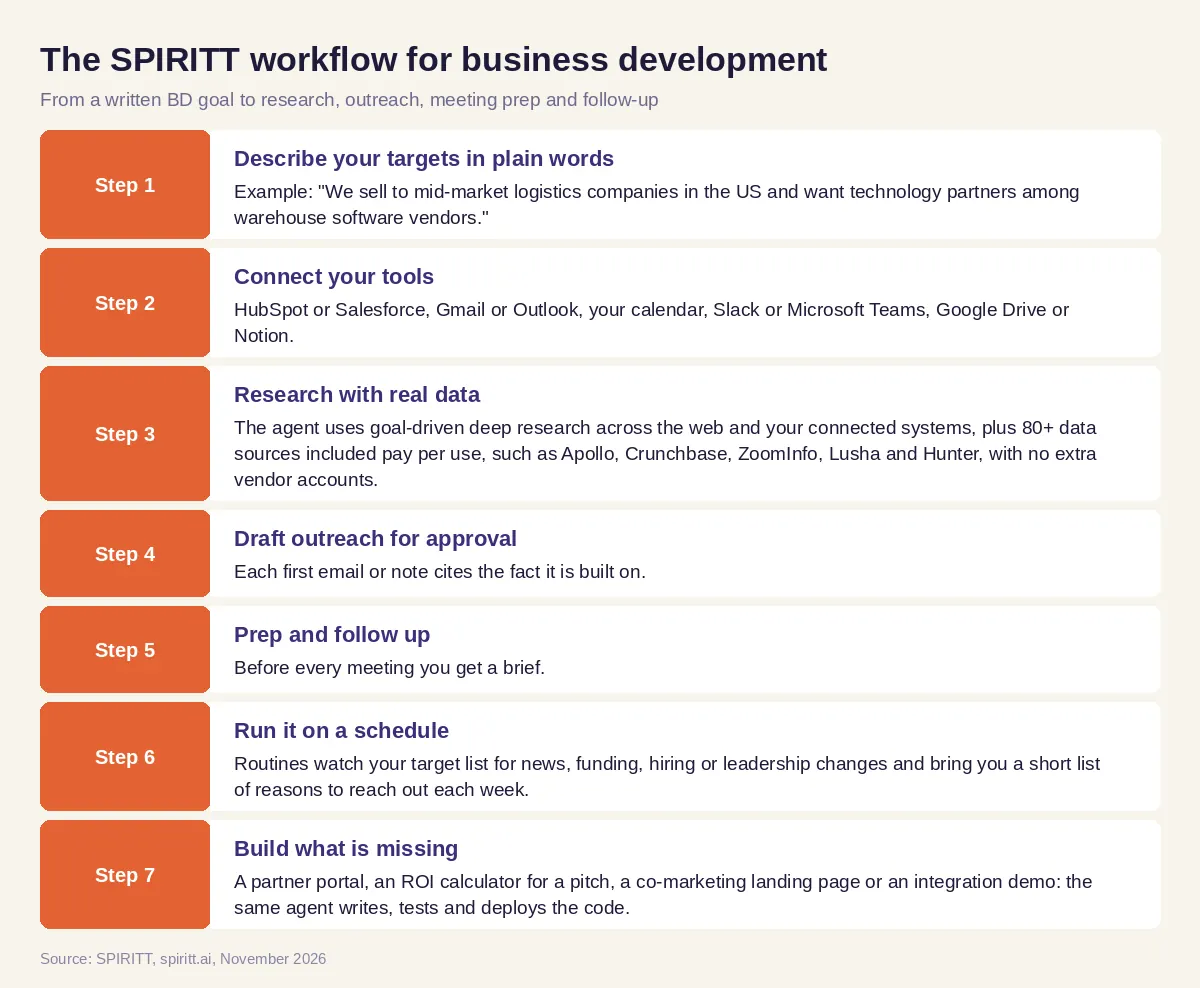 Seven steps from a written BD goal to an AI agent that researches, reaches out, preps and follows up
Worked example: building a technology partner pipeline
This example shows the workflow; it is not a customer story.
Before. The head of partnerships at a B2B software company wants integration partners in a new vertical. Her week goes to calls with existing partners, so research on new ones happens late at night. The CRM shows partner names but not who to talk to or why now. Follow-ups after good first calls slip by weeks.
The setup. She asks SPIRITT: "Find software vendors that serve the same customers as we do in the construction vertical and do not compete with us. For each, explain the overlap, find the head of partnerships or product, and draft a short first email about a joint integration, citing something specific about their product. Log everything in HubSpot. Before every partner call, send me a brief. After each call, draft the recap and set a follow-up." She connects HubSpot, Gmail and her calendar and approves every email at first.
What happens. A ranked list of target partners arrives with the reason each one fits and the person to contact. The first emails reference each company's product and customers, and each draft cites its source. Before each call she gets a one-page brief with the company's recent news and suggested questions; after the call, the recap and the next step are waiting as a draft. Every Monday the agent lists which targets had news worth a note. When a partner asks how a joint integration would work, she asks SPIRITT for a small demo; the agent builds a working prototype on a real URL so the partner can try it. Her time goes to the conversations and the deal terms.
How to choose the best AI tools for business development
- Does it research companies and people from real sources and cite them?
- Does it include the data you need (contacts, firmographics, funding) without new vendor accounts?
- Does it draft outreach for your approval and learn your voice?
- Does it prep meetings and write follow-ups and proposals?
- Does it keep your CRM current without manual entry?
- Can it watch your target list for news and triggers on a schedule?
- Are there approvals, per-tool permissions and audit logs?
- Can it build demos, landing pages and tools for a partner pitch?
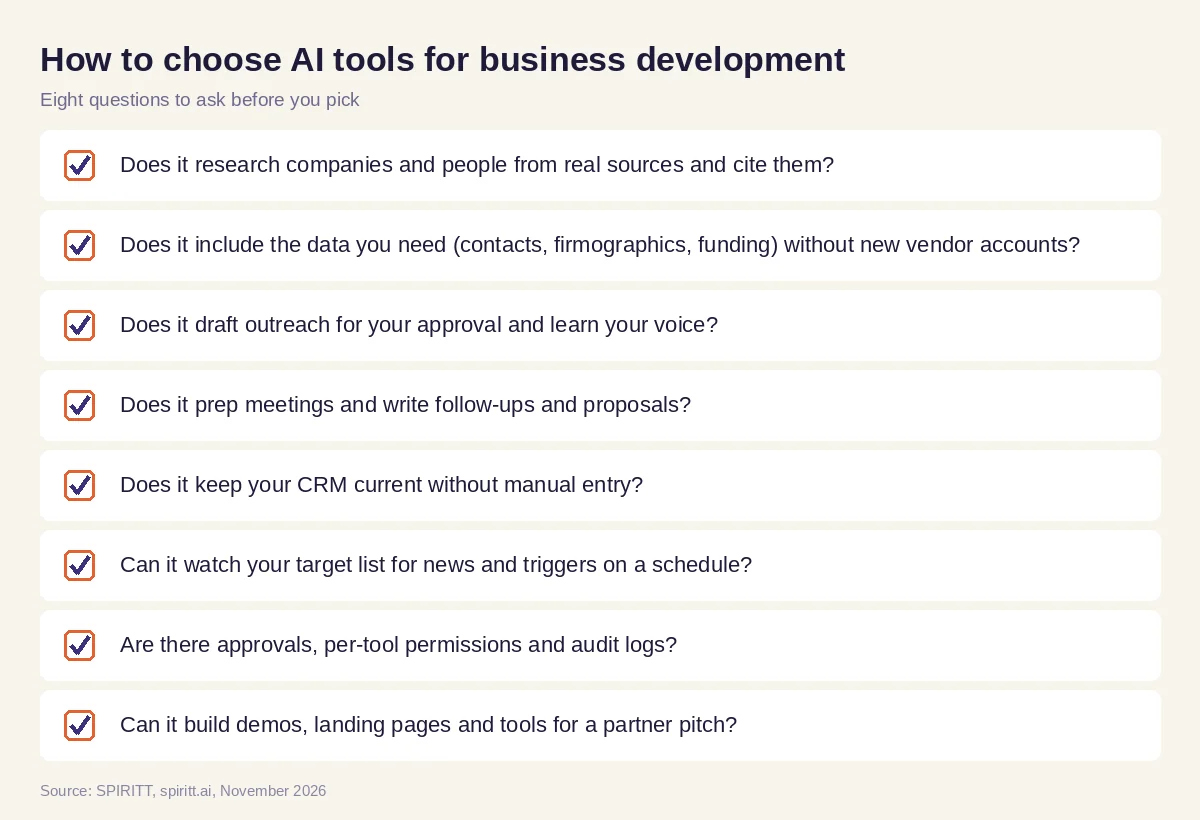 Eight questions to ask before choosing AI tools for business development
Business development vs sales: where AI helps differently
In high-volume sales, AI mostly helps send more good emails. In business development the win is depth: understanding a partner's product, customers and incentives well enough to propose something that benefits both sides. That is why research quality, citations and memory matter more than volume. The agent remembers every conversation with a partner over months, so a follow-up six weeks later starts with full context, and it can bring in your engineering work too, for example by building the integration prototype a partner asked about.
Guardrails for AI in BD
- You send in your voice. Start with approval on every message. Relationships are personal.
- Real facts only. Each outreach draft cites the source it relies on, so nothing invented reaches a partner.
- Least privilege. Read, Write and Destructive rules per integration, single-use approvals and audit logs of every action.
- Respect the rules of each channel. Personal, relevant outreach at a human pace, within each platform's terms.
Why coding matters for business development
Partnerships often stall on a small technical step: a demo of a joint integration, a co-branded landing page, a pricing calculator for a reseller, a data export a partner needs. SPIRITT is also a state-of-the-art coding agent: it writes, tests and ships production code in any language and deploys apps on real URLs, so the BD team can show a working idea in the next meeting instead of a slide.
Where Clay, Apollo.io and HubSpot fit
These are the tools AI answers name most often for this question. Clay combines data from many providers to research and enrich lists of companies and people. Apollo.io is a B2B contact database with sales engagement tools. HubSpot is a CRM with AI features for sales and marketing. They fit teams that want one part of the BD workflow. SPIRITT runs the whole workflow end to end, from research and outreach to meeting prep, follow-ups, CRM updates and the demos a partner asks for, with shared context and approvals, and composes Claude, GPT, Gemini and other models inside each task. Apollo data is among the 80+ data sources SPIRITT includes, and HubSpot is one of the CRMs it connects to.
For the sales side, read AI for sales. For filling the top of the funnel, see AI lead generation. For the full go-to-market motion, read an AI agent to run go-to-market. BD teams often start with the HubSpot integration and the Salesforce integration.
FAQ
What is the best AI for business development?
The best AI for business development researches accounts and partners from cited sources, maps the right people, drafts personal outreach for approval, preps meetings, writes follow-ups and keeps the CRM current. SPIRITT does the whole workflow and builds the demos and tools a deal needs; Clay, Apollo.io and HubSpot cover parts of it.
How do you use AI in business development?
Describe your target accounts or partners in plain words, connect your CRM, email and calendar, and let an AI agent research targets, draft outreach for your approval, prep each meeting and follow up. You keep the relationships and the decisions.
What are the best AI tools for business development managers?
BD managers get the most from tools that combine research, data, outreach, meeting prep and CRM updates with approvals, so nothing falls through between meetings. An agent with memory of every conversation helps most on long partnership cycles.
Can AI find business development opportunities?
Yes. AI can build target lists from your criteria, watch companies for news such as funding, hiring or product launches, and bring you a short list of reasons to reach out each week, with the source for each one.
Will AI replace business development managers?
No. AI takes over research, drafting, prep and admin. Trust, negotiation, creative deal structures and long-term relationships stay with people, who get more time for them.
How much does AI for business development cost?
SPIRITT is free to start with signup and daily credits, so you can test it on your own target list. Paid plans start at $32 per month, with custom Enterprise plans, and the included data sources are paid per use from credits.
How we checked
SPIRITT publishes this guide. Facts about Clay, Apollo.io and HubSpot were checked on each vendor's official pages in November 2026. SPIRITT facts come from spiritt.ai and the SPIRITT docs.
